

A broker sends in a commercial submission. The underwriter reviews it, finds the request sits above their authority, and refers it upward. The file waits in a queue while the broker keeps marketing the account to other carriers.
That wait is the referral cycle. Quote counts do not record it, and a hit ratio records only its result.
This guide explains what an underwriting referral is, where the time goes, and what recent agent surveys say about speed and placement. It then shows how to shorten the loop with four written decisions and which metrics to baseline in your first 30 days.
What Is an Underwriting Referral, and Where Does It Stall?
An underwriting referral sends a file to a person with greater authority because the risk exceeds the assigned underwriter's limit. No quote leaves until that person decides.
Referral sits in the middle of a longer sequence: submission receipt, appetite screening, data extraction, risk assessment and pricing, referral, quote, and bind. Every step before it feeds the referral, and every step after it waits.
What Triggers a Referral
Typical triggers include a limit above the underwriter's authority, a class or hazard grade outside their delegation, a loss history pattern, or a coverage request that departs from the standard form. Each carrier sets its own thresholds.
Some carriers write those thresholds in a delegation grid. Others hold them in the heads of senior underwriters, and the two setups behave very differently under volume.
Where the Clock Runs
Time accumulates at four points: the referring underwriter assembling the packet, the file waiting in the approver's queue, a request for missing information, and the answer traveling back to the broker.
The broker sees only the last two. The first two happen inside the carrier, which is why they go unmeasured.
How Does Referral Delay Affect Broker Placement?
Slow referrals cost placement because brokers move business away from carriers that are hard to work with. The evidence is indirect: no published survey we reviewed isolates referral delay, but three recent agent surveys measure the conditions around it.
Quote Cycles Are Still Long
Corporate Insight surveyed 214 independent agents in Q4 2025. Among commercial-focused agents, 55% said a typical quote cycle takes four to seven days, and 7% said one to three days.
The same survey ranked underwriting flexibility and appetite as the top carrier-selection factor at 39%, ahead of competitive pricing at 26%. Referred files are the ones that put that flexibility to the test.
Friction Moves Placement
Applied Systems surveyed 702 independent agents in April and May 2026. Of those agents, 90% said they have reduced business with a carrier because of friction in the submission process.
That figure covers submission friction broadly, not referrals alone. A referral that stalls with no visible status is a friction point in the same process, and agents respond to friction by moving volume.
The Bar Is Moving
First Connect's 2026 report, drawn from 238 independent agents, found that agents reporting significant quote-speed challenges with carrier partners fell from 22% to 11% year over year. The report credits a softer market and workflow investment on both sides.
Carriers that have not shortened their loops now stand out against a market that has.
Why Do Referral Loops Run Slow?
Referral loops run slow because of four failure points. Each one is a decision or a handoff, not a technology gap, and naming them shows where to start.
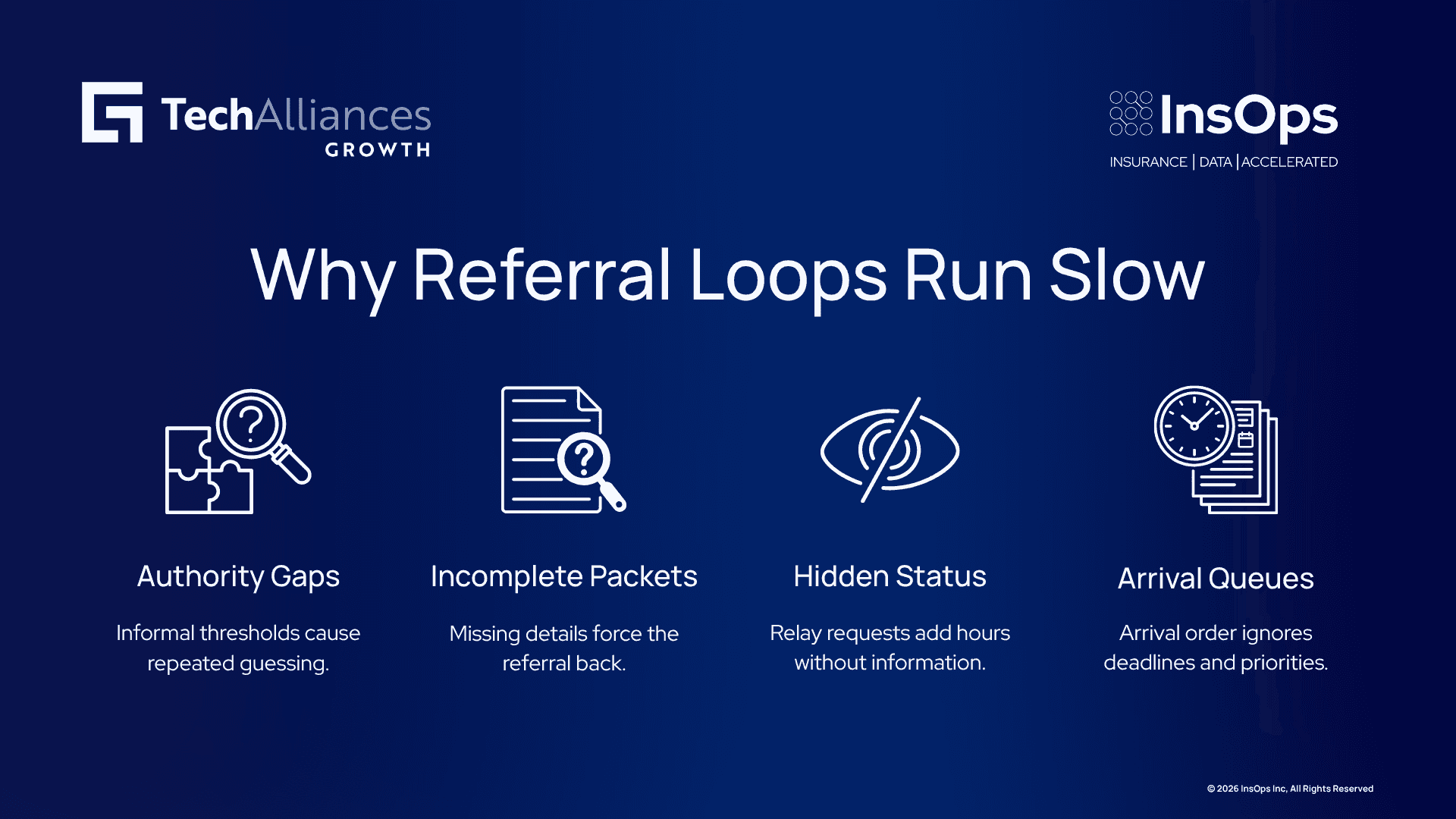
Authority That Nobody Wrote Down
When a threshold is informal, the underwriter guesses whether to refer, and the approver guesses whether the file belongs to them. Both guesses cost time, and both repeat on the next file.
Packets That Arrive Incomplete
An approver who opens a file and finds no loss summary, no rationale, and no stated exception must send it back. The loop restarts, and the broker waits through a second cycle.
Status That Nobody Can See
A broker asking for an update reaches the referring underwriter, who asks the approver, who then has to find the file. Each relay adds hours without adding information.
Queues Ordered by Arrival
When the approver works files in arrival order, a renewal expiring next week waits behind a new-business file with no deadline. Arrival order carries no signal about premium, broker service agreements, or effective dates.
How Do You Shorten a Referral Loop?
Shorten a referral loop by writing four decisions down for every referral type: the trigger, the packet, the owner, and the clock. We call this the Referral Loop Test, and a referral that fails any one of the four is the one that stalls.
Element | Question it answers | Written down means |
|---|---|---|
Trigger | When must this file be referred? | Limit, class, hazard grade, and loss history thresholds in a delegation grid |
Packet | What must the file contain at referral? | Loss summary, exposure details, requested terms, the threshold exceeded, and the underwriter's rationale |
Owner | Who decides, and who updates the broker? | A named role at each authority level and one named contact for status |
Clock | By when must the answer return? | A response target by referral type, with file age visible to the approver |
Write the Trigger
Convene the underwriters who refer and the ones who approve. Record each threshold as a number or a class, never as a judgment call.
Expect disagreement between senior underwriters. That disagreement is the finding, and resolving it is most of the work.
Standardize the Packet
Define the minimum contents of a referral and hold every referral to it. An approver should be able to decide from the packet alone, without opening the broker's original email.
A packet that meets the standard removes the send-back loop entirely.
Name the Owner
Assign one role to each authority level and one person to broker communication on the file. The broker should never have to ask who holds the decision.
Set the Clock
Set a response target by referral type, and make file age visible in the approver's queue. Rank referred files by effective date and broker service agreement, not arrival order.
A target with no visible aging is a wish. The queue view is what makes it a commitment.
Which Metrics Show Whether Referrals Are Getting Faster?
Five metrics show whether the loop is shortening, and none of them counts activity.
Metric | What it measures | What it catches |
|---|---|---|
Referral rate | Share of submissions referred | Thresholds set too low, pushing routine files upward |
Time in referral | Hours from referral request to approver decision | Queue and packet delays |
Referral return rate | Share of referrals sent back for missing information | Incomplete packets |
Broker status wait | Time from broker request to a substantive update | Invisible status |
Referred-file hit ratio | Bound policies as a share of referred submissions | Whether faster answers convert to placement |
Read hit ratio against your own trend and against submission volume. A softer market gives brokers more places to send business, so a falling ratio has more than one cause.
Baseline Before You Change Anything
Without a starting measurement, there is no result to report. This sequence takes about 90 days.

Days 1 to 30: pull the last 100 referred files and time-stamp the referral request, the decision, and every return for missing information.
Days 31 to 60: write the trigger grid, the packet standard, the owner map, and the response targets.
Days 61 to 90: apply them to live referrals and compare time in referral and return rate against the day-one baseline.
If return rate has not moved by day 90, the packet standard is too loose. That is a cheaper problem to find in a pilot than after a system purchase.
How InsOps Helps
InsOps builds an insurance-trained AI that assists underwriting teams with the data tasks behind a referral. LiLa, our insurance-trained LLM, runs inside your own environment, so PII and PHI never leave controlled infrastructure. A person reviews and validates every mapping before it is finalized.
Our Guidewire Integration Gateway connects to Guidewire UnderwritingCenter and PolicyCenter, so submission and policy data flows directly into the system where the referral is worked, without custom engineering.
InsOps is building toward assembling referral summaries inside LiLa, with the underwriter reviewing and finalizing each one before it reaches the approver. That work is in progress, and the decision on every referral stays with a person.
If you are evaluating how to shorten referral loops without adding manual handoffs, contact us to talk through what this looks like for your operation.
Frequently Asked Questions
What is an underwriting referral?
A referral is the handoff of a file to a higher authority level when the risk falls outside the assigned underwriter's delegated limits. It pauses the quote until an authorized person approves, declines, or changes terms.
Why do slow referrals matter to brokers?
Brokers market a submission to several carriers at once, so the carrier holding a file longest gives the broker the least to work with. Repeated waits change where that broker sends the next account.
What are the most common workflow bottlenecks that slow down commercial quotes?
Delays cluster where work changes hands: intake, requests for missing information, and referral to an approver. Queue time between those handoffs usually outweighs the time spent analyzing the risk.
How can insurers reduce quote turnaround time without increasing underwriting risk?
Keep the authority thresholds and shorten the path to them. A standard referral packet, a named owner, and a visible response target cut waiting time while every referral still ends in a human decision.
What metrics should insurers track to shorten quote turnaround time?
For referrals, track time in referral, referral return rate, and the broker's wait for a substantive status update. Baseline all three on recent files before changing any process.
How is AI used in commercial underwriting?
Insurance-trained AI assists by mapping and validating submission and policy data as it moves into underwriting systems, with a person approving the mappings. Underwriters and approvers keep every risk and pricing decision.
How long does it take to shorten a referral loop?
Plan on three months: one to measure, one to write the four decisions, and one to pilot them. The common pitfall is writing thresholds as judgment calls, which recreates the delay in a new form.