

Every P&C carrier's leadership team has asked the same question in the last two years: where is our AI ROI? Pilots get funded. Proofs of concept impress the board. Then most of them stall before they ever touch a production claims file or underwriting decision.
The gap isn't ambition. It's foundation. For a CTO, adopting AI in insurance means building the data infrastructure, governance policies, and operational discipline that let a model run safely on real policy, claims, and underwriting data, not just a sanitized demo dataset.
This article lays out what a production-ready AI foundation actually requires in P&C insurance, and where most technology roadmaps break down.
Why AI Pilots Stall Before Production
Insurance data is old, fragmented, and inconsistent. Decades of mergers, legacy core systems, and manual data entry have left most carriers with policy, claims, and underwriting data spread across systems that were never designed to talk to each other.
Generic AI models are trained on general-purpose data. They don't understand that a "loss date" field means something different in a claims system than in a policy system, or that state-specific regulatory requirements change how a field should be interpreted. Feed that model unprepared insurance data, and it will produce confident, plausible, wrong output.
That's the core problem underneath most stalled AI initiatives: AI needs clean, labeled, contextualized data, and raw insurance data isn't clean.
The Four Pillars of Production Readiness
1. An AI-Ready Data Foundation
Before any model touches production data, a CTO needs to know:
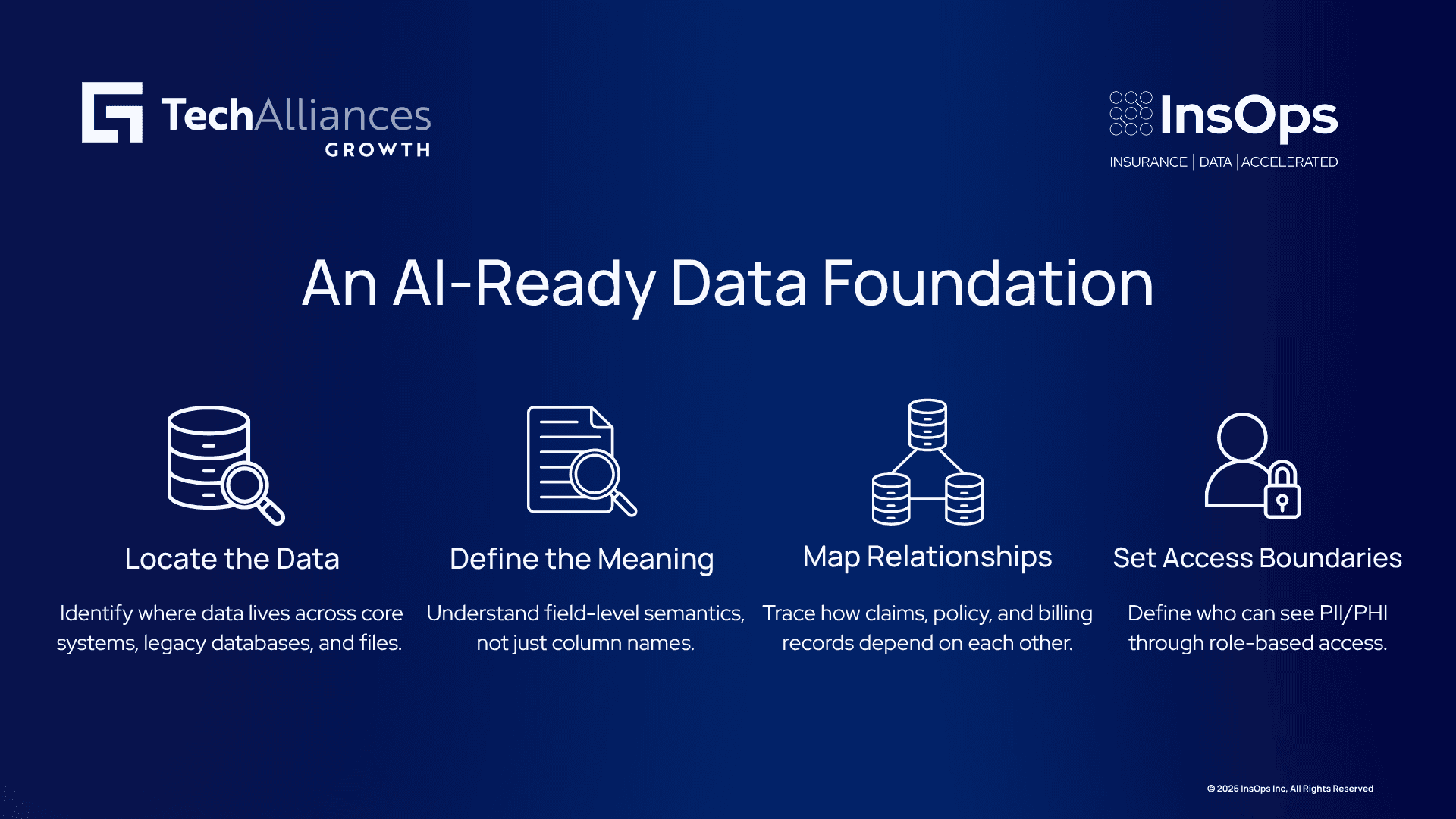
Where the data lives (which core systems, which legacy databases, which flat files)
What it means (field-level semantics, not just column names)
How systems relate to each other (a claim record's dependencies on policy and billing records)
Who's allowed to see it (PII/PHI boundaries, role-based access)
This is infrastructure work, not model work. Without it, every AI initiative downstream inherits the mess.
2. MLOps/LLMOps Discipline
Insurance AI can't run like a consumer chatbot. It needs the same operational rigor as any production system:
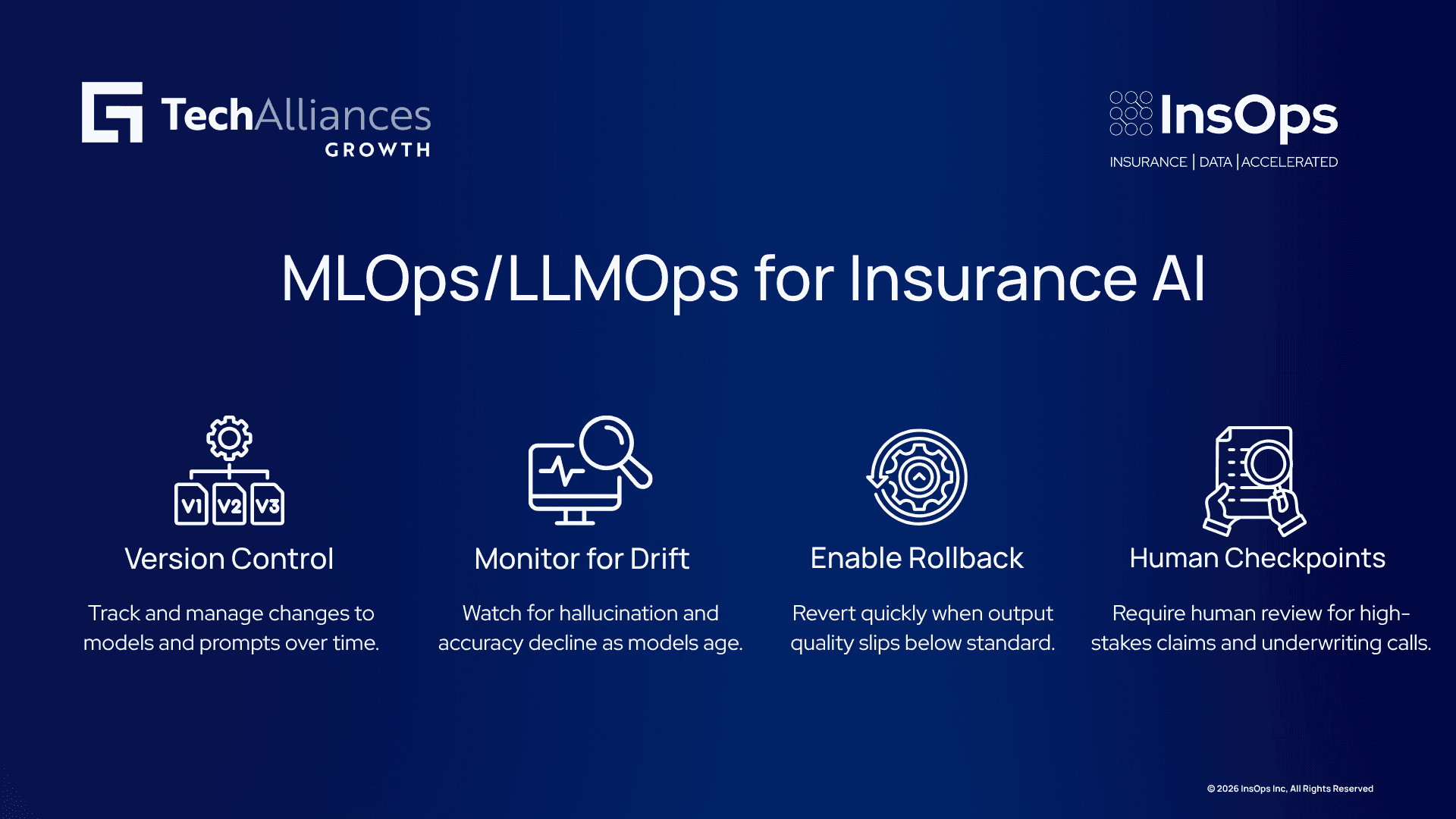
Version control on models and prompts
Monitoring for drift, hallucination, and accuracy degradation over time
Rollback procedures when output quality slips
Human-in-the-loop checkpoints for high-stakes decisions like claims and underwriting
A model that worked in the demo six months ago isn't guaranteed to work the same way today. LLMOps is the discipline of catching that before it becomes a claims payout error or a regulatory finding.
3. Governance Policies That Regulators Will Accept
NAIC guidance, state DOI requirements, HIPAA, and GDPR all apply differently depending on what the AI touches. A governance framework built for a generic AI platform will not hold up to an insurance regulatory review. CTOs need policies that address:
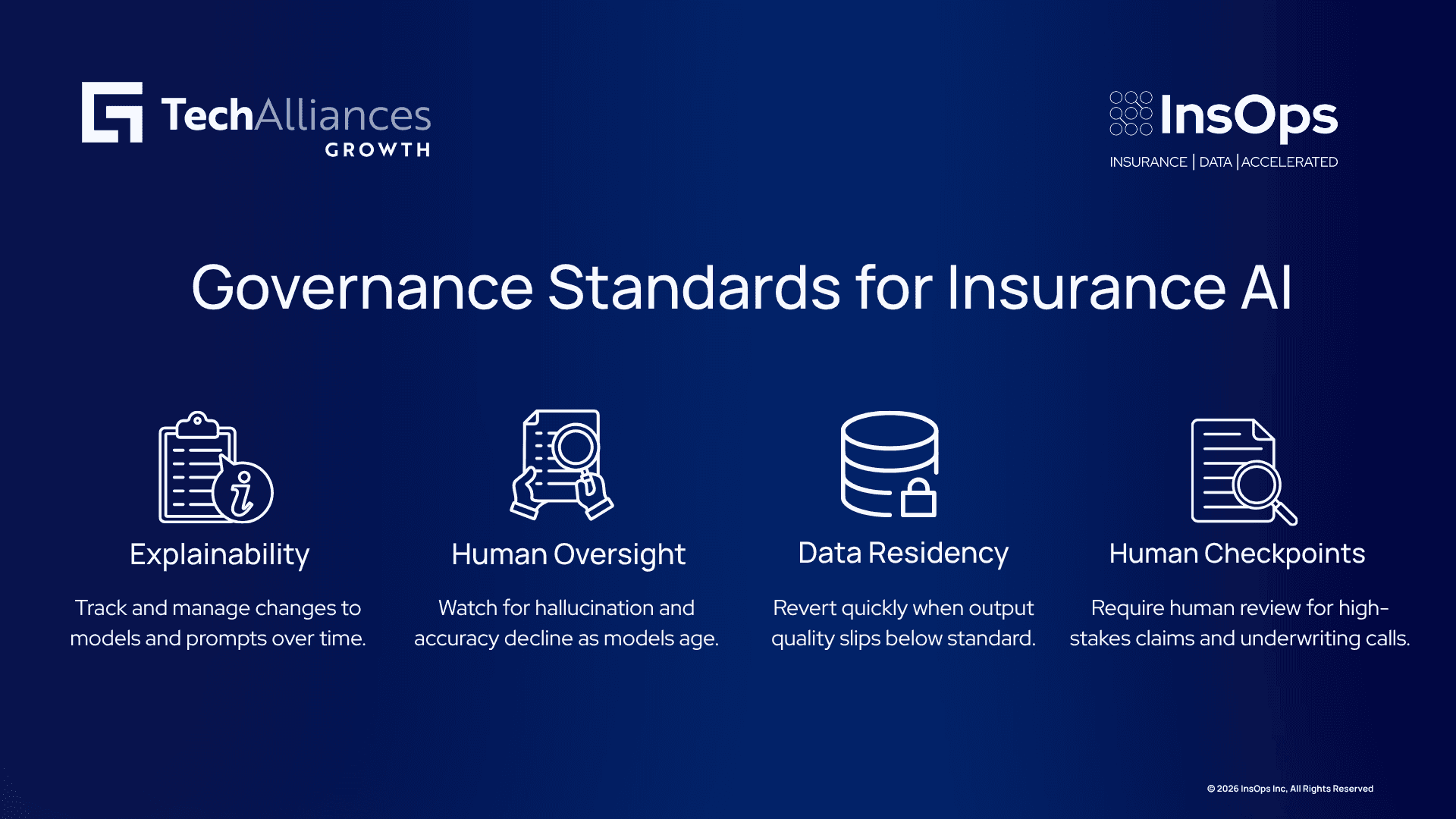
Explainability: can you show a regulator why the model produced a given output?
Human oversight: is a person reviewing and approving decisions, or is the system acting alone?
Data residency and control: does sensitive data ever leave the carrier's own environment?
Audit trails: can every AI-assisted decision be traced back to its inputs?
4. Domain-Specific AI Solutions With Measurable Outcomes
The last pillar is the one boards actually care about: results. Not "we deployed AI," but specific, measurable outcomes tied to specific use cases; faster legacy data migration, cleaner data flowing into Guidewire, lower litigation risk on open claims, less manual rework across policy and claims teams.
Generic AI platforms struggle here because they weren't built to understand P&C data relationships or regulatory context in the first place. Domain-specific tools, trained on insurance data patterns and built to run inside the carrier's own environment, close that gap.
What This Looks Like in Practice
A carrier moving from pilot to production typically works through these phases:
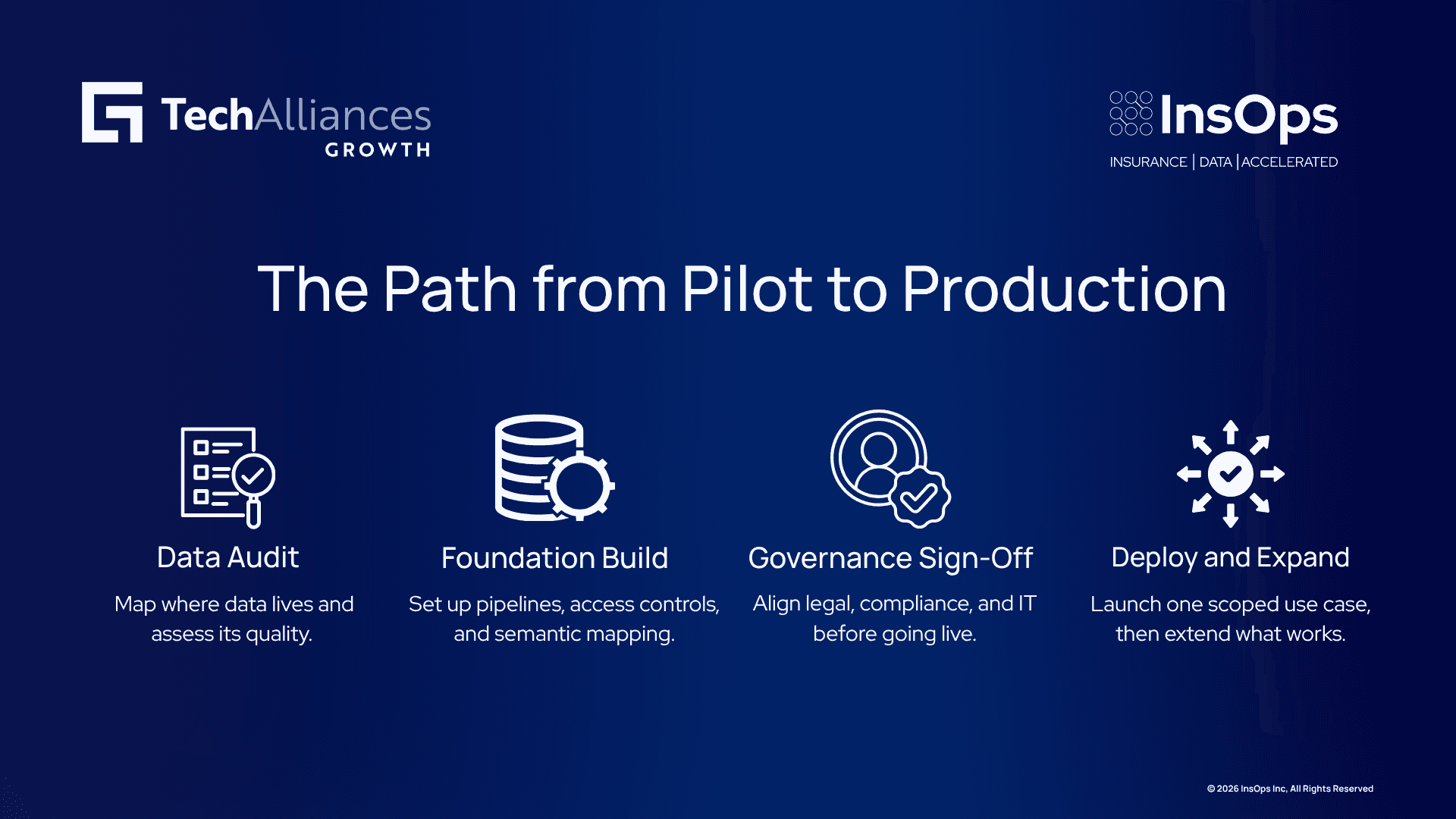
Data audit — map where policy, claims, and underwriting data live and how clean it is
Foundation build — establish data pipelines, access controls, and semantic mapping across systems
Governance sign-off — get legal, compliance, and IT security aligned on explainability and human-review requirements before any model goes live
Scoped deployment — start with one well-defined use case with measurable outcomes, not an open-ended "AI platform" rollout
Monitor and expand — once the first use case proves out, extend the same foundation to the next one
How InsOps Helps
InsOps closes the gap between AI ambition and AI in production for P&C carriers.
Our insurance-trained AI model, LiLa, runs inside the carrier's own environment, so PII and PHI never leave controlled infrastructure. LiLa is built on more than 25 years of insurance data engineering expertise and thousands of hours of model refinement on real P&C data relationships, not generic internet text.
For carriers building their data foundation, InsOps supports:
Legacy Data Migration — moving decades of policy and claims data from legacy core systems into modern platforms like Guidewire, with human-in-the-loop validation at every step. Golden Bear Insurance migrated 40+ years of claims data from AS/400 to Guidewire ClaimCenter Cloud in 6 months with 99%+ accuracy.
Integration Gateway — pre-built connectors for Guidewire PolicyCenter, ClaimCenter, BillingCenter, UnderwritingCenter, and PricingCenter, so data keeps flowing in real time without custom code
Data Privacy Protection — automated PII/PHI anonymization so sensitive data stays protected as it moves between systems
Litigation Risk Mitigation — LiLa analyzes open claims against historical claim data to surface litigation risk probability, helping claims teams prioritize review before a case escalates
LiLa always works alongside your team, not in place of it. Every output is built for human review before action is taken; LiLa never makes autonomous decisions on policy, claims, or underwriting matters.
If your organization is working through data foundation, governance, or production deployment challenges, get in touch with InsOps to talk through where your systems stand today.
FAQ
What does "AI production readiness" mean for an insurance carrier?
It means your data is clean and mapped, your operational monitoring (MLOps/LLMOps) is in place, your governance policies satisfy regulatory requirements, and you have at least one AI use case delivering measurable business outcomes, not just a pilot in a sandbox.
Why do generic AI models struggle with insurance data?
Generic models aren't trained on insurance-specific field semantics, data relationships, or regulatory frameworks. They can't reliably distinguish how the same term or field behaves differently across policy, claims, and billing systems, which leads to inaccurate output when applied to real insurance data.
What's the difference between MLOps and LLMOps?
MLOps covers the operational discipline for traditional machine learning models: monitoring, versioning, and deployment pipelines. LLMOps applies the same discipline specifically to large language models, with added focus on prompt management, hallucination monitoring, and human-in-the-loop review for generative outputs.
Does AI in insurance require full automation to deliver value?
No. Some of the highest-value AI deployments in P&C insurance keep a human reviewer in the loop at every step, particularly for claims and underwriting decisions. The value comes from removing manual data work and surfacing risk faster, not from removing human judgment.
How long does it take to build an AI-ready data foundation?
It depends on the number of source systems and the state of existing data, but carriers typically see meaningful results starting with one well-scoped use case, such as legacy data migration, within months rather than starting with an open-ended platform rollout.
How does InsOps keep sensitive data secure during AI deployment?
LiLa, InsOps's insurance-trained AI model, runs inside the carrier's own environment. PII and PHI never leave controlled infrastructure, and every AI-assisted output includes human-in-the-loop review before any action is taken.