

Every P&C carrier runs on data scattered across policy, claims, billing, and underwriting systems. Legacy cores, point solutions, spreadsheets, and third-party feeds all hold pieces of the same customer record, but none of them agree with each other.
For a CTO, this isn't an abstract problem. It's the reason release cycles slip, the reason integration projects run over budget, and the reason your analytics team spends more time reconciling data than using it.
The Real Cost of Data Silos
Insurance data silos aren't just an inconvenience. They create compounding technical debt.
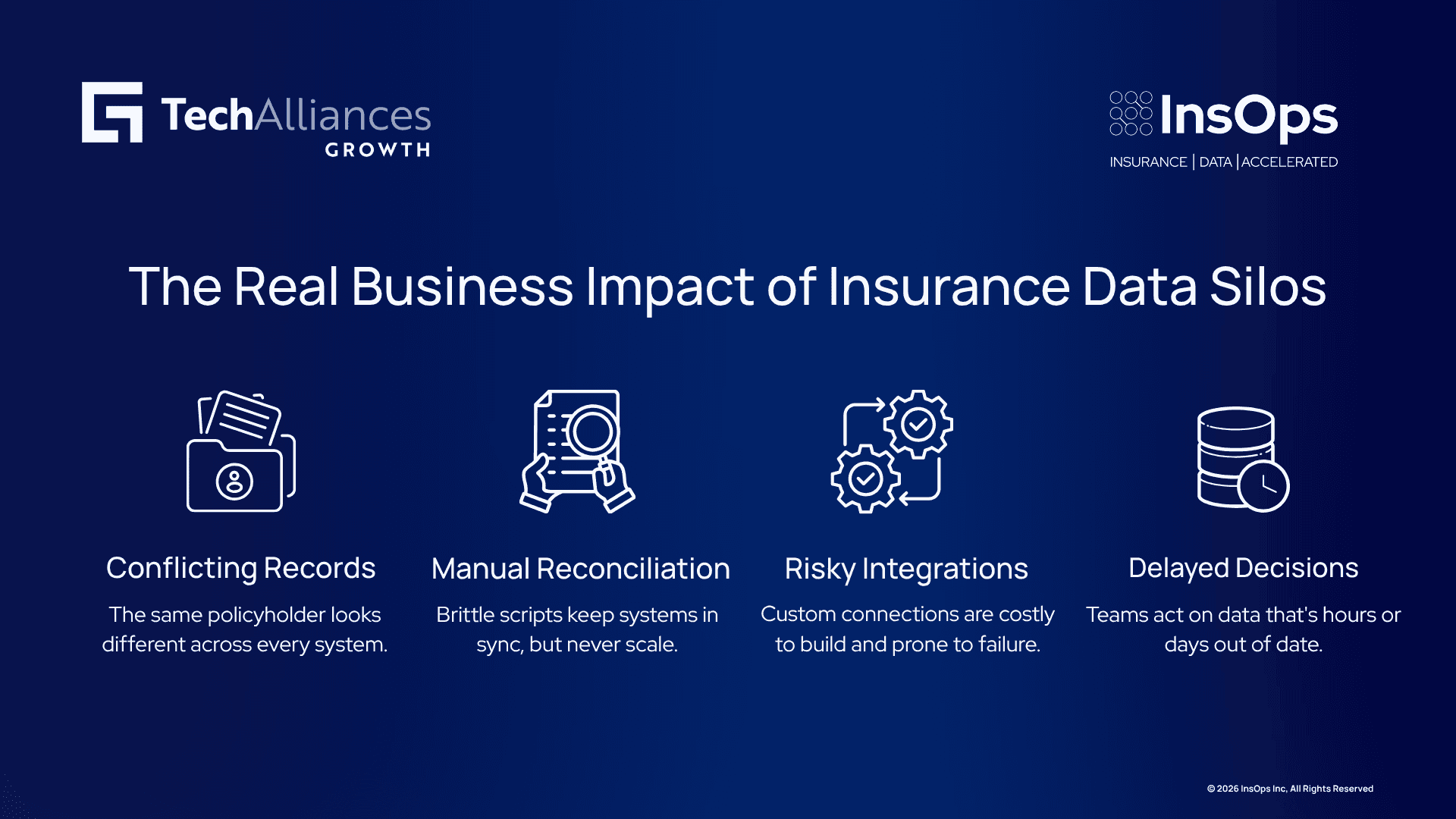
Duplicate and conflicting records. The same policyholder can exist differently in PolicyCenter, a legacy admin system, and a CRM. Every downstream system inherits that inconsistency.
Manual reconciliation work. Teams build brittle scripts and manual review steps just to keep systems roughly in sync. That work never scales and rarely survives a system upgrade.
Slow, risky integrations. Custom point-to-point connections between core systems and downstream applications are expensive to build and expensive to maintain. Every new integration adds another failure point.
Delayed decisions. Underwriting, claims, and distribution teams often work from data that's hours or days old, because real-time synchronization across systems was never built.
The traditional fix, more middleware and more custom code, adds cost without solving the underlying issue: insurance data isn't standardized, and generic integration tools don't understand what a policy, a claim, or an endorsement actually means.
What a Modern Integration Architecture Requires
Solving this for the long term means three things working together:
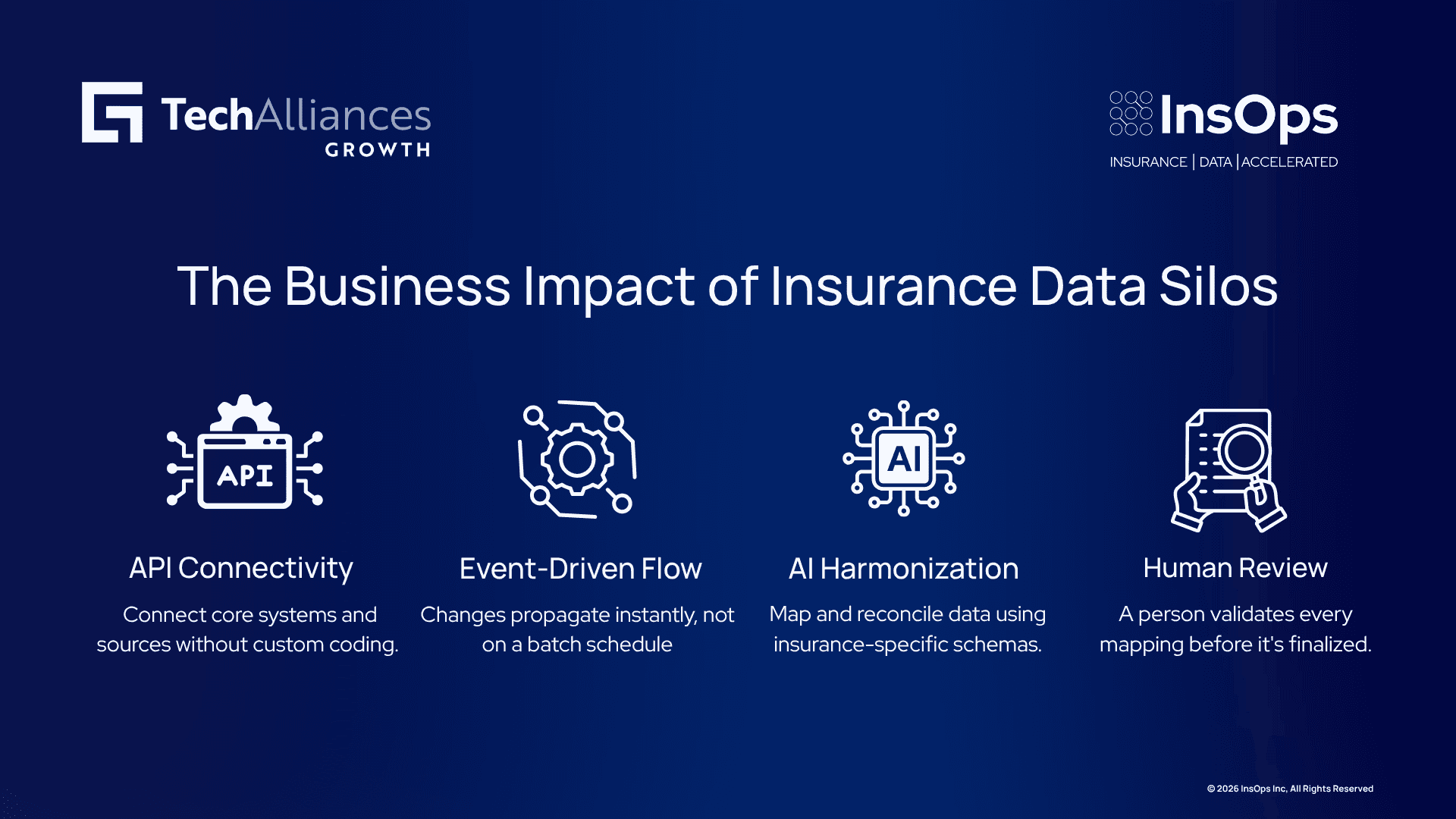
API-based connectivity to the core systems and third-party sources that already hold your data, without custom-coding every connection.
Event-driven architecture so that changes in one system (a new claim, an updated policy, a billing adjustment) propagate to other systems as they happen, not on a batch schedule.
AI-powered data harmonization that understands insurance-specific schemas and field semantics well enough to map and reconcile data, with a person reviewing before anything is finalized.
Most integration platforms are built for generic enterprise data. They don't recognize the difference between a claim status field and a policy status field, or understand how billing records relate to a policy term. That gap is where insurance-specific tooling matters.
How InsOps Helps
InsOps addresses data silos through our Integration Gateway, built specifically for P&C carriers running on Guidewire.
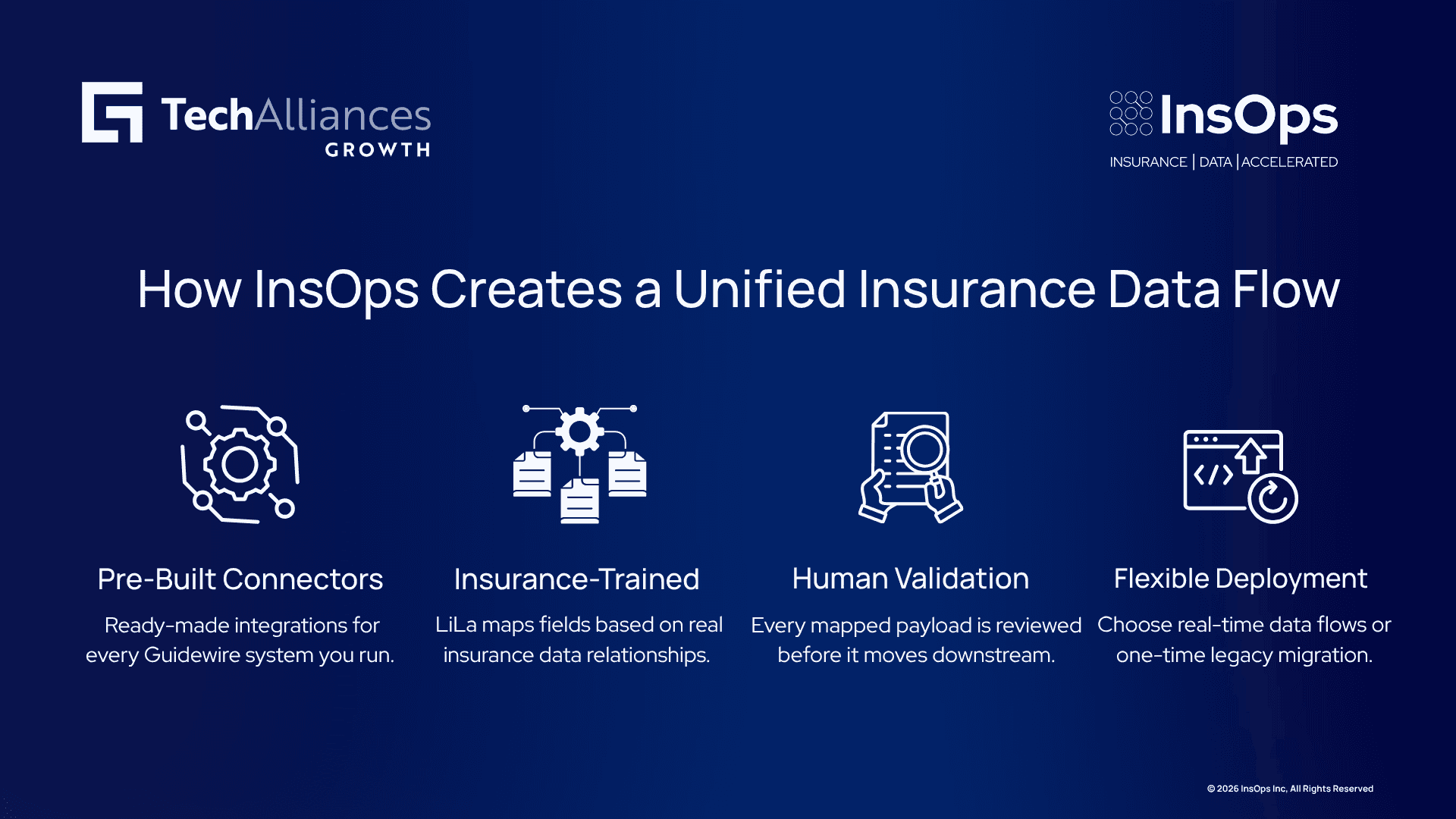
Pre-built connectors for the systems you already run. Integration Gateway includes pre-built connectors for Guidewire PolicyCenter, ClaimCenter, BillingCenter, UnderwritingCenter, PricingCenter, and the Quote Process. You're not starting integration work from scratch for each system.
Insurance-trained payload mapping. Our insurance-trained AI model, LiLa, reads incoming and outgoing payloads and maps fields based on how insurance data actually relates, not generic schema matching. LiLa recognizes the difference between similar-looking fields across policy, claims, and billing contexts.
Human-in-the-loop validation on every mapping. LiLa assists with mapping and flags data for review. It does not make final decisions on its own. Every mapped payload goes through human validation before it moves downstream, so your team stays in control of what actually gets written to production systems.
No custom code required. Because the connectors and mapping logic are already built for Guidewire's data model, your engineering team isn't maintaining custom point-to-point integrations for every new data flow.
Real-time or one-time, your choice. Whether you're establishing ongoing real-time data flows into Guidewire or running a one-time legacy data migration, InsOps supports the use case that matches where you are today. These are separate, independent engagements, so you're not locked into a bigger project than you need.
The result: InsOps migrates legacy data into Guidewire and keeps it flowing in real time, giving your teams one consistent view of policy, claims, and billing data instead of several conflicting ones.
FAQ
Does Integration Gateway replace our existing core systems?
No. Integration Gateway connects to the core systems you already run, including PolicyCenter, ClaimCenter, BillingCenter, UnderwritingCenter, and PricingCenter. It's designed to work within your existing Guidewire environment, not replace it.
How much custom development does our team need to do?
Integration Gateway uses pre-built connectors for Guidewire systems, so most data flows don't require custom code. Your team reviews and validates the mappings LiLa proposes rather than building integration logic from scratch.
Is this the same thing as a data migration project?
No. Legacy data migration is a one-time project to move historical data into Guidewire. Integration Gateway is for establishing and maintaining real-time data flows. They're independent use cases, and you can start with either one depending on your priority.
Does the AI make changes to our data automatically?
No. LiLa assists with mapping and flags recommendations, but a person on your team reviews and approves changes before anything is finalized in production. Nothing moves downstream without human validation.
Where does our data live during this process?
LiLa runs inside your own environment. Sensitive data doesn't leave your controlled infrastructure to be processed elsewhere.
What if we only want to solve this for one system, like ClaimCenter, right now?
That's a reasonable starting point. Integration Gateway can be scoped to a single Guidewire application and expanded to others as needed.
Is there a DOI compliance layer for this?
A DOI Compliance capability is currently in development. Contact us to discuss your timeline and requirements.