

For most P&C carriers, "modernization" has become a loaded word. It usually means a multi-year, multi-million-dollar program that starts with a bold vision and ends with a change order.
CTOs at insurance carriers know the real risk isn't staying on legacy systems. It's the migration itself.
The Core Problem
Legacy cores like AS/400, mainframe policy admin systems, and homegrown claims platforms hold decades of business logic. That logic is rarely documented. It lives in field names, undocumented workarounds, and tribal knowledge held by two or three engineers nearing retirement.
A full-system cutover assumes you can understand and replicate all of that logic before go-live. In practice, that assumption is where most projects break.
Industry data backs this up: 7 in 10 insurers are running outdated core systems, and the majority of modernization delays trace back to failed or delayed data migrations, not the new platform itself.
Why Incremental Wins
An incremental approach changes the risk profile entirely. Instead of one irreversible cutover, you move in stages:
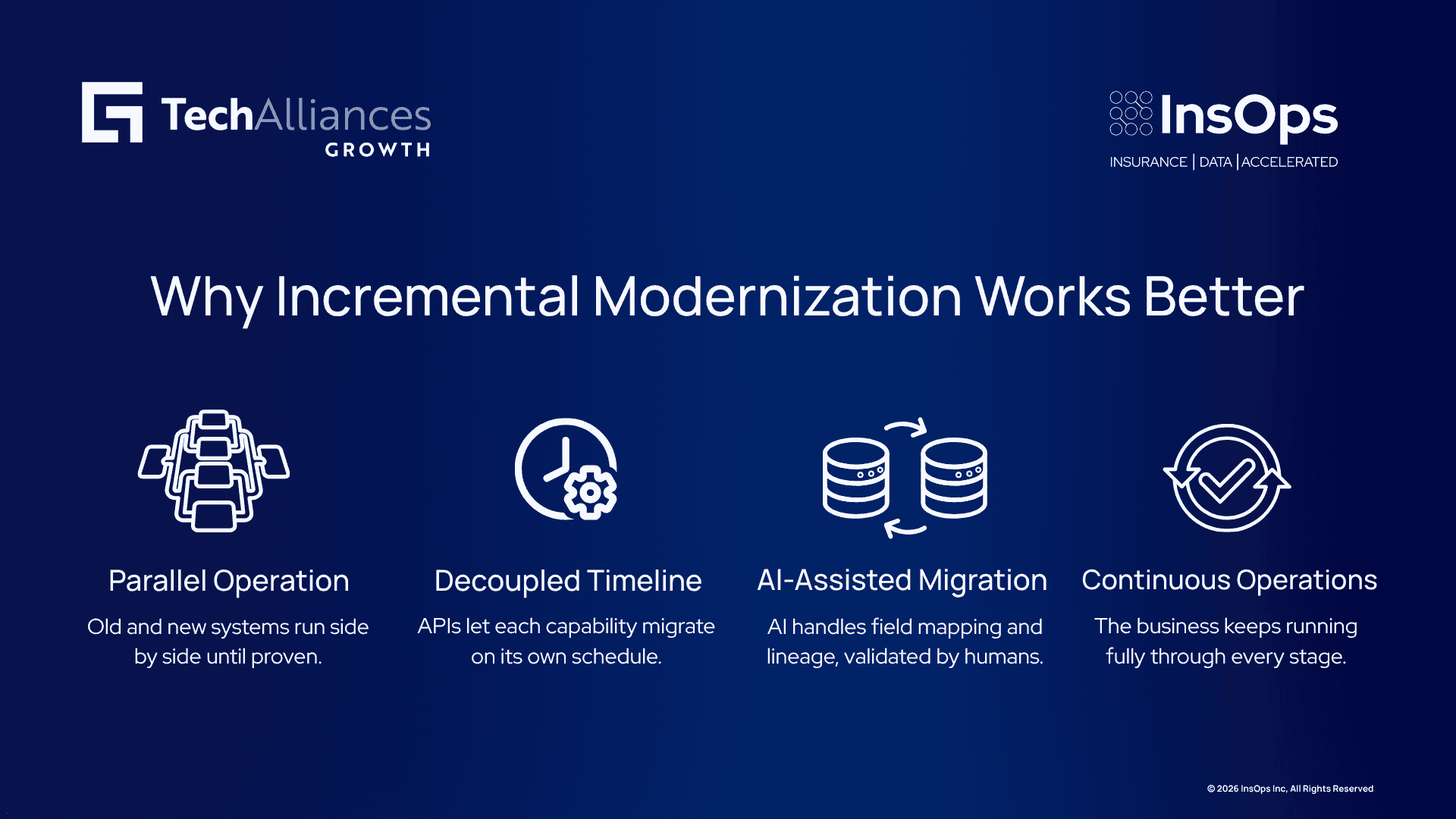
1. Cloud-native platforms as the target, not the starting point Guidewire and similar cloud-native cores become the destination, but the migration path runs through parallel operation, not a single switch-flip. Old and new systems run side by side until confidence is earned, not assumed.
2. APIs and microservices decouple the timeline Instead of migrating an entire monolith at once, APIs expose individual capabilities (quoting, claims intake, billing) as independent services. Each can move on its own schedule. A slow claims migration doesn't block a faster billing migration.
3. AI-assisted migration handles the translation problem The hardest part of legacy migration isn't moving data, it's understanding it. Field mapping, business rule extraction, and data lineage across decades of schema changes are exactly the kind of pattern-recognition work that insurance-trained AI models are suited for, with a human validating every mapping before it goes live.
4. Business continuity is a design constraint, not an afterthought Claims can't stop being processed. Policies can't stop being written business. Incremental modernization is built around this reality: every stage has to leave the business fully operational, because insurance doesn't get a maintenance window.
What This Looks Like in Practice
A carrier migrating 40+ years of claims history doesn't need every record understood at once. It needs a system that can:
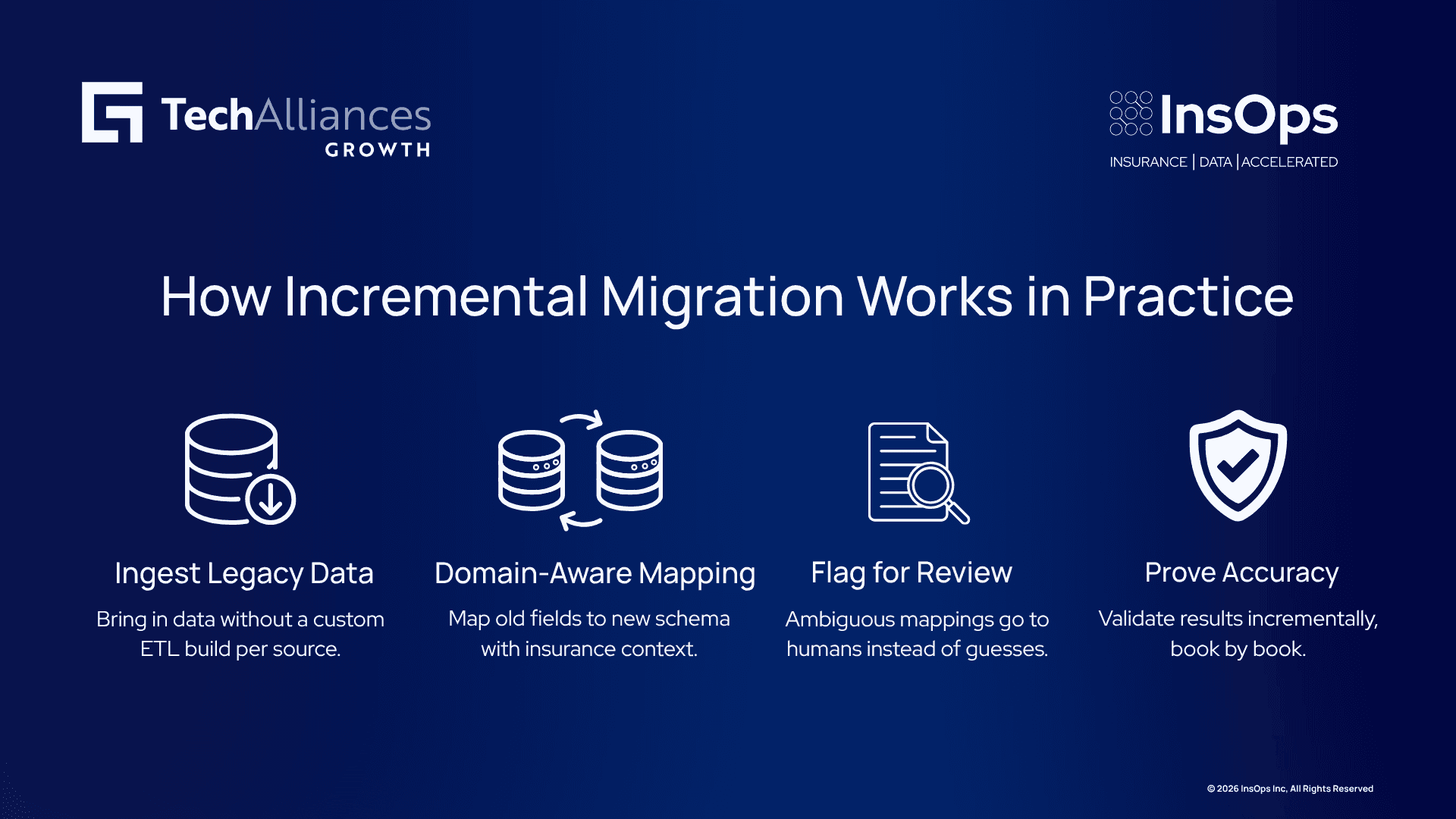
Ingest legacy data without requiring a custom ETL build for every source
Map old fields to new schema with domain awareness, not generic string matching
Flag ambiguous mappings for human review instead of guessing
Prove accuracy incrementally, one book of business or claim type at a time
This is the difference between a migration that takes six months with 99%+ accuracy and one that takes three years and still needs a cleanup phase afterward.
How InsOps Helps
InsOps was built specifically for this problem. Our insurance-trained AI model, LiLa, understands insurance domain logic, data relationships, and regulatory frameworks like NAIC, HIPAA, and GDPR, not just generic text patterns. That domain fluency is what makes incremental migration realistic instead of theoretical.
For legacy data migration, LiLa's Data Modernization capability maps and transforms legacy records into your target schema (Guidewire or otherwise) with human-in-the-loop validation at every step. Nothing moves without review. LiLa assists the migration; it doesn't make autonomous decisions about your data.
For carriers running parallel systems during a phased cutover, InsOps' Integration Gateway provides pre-built connectors into Guidewire PolicyCenter, ClaimCenter, BillingCenter, UnderwritingCenter, and PricingCenter, so real-time data flow between old and new environments doesn't require custom code for every integration point.
One proof point: a carrier migrated 40+ years of claims data from AS/400 to Guidewire ClaimCenter Cloud in six months, with 99%+ accuracy and $2M+ in cost savings. That is what incremental, AI-assisted migration looks like when the domain logic is actually understood, not just moved.
If you're a CTO evaluating a legacy modernization path, the question worth asking isn't "how fast can we replace this system." It's "how do we keep the business running while we do."
FAQs
What is incremental legacy modernization in insurance?
It's an approach where a carrier migrates or integrates legacy core systems in stages, moving one capability or book of business at a time, rather than cutting over the entire system at once. Old and new systems run in parallel until each stage is validated.
Why do legacy migrations fail or get delayed?
Most delays come from failed or incomplete data migrations, not the target platform itself. Legacy systems hold decades of undocumented business logic in field names and workarounds, and a full-system cutover assumes that logic can be understood and replicated all at once.
How does AI help with legacy data migration?
AI-assisted migration handles field mapping, business rule extraction, and data lineage across old schemas, work that requires pattern recognition across large, messy datasets. An insurance-trained model can flag ambiguous mappings for human review instead of guessing, which keeps a person in control of what actually moves.
Does AI make migration decisions on its own?
No. In a properly designed migration, AI assists with mapping and transformation, but a human reviews and approves before anything goes live. This is a deliberate design choice, not a limitation, since insurance data carries regulatory and financial consequences that require accountability.
Can a carrier migrate legacy data and integrate with Guidewire at the same time?
Yes, but they should be treated as separate workstreams. One-time legacy migration moves historical data into a new core system. Real-time integration keeps data flowing between systems on an ongoing basis. Carriers often run both, but conflating them into a single project increases risk unnecessarily.
How long does a legacy migration typically take with an incremental approach?
It depends on data volume and complexity, but a well-scoped incremental migration can move decades of historical data in months rather than years. One migration moved 40+ years of claims data in six months with 99%+ accuracy.