

For most P&C carriers, technical debt isn't a line item. It's the accumulated weight of every system that was extended instead of replaced, every integration built as a workaround, and every application kept alive because retiring it felt riskier than maintaining it.
CTOs inherit this debt whether they created it or not. And the traditional playbook for managing it, incremental patches, point-to-point integrations, and periodic "modernization" projects that stall before completion, isn't built for where the industry is headed.
The Real Cost of Deferred Modernization
Technical debt in insurance IT shows up in four recurring ways:
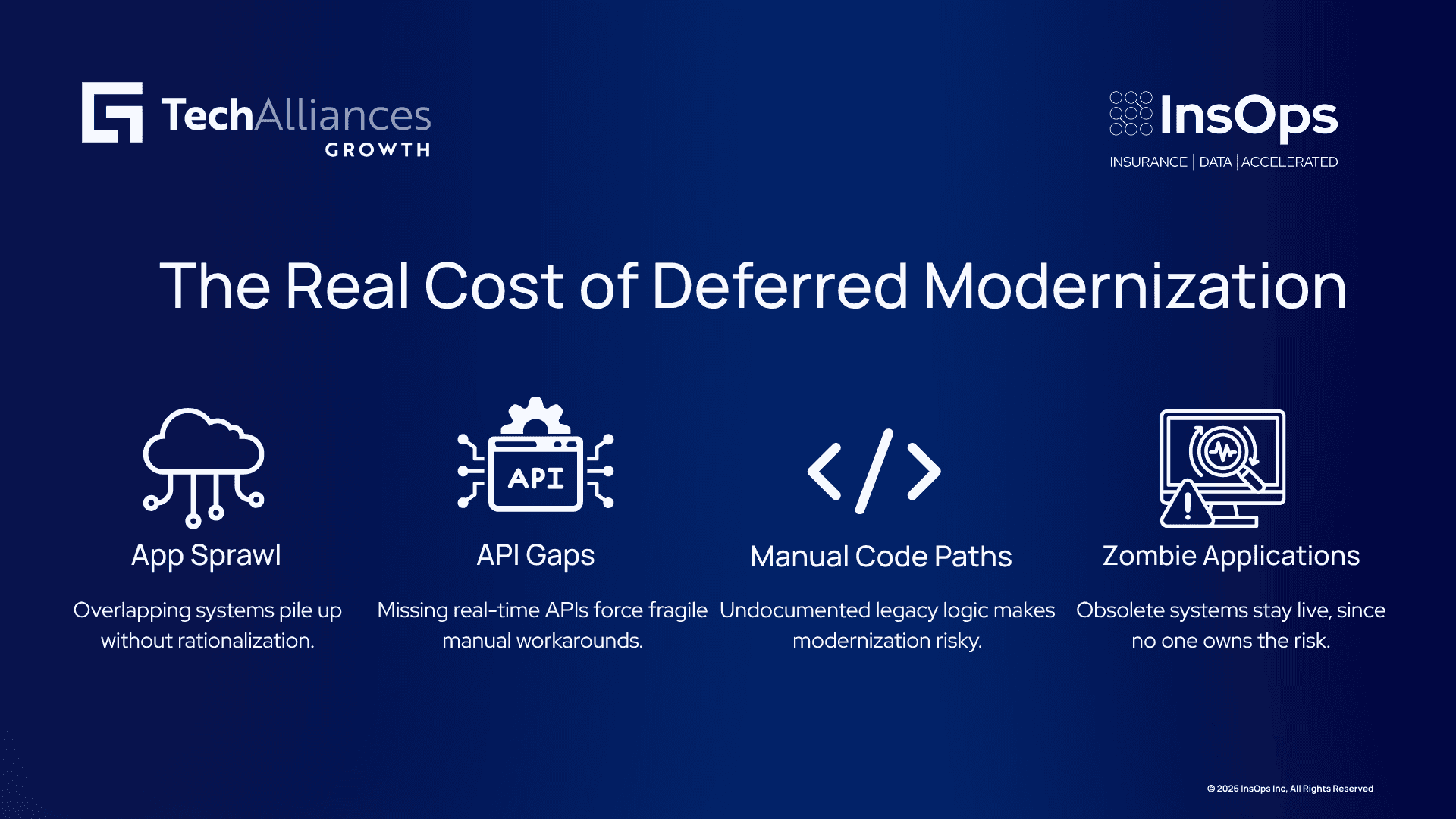
Application sprawl. Carriers running 15, 20, sometimes 30+ applications across policy, claims, underwriting, and billing, many overlapping in function, none rationalized against actual business need.
API gaps. Core systems that were never built for real-time data exchange, forcing manual exports, batch jobs, and custom point-to-point connections that break every time an upstream system changes.
Manual code paths. Legacy business logic embedded in COBOL, AS/400, or proprietary systems that no one fully documents anymore, modernized only through risky, manual rewrites.
Zombie applications. Systems that should have been retired years ago but remain in production because no one wants to own the migration risk.
Each of these compounds. An unrationalized application portfolio makes API enablement harder. Missing APIs make code modernization slower. Slow modernization keeps obsolete applications alive longer. The debt doesn't stay flat, it accelerates.
Why This Is a CTO-Level Priority Now
Three pressures are converging that make deferred technical debt more expensive than it used to be:
AI initiatives are stalling on data foundations. Carriers investing in AI and analytics are discovering their core systems can't feed clean, structured, real-time data to anything. The data isn't the problem, the debt sitting on top of it is.
Guidewire and other core system migrations are exposing hidden dependencies. Every rationalization effort surfaces integrations nobody mapped and business logic nobody documented.
Talent that understands legacy systems is retiring. The people who know why a given AS/400 field means what it means are leaving the workforce, taking undocumented context with them.
Waiting another budget cycle doesn't reduce the debt. It just narrows the window in which anyone can safely pay it down.
What Application Rationalization Actually Requires
A serious technical debt reduction strategy has four components, and they need to work together, not in isolation:
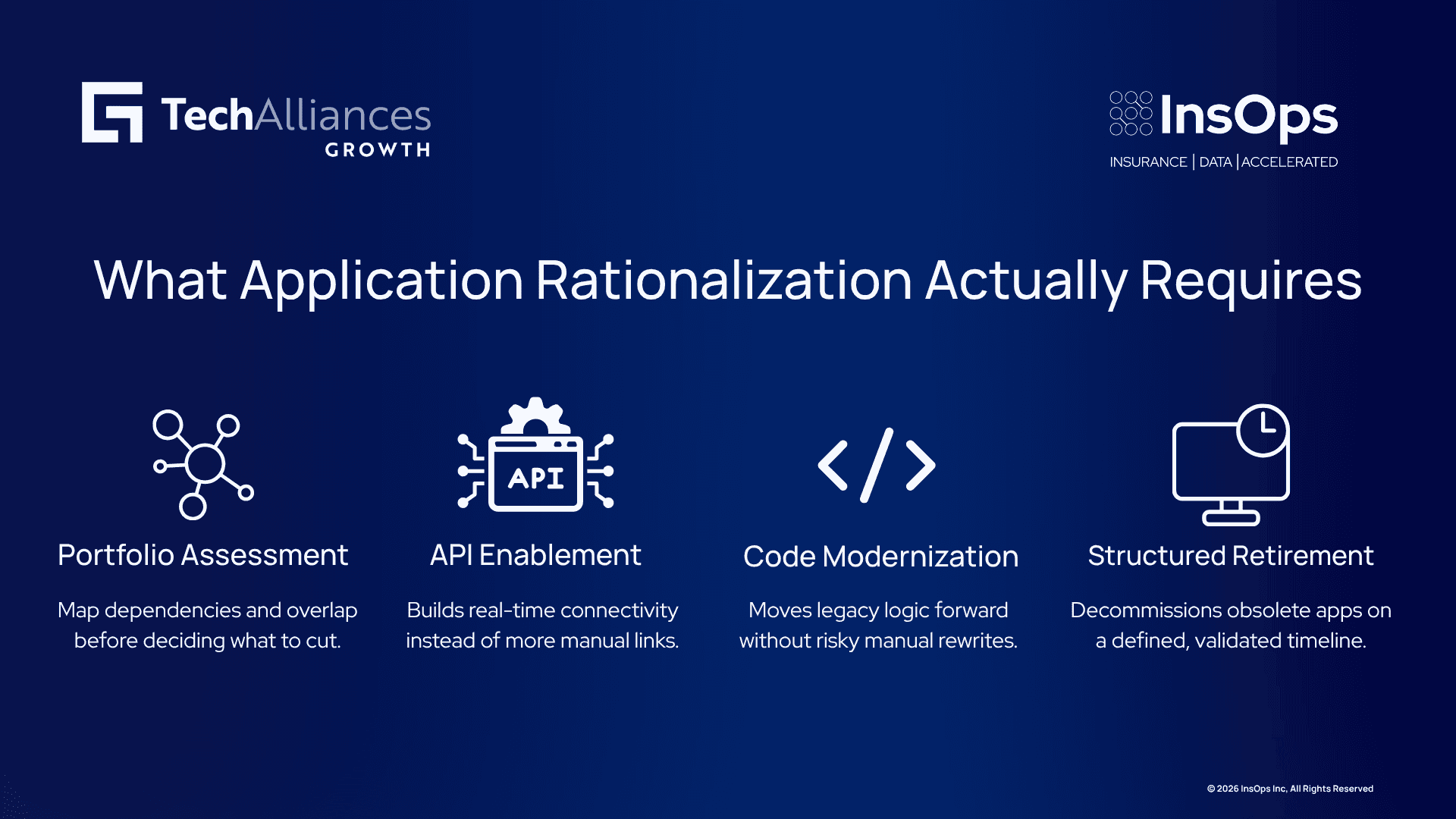
Portfolio assessment. Understand what every application actually does, who depends on it, and where functional overlap exists before deciding what to consolidate or retire.
API enablement. Build real-time connectivity into core systems so data moves without manual intervention, rather than layering another point-to-point integration on top of the problem.
Automated code modernization. Move legacy logic into modern architectures without a manual line-by-line rewrite, which is where most modernization projects lose time, budget, and accuracy.
Structured retirement. Decommission obsolete applications on a defined timeline, with validated data migration, not an indefinite "we'll get to it."
The carriers making progress on technical debt aren't the ones with the biggest budgets. They're the ones treating these four pieces as one connected initiative instead of four separate projects competing for the same resources.
How InsOps Helps
InsOps is built specifically for the data and integration problems underneath insurance technical debt, not as a generic modernization tool retrofitted for the industry.
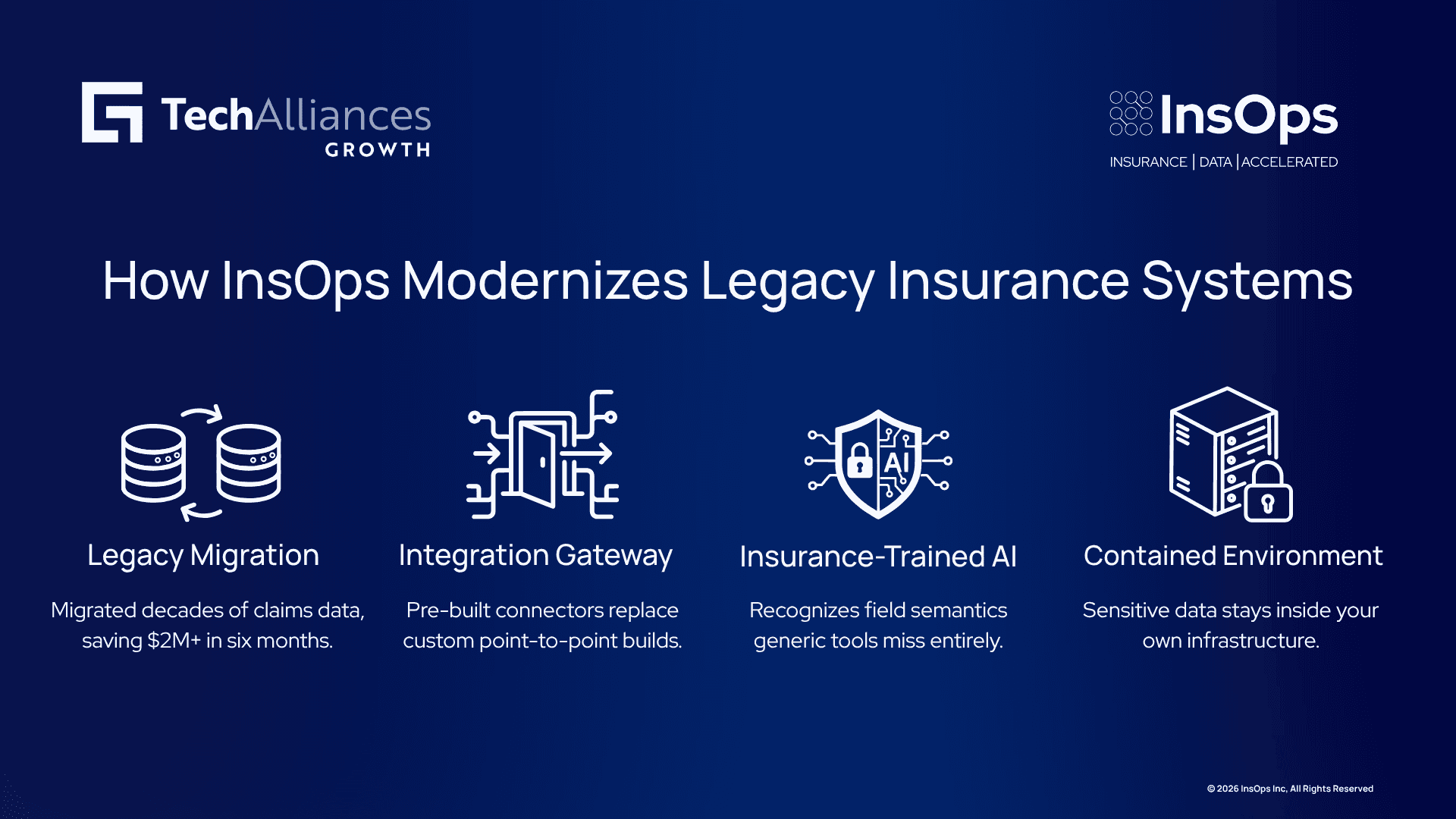
Legacy data migration. InsOps has migrated 40+ years of claims data from AS/400 into Guidewire ClaimCenter Cloud in 6 months, at 99%+ accuracy, with $2M+ in cost savings for the carrier involved. That's the kind of timeline and accuracy legacy modernization requires when the underlying system has decades of undocumented business logic embedded in it.
Integration Gateway. Rather than building custom point-to-point connections for every core system, InsOps provides pre-built connectors for Guidewire PolicyCenter, ClaimCenter, BillingCenter, UnderwritingCenter, and PricingCenter. Our insurance-trained AI model automatically maps payloads between systems, with human review built into every step, so real-time data flow doesn't require a developer rebuilding integration logic from scratch.
Insurance-trained data understanding. Generic modernization tools don't understand insurance data. InsOps runs on a model trained specifically on insurance domain logic, data relationships, and regulatory frameworks like NAIC, HIPAA, and GDPR, recognizing field semantics and data interdependencies that generic tools miss entirely.
Runs inside your environment. InsOps operates inside the insurer's own controlled infrastructure, so sensitive data never has to leave your environment to be modernized, mapped, or migrated.
The result: application rationalization and modernization efforts that move on a timeline measured in months, not years, with human oversight at every step.
FAQ
What is technical debt in the context of P&C insurance? Technical debt refers to the accumulated cost of maintaining outdated, overlapping, or poorly integrated applications instead of modernizing or retiring them. In P&C insurance, this typically includes legacy core systems, manual data exchange processes, and undocumented business logic built up over decades.
Why is application rationalization difficult for insurance carriers specifically? Insurance core systems often contain decades of business logic that isn't documented anywhere outside the system itself. Policy, claims, and underwriting data are deeply interdependent, so rationalizing one application can affect several others, making the process riskier than in industries with simpler data relationships.
How long does legacy data migration typically take? Timelines vary by scope and data complexity, but InsOps has migrated 40+ years of claims history into Guidewire ClaimCenter Cloud in 6 months. Projects without insurance-specific tooling often take significantly longer due to manual mapping and validation.
Does modernizing legacy systems mean replacing them entirely? Not necessarily. Modernization can mean migrating data and logic to a new core system, or it can mean building real-time API connectivity into an existing system to reduce manual work, without full replacement. The right approach depends on the carrier's specific portfolio and goals.
Is AI involved in application rationalization risky for a regulated industry? Human-in-the-loop review is essential. InsOps's insurance-trained AI model assists with mapping, migration, and integration tasks, but every output is validated by human review before it's used in production. The AI does not make autonomous decisions on carrier data.
Where should a CTO start if the application portfolio hasn't been assessed in years? Start with a portfolio assessment to understand what each application does, its dependencies, and where overlap exists. From there, prioritize the systems causing the most manual work or blocking real-time data flow, since those tend to offer the fastest return on modernization effort.