

For a P&C insurance CTO, cloud migration is rarely a single decision. It is a sequence of decisions, each carrying its own risk profile, budget line, and blast radius if something goes wrong. Core systems that write business today cannot go dark tomorrow. That reality is why the insurers who migrate successfully treat cloud transformation as a phased program, not a single cutover event.
This article lays out a practical, four-phase approach to cloud migration for P&C carriers: hybrid architecture as the operating model, containerization as the portability layer, and automated deployment pipelines as the risk-reduction mechanism.
Why Phased Migration Matters More in Insurance Than Almost Anywhere Else
Insurance core systems sit underneath policy issuance, claims processing, billing, and underwriting. A failed migration does not just cause downtime. It can stall new business intake, delay claims payments, and create regulatory exposure if data integrity is compromised mid-transition.
Three factors make phased migration the right default for insurance:
Data complexity. Decades of policy and claims history live in formats and schemas that predate modern data standards. Field semantics, data interdependencies, and legacy encoding conventions do not translate cleanly in a single pass.
Regulatory continuity. NAIC and state-level compliance requirements do not pause during a migration. Every phase needs to preserve auditability and reporting continuity.
Operational uptime requirements. Claims and billing systems are effectively always-on. A phased approach lets teams validate each layer before the next depends on it.
Phase 1: Assessment and Hybrid Architecture Design
Before any workload moves, the CTO's team needs an honest inventory: which systems are cloud-ready, which need remediation, and which should stay on-premises for the foreseeable future.
Hybrid architecture is not a compromise position. For most carriers, it is the correct end state for years, not just a transitional phase. Core policy admin systems like Guidewire PolicyCenter, ClaimCenter, and BillingCenter often run in a mix of on-premises and cloud-hosted environments during migration, and sometimes permanently, depending on data residency and regulatory requirements.
Key questions to resolve in this phase:
Which workloads have hard data residency or compliance constraints that require on-premises processing?
Where does latency between cloud and on-premises components create risk for real-time transactions like quoting or claims intake?
What is the data flow model between environments, and who owns data consistency across the boundary?
Getting this phase right prevents a common failure mode: migrating a workload to the cloud only to discover its dependencies were never mapped, forcing a costly reversal.
Phase 2: Containerization for Portability and Risk Isolation
Containerization is the mechanism that makes hybrid architecture manageable rather than chaotic. Packaging applications and their dependencies into containers means a workload can run consistently whether it sits on-premises, in a private cloud, or across multiple public cloud regions.
For insurance specifically, containerization offers three practical benefits:
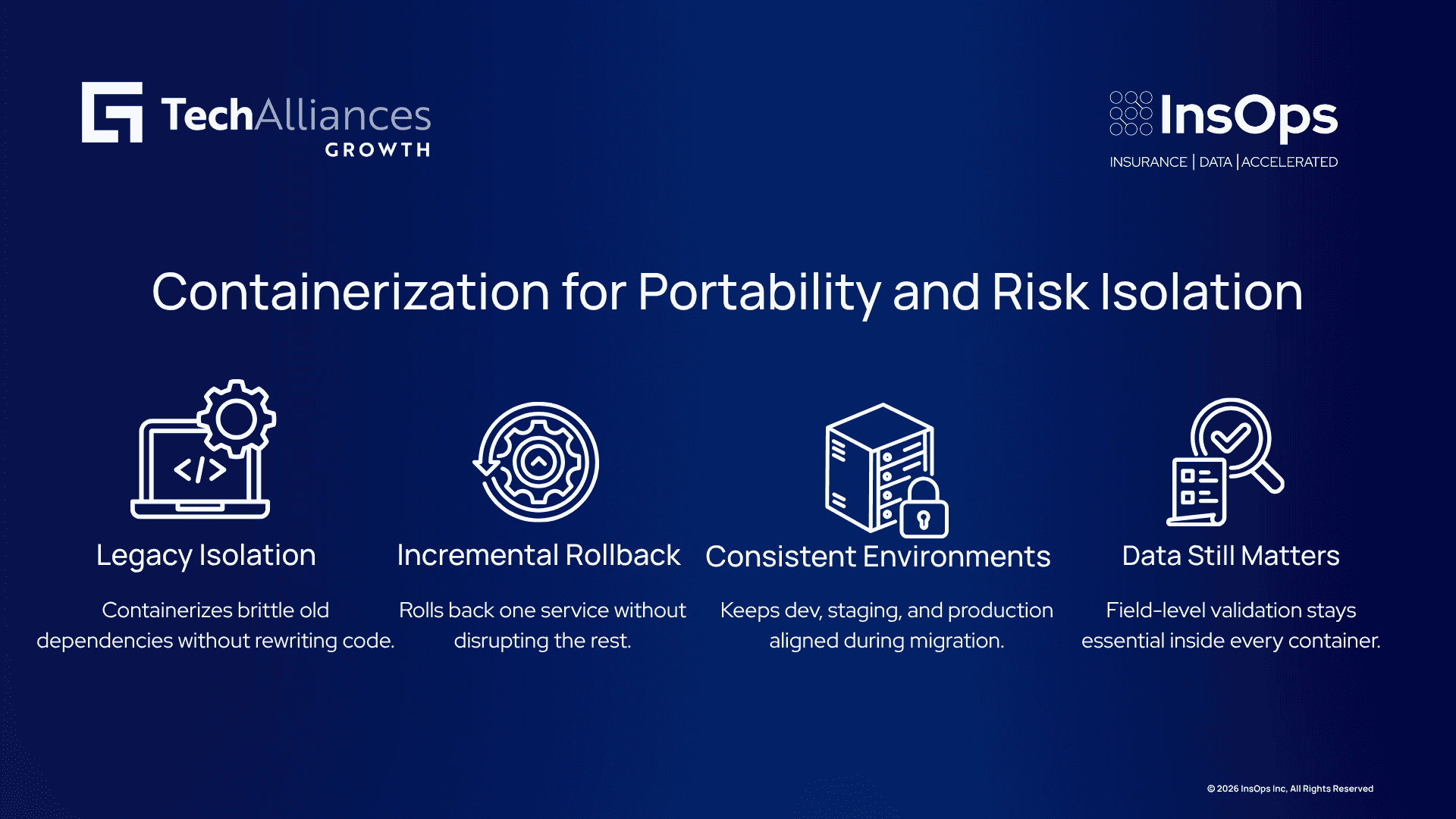
Isolation of legacy dependencies. Older applications with brittle dependencies can be containerized without rewriting the underlying code, reducing the risk of a lift-and-shift that breaks in a new environment.
Incremental rollback capability. If a containerized service misbehaves post-migration, it can be rolled back to a previous version without affecting other services, rather than triggering a full environment rollback.
Consistent environments across the migration timeline. Development, staging, and production stay aligned, which matters when migration phases run over many months and multiple teams are touching the same systems.
Containerization does not eliminate the need to understand what is inside each container. Data mapping and field-level validation still matter, particularly for claims and underwriting data where a misinterpreted field can propagate errors downstream.
Phase 3: Automated Deployment Pipelines to Minimize Cutover Risk
Manual cutovers are where most migration risk concentrates. A deployment pipeline that automates testing, validation, and rollback turns a high-stakes weekend cutover into a repeatable, lower-risk process.
For a phased migration, automated pipelines should include:
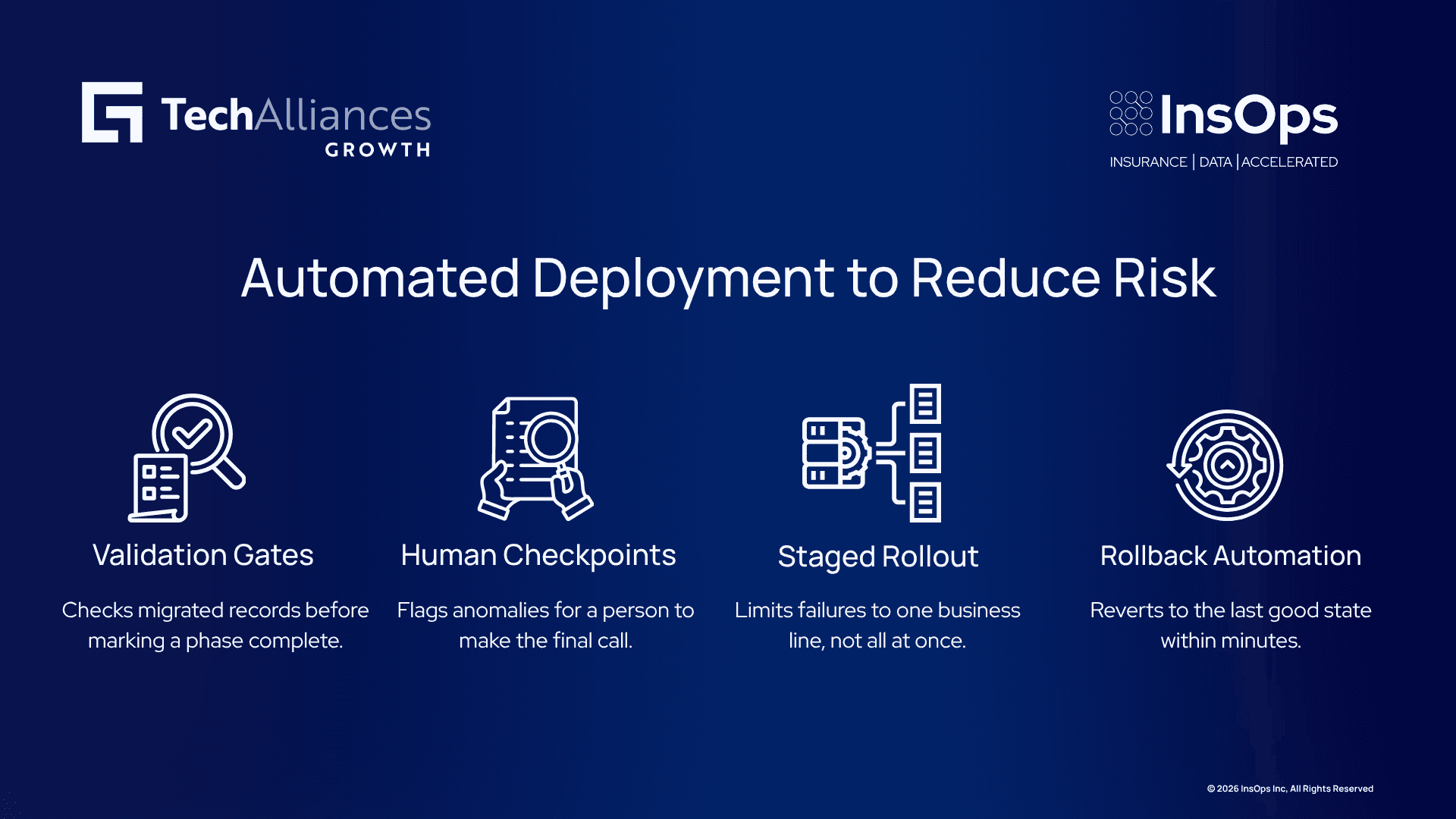
Automated data validation gates that check migrated records against source data before a phase is marked complete, rather than discovering discrepancies weeks later in production.
Human-in-the-loop checkpoints at points where automated validation flags anomalies, so a person makes the final call on ambiguous mappings rather than the pipeline proceeding on its own.
Staged rollout by business line or region, so a single pipeline failure affects one segment of business rather than all policyholders at once.
Rollback automation that can revert a deployment to the last known-good state without manual intervention, cutting recovery time from hours to minutes.
The goal of automation here is not to remove people from the process. It is to remove repetitive manual steps that introduce human error, while keeping a person in the loop for decisions that require judgment, particularly around data quality and mapping ambiguity.
Phase 4: Stabilization and Continuous Optimization
Migration does not end at cutover. The final phase is where carriers validate that the new environment performs as expected under real operational load, and where technical debt from the migration itself gets addressed.
This phase typically includes:
Performance tuning based on actual production traffic patterns, not migration-time assumptions
Cost optimization, since cloud spend often looks different in practice than in the initial business case
Decommissioning legacy infrastructure only after a defined stabilization period, not immediately at cutover
Documentation and knowledge transfer so the migrated environment is maintainable by the broader team, not just the migration project team
How InsOps Helps
Data migration is consistently one of the highest-risk components of any core system transformation. Industry data shows that a large share of modernization delays trace back to failed or delayed data migrations, not application logic. InsOps addresses this specific risk point.
LiLa, our insurance-trained AI model, understands insurance domain logic, field semantics, and data interdependencies that generic tools miss. Unlike generic AI models, LiLa was refined on more than 10,000 hours of insurance-specific data patterns, giving it the context to recognize how policy, claims, and billing data actually relate to one another.
For carriers migrating legacy data into Guidewire PolicyCenter, ClaimCenter, or BillingCenter, InsOps supports both models covered in this article:
One-time legacy data migration, where historical data moves from a legacy core system like AS/400 into a modern Guidewire environment. InsOps has supported migrations moving 40+ years of claims history in months rather than years, with human-in-the-loop validation at every mapping decision.
Real-time data flows through Integration Gateway, with pre-built connectors for Guidewire PolicyCenter, ClaimCenter, BillingCenter, UnderwritingCenter, and PricingCenter. LiLa auto-maps incoming payloads, with human review before data lands in the target system, supporting the hybrid architecture model many carriers run during and after migration.
Critically, LiLa runs inside the insurer's own environment. PII and PHI never leave controlled infrastructure, which matters directly for the phased, hybrid approach described above: carriers can validate data mapping and quality without introducing a new data exposure risk during transition.
Every mapping LiLa proposes goes through human review before it's finalized. LiLa assists migration and integration teams; it does not make autonomous decisions on data placement or transformation.
FAQ
How long does a phased cloud migration typically take for a P&C insurer?
Timelines vary by scope and legacy system complexity, but a full core system migration, including assessment, containerization, pipeline build-out, and stabilization, commonly runs six months to two years. Migrations with well-defined data mapping upfront tend to move faster.
Is hybrid architecture a permanent state or a transition phase?
It can be either. Some carriers use hybrid as a deliberate long-term model due to data residency or regulatory requirements. Others treat it as a transition step toward full cloud adoption. The right answer depends on your compliance obligations and workload characteristics, not a one-size-fits-all cloud strategy.
What is the biggest risk in a legacy-to-cloud data migration?
Data quality and field-level mapping errors, not infrastructure. Insurance data carries decades of inconsistent formats, undocumented field logic, and interdependencies that generic migration tools do not account for. This is why validation gates and human review checkpoints matter more than raw migration speed.
Do containerized applications still need data governance during migration?
Yes. Containerization solves portability and environment consistency; it does not solve data quality or field semantics. Those require separate validation, ideally handled by tools trained specifically on insurance data structures.
Can automated deployment pipelines fully replace manual oversight in a core system migration?
No, and they should not attempt to. Automation should handle repetitive validation and deployment steps to reduce human error, while flagged anomalies and ambiguous data mappings should still route to a person for a final decision. Full autonomy in core system migrations, particularly around claims and policy data, introduces risk that outweighs the efficiency gain.