

As P&C carriers move core systems, data pipelines, and modernization workloads to the cloud, the security model has to shift with them. Perimeter-based controls built for on-premises infrastructure don't translate directly to cloud environments, where misconfiguration, not external penetration, is the most common cause of exposure.
For CISOs, cloud security in insurance isn't a single control to deploy. It requires visibility into configuration posture across every cloud environment in use, identity-first access controls that don't assume network location implies trust, and continuous compliance monitoring that keeps pace with how quickly cloud environments change.
Why Cloud Misconfiguration Is a Distinct Risk Category
Cloud environments introduce a specific failure mode that on-premises infrastructure doesn't share in the same way:
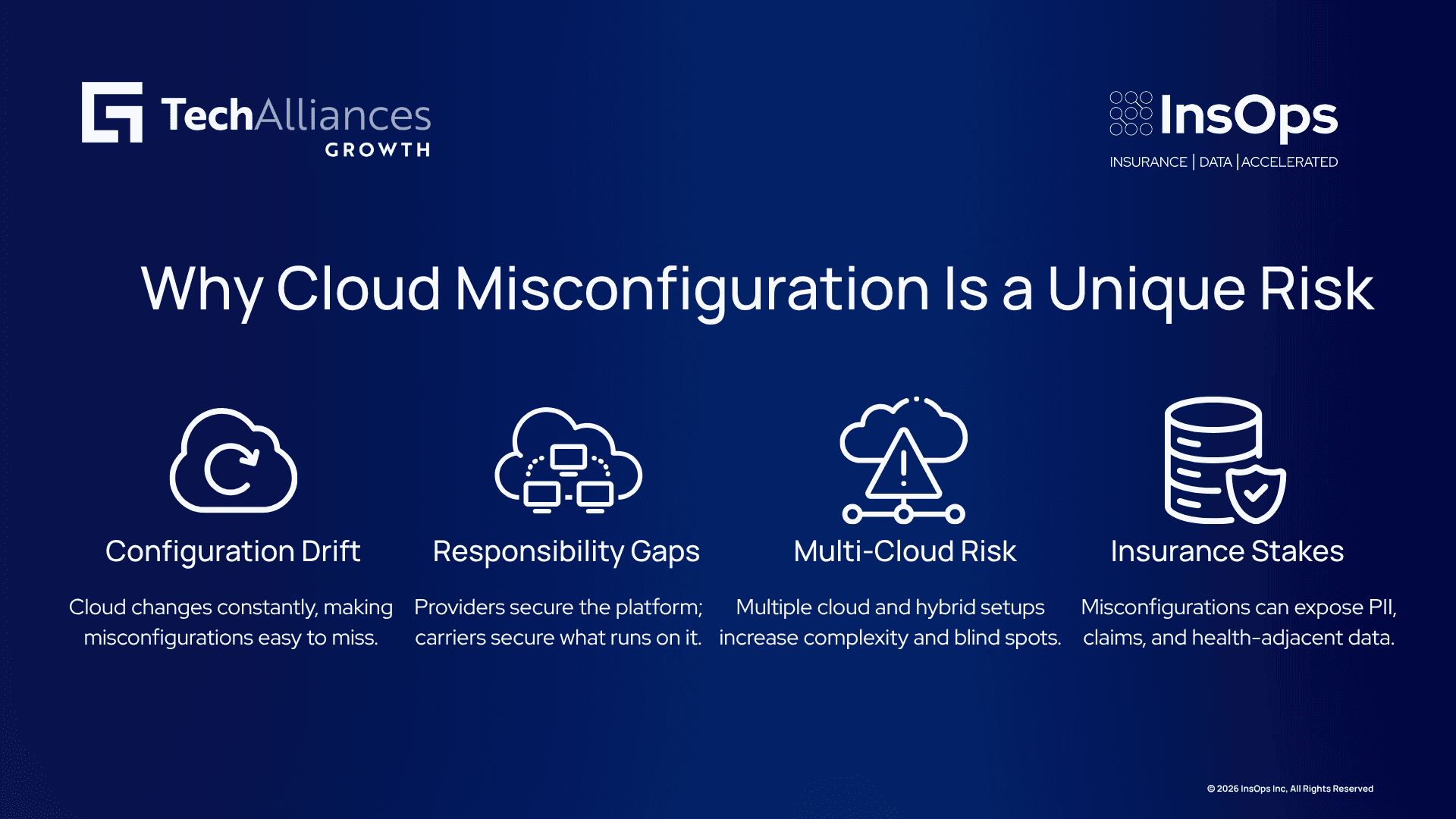
Configuration drift happens constantly. Cloud resources are created, modified, and decommissioned far more frequently than on-premises infrastructure, and each change is a chance for a misconfiguration, an overly permissive storage bucket, an exposed API endpoint, to go unnoticed.
Shared responsibility creates gaps. Cloud providers secure the infrastructure; the carrier is responsible for securing what runs on it. Confusion or gaps in understanding where that responsibility line sits is a common source of unmanaged risk.
Multi-cloud and hybrid environments multiply complexity. Carriers running workloads across multiple cloud providers, or hybrid cloud and on-premises environments, face inconsistent security tooling and visibility unless a unified posture management approach is in place.
Insurance data sensitivity raises the stakes of any misconfiguration. A misconfigured storage bucket or database in a generic industry might expose low-sensitivity data. In insurance, the same misconfiguration can expose policyholder PII, claims data, or health-adjacent information tied to bodily injury claims.
Why Identity Has Replaced the Network Perimeter
In cloud environments, the traditional network perimeter effectively doesn't exist in the same way it did for on-premises infrastructure. Resources are accessed from anywhere, by users, services, and automated processes, making network location a poor basis for trust decisions.
Identity-first security addresses this by making every access decision based on verified identity, device posture, and context, rather than assuming access from within a given network range is inherently trustworthy. This applies not just to human users but to service accounts and machine identities, which in cloud environments often outnumber human accounts and carry broad permissions that go under-reviewed.
What Comprehensive Cloud Security Requires
Four practices need to work together to manage cloud security risk effectively in a P&C insurance environment:
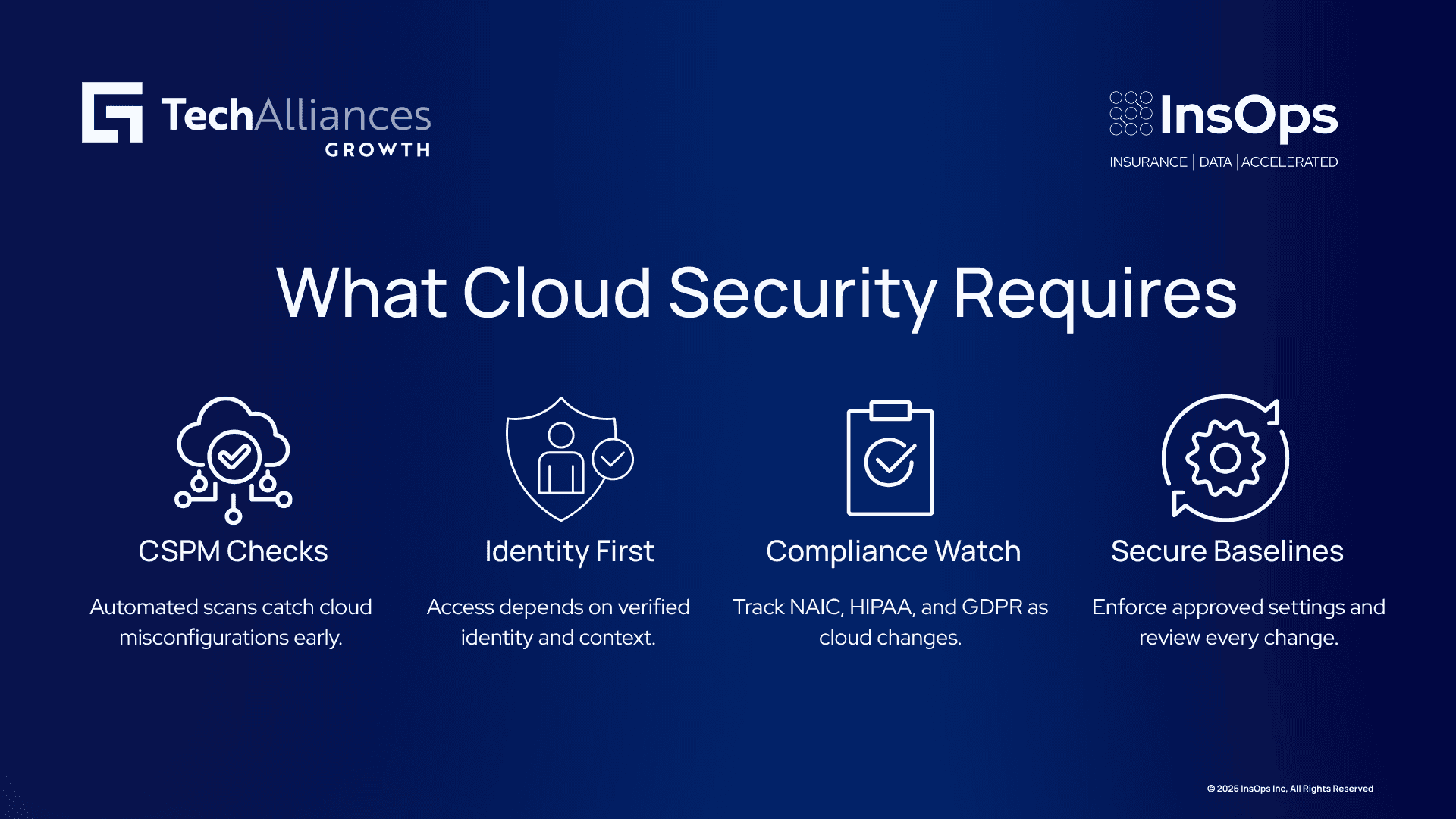
Cloud Security Posture Management (CSPM). Continuous, automated assessment of cloud configurations against security best practices and compliance requirements, catching misconfigurations before they become exploitable gaps rather than after an incident.
Identity-first security. Access decisions based on verified identity and context for both human and machine identities, replacing network-location-based trust assumptions that don't hold in cloud environments.
Continuous compliance monitoring. Ongoing verification that cloud configurations meet regulatory requirements, NAIC, HIPAA where applicable, and GDPR for carriers with international exposure, rather than periodic point-in-time audits that miss drift between review cycles.
Secure cloud configuration management. Defined, enforced baseline configurations for cloud resources, with changes tracked and reviewed, reducing the chance that a one-off manual change introduces an unreviewed security gap.
Why Modernization Projects Are a Critical Moment for Cloud Security
Legacy modernization and data migration initiatives are often exactly when carriers move significant workloads and sensitive data into the cloud for the first time, or expand existing cloud footprint substantially. This makes these projects a critical point for cloud security posture, not an afterthought to address once the migration is complete.
Data migrated into a cloud-based core system, or flowing through cloud-based integration and transformation processes, needs the same identity-first access controls, configuration management, and compliance monitoring as any other cloud workload, ideally designed in from the start rather than retrofitted after the migration is already live.
How InsOps Helps
InsOps supports cloud security specifically around the migration and integration workloads that move sensitive insurance data into and through cloud environments.
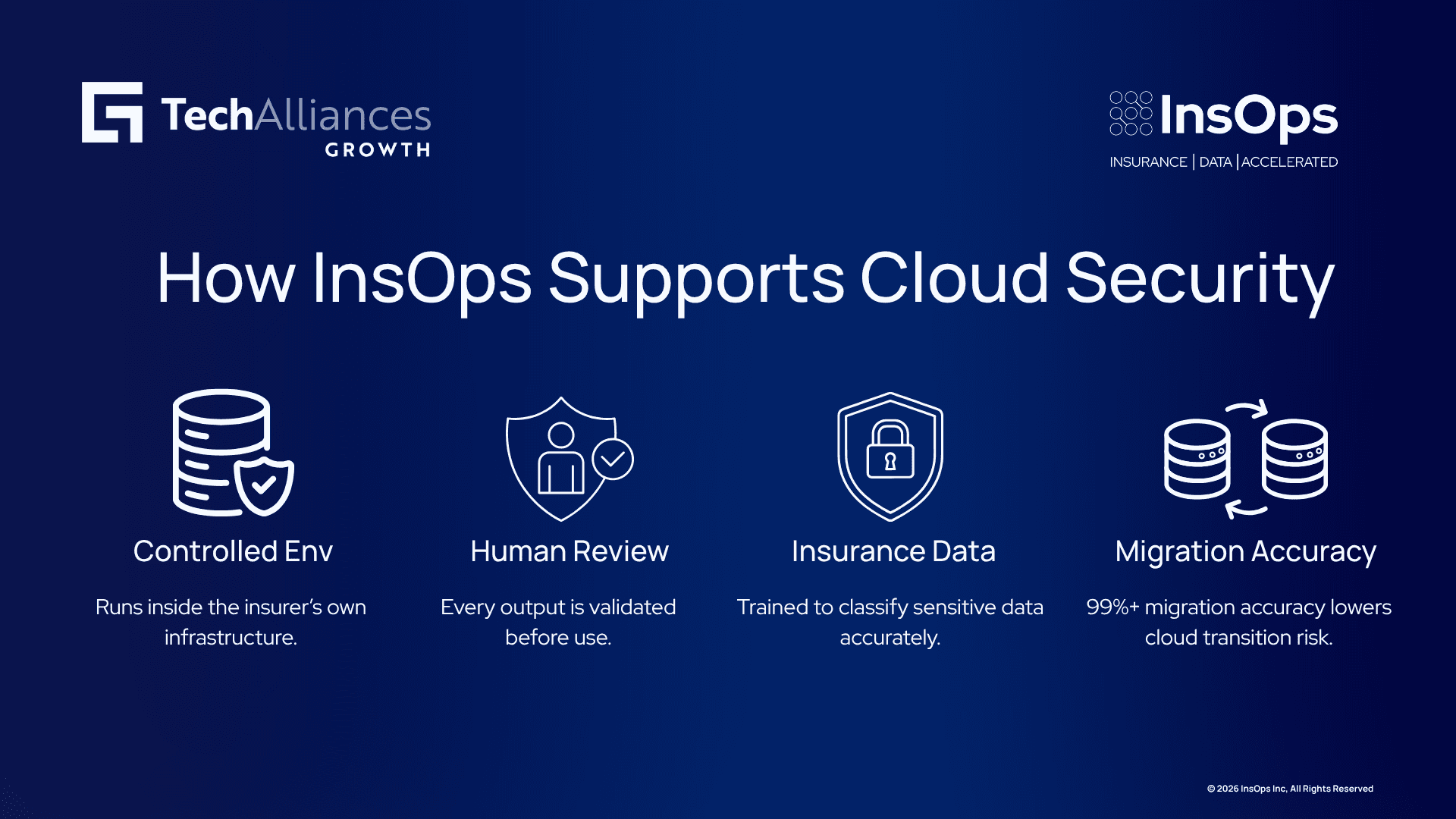
Operates inside your controlled environment. InsOps runs inside the insurer's own infrastructure, meaning sensitive data involved in migration and integration work doesn't require standing up a separate, additional cloud environment with its own configuration and access management burden.
Human-in-the-loop validation reduces unreviewed automated action. InsOps never processes or transforms data autonomously. Every output is validated by human review, which matters in cloud environments where machine identities and automated processes often carry broad, under-reviewed permissions.
Insurance-trained data handling supports accurate classification. Understanding which data is sensitive, and where it resides after migration into a cloud-based core system, depends on accurate classification. Our AI model is trained specifically on insurance data structures, supporting more accurate identification of sensitive data as it moves into cloud environments.
Proven migration accuracy reduces downstream configuration risk. InsOps's migration of 40+ years of AS/400 claims data into Guidewire ClaimCenter Cloud achieved 99%+ accuracy, reducing the risk of sensitive data being incompletely migrated, duplicated, or left in an improperly configured intermediate state during a cloud transition.
For CISOs, InsOps's relevance to cloud security is focused: it's the layer that handles data as it moves into and through cloud-based core systems during migration and integration, and it does so without requiring sensitive data to leave the insurer's controlled infrastructure. CSPM, identity-first access controls, and continuous compliance monitoring remain necessary as standalone practices across the broader cloud environment.
FAQ
Why is cloud misconfiguration considered a bigger risk than external attacks for many cloud environments? Because cloud resources change frequently, and each change is an opportunity for a misconfiguration, like an overly permissive storage setting, to go unnoticed. Configuration drift happening at scale and speed makes it a more persistent and common source of exposure than externally initiated attacks in many cloud security incidents.
What does "identity-first security" mean in a cloud context? It means access decisions are based on verified identity and context, for both human users and machine or service identities, rather than assuming trust based on network location. This matters especially in cloud environments where the traditional network perimeter doesn't apply the same way it did on-premises.
How is CSPM different from traditional vulnerability scanning? CSPM focuses specifically on cloud configuration, checking settings like access permissions, storage configurations, and network rules against security best practices and compliance requirements, continuously, rather than scanning for known vulnerabilities in software or systems.
Why do machine identities and service accounts matter as much as human user accounts in cloud security? In cloud environments, automated processes and service accounts often outnumber human accounts and can carry broad permissions that go under-reviewed. Identity-first security needs to apply the same verification and access principles to these machine identities as it does to human users.
Why are legacy modernization projects a particularly important moment for cloud security? Because they often involve moving significant volumes of sensitive data into the cloud for the first time, or substantially expanding existing cloud footprint. Building identity-first access controls, configuration management, and compliance monitoring in from the start of these projects is more effective than retrofitting them after the migration is complete.
Does InsOps provide CSPM or cloud configuration management? No. InsOps focuses on legacy data migration and integration for P&C insurers, operating inside the insurer's own controlled environment with human-reviewed processing. Dedicated CSPM, identity-first access management, and continuous compliance monitoring tools remain necessary for securing the broader cloud environment.