

A P&C carrier's security posture is only as strong as its weakest connected partner. MGAs, TPAs, brokers, data vendors, InsurTech tools, every one of these relationships involves some level of data exchange or system access, and every one of them extends the carrier's actual attack surface well beyond what internal security controls can directly govern.
For CISOs, third-party risk has moved from a periodic vendor questionnaire exercise to an ongoing operational requirement. Continuous vendor security assessment, standardized risk scoring, enforced security standards, and active monitoring of partner integrations aren't administrative overhead anymore. They're the difference between knowing your actual risk exposure and discovering it after an incident.
Why Third-Party Risk Has Escalated in Insurance
Several factors specific to P&C insurance make supply chain risk harder to manage than a generic vendor security checklist assumes:
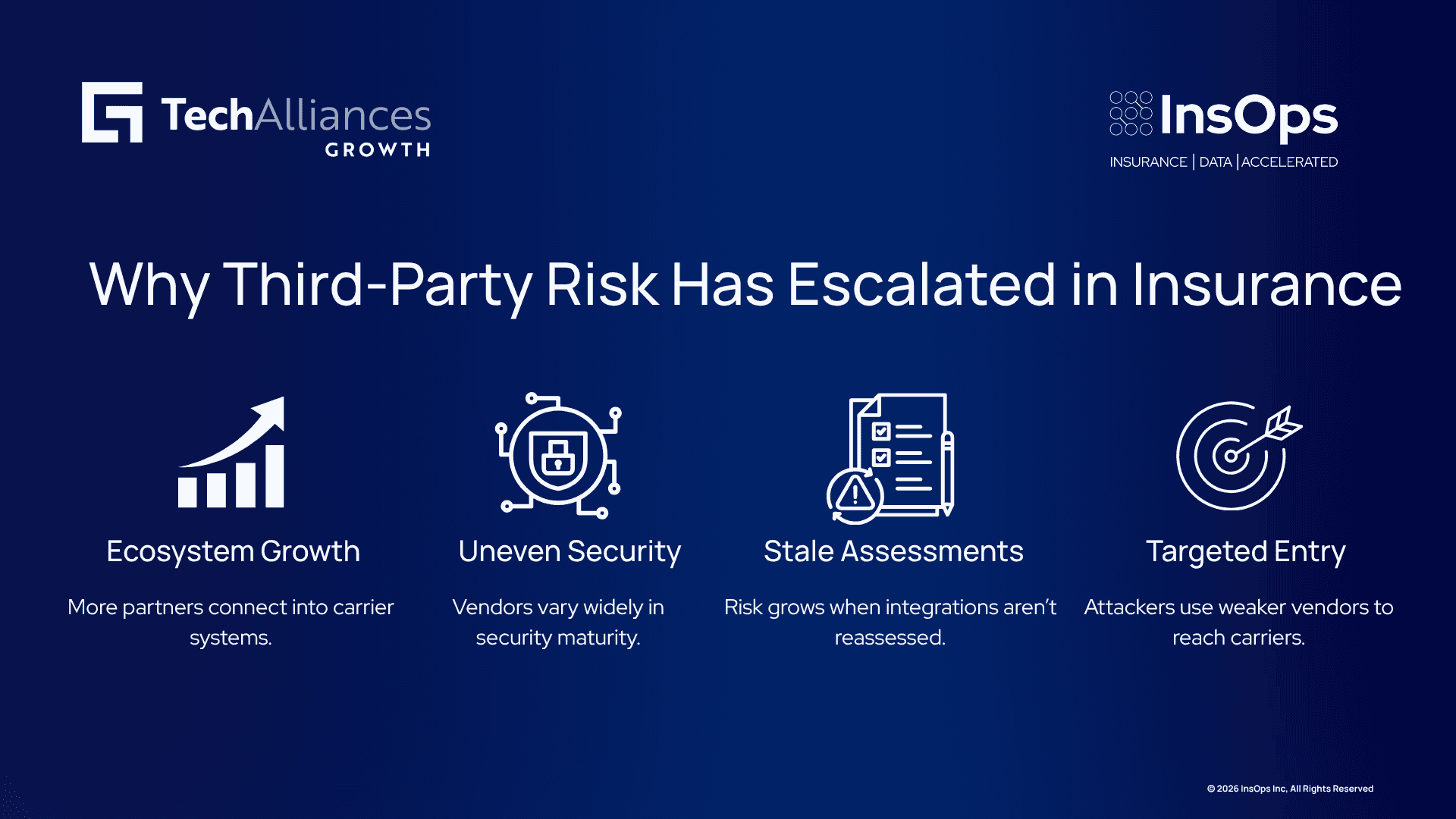
The partner ecosystem keeps growing. MGAs, brokers, TPAs, surplus lines operators, and a growing number of InsurTech point solutions all connect into carrier systems, each one a new potential vector into sensitive data.
Vendor security postures vary widely. A large, established data vendor and a small InsurTech startup rarely have comparable security maturity, yet both may end up with meaningful access to policy or claims data.
Integration points often outlive their original risk assessment. A partner connection assessed as low-risk at onboarding can become significantly riskier over time as the scope of data exchanged grows, without a corresponding reassessment.
Point-to-point integrations are hard to monitor consistently. When each partner connection is custom-built, there's no standardized way to monitor activity across all of them, making it difficult to spot anomalous behavior at any single connection point.
Attackers increasingly target the supply chain directly. Rather than attacking a well-defended carrier head-on, attackers target a smaller, less-secured vendor with legitimate access into the carrier's systems, using that relationship as the entry point.
Why Point-in-Time Vendor Assessment Isn't Enough
Traditional third-party risk management often relies on a security questionnaire and a point-in-time review at onboarding. That approach has a structural weakness: vendor security posture, and the scope of data a partner actually accesses, both change over time, while the original assessment doesn't.
A partner that started with limited, low-sensitivity data access can expand into handling more sensitive claims or policy data as the relationship grows, without triggering a fresh risk assessment. A vendor's own security posture can degrade after a leadership change, an acquisition, or simply through inconsistent maintenance, none of which shows up in a one-time questionnaire completed years earlier.
Continuous assessment closes this gap by treating vendor risk as something that needs ongoing visibility, not a single approval gate at the start of the relationship.
What Effective Third-Party Risk Management Requires
Four practices need to work together to manage supply chain risk effectively:
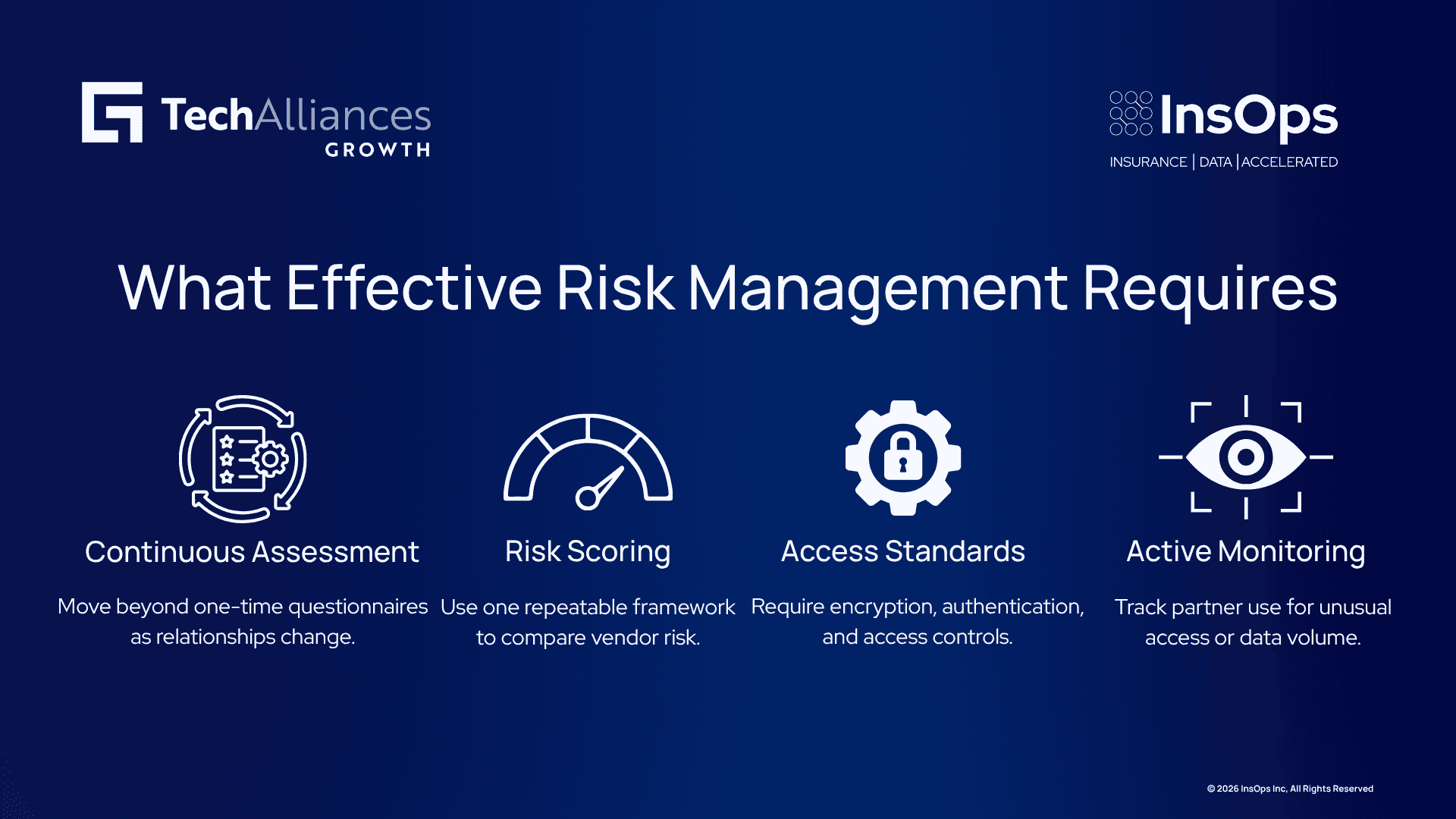
Continuous vendor security assessment. Moving beyond a one-time questionnaire to ongoing evaluation of vendor security posture, particularly as the scope of a partner relationship changes over time.
Standardized third-party risk scoring. A consistent framework for evaluating and comparing vendor risk, so decisions about access and data sharing are based on a repeatable standard rather than ad hoc judgment calls that vary by team or reviewer.
Enforced security standards for partner access. Clear, mandatory security requirements, encryption, authentication practices, access controls, that vendors must meet to maintain integration access, not just guidelines that are recommended but not verified.
Active monitoring of partner integrations. Ongoing visibility into how each partner connection is actually being used, flagging unusual access patterns or data volumes that might indicate a compromised vendor or credential.
The goal isn't to eliminate third-party relationships, they're essential to how modern insurance distribution and operations function. It's to make sure the risk each relationship carries is visible, current, and actively managed rather than assessed once and assumed to hold indefinitely.
Why Integration Architecture Is Part of the Risk Picture
How partner integrations are built directly affects how manageable third-party risk actually is. A carrier with dozens of custom, point-to-point integrations built by different teams over different years has no consistent way to monitor them all, or even a complete inventory of what access each one grants. A carrier with a standardized integration approach has a single, governed layer where partner access, monitoring, and security enforcement can be applied consistently.
This means the integration architecture decisions covered elsewhere in a modernization roadmap, moving away from point-to-point connections toward standardized, API-first integration, aren't just an efficiency improvement. They're a direct contributor to how effectively third-party risk can be monitored and controlled.
How InsOps Helps
InsOps supports third-party and supply chain risk management by replacing the kind of ad hoc, hard-to-monitor integration points that often create blind spots in vendor risk oversight.
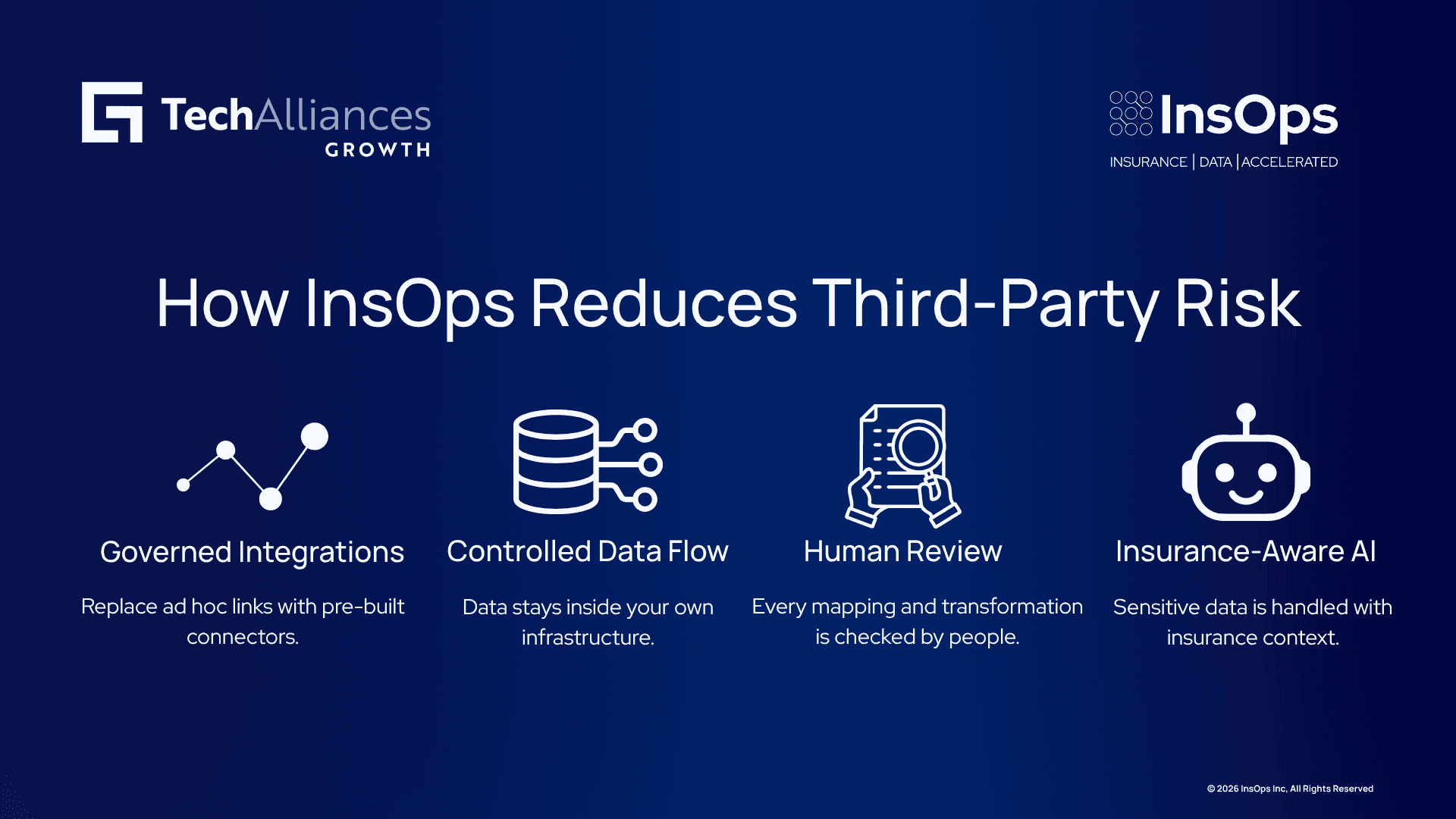
Standardized integration over custom point-to-point connections. Integration Gateway provides pre-built connectors for Guidewire PolicyCenter, ClaimCenter, BillingCenter, UnderwritingCenter, and PricingCenter, giving carriers a consistent, governed integration layer rather than a patchwork of custom connections built differently by different teams over time.
Data stays inside your controlled environment. InsOps operates inside the insurer's own infrastructure. Data involved in partner integrations is mapped and transformed without being sent to an external environment, reducing one variable in the vendor risk equation for the integration work itself.
Human-in-the-loop oversight. InsOps never processes integration data autonomously. Every mapping and transformation output is validated by human review, providing a consistent oversight checkpoint for data moving through partner-facing integration pathways.
Insurance-trained data handling. Our AI model understands insurance-specific data sensitivity and structure, supporting more accurate classification and handling of sensitive data as it moves through partner integration points.
For CISOs, InsOps's role in third-party risk management is specific: it strengthens the integration layer connecting core systems to partners and vendors, making that layer more consistent and governable, which supports, but doesn't replace, a broader vendor security assessment and monitoring program.
FAQ
Why is third-party risk considered a growing concern for P&C insurers specifically? The partner ecosystem, MGAs, brokers, TPAs, data vendors, and InsurTech tools, keeps expanding, and each connection represents a potential path into sensitive policy and claims data. Vendor security maturity varies widely, and attackers increasingly target smaller, less-secured partners as an entry point into larger organizations.
Why isn't a one-time vendor security questionnaire sufficient? Because both a vendor's security posture and the scope of data they access can change significantly over time, while a point-in-time assessment doesn't. A partner relationship can expand into more sensitive data access, or a vendor's security practices can degrade, without triggering a new review under a one-time assessment model.
What does "continuous" third-party risk assessment actually involve in practice? It means evaluating vendor security posture and access scope on an ongoing basis rather than only at onboarding, incorporating changes in the relationship, new access requests, and periodic reassessment rather than relying solely on the original approval.
How does integration architecture affect third-party risk management? Custom, point-to-point integrations built individually for each partner are difficult to monitor consistently and often lack a complete inventory of what access each connection grants. Standardized integration architecture provides a single, governed layer where monitoring and security enforcement can be applied consistently across all partner connections.
Does InsOps assess vendor security or perform third-party risk scoring? No. InsOps focuses on the integration layer itself, providing standardized, pre-built connectors for Guidewire-based systems rather than vendor risk assessment or scoring. Dedicated third-party risk management tools and processes are still necessary for evaluating vendor security posture directly.
How does reducing point-to-point integrations help with supply chain risk specifically? It reduces the number of inconsistently built, individually monitored connections in the environment, replacing them with a standardized integration layer where security practices and monitoring can be applied uniformly, making it easier to maintain visibility across all partner connections rather than managing each one as a unique case.