

Every P&C carrier's technology ecosystem keeps growing. MGAs, brokers, TPAs, surplus lines operators, data providers, InsurTech vendors, each new partner or capability typically means another connection into core systems. Handled the old way, one custom integration at a time, this doesn't scale. It just adds another fragile connection that someone has to maintain indefinitely.
For CTOs, the fix isn't building integrations faster. It's changing the model entirely: standardized API gateways, reusable integration platforms, and secure onboarding processes that make each new partner connection incremental instead of a full custom build.
Why Point-to-Point Integration Breaks Down at Scale
Most carriers didn't choose point-to-point integration as a strategy. It's what accumulates when every partner connection gets solved individually, over years, by different teams, under different deadlines. The result has predictable problems:
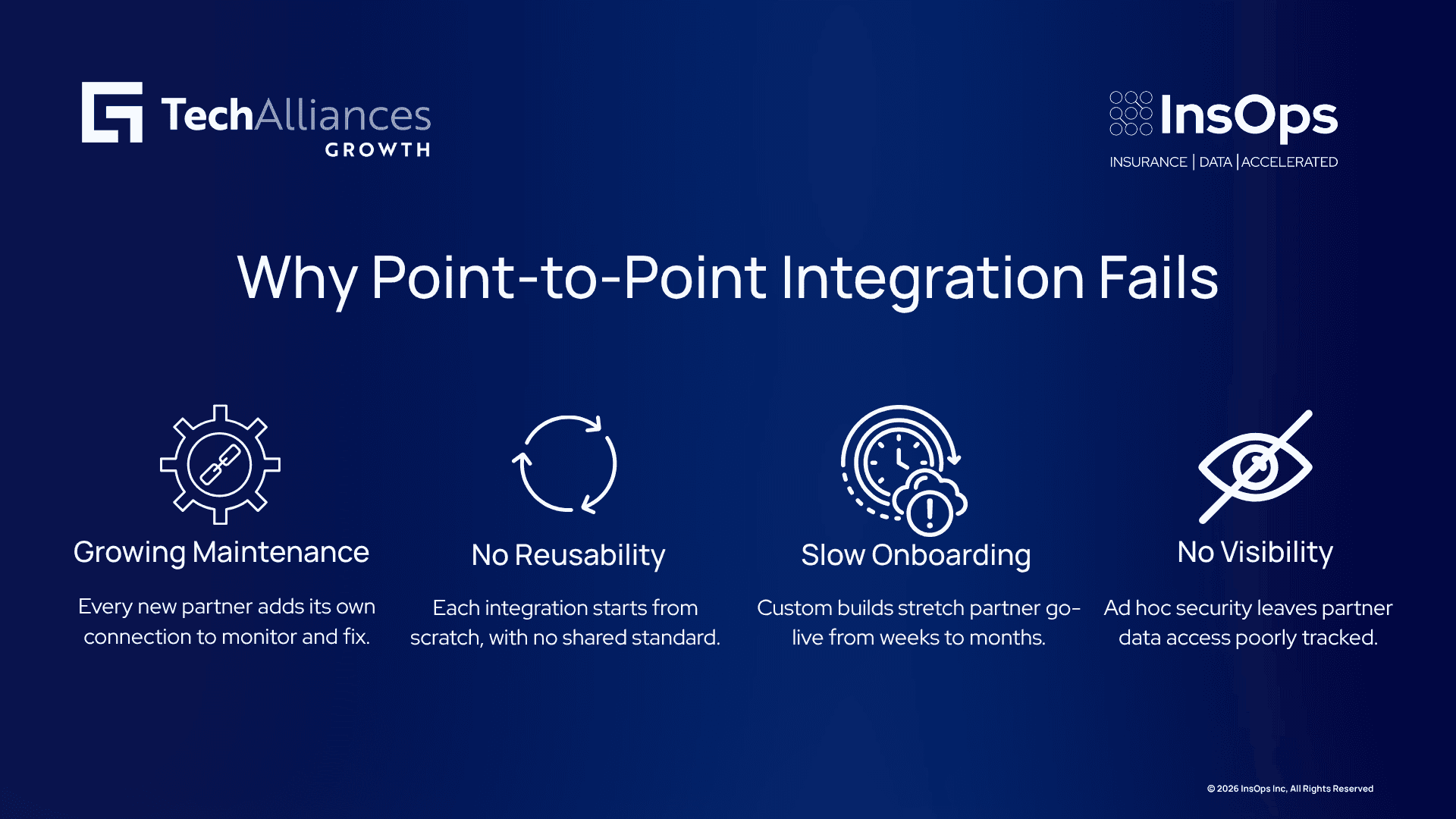
Maintenance grows linearly with every new partner. Each point-to-point connection is its own thing to monitor, patch, and fix when something upstream changes. Ten partners means ten separate integration burdens, not one shared one.
No standardization means no reuse. A connection built for one MGA doesn't help when the next MGA needs to connect. Every integration effectively starts from zero.
Partner onboarding takes too long. When each new connection requires custom development, the time between signing a partner and going live stretches from weeks to months, directly affecting distribution growth.
Security review happens ad hoc. Without a standardized onboarding process, secure connectivity practices vary by whoever built the last integration, rather than being enforced consistently across every partner.
Nobody has full visibility into the ecosystem. With integrations scattered across point-to-point connections, it becomes difficult to answer a basic question: which partners have access to what data, and how is that access secured?
What a Standardized Integration Model Looks Like
Moving away from point-to-point integration means building infrastructure that treats partner connectivity as a repeatable capability, not a one-off project every time:
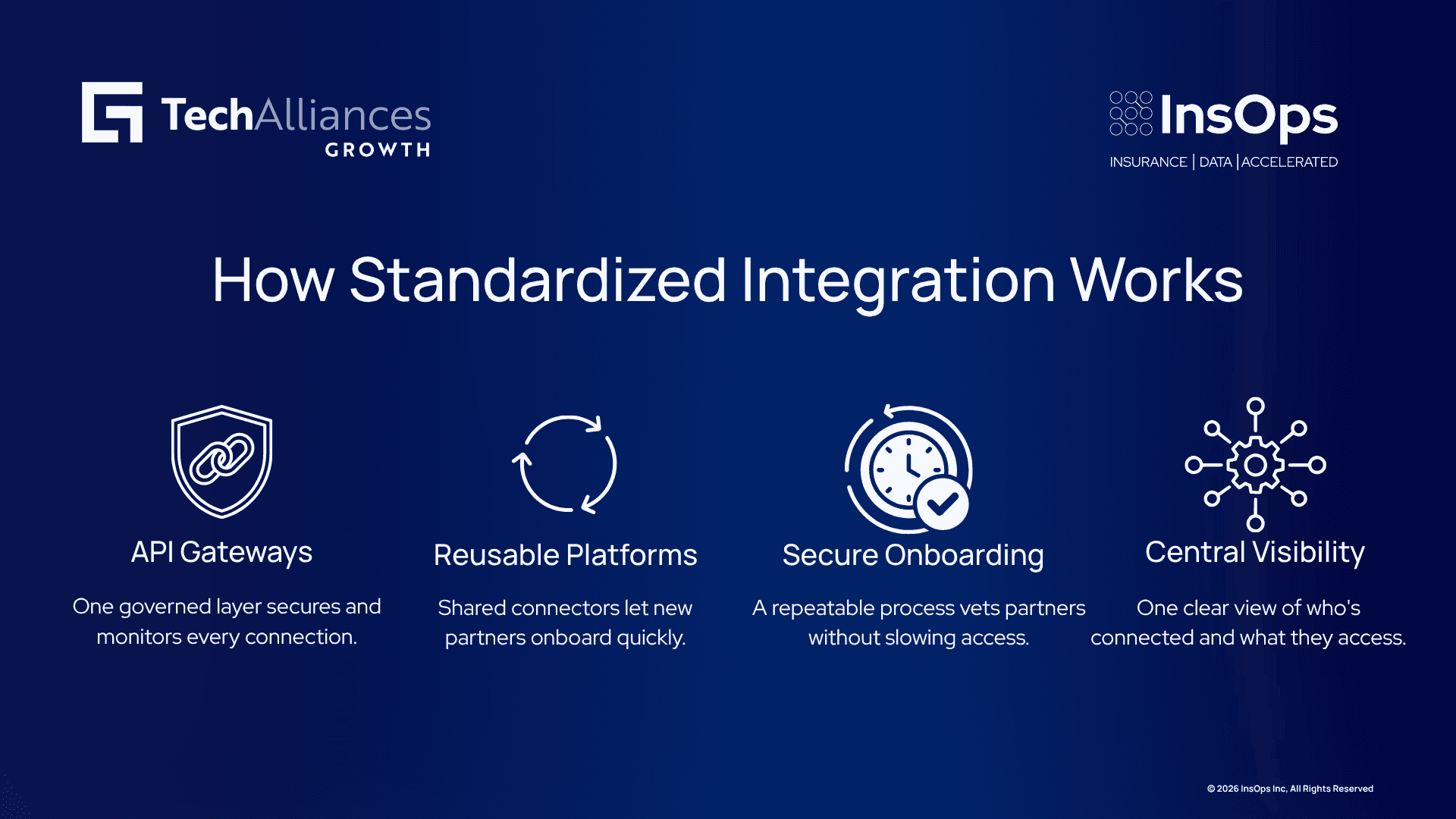
API gateways as the standard entry point. A single, governed layer where partner and vendor connections are established, monitored, and secured consistently, rather than each connection having its own bespoke access path.
Reusable integration platforms. Common connectors and data mapping logic that new partners can be onboarded onto quickly, instead of requiring custom-built integration work for each one.
Secure onboarding processes. A defined, repeatable path for validating a new partner's security posture and provisioning access, so onboarding speed doesn't come at the cost of consistent security review.
Centralized visibility. A clear, current picture of which partners are connected, what data they access, and how that access is secured, replacing the fragmented knowledge that comes with scattered point-to-point connections.
Done well, this doesn't just reduce maintenance burden. It changes onboarding a new partner from a development project into a configuration exercise.
Why This Matters More as Distribution Gets More Complex
Distribution channels in P&C insurance keep diversifying. MGAs, brokers, TPAs, and surplus lines operators all expect faster, more reliable data exchange than a manual file transfer or a custom-built connection can offer. Carriers that can onboard a new distribution partner in weeks instead of months have a real competitive advantage in a market where speed to market often determines which carrier gets the business.
At the same time, every new partner connection is a potential point of security exposure. A standardized, secure onboarding process isn't just an efficiency gain, it's risk management for an ecosystem that's only going to keep expanding.
How InsOps Helps
InsOps addresses the specific problem underneath vendor and ecosystem integration: connecting core insurance systems to the outside world without building custom integration logic for every partner.
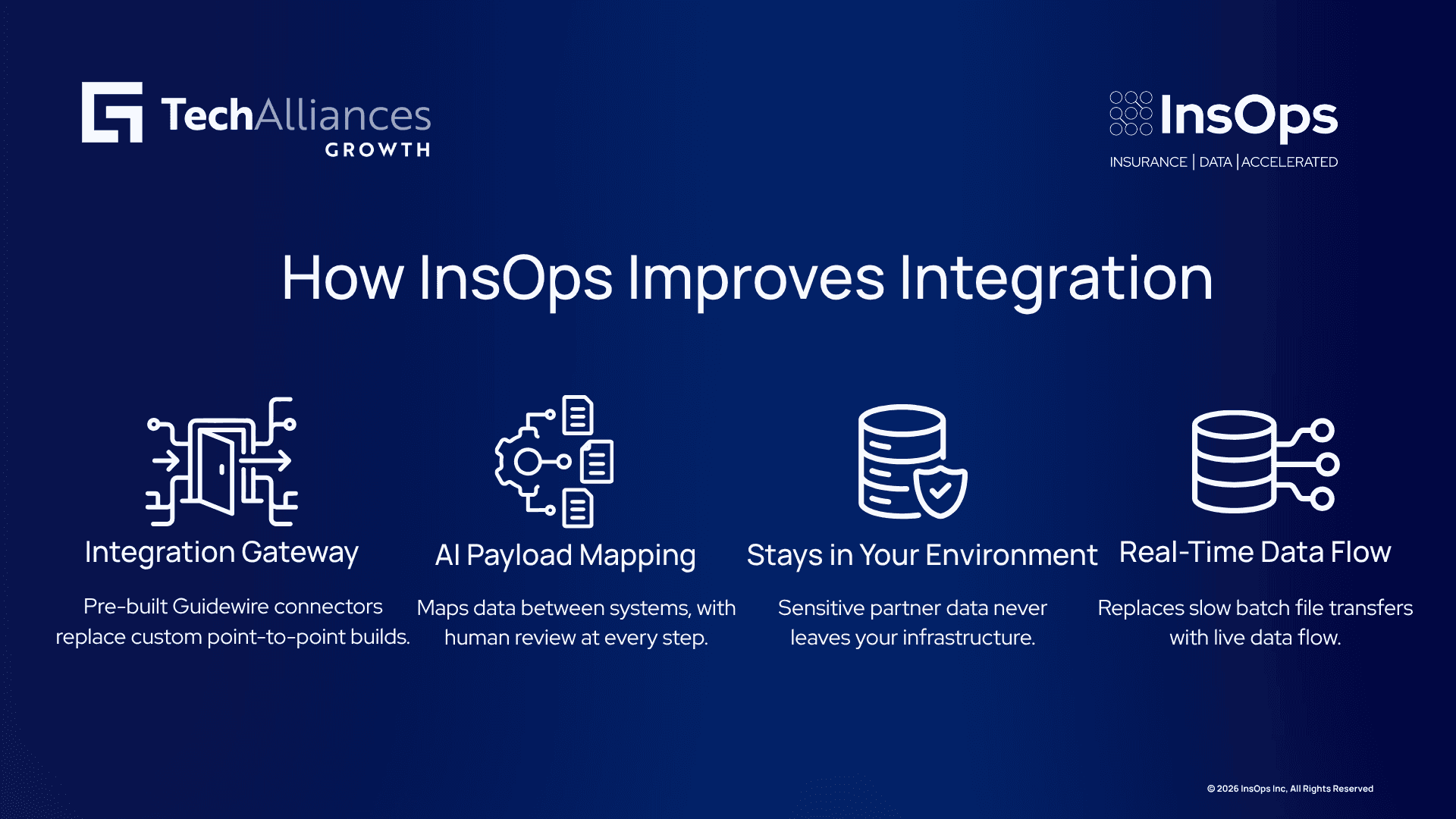
Integration Gateway, not point-to-point connections. InsOps provides pre-built connectors for Guidewire PolicyCenter, ClaimCenter, BillingCenter, UnderwritingCenter, and PricingCenter. Rather than a new custom build for each partner or data source, these connectors provide a standardized foundation that new integrations can build on.
AI-powered payload mapping. Our insurance-trained AI model automatically maps data payloads between systems, with human review at every step, reducing the manual mapping work that typically slows partner onboarding down.
Runs inside your controlled environment. InsOps operates inside the insurer's own infrastructure, meaning sensitive data involved in partner data exchange never has to leave your environment to be mapped or transformed, a meaningful factor in secure partner onboarding.
Real-time data flow, not batch file exchange. InsOps establishes real-time data flows into Guidewire with AI-powered mapping and transformation, replacing the manual file transfers that slow down and complicate ecosystem connectivity.
Human-in-the-loop by design. InsOps never operates autonomously. Every data mapping and integration output is validated by human review, which matters when onboarding new partners into systems that carry regulatory and security requirements.
For CTOs trying to reduce the maintenance burden of a growing partner ecosystem, InsOps removes the need to build integration logic from scratch for every new connection to a Guidewire-based core system.
FAQ
What's the difference between point-to-point integration and an API gateway model? Point-to-point integration means each partner or system connection is built individually, with its own custom logic and maintenance requirements. An API gateway model provides a single, standardized entry point for connections, so new partners can be onboarded using shared infrastructure rather than starting from scratch each time.
Why does point-to-point integration become unsustainable as a carrier grows its partner ecosystem? Because maintenance burden grows linearly with every new connection. Each point-to-point integration is monitored, patched, and fixed independently, so ten partner connections require ten times the ongoing maintenance work of a shared, standardized approach.
How does standardized integration affect partner onboarding timelines? It significantly shortens them. When new partners can connect through existing, reusable infrastructure rather than requiring custom-built integration work, onboarding shifts from a development project measured in months to a configuration process measured in weeks.
Does a standardized integration model improve security, or just efficiency? Both. A defined, repeatable onboarding process ensures every partner connection goes through consistent security review, rather than security practices varying based on whoever built a given point-to-point connection in the past.
Is API gateway adoption only relevant for carriers with many distribution partners? It's most immediately valuable for carriers with a growing or complex partner ecosystem, but the underlying benefit, reduced maintenance burden and faster onboarding, applies to any carrier expecting their partner or vendor relationships to grow over time.
Does InsOps replace the need for an API gateway strategy entirely? InsOps focuses specifically on integration with Guidewire-based core systems through pre-built connectors and AI-assisted mapping. It supports a broader API gateway and ecosystem integration strategy by removing the need for custom-built connections into those specific core systems.