

Every CTO eventually faces the same question from the board or the CFO: what are we actually getting for our technology spend? In P&C insurance, that question has gotten harder to answer as infrastructure costs, application portfolios, and modernization initiatives have all grown more complex at the same time.
Cost optimization isn't about cutting budgets. It's about knowing where technology spend is actually generating value, and where it's just accumulated cost with no clear return. That requires visibility most carriers don't have yet, across infrastructure, applications, and the manual work still absorbing engineering time that should be going toward higher-value initiatives.
Why Technology ROI Is Hard to Measure in Insurance IT
A few structural issues make cost optimization more difficult in P&C insurance than in many other industries:
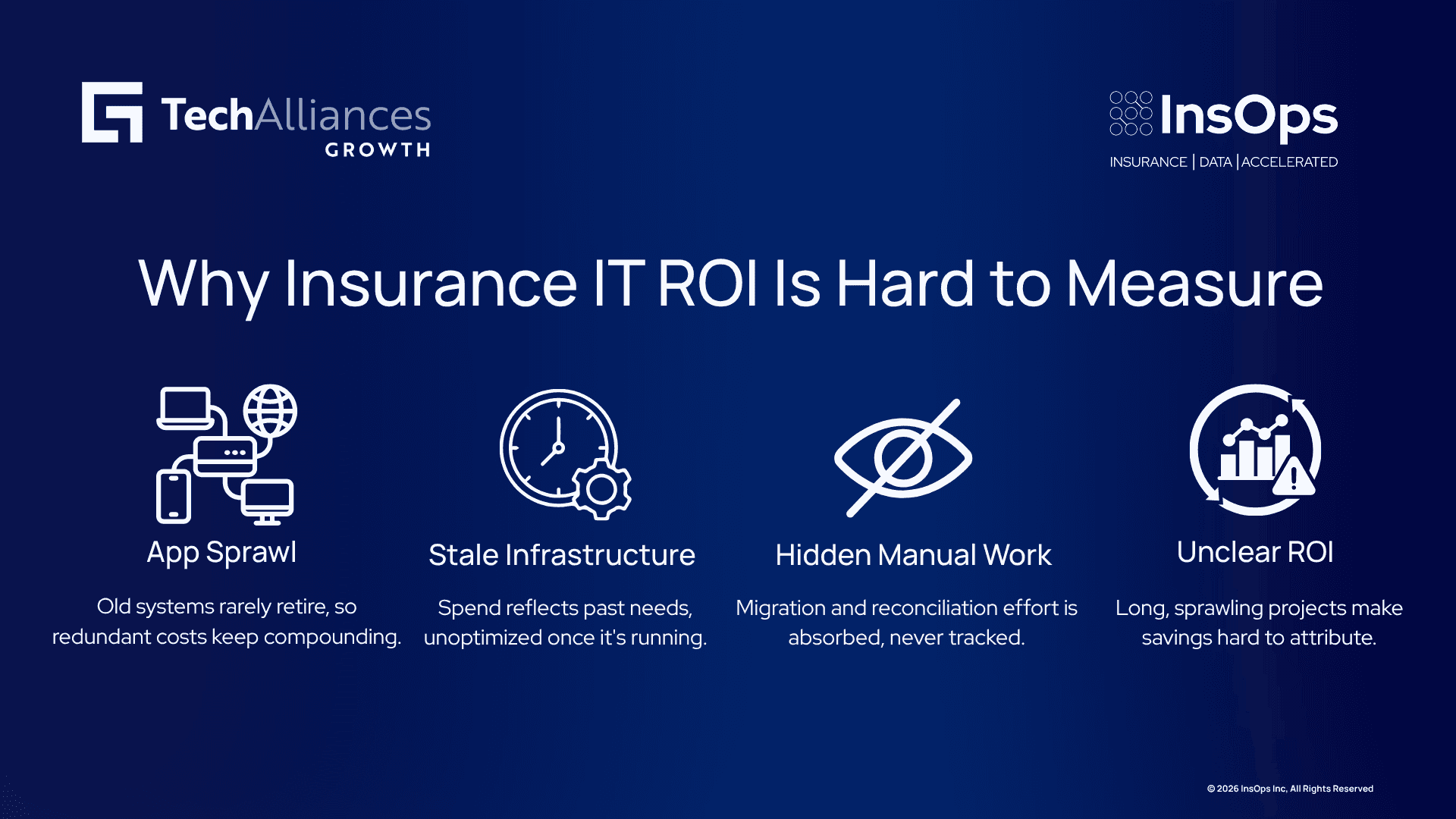
Application portfolios grow without corresponding cleanup. New systems get added for new capabilities, but old ones rarely get formally retired, so the cost of maintaining redundant or underused applications compounds year over year.
Infrastructure spend often reflects historical decisions, not current needs. Cloud and on-prem infrastructure sized for past assumptions about volume and usage frequently goes unoptimized, because no one revisits it once it's running.
Manual data work hides as a fixed cost. Teams spend significant time on manual data migration, mapping, and reconciliation work that never shows up as a discrete line item, it's just absorbed into "how things are done," making it invisible to standard cost analysis.
Modernization ROI is hard to isolate. When a legacy migration or integration project spans many months and touches multiple systems, it's difficult to cleanly attribute cost savings or efficiency gains back to the specific investment that produced them.
The result: many carriers are spending on infrastructure, applications, and manual processes without a clear picture of which parts of that spend are earning their keep.
Where Real Cost Optimization Comes From
Meaningful cost optimization in insurance IT tends to come from four areas working together:
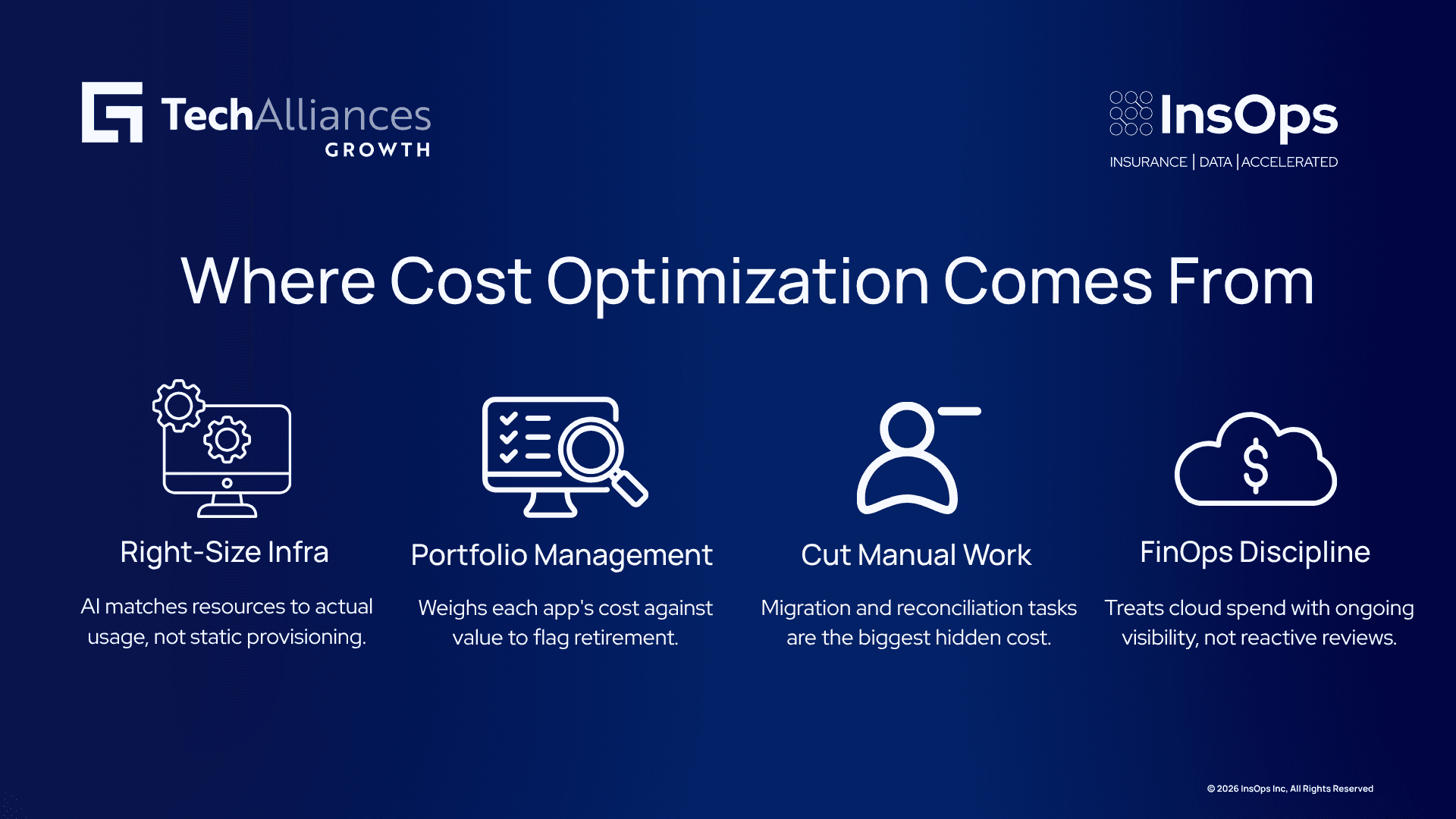
AI-driven infrastructure optimization. Right-sizing cloud and infrastructure resources based on actual usage patterns rather than static provisioning, catching both over-provisioned and under-provisioned resources.
Application portfolio management. Understanding what every application actually costs to maintain versus the value it delivers, so redundant or low-value systems become clear candidates for consolidation or retirement.
Reducing manual, repetitive work. Data migration, mapping, and reconciliation tasks that consume engineering hours without producing new capability are often the largest hidden cost in a technology budget, and the easiest to systematically reduce.
FinOps practices. Treating cloud and infrastructure spend with the same discipline as any other budget category, with ongoing visibility into cost drivers rather than periodic, reactive reviews.
The common thread: cost optimization isn't a one-time initiative. It requires ongoing visibility into where spend is going and what it's actually producing.
The Connection Between Legacy Debt and Cost
A significant portion of insurance IT cost sits in exactly the areas covered elsewhere in this series: application sprawl, manual integration work, and legacy systems kept alive past their useful life. Every obsolete application still running is infrastructure cost with no corresponding value. Every point-to-point integration still being manually maintained is engineering time that could go toward higher-return work.
This means cost optimization and technical debt reduction aren't separate initiatives competing for budget. They're the same problem viewed from different angles, and progress on one tends to produce ROI on the other.
How InsOps Helps
InsOps supports cost optimization directly by reducing two of the largest hidden costs in insurance IT: manual legacy data work and custom integration maintenance.

Migration ROI with a documented result. InsOps migrated 40+ years of AS/400 claims data into Guidewire ClaimCenter Cloud in 6 months, at 99%+ accuracy, delivering $2M+ in cost savings. That's a concrete return on a modernization investment, not an abstract efficiency claim.
Reduced manual integration maintenance. Integration Gateway's pre-built connectors for Guidewire PolicyCenter, ClaimCenter, BillingCenter, UnderwritingCenter, and PricingCenter reduce the ongoing engineering time spent maintaining custom, point-to-point connections, freeing that capacity for higher-value work.
Insurance-trained accuracy reduces rework costs. Because our AI model understands insurance-specific data relationships and field semantics, migration and mapping work requires less manual correction than generic tooling, reducing the hidden cost of fixing errors after the fact.
A recurring model tied to ongoing value, not just a one-time project. InsOps supports both one-time legacy modernization and recurring integration needs, giving carriers a clear way to evaluate ROI against actual usage and outcomes rather than a single upfront cost.
Runs inside your environment, avoiding added infrastructure cost. Because InsOps operates inside the carrier's own infrastructure, carriers aren't paying for a separate, parallel environment just to run migration or integration workloads.
For CTOs building a defensible cost optimization story, the highest-leverage areas are often the ones hiding in plain sight: manual data work, redundant applications, and integration maintenance that's been accepted as a fixed cost for years without being reexamined.
FAQ
Why is technology ROI harder to measure in insurance IT than in other industries? Application portfolios accumulate over time without corresponding cleanup, manual data work often isn't tracked as a discrete cost, and modernization projects span many months, making it difficult to cleanly attribute savings to a specific investment.
What's the difference between cost cutting and cost optimization? Cost cutting typically means reducing budgets across the board. Cost optimization means identifying which spend is generating value and which isn't, then reallocating resources toward higher-return areas, which sometimes means increasing investment in specific places, like legacy modernization, to reduce larger ongoing costs elsewhere.
How does application portfolio management contribute to cost optimization? By making the maintenance cost and business value of every application visible side by side, portfolio management identifies redundant, underused, or high-maintenance systems that are strong candidates for consolidation or retirement, directly reducing ongoing infrastructure and support costs.
Is manual data work really a significant hidden cost? Yes. Manual migration, mapping, and reconciliation work consumes engineering hours that don't show up as a distinct budget line item, but the cumulative time cost across a year is often substantial, and it's typically one of the more addressable sources of savings once identified.
What is FinOps, and why does it matter for insurance IT specifically? FinOps applies financial accountability and ongoing visibility practices to cloud and infrastructure spend. For insurance IT, where infrastructure decisions are often made once and rarely revisited, FinOps practices help catch cost drift before it becomes a large, entrenched expense.
How does legacy data migration produce a measurable ROI? By replacing ongoing costs, maintaining an outdated system, manual data handling, integration workarounds, with a one-time investment that removes those costs going forward. InsOps's Golden Bear migration, for example, produced $2M+ in documented cost savings alongside the underlying modernization.