

Ransomware attacks against insurers aren't just more frequent, they're more sophisticated, increasingly powered by AI on the attacker's side. Threat actors are using AI to automate reconnaissance, craft more convincing phishing attempts, and adapt attack patterns faster than traditional signature-based defenses can respond.
For CISOs in P&C insurance, this shift changes the calculus. Perimeter-based security models built around the assumption that anything inside the network can be trusted are no longer sufficient against attackers who can move laterally, exploit legitimate credentials, and adapt in real time. Zero Trust architecture, AI-powered threat detection, and automated incident response aren't emerging best practices anymore. They're baseline requirements.
Why Insurance Is a High-Value Ransomware Target
P&C carriers carry a specific combination of risk factors that make them attractive targets:
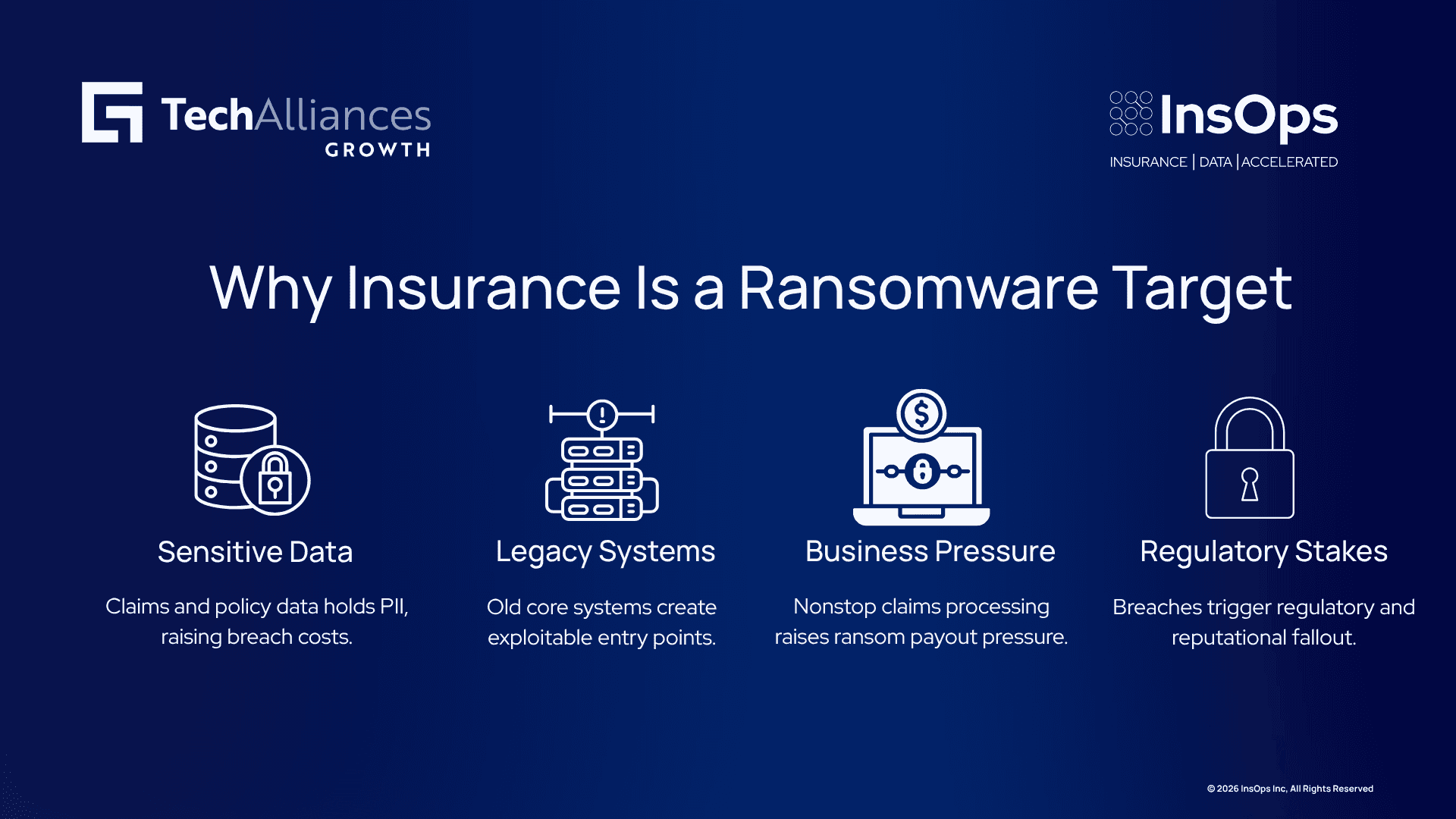
Data sensitivity is extremely high. Policy, claims, and underwriting data often includes personally identifiable information and, in some cases, health-adjacent data tied to claims, making a breach both damaging and expensive to remediate under regulatory requirements.
Legacy systems create exploitable gaps. Core systems built decades ago often weren't designed with modern security assumptions in mind, and every legacy connection or manual data exchange point is a potential entry point.
Business interruption pressure increases payout likelihood. Insurers process claims and payments continuously; any disruption creates direct financial and reputational pressure, which attackers count on when demanding ransom.
Regulatory and reputational stakes compound the cost. A breach doesn't just cost recovery time. It triggers regulatory scrutiny under frameworks like NAIC requirements, HIPAA where applicable, and state-level breach notification laws, on top of the reputational damage of a carrier failing to protect its own policyholders' data.
Why Perimeter Security No Longer Holds
Traditional network security assumed that anything inside the perimeter, once authenticated, could be trusted by default. AI-powered attacks break that assumption in several ways:
Credential-based attacks bypass perimeter defenses entirely. If an attacker gains valid credentials, perimeter security doesn't stop lateral movement once they're inside.
AI accelerates reconnaissance and adaptation. Attackers can now use AI to identify vulnerabilities, craft targeted phishing content, and adjust tactics faster than manual security review can keep pace with.
Legacy integration points are often under-monitored. Point-to-point connections and manual data exchange processes built up over years frequently fall outside the scope of modern security monitoring, creating blind spots attackers can exploit.
Zero Trust architecture addresses this directly by removing the assumption of implicit trust. Every access request is verified, regardless of where it originates, based on identity, device posture, and context, not network location.
What a Modern Defense Posture Requires
Four capabilities need to work together to meaningfully reduce ransomware and AI-powered attack impact:
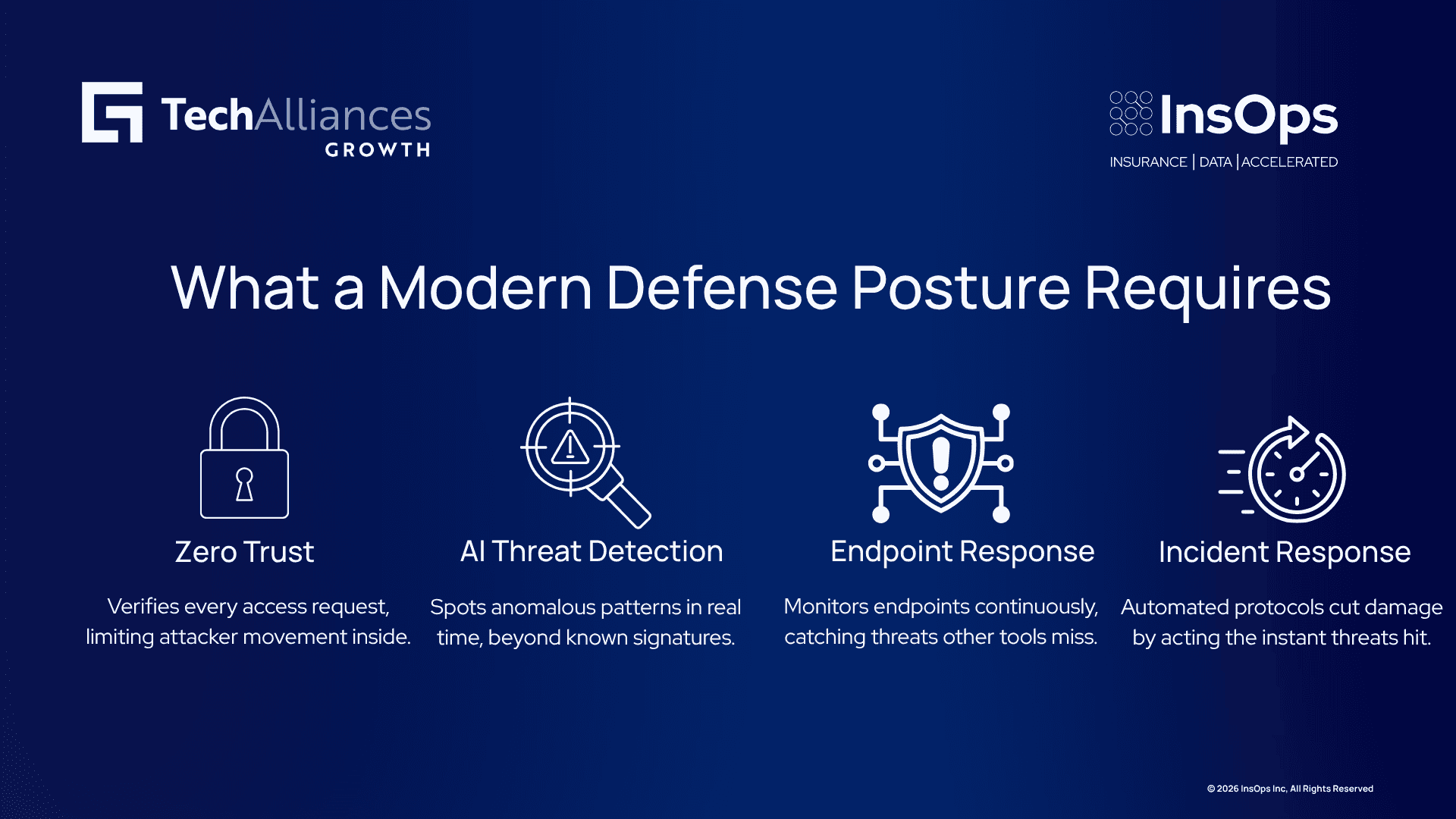
Zero Trust architecture. Continuous verification of every access request, with no implicit trust granted based on network location, limiting how far an attacker can move even after gaining initial access.
AI-powered threat detection. Matching the speed and adaptability of AI-driven attacks requires detection systems that can identify anomalous patterns in real time, not just match against known signatures.
Endpoint Detection & Response (EDR). Continuous monitoring and response capability at the endpoint level, catching malicious activity that perimeter and network-level tools miss.
Automated incident response. When an attack is detected, response speed determines impact. Predefined, systematic response protocols that trigger immediately reduce the window an attacker has to cause damage, compared to processes that wait for manual escalation.
None of these function well in isolation. Zero Trust without strong detection still leaves attacks undetected longer than necessary. Detection without fast response still allows damage to accumulate while a team manually coordinates next steps.
Why This Connects to Data Architecture Decisions
Security posture and data architecture aren't separate conversations. Every legacy system still running, every manual data exchange point still in place, and every point-to-point integration still unmonitored is both a technical debt problem and a security exposure. Reducing the number of loosely governed data movement points in an insurer's environment is one of the most direct ways to shrink the attack surface available to ransomware actors.
This is also where data handling practices during migration and modernization projects matter. Moving large volumes of sensitive claims and policy data between systems is itself a security-sensitive operation, and the practices used during that process, where the data goes, who touches it, whether it ever leaves controlled infrastructure, carry real security implications independent of the broader threat detection stack.
How InsOps Helps
InsOps isn't a threat detection or incident response platform, and CISOs evaluating ransomware defense should look to dedicated Zero Trust, EDR, and detection vendors for that layer of the stack. Where InsOps contributes directly is in reducing security exposure during the legacy data migration and integration work that often creates the blind spots attackers exploit.
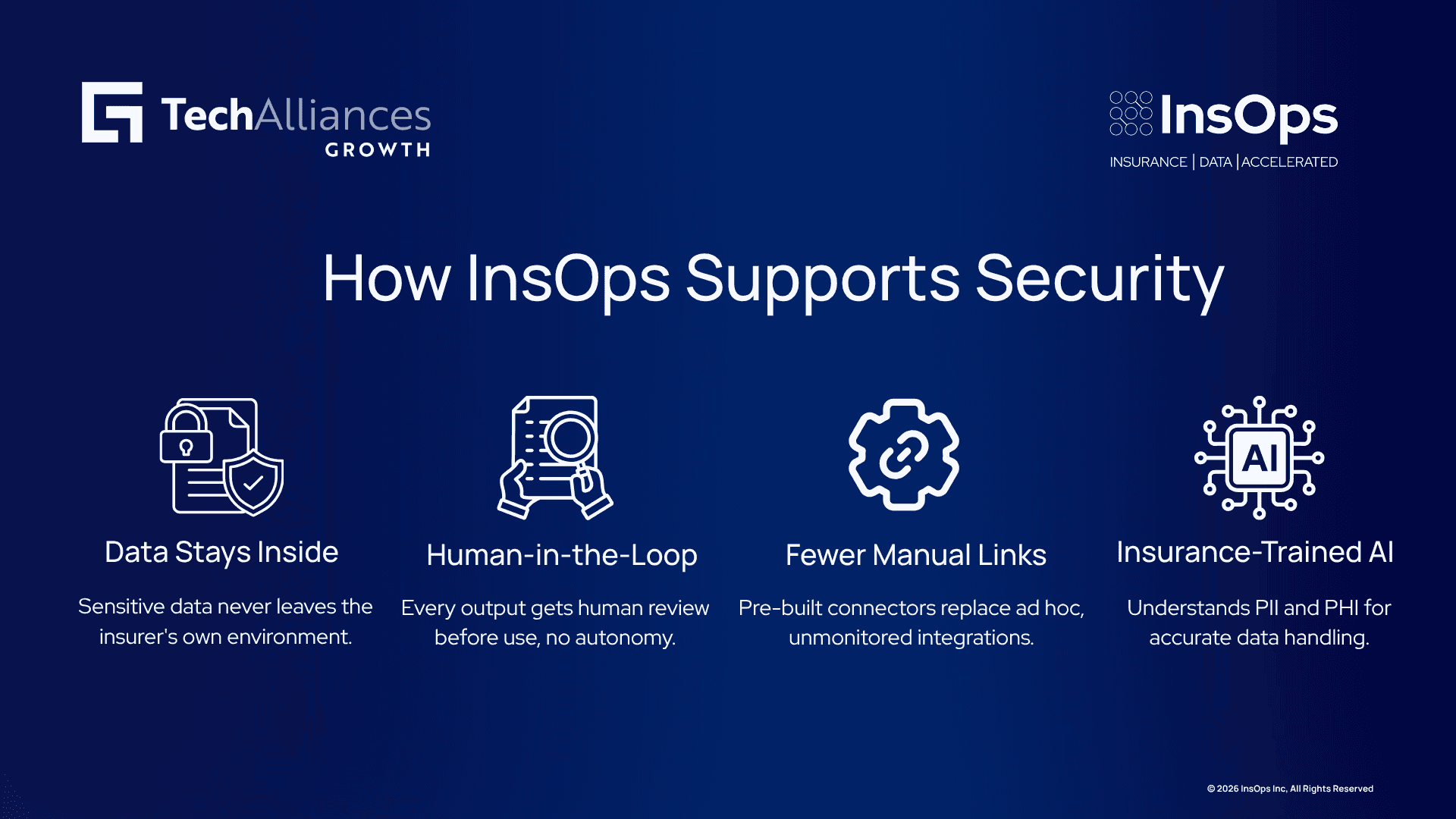
Data never leaves your controlled environment. InsOps operates inside the insurer's own infrastructure. Sensitive policy and claims data is never transferred to an external environment for mapping, migration, or transformation, reducing one of the more overlooked exposure points in modernization projects.
Human-in-the-loop, not autonomous action. Every InsOps output, whether a data mapping, migration, or integration task, is validated by human review before use. This creates a consistent checkpoint rather than an unsupervised process operating on sensitive data.
Reducing manual, under-monitored integration points. Integration Gateway's pre-built connectors for Guidewire PolicyCenter, ClaimCenter, BillingCenter, UnderwritingCenter, and PricingCenter replace ad hoc, manually maintained point-to-point connections, the kind of legacy integration paths that often fall outside consistent security monitoring.
Insurance-trained data handling. Our AI model understands insurance-specific data sensitivity, including PII and PHI embedded in claims data, supporting more accurate classification and handling during migration and integration work.
For CISOs, the practical takeaway is that reducing ransomware exposure isn't only about the detection and response stack. It's also about shrinking the number of legacy, manually maintained data pathways in the environment, and ensuring that when sensitive data does move, it does so inside a controlled environment with human oversight at every step.
FAQ
Why are P&C insurers considered high-value ransomware targets? Insurers hold highly sensitive policy, claims, and underwriting data, often including PII and health-adjacent information, and any operational disruption creates immediate financial and reputational pressure, both of which increase the likelihood an attacker expects a ransom to be paid.
What makes AI-powered cyberattacks different from traditional attacks? AI allows attackers to automate reconnaissance, generate more convincing phishing content, and adapt tactics faster than manual or signature-based defenses can respond to, requiring detection systems that can identify anomalous behavior in real time rather than relying solely on known attack patterns.
Why is Zero Trust architecture considered essential now rather than optional? Because credential-based attacks and lateral movement bypass perimeter defenses entirely once an attacker gains valid access. Zero Trust removes the assumption of implicit trust for anything inside the network, requiring continuous verification regardless of where an access request originates.
How does legacy system modernization relate to ransomware risk? Legacy systems and the manual, point-to-point integrations built around them often fall outside consistent security monitoring, creating blind spots. Reducing the number of these unmonitored data pathways during modernization directly shrinks the attack surface available to attackers.
Does automated incident response replace the need for a human security team? No. Automated response protocols reduce the time between detection and initial containment, limiting damage during the critical early window of an attack, but human security teams remain essential for investigation, decision-making, and recovery beyond that initial response.
Is InsOps a cybersecurity or threat detection tool? No. InsOps focuses on legacy data migration and system integration for P&C insurers. It supports security posture indirectly, by keeping sensitive data inside the insurer's controlled environment and reducing manually maintained integration points, but it isn't a substitute for dedicated Zero Trust, EDR, or threat detection tooling.