

P&C insurers hold some of the most sensitive data any industry manages, policyholder PII, claims details, health-adjacent information tied to bodily injury claims, financial data tied to billing and payments. Protecting it isn't a single control. It requires knowing where sensitive data actually lives, classifying it correctly, and monitoring it continuously, across systems that were often never designed with modern data protection practices in mind.
For CISOs, this creates a persistent gap between the data protection program on paper and the reality of where sensitive data actually sits inside the organization. Discovery and classification, encryption, tokenization, DLP, and continuous monitoring all matter, but only if they cover the full data footprint, including the legacy systems and manual data flows that formal programs often miss.
Why Sensitive Data Protection Is Harder Than It Looks in Insurance IT
A few structural realities make this more difficult in P&C insurance than the standard data protection playbook assumes:
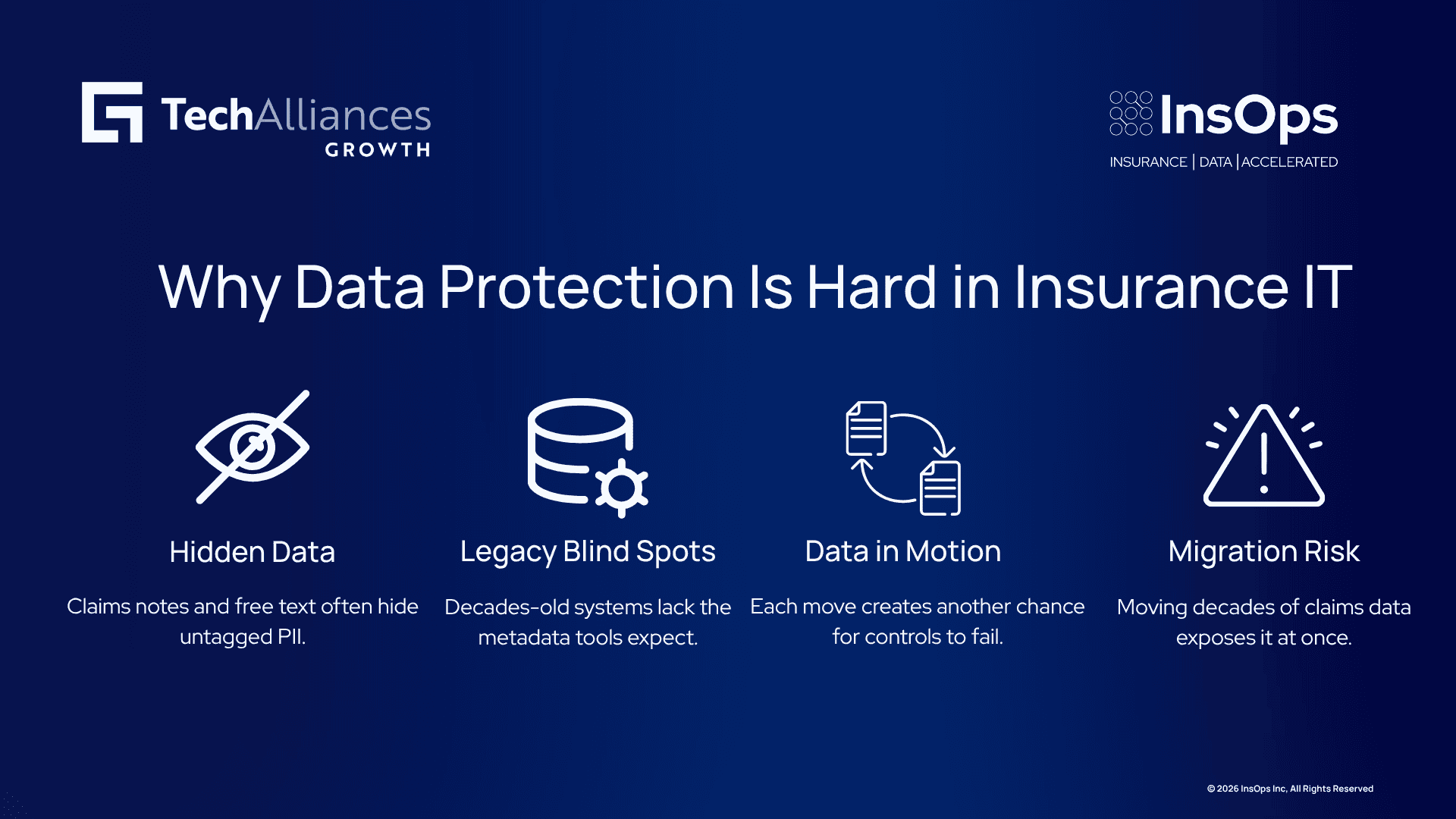
Sensitive data hides in unstructured fields. Claims notes, adjuster comments, and free-text fields frequently contain PII or health-adjacent information that isn't tagged or classified as sensitive, because it was never entered into a structured field designed to be recognized as such.
Legacy systems weren't built with modern classification in mind. Decades-old core systems, AS/400 and similar platforms, often lack the metadata and structure that automated discovery tools expect, making sensitive data harder to locate systematically.
Data moves constantly, and each movement is a new exposure point. Between core systems, integration layers, and third-party partners, sensitive data is in near-constant motion, and every movement is a point where classification, encryption, or monitoring can fail to keep up.
Manual migration projects are a high-risk moment. Moving decades of claims and policy data from a legacy system to a modern platform is exactly when large volumes of sensitive data are most exposed, if the migration process itself doesn't handle classification and protection correctly.
The result: many carriers have solid data protection policies that don't fully account for where sensitive data actually resides in practice, particularly in legacy environments and during migration projects.
What Comprehensive Sensitive Data Protection Requires
Effective protection of sensitive customer data in P&C insurance rests on five connected practices:
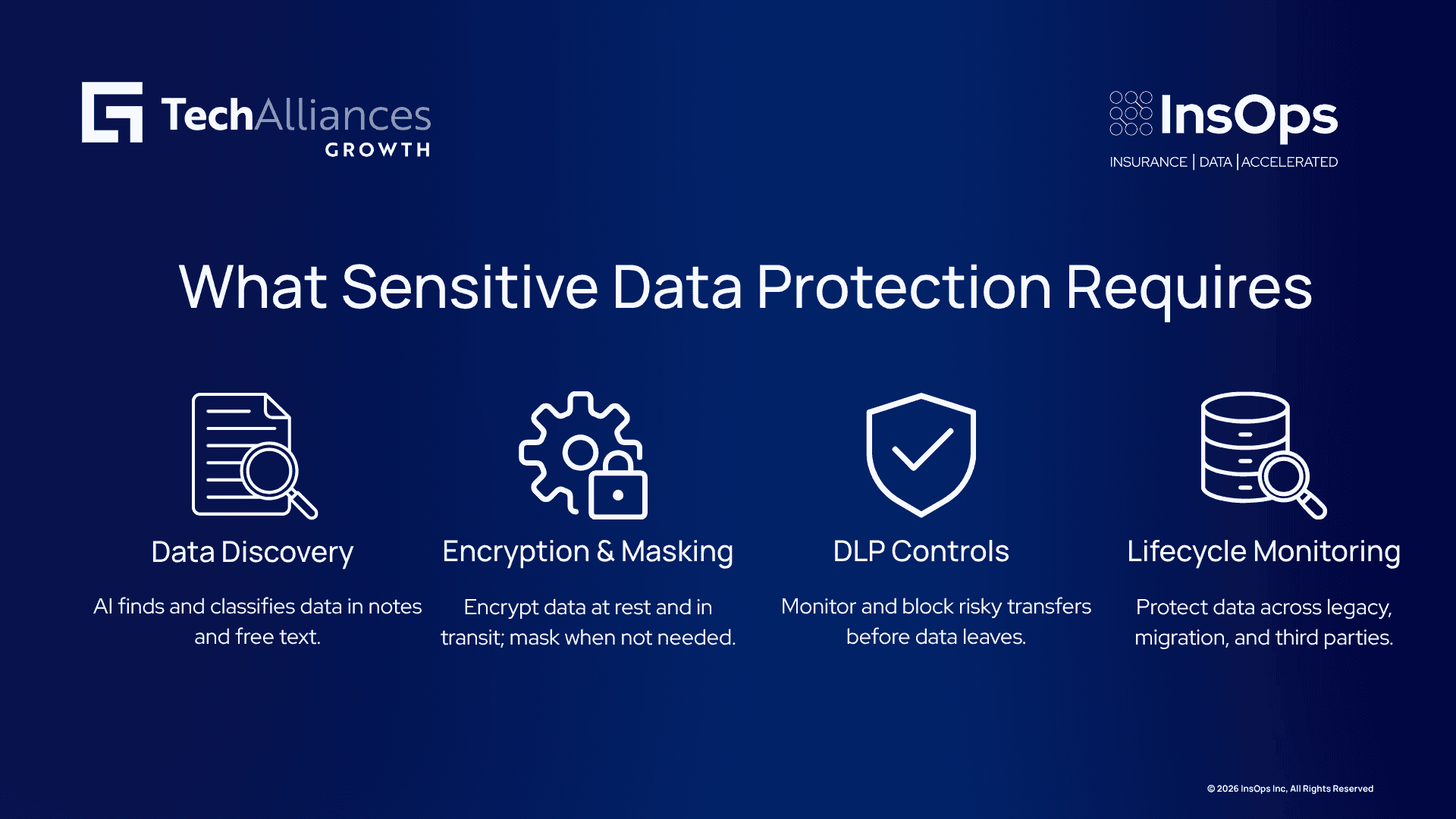
AI-driven data discovery and classification. Systematically identifying where sensitive data lives, including in unstructured fields like claims notes, rather than relying on manual audits that miss data outside expected structured fields.
Encryption. Protecting sensitive data both at rest and in transit, so a breach of storage or interception in transit doesn't expose usable information.
Tokenization and anonymization. Replacing sensitive values with non-sensitive equivalents where full data isn't needed, particularly important for testing, analytics, and any use case where the underlying PII or PHI value itself isn't required.
Data Loss Prevention (DLP). Monitoring and controlling how sensitive data moves, flagging and blocking transfers that violate policy before data leaves the controlled environment.
Continuous monitoring. Ongoing visibility into where sensitive data is accessed, by whom, and how, rather than periodic audits that only catch issues after the fact.
These practices need to extend across the full data lifecycle, not just production systems in active use. Legacy data, data in motion during migration, and data flowing through third-party integrations all carry the same protection requirements as data sitting in a well-governed core system.
Why Migration and Integration Projects Are a Critical Moment
Sensitive data protection often gets evaluated as a steady-state concern, how well is data protected in systems as they currently run. But some of the highest-risk moments for sensitive data occur during transition: migrating claims data from a legacy system to a modern platform, or establishing new integration pathways to partners and vendors.
During these projects, large volumes of sensitive data are extracted, transformed, and moved, sometimes to environments or vendors outside the carrier's direct infrastructure. If classification and protection practices aren't built into the migration or integration process itself, this becomes a significant, often underestimated exposure window.
How InsOps Helps
InsOps is built around the specific problem of handling sensitive insurance data correctly during migration, transformation, and integration, not just monitoring it once it's already sitting in a production system.
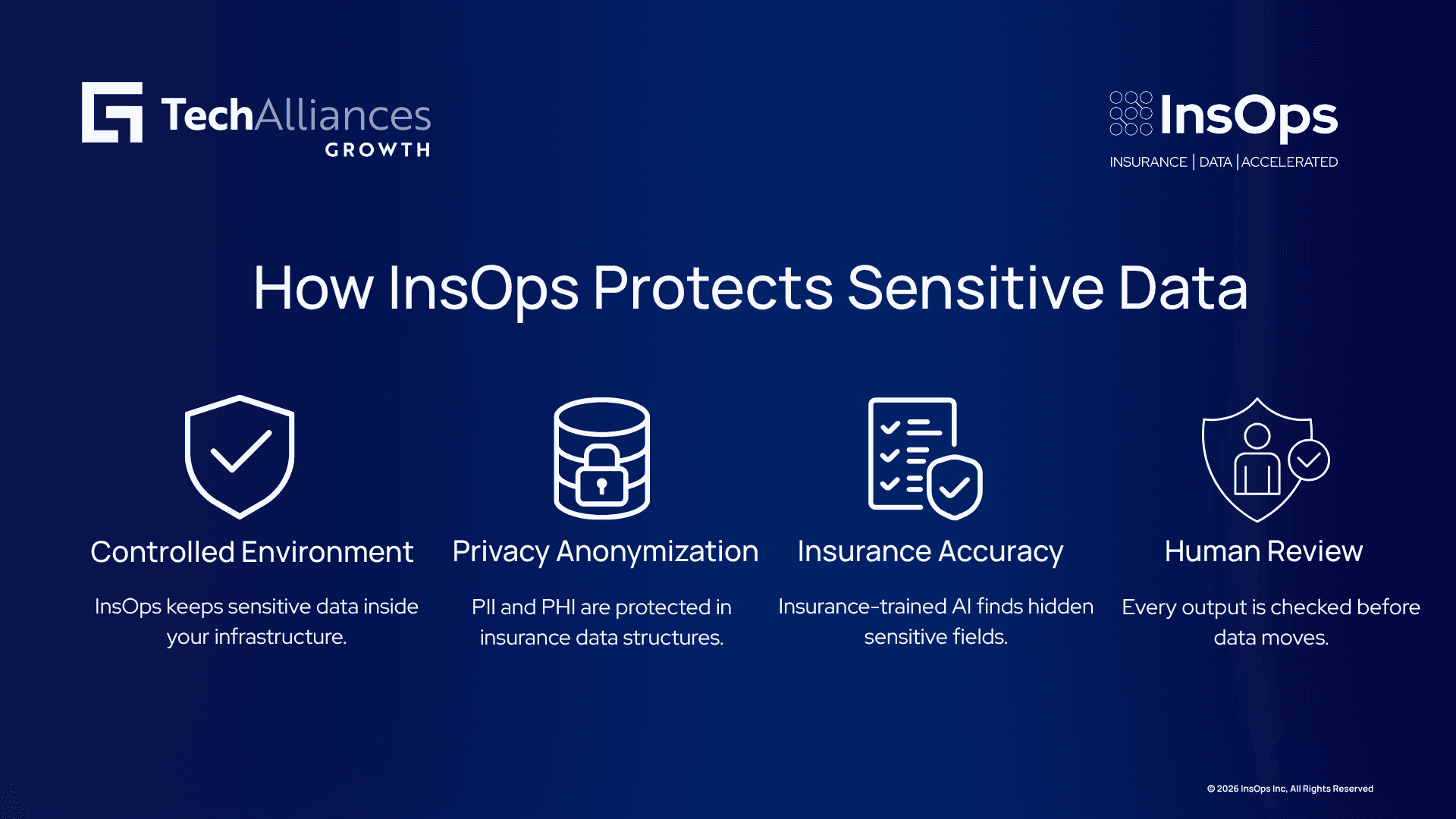
Runs entirely inside your controlled environment. InsOps operates inside the insurer's own infrastructure. Sensitive PII and PHI never leave controlled infrastructure to be classified, mapped, or transformed by an external system, directly addressing one of the highest-risk exposure points in modernization projects.
Purpose-built anonymization capability. InsOps includes a dedicated PII and PHI anonymization capability, powered by our core AI model's Data Privacy wrapper, designed specifically to identify and protect sensitive data within insurance-specific data structures, including unstructured fields like claims notes.
Insurance-trained classification accuracy. Generic data discovery tools don't understand insurance-specific field semantics or where PII and PHI typically hide in claims and policy data. Our model is trained specifically on insurance domain logic, improving the accuracy of identifying sensitive data that generic classification tools miss.
Human-in-the-loop validation. InsOps never classifies or transforms sensitive data autonomously. Every output is validated by human review, creating a consistent checkpoint for sensitive data handling rather than relying on an unsupervised automated process.
Proven accuracy at scale. InsOps's migration of 40+ years of AS/400 claims data into Guidewire ClaimCenter Cloud achieved 99%+ accuracy, a critical benchmark when the data being migrated includes decades of sensitive policyholder and claimant information.
For CISOs, the priority isn't just strengthening monitoring and DLP on systems already in production. It's ensuring that sensitive data protection holds during the moments of highest exposure, migration, transformation, and integration, where InsOps is specifically designed to keep data inside a controlled environment with human oversight throughout.
FAQ
Why is sensitive data harder to protect in legacy insurance systems specifically? Legacy systems often lack the metadata and structure modern discovery tools expect, and sensitive information frequently sits in unstructured fields like claims notes rather than tagged, structured fields, making it harder to locate and classify systematically.
What's the difference between encryption and tokenization for sensitive data protection? Encryption protects data by making it unreadable without a decryption key, while still preserving the original value for authorized use. Tokenization replaces the sensitive value entirely with a non-sensitive substitute, useful when the actual PII or PHI value isn't needed, such as in testing or analytics environments.
Why are data migration projects considered high-risk for sensitive data exposure? Because large volumes of sensitive data are extracted, transformed, and moved during migration, often to new environments or through new tooling. If classification and protection practices aren't built into the migration process itself, this creates a significant exposure window that steady-state monitoring doesn't address.
Can generic data discovery and classification tools handle insurance-specific sensitive data effectively? Generic tools often struggle with insurance-specific data structures, particularly unstructured fields like adjuster notes, where PII or PHI may appear without being tagged as sensitive. Tools trained specifically on insurance data are generally more accurate at identifying this kind of embedded sensitive information.
Does continuous monitoring replace the need for encryption and DLP? No. Continuous monitoring provides visibility into how sensitive data is accessed and moved, but it works alongside encryption and DLP rather than replacing them, encryption protects data itself, DLP controls its movement, and monitoring provides ongoing visibility across both.
How does InsOps handle PII and PHI during data migration specifically? InsOps includes a dedicated anonymization capability built on its core AI model, designed to identify and protect sensitive data within insurance-specific structures, including unstructured fields. All processing happens inside the insurer's own controlled environment, with human review validating outputs before use.