

Every legacy system still running in a P&C carrier's environment is doing double duty as a security liability. Built decades before current threat models existed, these systems weren't designed with modern authentication, API security, or network segmentation in mind, and every year they stay in production, the gap between their security posture and current expectations widens.
For CISOs, this creates a specific tension. Legacy modernization is usually framed and funded as an IT initiative, focused on cost, capability, and technical debt. But the security implications are just as significant, and they don't get resolved unless vulnerability assessment, secure API design, and network segmentation are built into the modernization effort itself, not treated as a separate workstream.
Why Legacy Systems Are a Persistent Security Gap
Several characteristics of legacy insurance systems make them disproportionately risky from a security standpoint:
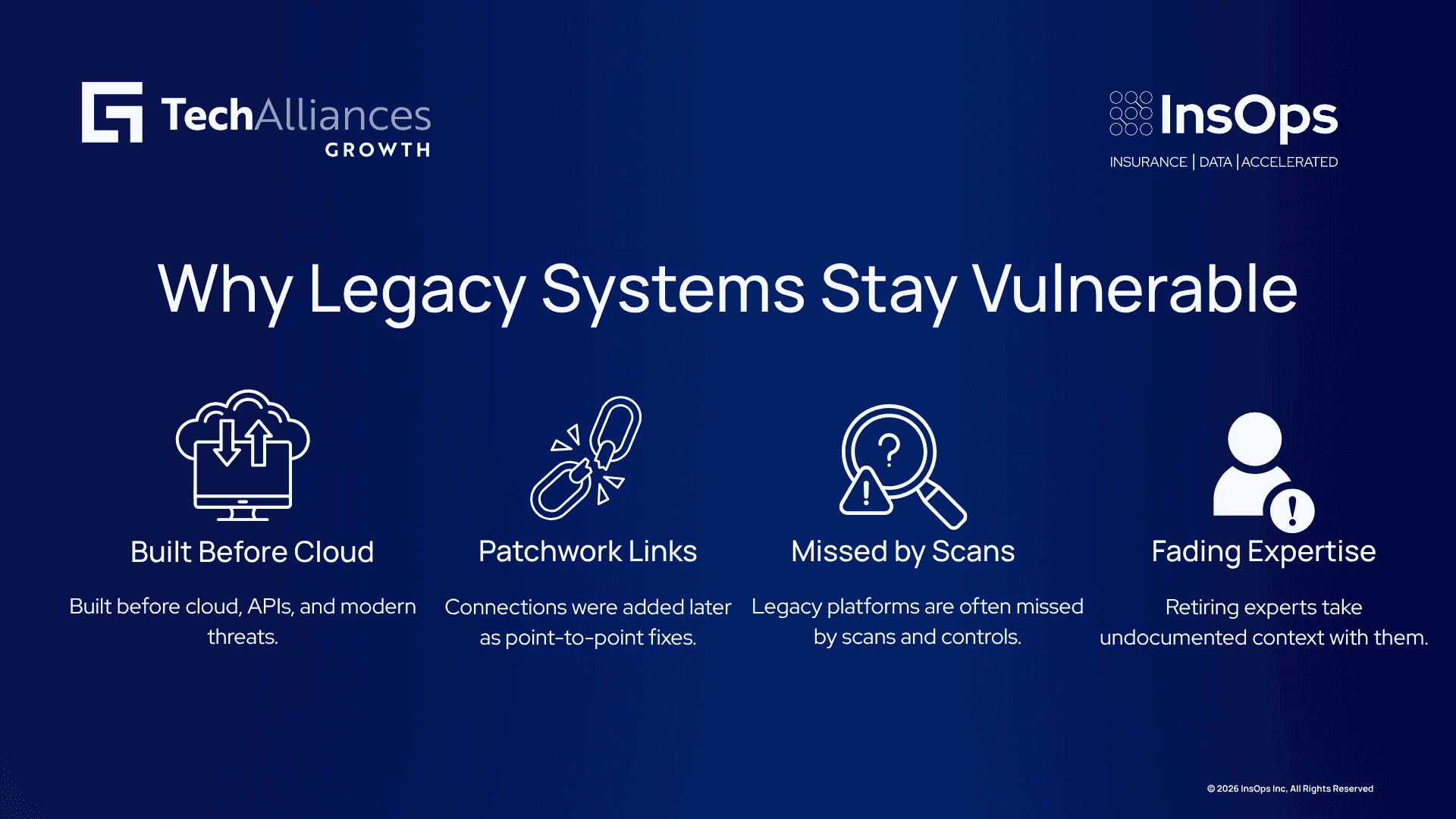
They predate modern security assumptions. Systems like AS/400 platforms were built for an era before API-first architecture, cloud infrastructure, and today's threat landscape, and their underlying security models often haven't kept pace.
Integration was bolted on, not designed in. Legacy systems typically weren't built to expose secure, well-governed APIs. Connections added over time tend to be point-to-point workarounds, often with inconsistent authentication and access control practices.
Vulnerability assessment coverage is inconsistent. Legacy systems are frequently excluded from, or inadequately covered by, modern vulnerability scanning and assessment tools, because those tools are built for contemporary infrastructure, not decades-old platforms.
Network segmentation is often incomplete around legacy systems. Older systems may have broader network access than current security practice would allow, sometimes because segmenting them properly risks breaking integrations no one fully understands anymore.
Institutional knowledge is disappearing. The people who understood a legacy system's original security model, and its since-accumulated exceptions and workarounds, are retiring, taking undocumented context about the system's actual attack surface with them.
Why Modernization Projects Are a Security Opportunity, Not Just a Risk
It's tempting to think of legacy modernization purely as introducing risk, moving sensitive data, standing up new integrations, changing systems that have run stably for years. That risk is real. But modernization is also the best opportunity a CISO gets to close security gaps that are otherwise very difficult to address in a stable, long-running legacy environment.
A legacy system that's been in production for twenty years is hard to retroactively secure without disrupting operations. A legacy system in the middle of a modernization project is an environment where security requirements can be built directly into the new target architecture, secure APIs from the start, proper network segmentation, continuous vulnerability assessment integrated into the pipeline, rather than retrofitted later.
This is why CISOs benefit from treating modernization projects as security initiatives with IT execution, not IT initiatives with a security review at the end.
What Secure Modernization Requires
Closing the legacy security gap during modernization efforts requires four practices working together:
Application modernization with security requirements built in. Moving legacy logic and data to modern architecture is the moment to establish current authentication, encryption, and access control standards, not carry forward legacy security assumptions into a new environment.
Secure API design from the start. Every new integration point built during modernization should be designed with proper authentication, rate limiting, and access control from the outset, rather than exposing legacy-style broad access through a modern interface.
Network segmentation aligned to actual data sensitivity. As systems modernize, segmentation should be re-evaluated based on current data flows and sensitivity, not inherited from legacy network architecture that may no longer reflect how the system is actually used.
Continuous vulnerability assessment integrated into the modernization pipeline. Rather than a one-time security review before go-live, vulnerability assessment should run continuously throughout the modernization project and into the new system's operational life.
How InsOps Helps
InsOps directly supports the legacy modernization process where a significant share of security exposure originates: the migration of sensitive data out of legacy systems and the integration points that connect those systems to the rest of the environment.
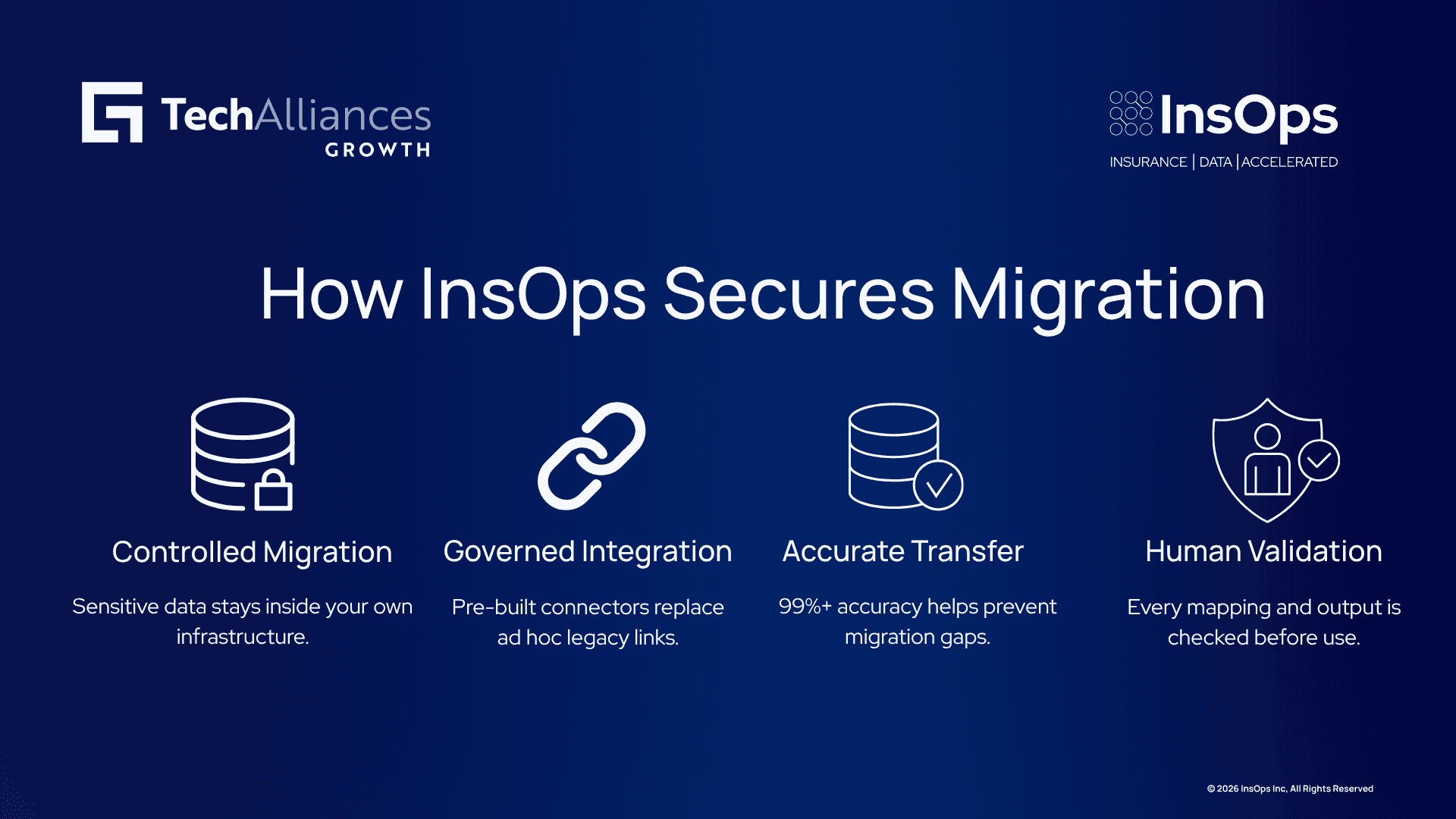
Controlled environment throughout migration. InsOps operates entirely inside the insurer's own infrastructure. Sensitive data extracted from legacy systems during migration never leaves controlled infrastructure to be processed elsewhere, closing off a common exposure point in legacy modernization projects.
Replacing ad hoc legacy connections with governed integration. Integration Gateway provides pre-built connectors for Guidewire PolicyCenter, ClaimCenter, BillingCenter, UnderwritingCenter, and PricingCenter, replacing the inconsistent, manually built point-to-point connections that often characterize legacy integration with a standardized, more consistently governed approach.
Proven accuracy reduces the risk of incomplete or corrupted migration. InsOps's migration of 40+ years of AS/400 claims data into Guidewire ClaimCenter Cloud achieved 99%+ accuracy, an important factor in ensuring sensitive data isn't left behind, duplicated, or improperly transformed during the transition, outcomes that can themselves create security and compliance gaps.
Human-in-the-loop validation at every step. InsOps never processes or migrates legacy data autonomously. Every mapping and migration output is validated by human review, providing a consistent checkpoint during exactly the kind of large-scale data movement that carries the highest security risk.
Insurance-trained understanding of legacy data structures. Because our AI model is trained specifically on insurance domain logic, it's better positioned to correctly identify and handle sensitive data within legacy formats than generic modernization tools, reducing the chance sensitive information is mishandled during the transition.
For CISOs, the practical opportunity is treating an upcoming legacy modernization project as a chance to close security gaps that have been difficult to address in the stable, long-running legacy environment, and ensuring the migration process itself, not just the resulting new system, holds to the same security standard.
FAQ
Why are legacy systems considered a persistent security risk even if they haven't been breached yet? Legacy systems were built before current authentication, API security, and threat models existed, and vulnerability assessment tools often don't cover them adequately. The absence of a known breach doesn't mean the exposure isn't there, it may simply mean it hasn't been found or exploited yet.
Should network segmentation be revisited during a modernization project, even if the current setup hasn't caused problems? Yes. Legacy network segmentation often reflects historical assumptions rather than current data sensitivity and usage patterns. A modernization project is a natural point to reassess segmentation based on how the system and its data are actually used today.
Why should CISOs be involved early in legacy modernization projects rather than reviewing security at the end? Because modernization projects are one of the best opportunities to build security requirements into a new architecture from the start, secure APIs, proper segmentation, integrated vulnerability assessment, rather than retrofitting security onto a system that's already gone live.
Does data migration itself carry security risk, separate from the security of the source and target systems? Yes. The migration process involves extracting, transforming, and moving large volumes of sensitive data, often through external tools or environments. If that process isn't handled inside a controlled environment with proper oversight, it becomes its own exposure point independent of how secure either system is on its own.
How does continuous vulnerability assessment differ from a one-time pre-launch security review? A one-time review only catches issues present at that specific point in time. Continuous assessment identifies new vulnerabilities as they emerge throughout the modernization process and after go-live, which matters because both the system and the threat landscape keep changing.
Does InsOps replace the need for dedicated vulnerability assessment or API security tooling? No. InsOps focuses specifically on secure, accurate legacy data migration and integration with Guidewire-based core systems. It reduces security exposure during that specific process, but CISOs should still maintain dedicated vulnerability assessment, API security, and network segmentation practices as part of a complete modernization security program.