

Identity has become the primary control point for security in P&C insurance, not because network security stopped mattering, but because the assumptions network-based security relied on no longer hold. Employees work from anywhere, systems span cloud and on-premises environments, partners connect through APIs, and service accounts often carry more access than any individual employee. In that environment, verifying who or what is requesting access, continuously, is the control that actually determines exposure.
For CISOs, this means Identity & Access Management isn't one control among many. It's foundational infrastructure that every other security practice, from Zero Trust architecture to cloud security to third-party risk management, ultimately depends on.
Why Identity-Based Risk Is Distinct in Insurance
A few characteristics of P&C insurance environments make identity and access management especially consequential:
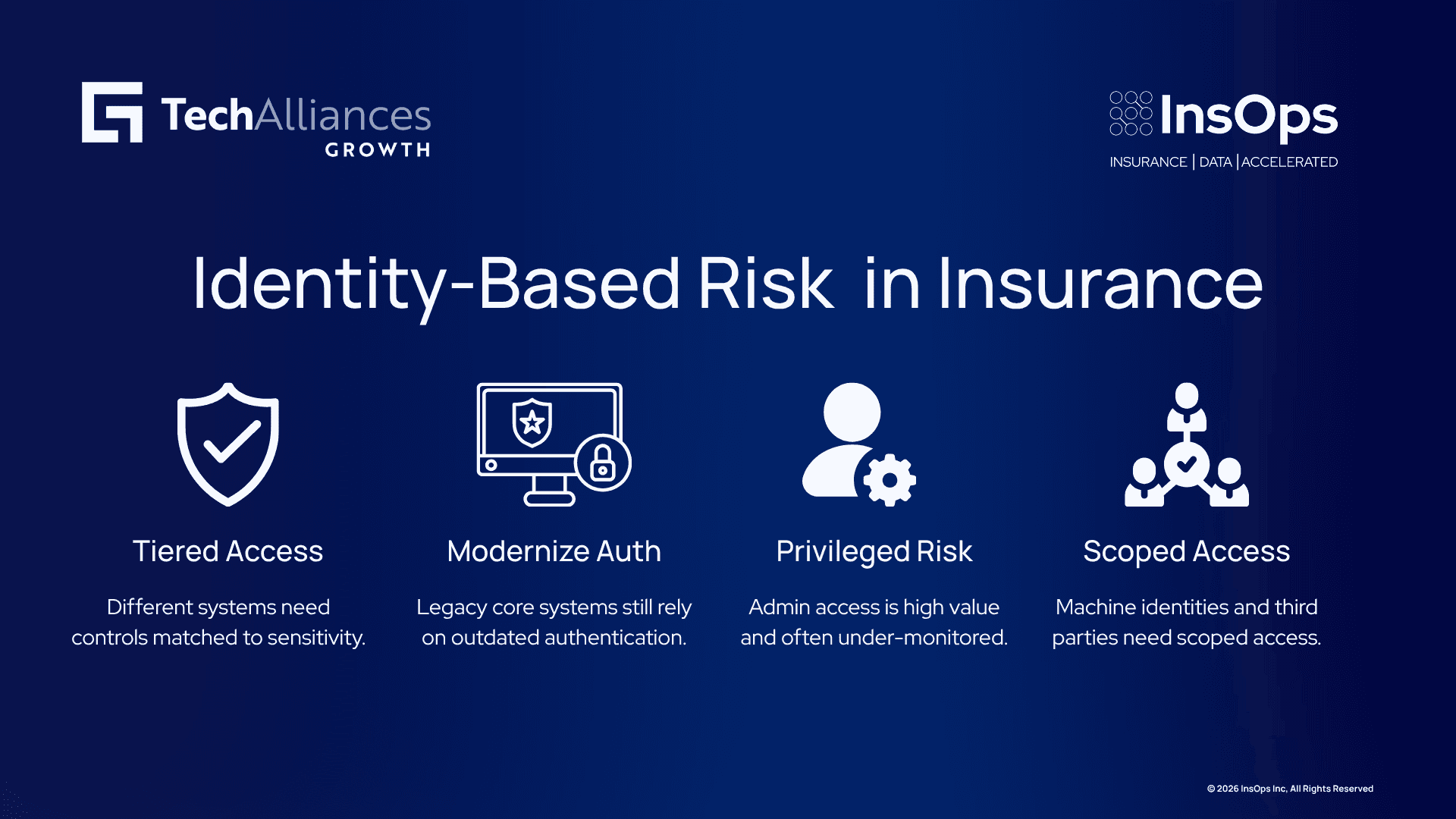
Access spans a wide range of sensitivity levels. A single carrier's environment includes access to policy data, claims data, underwriting logic, and financial systems, each with different sensitivity levels and regulatory implications, requiring access controls that can differentiate accordingly rather than treating all internal access as equivalent.
Legacy systems often have weak or outdated authentication. Core systems built decades ago frequently rely on authentication models that predate modern MFA and adaptive authentication standards, creating access points that don't meet current security expectations.
Privileged accounts carry outsized risk. Administrative access to core systems, databases, and integration platforms represents some of the highest-value targets in the environment, yet privileged access is often under-monitored relative to its risk level.
Machine identities are proliferating. Integration platforms, automated processes, and AI tools increasingly operate under service accounts and API keys that can carry broad permissions, often reviewed far less rigorously than human user access.
Partner and vendor access complicates the identity boundary. Third-party integrations mean identity management extends beyond the carrier's own workforce to partners, MGAs, and vendors, each requiring appropriately scoped access rather than broad, standing permissions.
Why MFA Alone Isn't Sufficient Anymore
Multi-Factor Authentication remains a baseline requirement, but it's no longer sufficient on its own against modern threats. Credential theft, phishing-resistant attack techniques, and session hijacking can bypass certain MFA implementations, particularly those relying on SMS or basic push notifications without additional context.
This is why MFA needs to work alongside adaptive authentication, access decisions that factor in device posture, location, behavior patterns, and risk signals, rather than treating every authentication attempt as equivalent once a second factor is provided. A login attempt from an unusual location, on an unrecognized device, at an atypical time, carries different risk than a routine login from a known device on a trusted network, even if both provide the same MFA factor.
What Comprehensive Identity & Access Management Requires
Effective IAM in a P&C insurance environment rests on four connected practices:
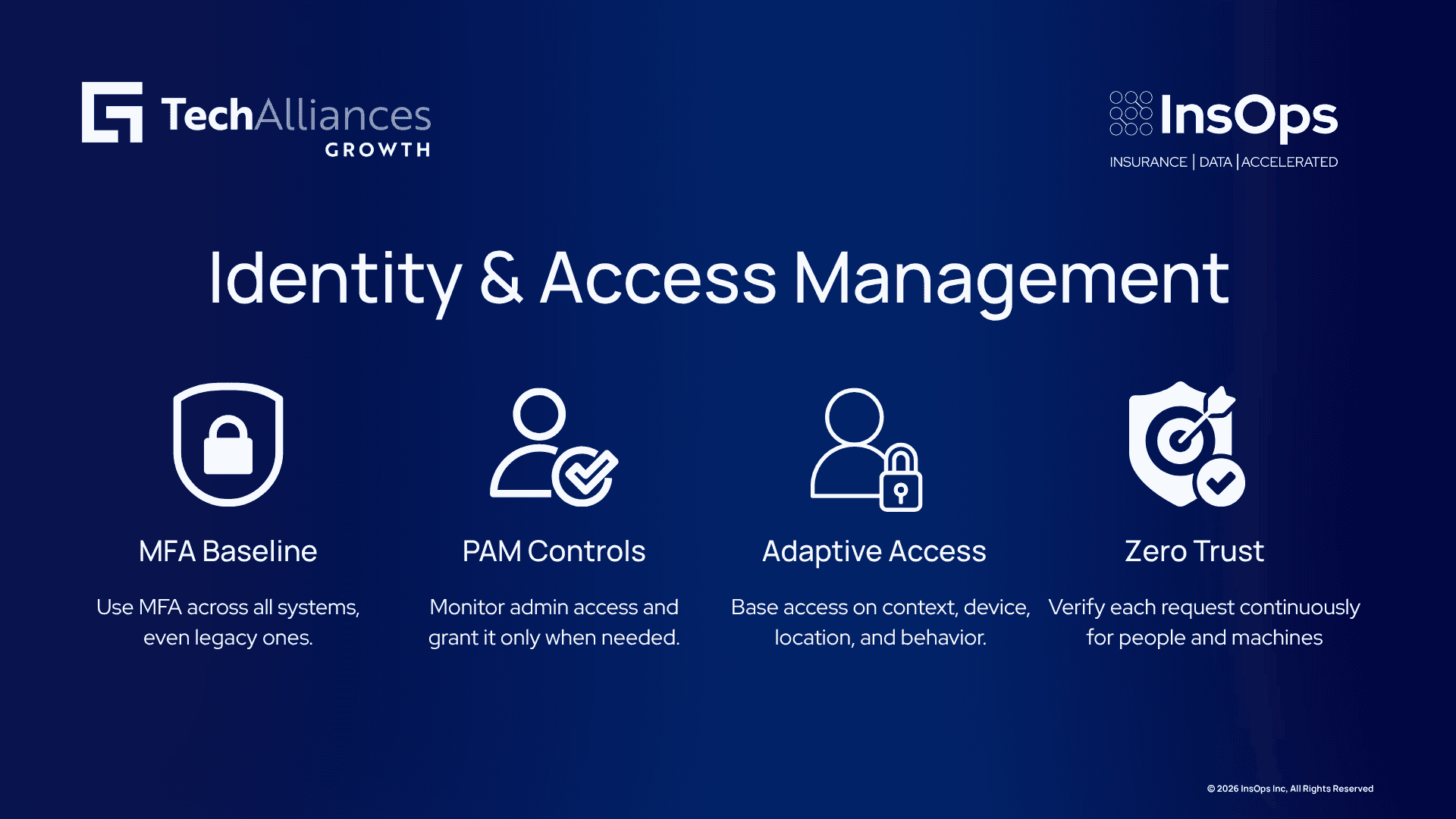
Multi-Factor Authentication as a baseline. Applied consistently across all systems, including legacy platforms that may require additional integration work to support modern authentication standards.
Privileged Access Management (PAM). Dedicated controls, monitoring, and just-in-time access provisioning for administrative and high-privilege accounts, ensuring privileged access is granted only when needed and closely monitored when active.
Adaptive authentication. Risk-based access decisions that factor in context, device, location, behavior, rather than static authentication requirements applied uniformly regardless of risk signals present at the time of access.
Zero Trust Identity principles. Continuous verification of identity for every access request, with no implicit trust granted based on network location or prior authentication, extending to human users, service accounts, and machine identities alike.
Machine identities deserve particular attention in this framework. As integration platforms, automated data pipelines, and AI tools become more prevalent, the access these non-human identities carry needs the same rigor applied to human privileged access, clear scoping, monitoring, and periodic review, rather than being granted broadly at setup and left unreviewed.
Why Integration and Modernization Projects Are an Identity Risk Moment
Legacy modernization and system integration projects are a particularly important moment for identity and access management, for two reasons. First, new integrations typically require new service accounts and API access, and how tightly those are scoped at creation determines the risk they carry for the life of the integration. Second, migration projects often involve temporary elevated access for the migration process itself, access that needs to be properly time-bound and monitored, not left in place indefinitely after the project concludes.
Carriers that build strong identity practices into modernization projects from the start avoid accumulating the kind of loosely scoped, forgotten service accounts that tend to show up as security gaps years later.
How InsOps Helps
InsOps supports identity and access management principles specifically within the scope of legacy data migration and system integration, where new access requirements are most often introduced.
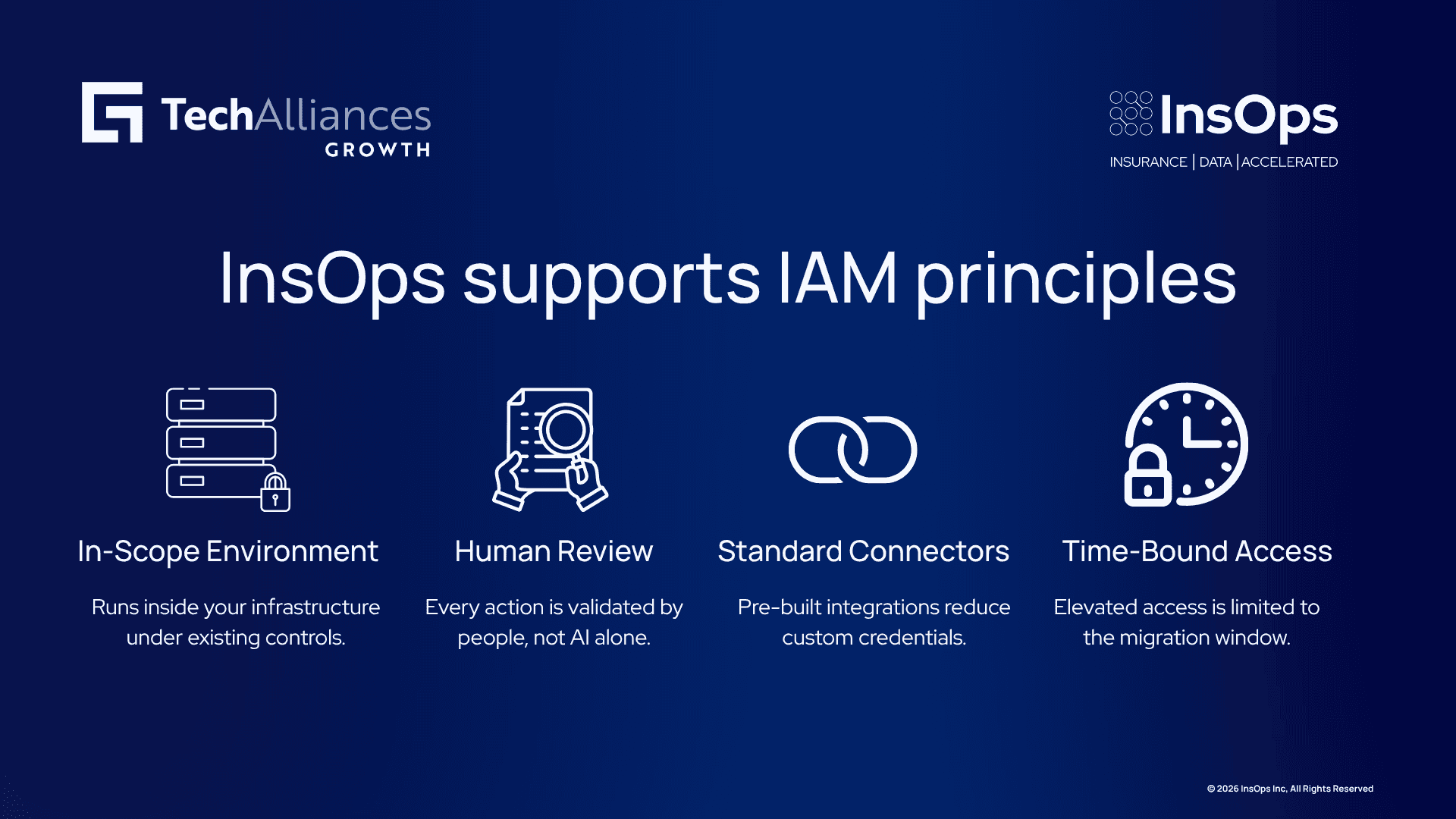
Runs inside your controlled environment, under your access model. InsOps operates inside the insurer's own infrastructure, meaning migration and integration work happens under the carrier's existing identity and access controls, rather than requiring sensitive data to be granted to a separate, externally managed environment with its own access model.
Human-in-the-loop by design, not autonomous access. InsOps's AI model never acts independently. Every data mapping, migration, or integration action is validated by human review, ensuring that access to sensitive data during these processes is consistently paired with human accountability rather than unsupervised automated action.
Reduces the proliferation of custom integration credentials. Integration Gateway's pre-built connectors for Guidewire PolicyCenter, ClaimCenter, BillingCenter, UnderwritingCenter, and PricingCenter provide a standardized integration approach, reducing the number of separately built, separately credentialed point-to-point connections that tend to accumulate as distinct, hard-to-track access points over time.
Supports scoped, time-bound migration work. Because InsOps is designed for structured, human-reviewed migration projects rather than standing, indefinite access, it aligns naturally with the practice of granting elevated access for the duration of a migration effort rather than leaving broad access in place after the project concludes.
For CISOs, InsOps's relevance to identity and access management is specific to the migration and integration context: it reduces the number of new, separately managed access points a modernization project introduces, and keeps that access inside the carrier's existing identity model rather than extending it to an external environment.
FAQ
Why is identity considered "the new perimeter" in modern security architecture? Because traditional network-based security assumed trust could be established by network location, inside the firewall meant trusted. With cloud environments, remote work, and extensive third-party integration, that assumption no longer holds, so verified identity, continuously checked, has become the primary basis for access decisions instead.
Why isn't MFA alone sufficient for strong identity security anymore? Certain MFA implementations, particularly SMS-based or basic push notifications, can be bypassed through phishing-resistant attack techniques or session hijacking. Adaptive authentication that factors in device, location, and behavioral context provides an additional layer of risk-based decision-making beyond a static second factor.
What makes Privileged Access Management different from standard access controls? PAM applies specifically to administrative and high-privilege accounts, which represent the highest-value targets in an environment. It typically includes just-in-time access provisioning, so elevated permissions are granted only when actively needed rather than standing indefinitely, along with heightened monitoring of privileged sessions.
Why do machine identities need the same rigor as human privileged access? Service accounts, API keys, and automated processes often carry broad permissions that go under-reviewed compared to human user access, yet they can be exploited just as effectively if compromised. As integration platforms and AI tools proliferate, machine identity access needs the same scoping, monitoring, and periodic review as human privileged accounts.
Why are modernization and integration projects considered a key moment for identity risk? New integrations typically require new service accounts and access credentials, and migration projects often involve temporary elevated access. How tightly that access is scoped, and whether it's properly time-bound and reviewed after the project ends, determines whether the project leaves behind a lasting security gap or a properly closed-out access grant.
Does InsOps provide MFA, PAM, or adaptive authentication capabilities? No. InsOps focuses on legacy data migration and system integration, operating inside the insurer's existing identity and access model rather than providing IAM tooling itself. Dedicated MFA, PAM, and adaptive authentication solutions remain necessary as the broader identity security foundation.