

Why Your Standard Claims Process Breaks During Catastrophe Events
When claim volume jumps far beyond a carrier's normal weekly intake within days of a hurricane, wildfire, or flood, most claims operations don't fail all at once. They fail in the same handful of places, over and over.
That's because the process underneath was never built for that kind of load. This article walks through why that gap exists, exactly where it breaks, and what a claims operation built for surge conditions looks like instead.
What Standard Claims Processing Actually Assumes
Most claims workflows are built around a simple premise. Claims arrive one at a time, in roughly predictable numbers, and move through intake, review, and settlement in sequence.
Under normal conditions, that structure works well. A steady stream of claims can move through defined queues without much friction, because volume rarely outpaces the team's capacity to work it in order.
Predictable Volume and Sequential Queues
Standard workflows route each claim through the same fixed sequence: intake, severity review, adjuster assignment, vendor coordination, and customer communication, largely one after another. This works when new-claim volume stays within a range the team has planned staffing around.
Where This Model Holds Up
Under day-to-day conditions, sequential processing keeps claims organized and auditable. Every claim gets the same review steps in the same order, which makes tracking status and maintaining compliance straightforward when volume is steady.
Why Catastrophe Events Break Those Assumptions
A catastrophe event doesn't just add more claims. It changes the shape of the problem entirely.
Sudden, Simultaneous Volume
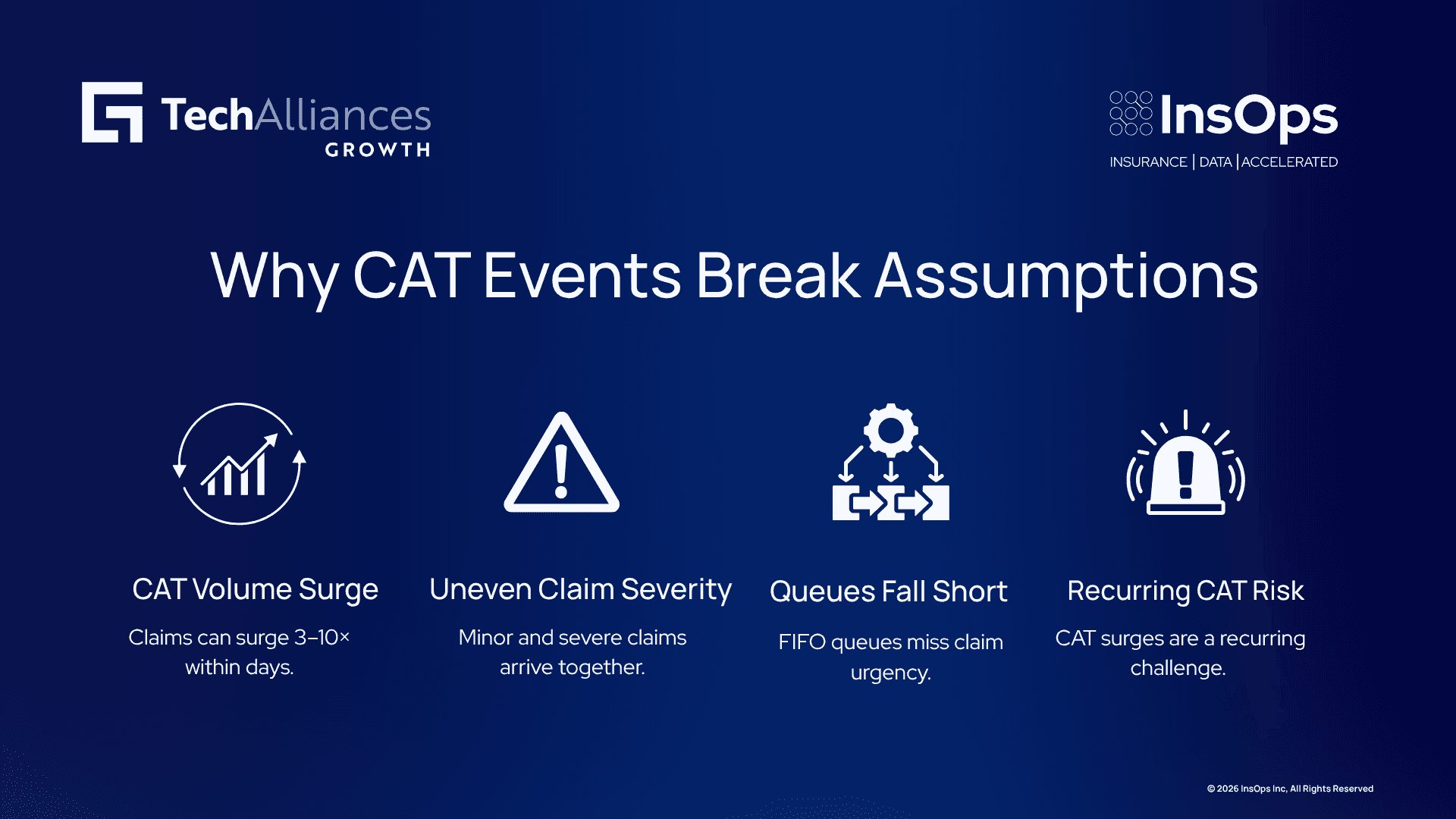
Catastrophe events such as hurricanes, wildfires, floods, and severe storms can push claim volume 3 to 10 times higher than normal within a matter of days. That's not a gradual ramp a team can staff up for in advance.
It's a step change that arrives all at once, often across a concentrated geographic area. That's exactly the condition sequential, one-at-a-time processing wasn't built to absorb.
Uneven Severity, All at Once
A CAT event doesn't produce a uniform set of claims. Total losses, minor damage, and everything in between arrive in the same intake window, with no natural order to how urgent each one actually is.
Standard queues, built around first-in-first-out processing, don't distinguish between them.
The Scale of the Problem Industry-Wide
This isn't a rare event insurers can treat as an outlier. Verisk's 2026 Global Modeled Catastrophe Losses Report puts the industry's average annual insured catastrophe loss benchmark at $171 billion, up roughly $19 billion from a year earlier. That's the highest estimate Verisk has reported to date.
That benchmark held even in a year with no U.S. hurricane landfalls, which is the report's own point: a quiet season doesn't mean a quiet risk environment. For claims operations, surge conditions are a recurring planning requirement, not a once-in-a-decade exception.
Where the Standard Process Actually Breaks
The breakdown isn't one single failure point. It's a handful of specific places where a sequential process meets simultaneous demand and can't keep up.
Manual Triage Bottlenecks
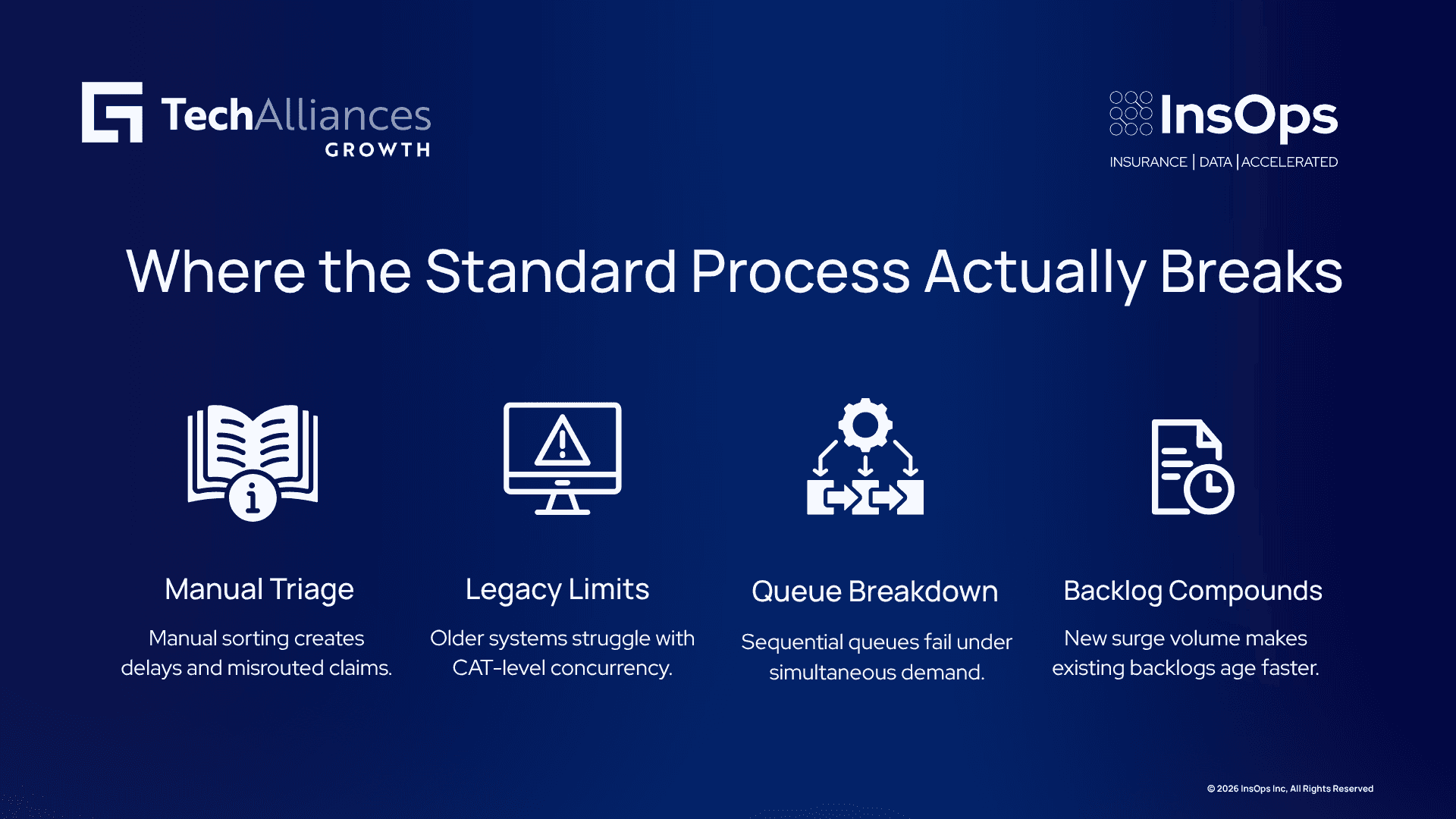
When claims are reviewed and categorized by hand, intake variability alone creates delays. Inconsistent categorization, misrouted claims, and delayed prioritization compound as claims arrive faster than a manual process can sort them.
That sorting lag is often where a claim first starts falling behind.
Legacy Systems Hitting Their Limits
Older claims platforms frequently aren't built for the concurrency a CAT event demands. Simultaneous intake, adjuster uploads, and internal coordination can overload systems that hold up fine under everyday conditions.
When platforms buckle, teams fall back on manual workarounds like spreadsheet tracking, which introduces its own documentation and compliance risk.
Sequential Queues Meeting Simultaneous Demand
Most claims operations still route each stage, one after another, through separate queues. That structure holds up under normal conditions but breaks when a carrier needs to process a large number of claims across multiple regions and loss types at once.
The result is a process that can technically identify which claims are most urgent but still ends up handling them in arrival order rather than priority order.
The Backlog Compounds
If a backlog already exists heading into a catastrophe event, the surge doesn't add to it evenly. New volume outpacing surge capacity is what turns an existing backlog into a rapidly aging one, since every delayed claim keeps aging while new claims arrive on top of it.
Sequential vs. Event-Driven Processing
The core mismatch is structural: a process built for one claim at a time meeting an event that produces thousands at once. Here's how the two models compare across the stages where the breakdown shows up.
Process stage | Sequential (standard) model | Event-driven model |
|---|---|---|
Intake | Claims processed in the order received | Claims segmented by severity and urgency as they arrive |
Triage | Manual review, one claim at a time | Predefined rules trigger categorization automatically |
Escalation | Waits for a person to flag and route the claim | High-severity claims trigger immediate routing |
Communication | Sent after each claim is individually reviewed | Status updates can go out in parallel with processing |
What Changes When Claims Operations Are Built for Surge Conditions
Triage by Severity, Complexity, and Urgency
A surge-ready process sorts incoming claims by how severe the damage is, how complex the claim is likely to be, and how urgent the policyholder's situation is. That lets adjusters spend their time on the claims that need it most first.
Closing the Gap Between Insight and Execution
Many carriers already have strong catastrophe risk data. The harder problem is turning that data into action fast enough.
Reducing the time between when a signal is available, a storm making landfall or a flood threshold being crossed, and when the claims process actually responds to it is where most of the recoverable time sits.
How InsOps Helps
InsOps builds an insurance-trained AI that assists claims teams with surfacing severity, complexity, and urgency signals as claims come in during a surge, so adjusters can see which files need attention first. LiLa, our insurance-trained LLM, runs inside your own environment, so policyholder PII and PHI never leave controlled infrastructure. A person reviews and validates every prioritization recommendation before it changes how a claim is worked.
Our Integration Gateway connects to Guidewire ClaimCenter and related systems, so claims data flows into a unified view without custom engineering. That view exists before a catastrophe event hits, rather than getting assembled during one.
Fully dynamic adjuster allocation during a live catastrophe event is something InsOps is building toward inside LiLa, not a capability available today. If you're evaluating how to prioritize claims during a surge without adding proportional headcount, contact us to talk through what this could look like for your operation.
Frequently Asked Questions
How much can catastrophe claim volume increase?
During major events, claim volume is known to run 3 to 10 times above normal levels within a matter of days. The increase tends to arrive all at once rather than ramping up gradually, which is what makes it hard to staff for in advance.
How do legacy claims systems fail during CAT surges?
Older platforms are frequently not built to handle catastrophe-level concurrency. When claim intake, adjuster uploads, and internal coordination all spike together, systems that work fine under normal conditions can buckle, pushing teams toward manual workarounds that carry their own compliance risk.
Why does the claims process break down during catastrophe events?
Standard claims processes assume predictable, sequential volume, one claim moving through intake, review, and settlement before much attention goes to the next. Catastrophe events replace that with simultaneous, high-volume, unevenly severe claims across a wide area within days, so the sequential queue itself becomes the bottleneck.
What's the difference between sequential and event-driven claims processing?
Sequential processing moves each claim through the same stages, one step at a time, in the order claims arrive. Event-driven processing uses predefined triggers to begin triage, assignment, and communication in parallel as conditions change, rather than waiting for manual escalation between each step.
How can insurers scale claims operations without adding headcount?
Structured triage that segments claims by severity, complexity, and urgency lets existing adjusters focus on the claims that need them most, instead of processing strictly in arrival order. Reducing manual touches in intake and documentation review, while keeping a person validating any AI-assisted recommendation, is what allows a fixed team to absorb more claims without a proportional staffing increase.
Why does a claims backlog get worse after a catastrophe event?
A catastrophe event's volume spike doesn't just add claims one at a time. It arrives faster than manual triage and legacy systems can process, so unresolved claims accumulate while new ones keep arriving on top of them.
What causes a claims backlog to compound after a CAT event?
If a backlog already existed before the catastrophe hit, the surge adds new volume on top of it rather than replacing it. Once new intake outpaces surge capacity, the existing queue keeps aging while the team is also absorbing the new spike, which is what turns a manageable backlog into a fast-growing one.
How is AI used in catastrophe claims triage without removing human judgment?
AI-assisted triage can surface severity, complexity, and urgency signals as claims come in, helping identify which files need attention first. A person still reviews and validates each recommendation before it changes how a claim is worked, so the judgment call on any individual claim stays with an adjuster, not the system.