

When a hurricane, wildfire, or major storm hits, claim volume can jump well beyond what a normal week brings in. An operations lead needs to know where the bottleneck actually is before picking a fix.
Why CAT Events Overwhelm Normal Claims Capacity
Catastrophe losses aren't a steady, predictable stream. They arrive in short, intense bursts tied to specific events.
Global insured losses from natural catastrophes totaled $137 billion in 2024, trending toward $145 billion in 2025, according to Swiss Re's Sigma report. That's a rising baseline a claims team has to absorb in short windows, not spread evenly across the year.
Where the Bottlenecks Actually Happen During a Surge
The first bottleneck isn't settling claims. It's sorting them.
As Deloitte Canada's Colin Asselstine put it, "the first thing that you need to do is triage your claims in a way that helps you to organize them." Simple, low-risk claims need to move fast so adjusters can focus on the ones with real impact on a policyholder's life.
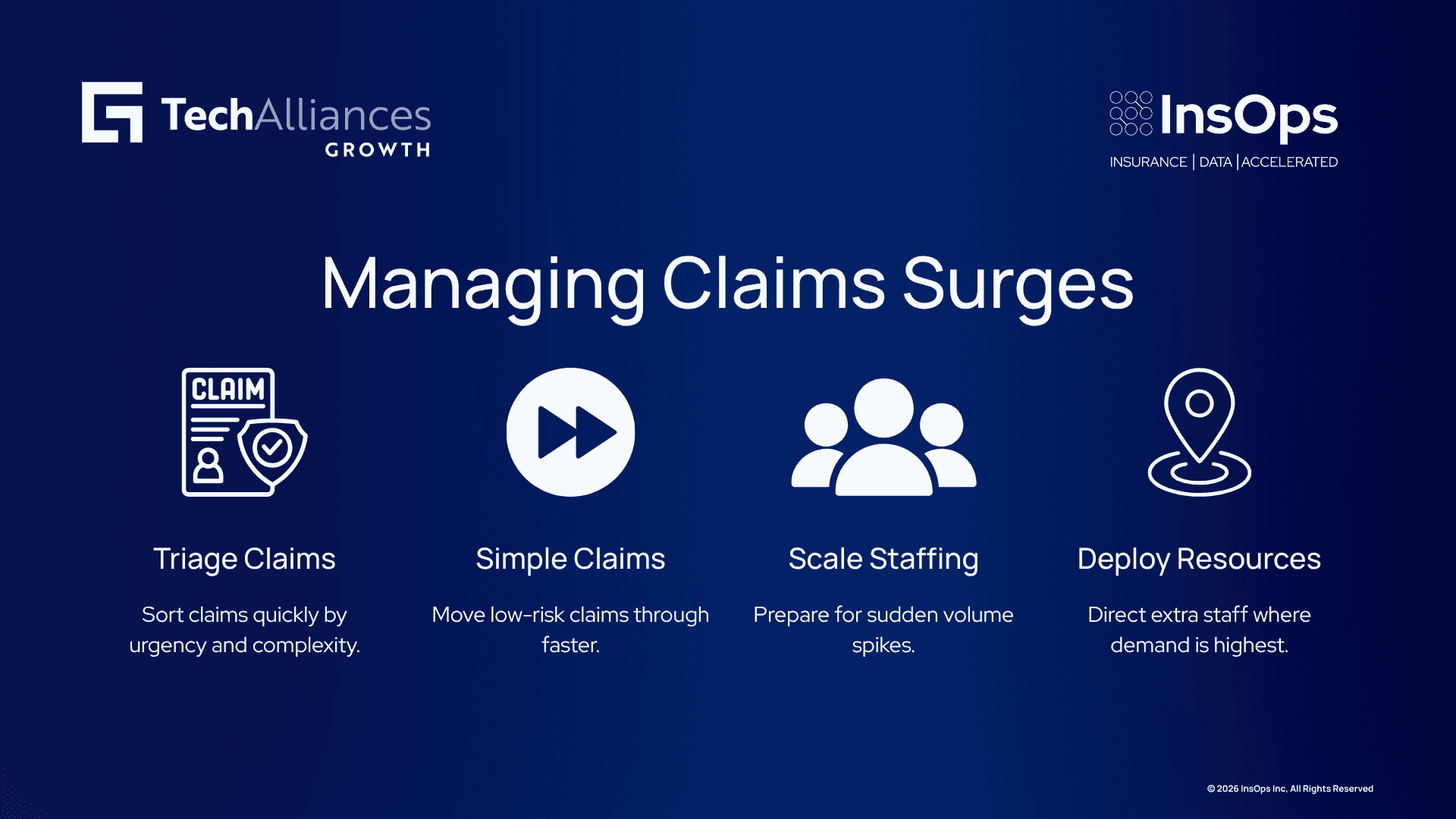
The second bottleneck is staffing. Normal headcount isn't built for a 3x or 5x spike in volume, so someone has to decide where extra hands come from.
How Insurers Traditionally Scale for CAT Events
Historically, carriers have pulled adjusters from other lines, commonly auto, to support property claims during a surge. Those adjusters often only have partial familiarity with property coverage and process.
That's the actual constraint: not a lack of people, but a lack of people who already know the specific coverage they're being asked to handle.
Where AI-Assisted Tools Fit During a Surge
AI-assisted tools are showing up in two places right now: triage, and back-office support for adjusters and call center staff.
On triage, tools can scan incoming claims and push the most urgent cases to the top of the queue instead of adjusters revisiting files days later. On the back office side, tools can transcribe calls, suggest a next step, and cut call time, freeing an adjuster to focus on the conversation itself.
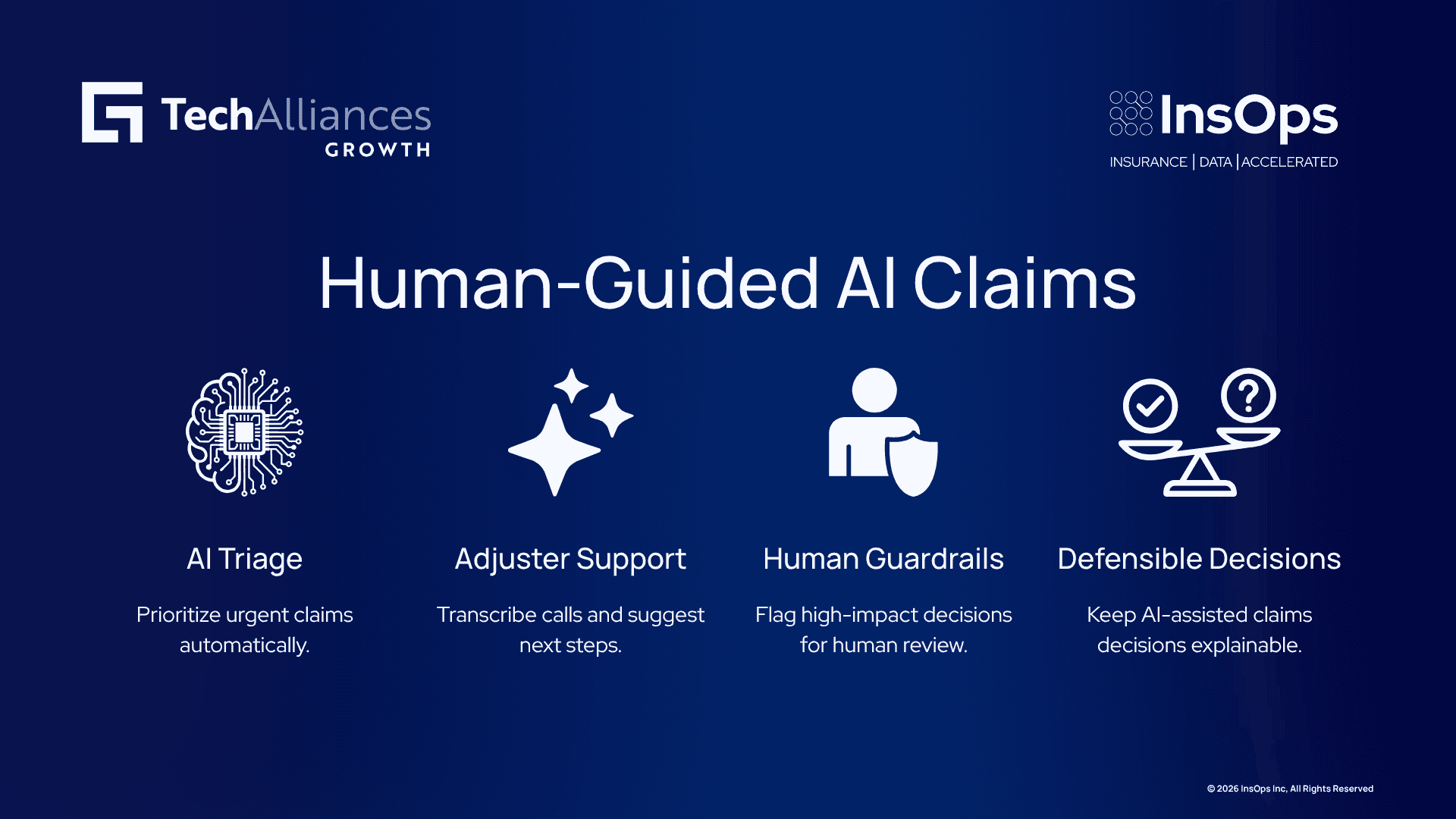
Guardrails matter here. Deloitte's own description of this work includes flags for when a model is about to influence a higher-impact claims decision, and rules that force a hand-off to a human in specific scenarios. That's not a limitation bolted on afterward. It's what makes the process defensible when a regulator or a policyholder asks how a decision was reached.
How InsOps Helps
InsOps is building toward this kind of capability inside LiLa: helping surface the right claim and coverage information to adjusters during a CAT surge, so staff supporting a line they don't normally handle have what they need in front of them.
This isn't a shipped feature today, and InsOps doesn't automate claims decisions or adjuster assignment on its own. A human adjuster remains in control of every decision. Contact us to talk through what this could look like for your CAT response.
FAQ
What is a catastrophe (CAT) adjuster?
A licensed property and casualty adjuster deployed specifically to handle claims from a major event like a hurricane, wildfire, or hailstorm, when volume exceeds what resident staff adjusters can handle.
How do insurers traditionally scale claims handling during a catastrophe?
By pulling adjusters from other lines of business, most commonly auto, to support property claims, and by activating pre-designated CAT response teams.
Can AI make claims decisions during a CAT event without a human?
No. Current AI-assisted tools support triage and back-office tasks like call transcription and next-step suggestions. A human adjuster still reviews and makes the final decision, with guardrails in place to flag when a decision needs human sign-off.