

Underwriters spend 30–40% of their time on administrative triage. They download emails, organize attachments, extract data from loss runs and submission packets, and reconcile conflicting numbers across formats. Meanwhile, brokers move business elsewhere because your team is still sorting files.
When submissions arrive in diverse formats—emails, PDFs, scanned documents, loss runs—traditional triage systems require manual data extraction and validation before underwriters can even assess risk. This administrative burden doesn't just drain time. It directly reduces capacity and slows decisions on high-value opportunities.
This article covers the real bottleneck of manual submission triage, why data structure is the key to intelligent prioritization, and how LiLa assists underwriting teams in extracting and routing submissions without manual field work.
The Hidden Cost of Manual Submission Triage
Underwriters spend up to 3 hours per day on manual data entry, referrals, and triage work. A London Market study found that underwriters devote 30–40% of their working hours to administrative tasks like normalizing documents, re-keying data, and reconciling fields across systems. By the time data is organized and validated, faster competitors have already placed the business elsewhere.
What Underwriters Actually Spend Time On
Download attachments from email. Open each file separately. Find the loss run. Look for the most recent carrier report. Cross-reference "Revenue" listed in the application against "Annual Sales" in the attached financial statement. Confirm which number is authoritative. Check the broker's submission checklist. Flag missing items. Return to email to request additional documents. Repeat with the next submission.
This is the reality of manual triage. The work is predictable, structured, and repetitive. It is also unavoidable without data extraction.
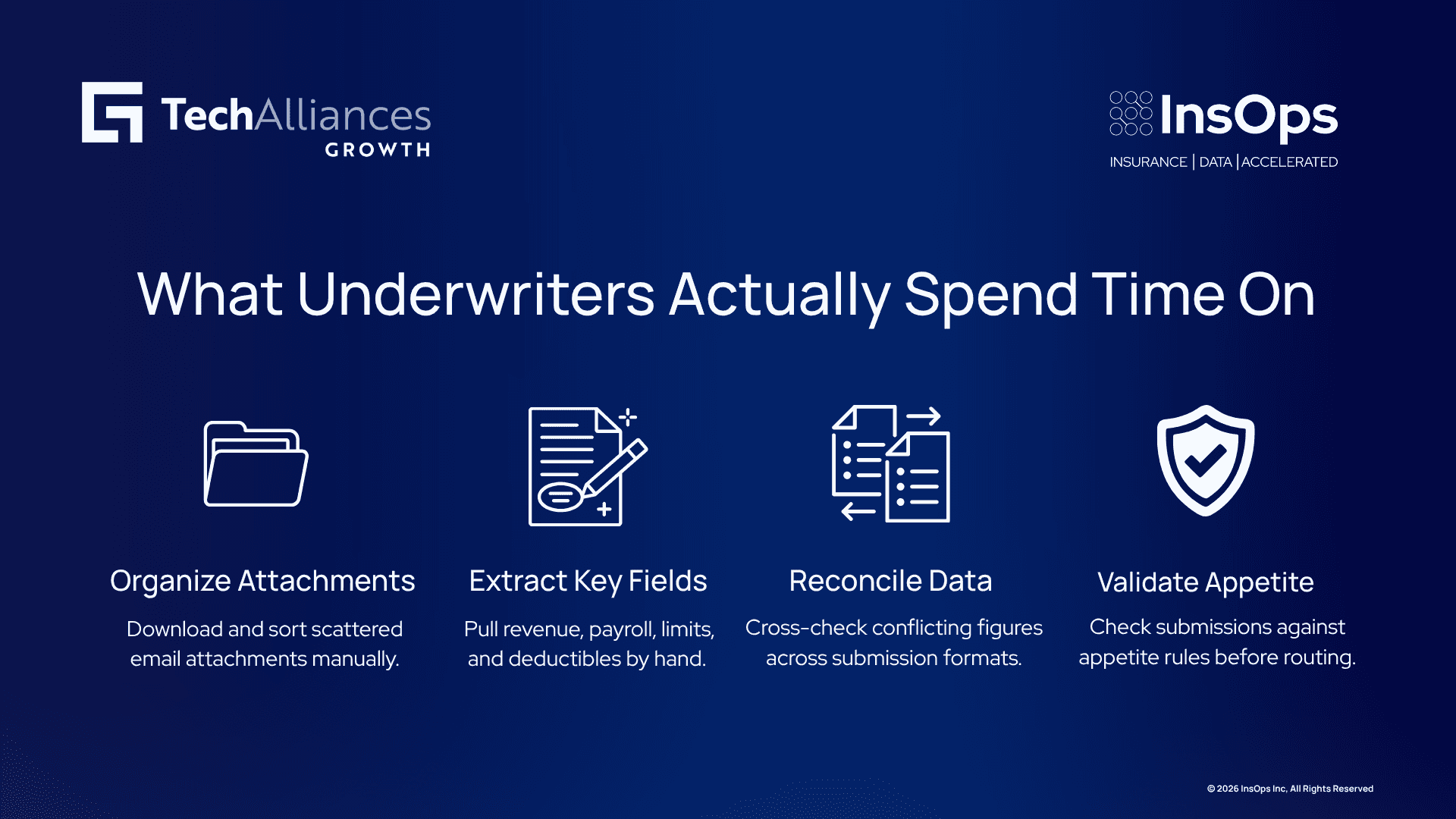
Key tasks consuming underwriter time:
Downloading and organizing scattered email attachments
Extracting key fields: revenue, payroll, total insured value, locations, limits, deductibles
Reconciling conflicting data across submission formats
Validating against appetite rules before routing
The Capacity Impact
A commercial submission typically takes 2–4 hours to triage before an underwriter can assess risk. For a busy underwriting team handling dozens of submissions daily, this creates a processing backlog. Rework due to data inconsistencies extends timelines further. Meanwhile, high-value submissions sit in a queue because administrative triage hasn't surfaced them yet.
The result: slower response to brokers, missed opportunities, and reduced profitability.
Why Submission Triage Is Fundamentally a Data Problem
Submissions do not arrive in a standard format. A single placement might include emails, PDFs of financial statements, scanned loss runs, certificates of insurance, questionnaires, and site photos. Even then, completeness and consistency are not guaranteed.
The core challenge is that underwriting appetite logic requires specific, validated data fields. You cannot route a submission by industry without first extracting and validating the industry classification. You cannot match appetite limits without knowing the total insured value. You cannot assess risk without understanding the loss history. But extracting these fields from unstructured submission packets currently requires manual work.
The Data Extraction Bottleneck
Submissions arrive in formats that vary by broker, MGA, or carrier. Loss runs, in particular, have no universal template. Each carrier formats them differently. Column headers differ. Date formats vary. Currency conventions change. A field labeled "AL" in one loss run means Auto Liability; in another, it means Alabama.
Manual extraction means someone reads each document, finds the relevant field, and re-enters it into a system. For loss runs alone, research shows this process can consume 90–120 minutes per submission.
Appetite Matching Requires Structured Data
Underwriting appetite rules reference specific fields: line of business, industry classification, geographic territory, revenue range, years in business, loss history. If these fields are unstructured or unverified, appetite logic cannot be applied. An underwriter must manually review the submission and make a judgment call.
This creates a validation bottleneck. Appetite matching—which should be automated—instead requires human review because data quality cannot be trusted.
How Intelligent Triage Works
Effective submission triage follows a consistent pattern, regardless of source format:
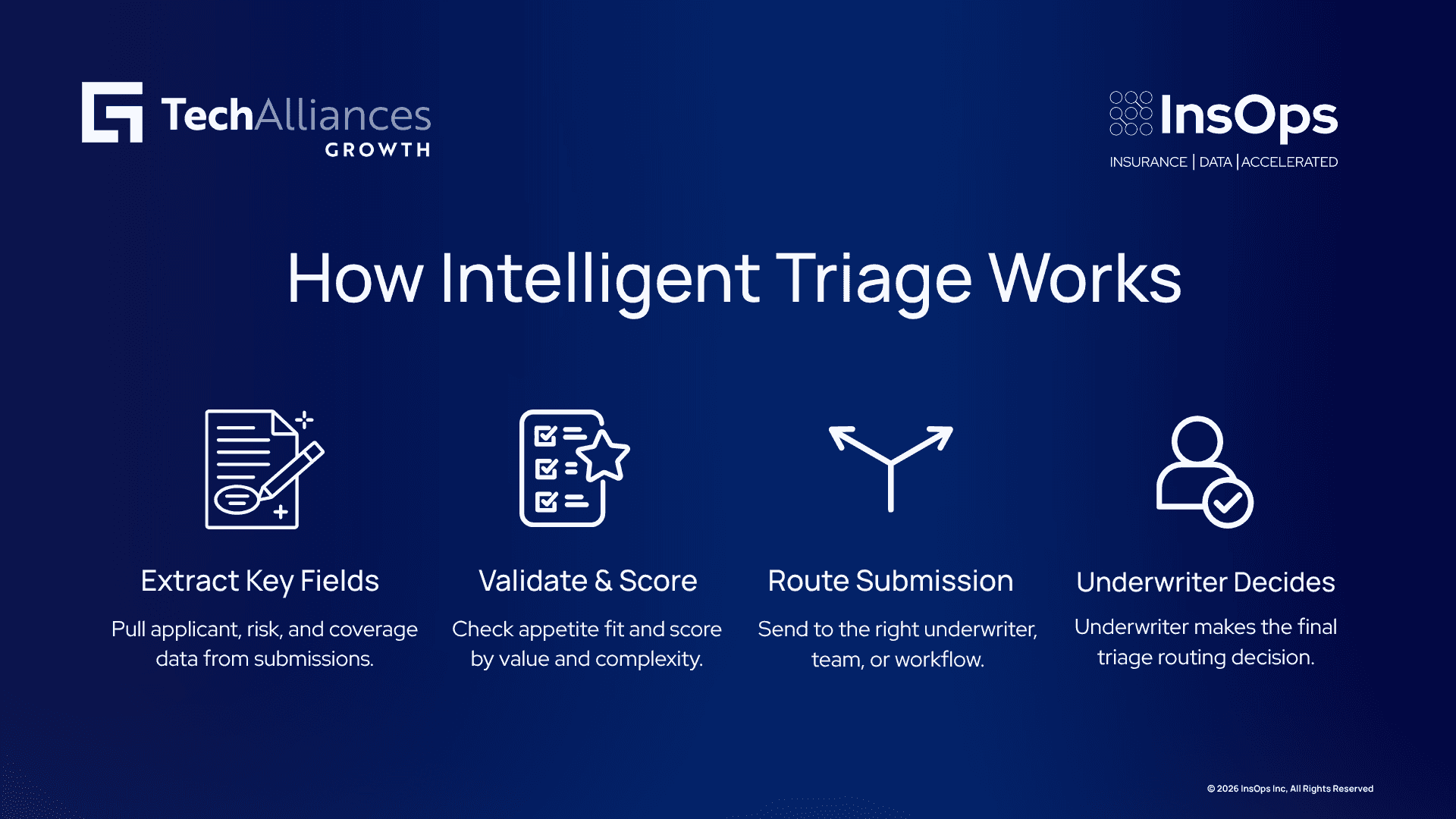
Extract key fields from incoming submission documents (applicant data, risk profile, coverage details)
Validate extracted data against appetite rules and business logic
Score submissions by value, complexity, and fit to appetite
Route to appropriate underwriter, team, or workflow stream
Underwriter decides final triage routing
The critical shift from manual triage is step 1: structured extraction that eliminates manual reading and re-entry.
Automated Field Extraction
Instead of an underwriter manually opening each file and transcribing data, an AI system reads submission documents—regardless of format—and identifies and extracts key fields automatically. It handles semi-structured data: PDFs, mixed document types, scanned images.
The output is consistent, structured data that can be validated, scored, and routed programmatically.
Data-Driven Appetite Matching
Once data is structured and validated, appetite matching becomes straightforward. A submission that matches your preferred risk profile (industry, geography, revenue, loss history) is flagged as high-value and routed first. A submission that falls outside appetite is flagged for decline or referral. Submissions in the gray zone are surfaced to your most experienced underwriter.
This data-driven approach ensures high-value business gets to underwriters first, not based on email order or broker relationships.
How InsOps Assists Submission Triage
InsOps builds an insurance-trained AI that assists underwriting teams with data extraction and intelligent prioritization. LiLa, our insurance-trained LLM, understands insurance submission schemas—applicant information, risk profile, coverage details, loss history—and can extract key fields from diverse submission formats.
Data Preparation Without Manual Work
LiLa reads unstructured submission documents and extracts key fields automatically. It handles emails, PDFs, scanned loss runs, and mixed-format packets. It validates extracted data against source documents and flags inconsistencies.
The underwriter then reviews the extracted data and confirms accuracy. This review step is fast—validating existing data is much quicker than extracting it from scratch.
Intelligent Prioritization
Once data is structured, LiLa scores submissions against your appetite rules and business priorities. High-value, on-appetite submissions surface first. Lower-value or off-appetite submissions are routed to appropriate workflow streams.
Underwriters see recommended routing and confidence scores. They make the final triage decision.
This is human-in-the-loop by design. LiLa assists with data preparation and prioritization. Underwriters own the triage decision. A person reviews and validates every extracted field and routing recommendation before submissions are processed.
Real-World Impact
Teams using data-driven submission triage report consistent gains:
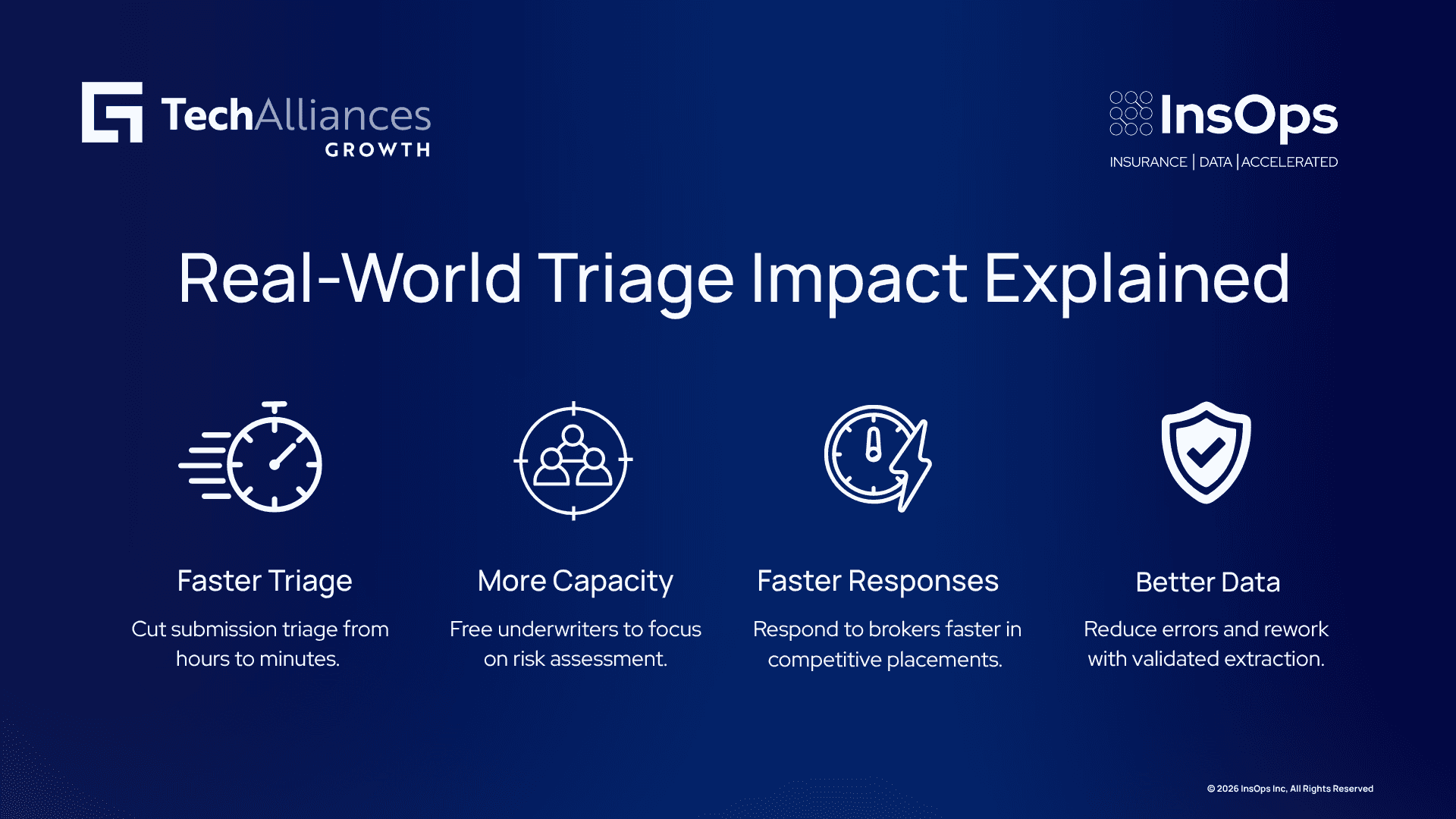
Reduced triage time: From 2–4 hours to 15–30 minutes per submission
Improved capacity: Underwriters focus on risk assessment, not data work
Faster broker response: Competitive advantage in competitive placements
Better data quality: Validated extraction reduces errors and downstream rework
Getting Started With Intelligent Triage
Intelligent submission triage requires three elements:
Intake channels mapped: Where do submissions arrive? Email, agency portal, MGA feeds, or all three?
Underwriting workflow defined: What fields matter for triage? What appetite rules apply? What routing paths exist?
Data extraction configured: LiLa learns your submission schema and appetite logic, extracting and scoring submissions accordingly.
The integration is straightforward. Submissions flow into your underwriting workflow without manual organization. Underwriters receive extracted data with scoring and routing recommendations. They validate and decide.
How InsOps Helps
InsOps builds an insurance-trained AI that assists with submission data extraction and prioritization. LiLa, our insurance-trained LLM, runs inside your own environment, so applicant and risk data never leaves controlled infrastructure. A person reviews and validates every extracted field and triage recommendation before submissions are routed.
Our offering connects to your incoming submission channels—email, agency portals, MGA feeds—so submission data flows directly into your underwriting workflow without custom engineering or manual organization. InsOps assists with data preparation and prioritization so underwriters focus on risk assessment and underwriting decisions, not administrative triage.
If you are evaluating how to reduce underwriter triage time without manual extraction and data validation, contact us to talk through what this could look like for your operation.
Frequently Asked Questions
What exactly is submission triage?
Submission triage is evaluating and prioritizing incoming insurance applications. Submissions are sorted by value and fit to appetite so high-value opportunities reach underwriters first.
How long should submission triage take?
Manual triage takes 2–4 hours per commercial submission. Intelligent triage with automated data extraction can reduce this to 15–30 minutes, freeing underwriters for higher-value work.
What data do you need to prioritize submissions?
Effective triage requires applicant data (name, industry, location), risk data (coverage types, limits, loss history), and submission metadata. Data must be structured and validated to enable appetite matching.
How do you handle submissions in different formats?
InsOps' LiLa can extract key fields from diverse submission formats—PDFs, emails, scanned documents, loss runs—and map them to your internal schema automatically.
Can AI triage replace underwriter judgment?
No. LiLa assists by preparing and prioritizing data. Underwriters make final triage decisions. This is human-in-the-loop by design—AI handles data work, humans own the routing decision.
What's the difference between submission triage and routing?
Triage is evaluating and prioritizing submissions. Routing is directing them to a specific underwriter or team. Triage informs routing, but humans make routing decisions.
How do you ensure data quality in automated extraction?
InsOps validates extracted fields against source documents and flags inconsistencies for underwriter review. Underwriters confirm accuracy before submission routing.
What if my submissions are highly nonstandard?
LiLa is trained on insurance schemas across policy, claims, and underwriting. Even nonstandard submissions can be mapped to your internal schema with underwriter validation.