

Your loss ratio is climbing. Premiums seem competitive. Claims track historical trends. Yet underwriting margins are shrinking quarter over quarter. The culprit hides in data.
Pricing accuracy—how well your models predict claims costs—drives everything. Accurate models charge the right premium for the right risk. Drifting models leave money on the table or price you out of business.
This article explains why pricing accuracy protects margin, what breaks your models, and how to fix it.
Why Pricing Accuracy Matters More Than Most Think
Pricing accuracy starts with your loss ratio: total claims paid divided by total premiums earned. A 60% loss ratio means you pay $60 in claims on $100 premium. A 70% ratio means you pay $70. That 10-point swing wipes out profit on an entire line.
For a midmarket P&C carrier writing $500 million annually, 1-point loss ratio improvement equals $5 million in profit. That's pricing leverage.
Allstate's 2024 telematics program proves this. Real-time driving behavior data fed into their pricing models delivered a 27% loss ratio improvement on telematics-enabled customers. On a $64 billion base, applying that to just 20% of their portfolio creates tens of millions in profit.
What changed? Better data. Not better actuaries. Not fancier math. Data that reflected reality.
The inverse is equally destructive. Underpriced segments compound. Mispriced business sits on the books for months before claims development reveals the problem.
What's Actually Breaking Your Pricing Models
External factors matter: inflation, weather, claim patterns. But they rarely cause accuracy loss.
The real problem is data lag.
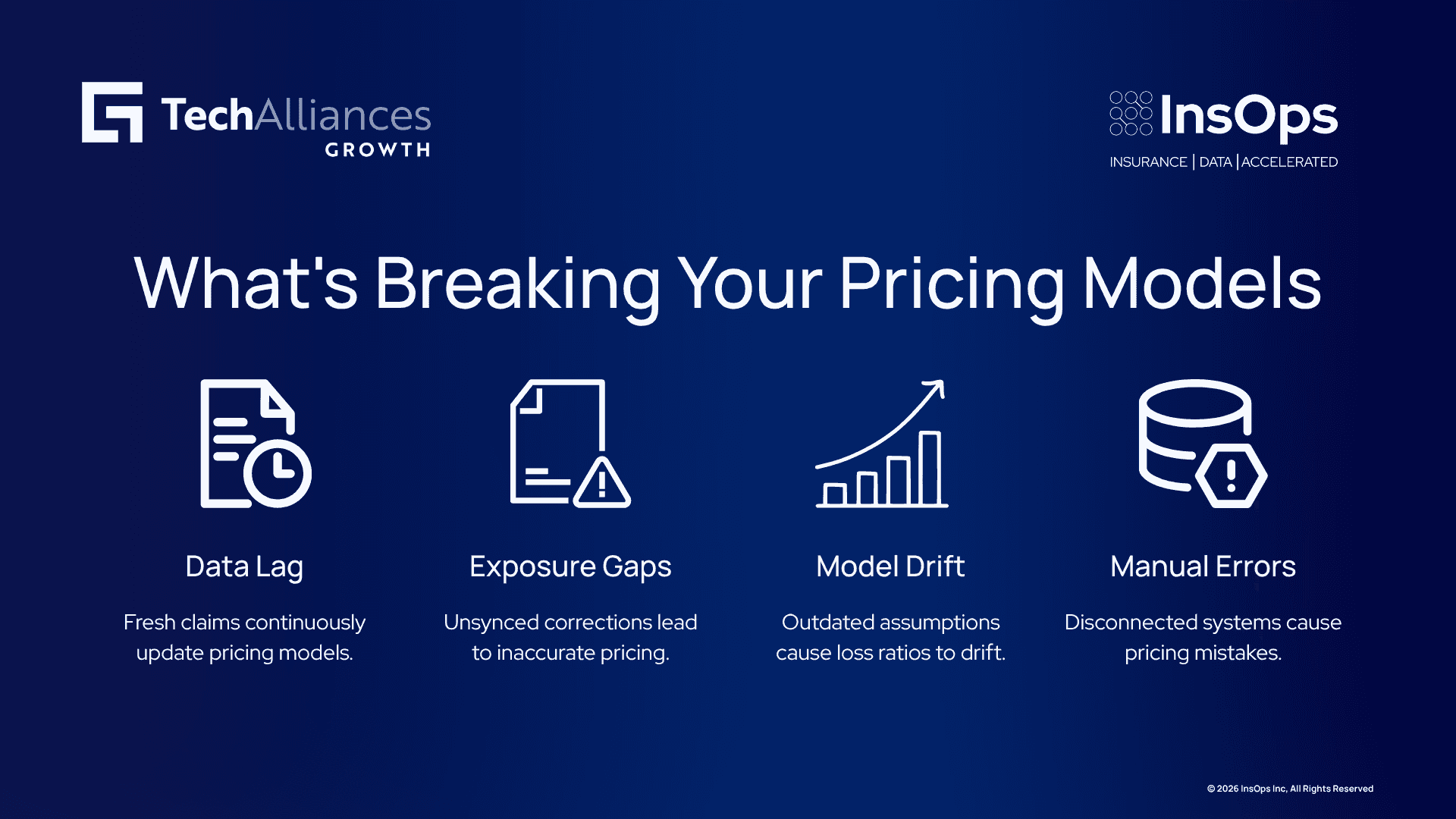
Stale Claim Histories
Your model trained on June data is still running in September. Three months of fresh claims sit in your system, not flowing to pricing. Quarterly refreshes build on outdated patterns.
Real-time flow fixes this. Fresh claims update models continuously, reflecting current loss environment, not lagged data.
Incomplete Exposure Data
A policy has wrong square footage or occupancy. Underwriting flagged it but the correction hasn't synced to your data warehouse. Your model prices it as retail when it's actually office. Result: mispricing, margin loss.
This happens thousands of times across large portfolios. Manual data handling creates friction, which creates lag, which creates inaccuracy.
Model Drift
Your 2022 model was accurate. Market conditions shifted: claims inflation, new behavior, new competitors. The model's assumptions don't hold. Refreshing requires actuarial, IT, and testing time. Months pass. Loss ratios drift. Q1 business is priced at yesterday's rates.
Manual Data Errors
A $50,000 reserve gets entered as $500,000 in one system. Your pricing team uses $500K in reserve assumptions. Your model over-estimates severity. You overprice. You lose volume.
These failures happen daily across disconnected systems with manual touchpoints at every step.
How Leading Carriers Improved Pricing Accuracy
The industry has proven that pricing accuracy isn't hard to improve if you fix the data problem
Allstate: 27% Loss Ratio Improvement
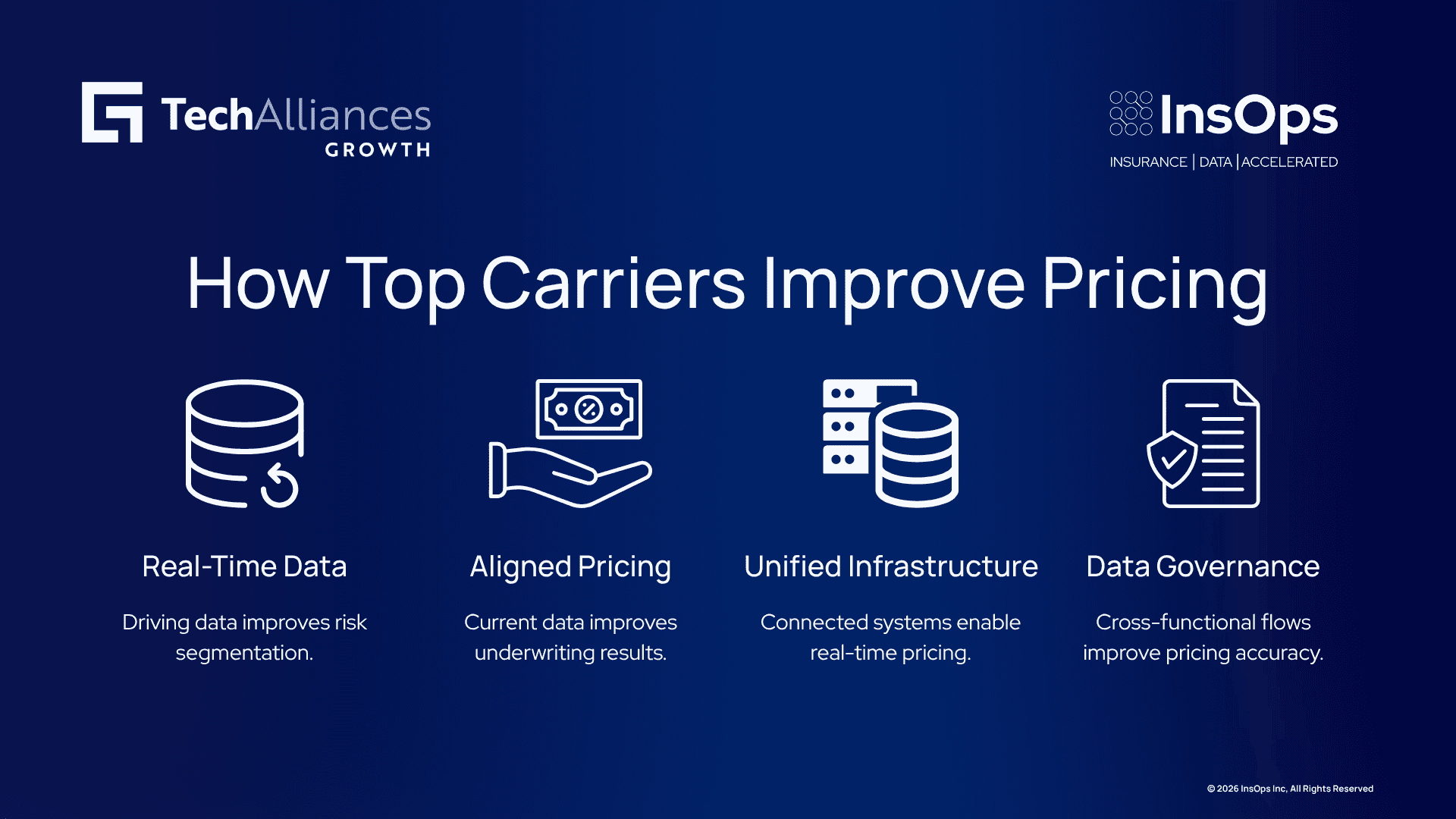
Allstate's telematics success came from building a data pipeline, not better math. Driving behavior flowed directly into pricing engines in near-real-time. Models segmented by actual risk, not demographics. Result: 27% loss ratio improvement, opening profitability on previously risky segments.
Industry Shift: From Annual to Real-Time
Verisk and APCIA reported a $24.8 billion underwriting gain in 2024, reversing a $21.8 billion loss in 2023. The turnaround came from "more aligned pricing" as carriers matched premiums to actual risk via current data.
S&P Global projected 2024-2025 combined ratios of 98-100%, stabilizing after years of losses. That stabilization came from pricing discipline, which came from better data.
The PricingCenter Trend
Guidewire's PricingCenter signals industry direction: unified infrastructure connecting directly to core system data. The pitch centers on speed, precision, and real-time updates. Why? Carriers know annual-refresh models leave money on the table.
All three examples share one thing: data flowing into pricing systems without artificial delays or manual steps.
The Data Accuracy Imperative
Pricing accuracy is a governance problem, not a technical one.
Your claims system knows that one class of business settles 15% higher than your model assumes. That information sits in tables. Pricing doesn't see it until quarterly review. Your model doesn't know until you manually update it.
Your policy system has updated exposure data. A building was upgraded. A business moved to a safer location. Risk decreased. But if that update doesn't reach pricing before renewal quotes go out, customers get inaccurate rates.
External data sharpens pricing if integrated: telematics, IoT, weather, economic indicators. Integration requires infrastructure and governance, not just data.
Pricing accuracy is cross-functional. Actuarial determines what data matters. Analytics builds the flow. IT integrates it. Underwriting flags exceptions. Claims feeds updates back.
Building a Pricing Accuracy Framework
You don't need to overhaul everything at once. Start with these four steps.
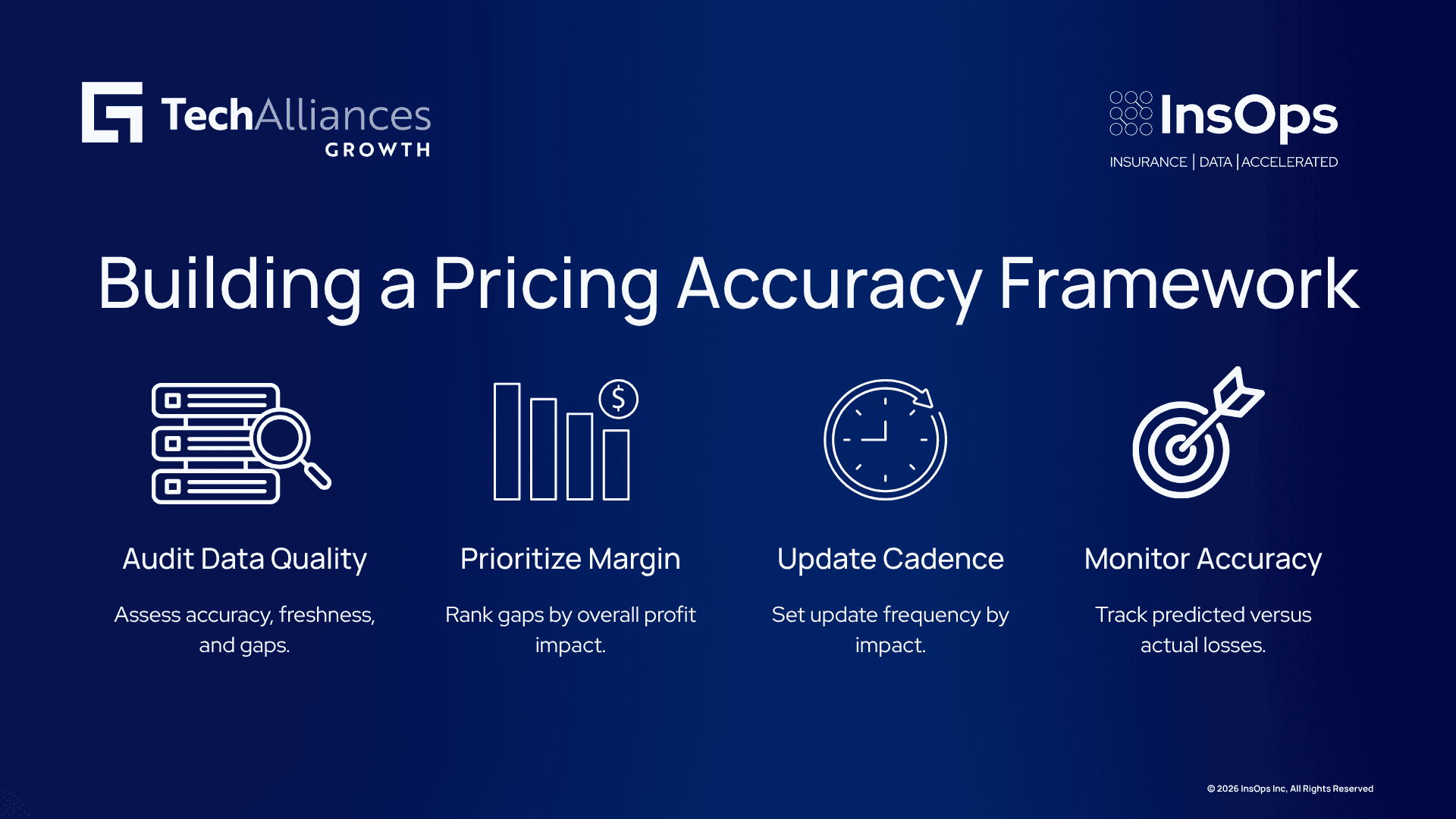
Step 1: Audit Your Data Quality
List every element feeding your pricing models: claim severity, claim frequency, exposure attributes, renewal history, external indicators. For each, ask: How current is this? How accurate? How much lag before it breaks our model?
You'll find gaps. One carrier's catastrophe modeling used 18-month-old weather data. Another's fraud indicators didn't flow to pricing at all. Another's commercial exposure data lagged underwriting by 45 days.
Document gaps. Don't fix all at once.
Step 2: Prioritize by Margin Impact
Some gaps cost millions. Others are nuisances. Severity data lagging 30 days hurts more than incomplete addresses.
Map each gap to margin impact: How much profit if fixed? Rank by impact. That's your roadmap.
Step 3: Establish Data Update Cadence
For each critical element, decide update frequency. Catastrophe modeling needs weather weekly or daily. Exposure classification needs monthly. Claims severity needs real-time or 24-hour tolerance.
Match frequency to business impact. Don't over-invest in real-time for low-impact data. Don't tolerate quarterly delays for high-impact data.
Step 4: Monitor Model Accuracy Continuously
Stop waiting for year-end loss development. Build dashboards showing monthly whether predicted loss ratios match actual by segment.
When a segment drifts (predicted 65%, actual 72%), you see it immediately. Course-correct mid-quarter instead of bleeding margin all year.
Insurance-trained AI accelerates this. Our insurance-trained AI model identifies gaps faster than manual audits and flags them automatically. Trained on thousands of insurance datasets, it spots patterns that apply to your situation.
How InsOps Helps
Pricing accuracy depends on data flowing cleanly from claims, policy, and external sources into your pricing engine. That flow is hard to build alone.
InsOps assists with the data pipeline. LiLa, our insurance-trained AI model, understands how claims data maps to pricing inputs, how policy attributes relate to risk, and how external data connects to underwriting segments. It helps your teams identify which data gaps drive margin loss and validate that data feeding your pricing models is correct before use.
Every step includes human review. A person validates data mappings. A person approves before production use. The AI assists. Your team decides.
If you're evaluating how to tighten pricing accuracy without months of delay, contact us to talk through what this could look like.
Frequently Asked Questions
What's a "good" loss ratio target?
Depends on your line and expense structure. Personal auto typically targets 60-65%. Commercial varies. Consistency matters: hitting target month after month means pricing is accurate and risk selection works. Persistent misses signal data or model drift.
How often should we update pricing models?
Traditional: once or twice yearly. Competitive now: monthly. Advanced: continuous monitoring with updates triggered by segment drift. Start monthly. If data quality supports it, move to continuous. Match frequency to how fast your loss environment changes.
Can predictive modeling eliminate pricing inaccuracy?
No. Predictive models are only as good as the data they're trained on. A perfect algorithm fed stale or incomplete data will produce inaccurate prices. Better data matters more than better algorithms.
What role does external data play in pricing accuracy?
Significant, but only if integrated. Telematics (in auto), IoT sensors (in property), weather data, economic indicators—all sharpen pricing if they're current and clean. The problem: most carriers don't have infrastructure to integrate external data into pricing workflows. That's changing.
How do we measure whether our pricing model is accurate?
Compare predicted loss ratios to actual by segment. If you predict 65% for small commercial and see 68%, the model has drifted. The gap shows how much accuracy you've lost. Ideal: actual tracks within 2-3 points of predicted.
How long does it take to improve loss ratios through better pricing?
Quick wins (data cleanup, model refresh): 60-90 days. Structural improvements (data pipeline, real-time integration): 4-6 months. Significant recovery: 12 months. You can't reprice existing business retroactively; improvements compound as you turn portfolio through renewals.
What's the relationship between pricing accuracy and customer retention?
Strong. If you underprice a segment and have to correct it at renewal, customers with accurate premium land and renew. Customers you underpriced feel rate shock and shop. Conversely, customers in segments you overprice see your rates as uncompetitive. Accuracy across the board means predictable rates, fewer surprises, higher retention.
Why is real-time data important for pricing?
Because markets move and your models can drift between refreshes. A real-time data feed lets you detect drift immediately and adjust pricing before you've mispriced significant new business. It also lets you respond to external events—a major natural disaster, a regulatory change—faster than carriers still doing annual pricing.