

Underwriters at most P&C carriers spend hours extracting data from multiple disconnected systems. Policy information lives in a legacy core system from the 1990s. Risk data feeds flow into Guidewire PolicyCenter. Claims history sits in a separate platform. Customer data lives in a CRM that nobody fully trusts. And critical third-party data—credit scores, loss histories, exposure mapping—arrives in formats that require manual entry or spreadsheet manipulation.
The result is predictable. Quote turnaround stretches from hours to days. Underwriters see incomplete risk profiles. Pricing decisions become inconsistent. Data entry errors force rework cycles. And capacity stalls because every submission requires manual compilation before an underwriter can even evaluate it.
While 74% of insurers acknowledge that legacy systems hinder their business growth, only 28% have developed a comprehensive modernization plan. The gap between awareness and action isn't hesitation. It's a confidence problem. Carriers cannot credibly plan consolidation for systems they don't fully understand.
This article walks you through a practical roadmap for consolidating fragmented underwriting data through API-based integration and real-time workflows. You'll learn how to create a unified workspace without migrating off the legacy core or building custom code.
The Cost of Data Silos in Underwriting
Data silos in underwriting aren't just inefficient. They have measurable business impact.
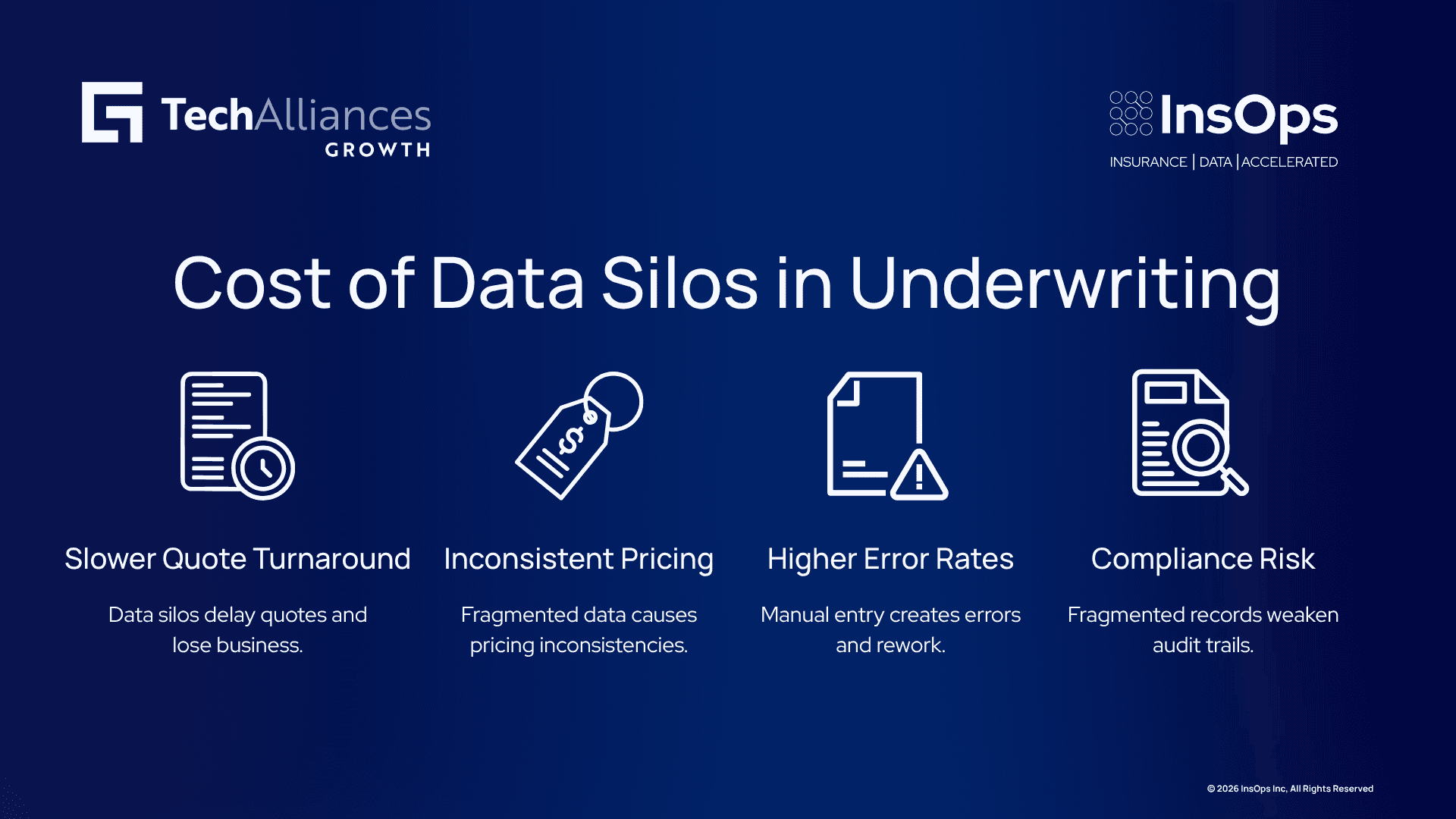
Slower Quote Turnaround
When underwriters manually compile data from separate systems, each submission adds 1-2 days to turnaround. Quote delays mean lower win rates on new business. Brokers shop to competitors. Momentum is lost.
That delay compounds across the portfolio. When 30% of quotes miss windows because of data compilation time, the portfolio-level impact is measurable: lower close rates, lost new business, reduced competitiveness.
Inconsistent Pricing
Different underwriters see different risk data depending on which systems they access first and how they cross-reference information. This leads to pricing inconsistency across the same line of business. Surcharges get missed. Discounts get misapplied. Premium leakage follows.
Over a year, premium leakage from inconsistent pricing and missed surcharges runs into millions for mid-market carriers.
Higher Error Rates
Manual data entry produces errors at predictable rates. Field mismatches between systems force rekeying. Missing data in one system means guessing or requesting clarification. Each error requires rework. Rework delays closure. Delayed closures accumulate into backlog.
Compliance and Audit Risk
Fragmented records make audit trails weak. When underwriting decisions are based on data pulled from disconnected systems at different times, consistency is hard to demonstrate. Regulators expect carriers to justify pricing and risk-selection decisions. Fragmented data makes that justification difficult.
Capacity Constraints
Manual data workload limits how many submissions underwriting can process. Hiring more underwriters doesn't scale the problem—it just distributes it. The bottleneck is structural. Until data flows in unified format, capacity improvement requires pure headcount growth and diminishing returns.
Where Data Silos Originate
Understanding root causes helps you recognize why consolidation is different from other modernization projects.
Legacy Core Plus Modern Systems in Parallel
Most carriers run 10+ years of legacy policy systems alongside newer Guidewire implementations. The data models don't align. APIs don't exist between them. Both systems are in production, both are critical, and neither can be switched off during consolidation.
Many insurers have accumulated multiple policy administration systems through acquisitions, with each carrying its own data model and business rule implementation. The integration patches applied after each M&A deal were never rationalized. Undocumented dependencies mean a billing change in one acquired system can trigger policy status errors in another.
Fragmented Third-Party Data
Risk data comes from multiple vendors—credit bureaus, loss history providers, CLUE databases, industry exposure mapping. Each source has different formats, update frequencies, and governance rules. None of them were designed to feed into a single unified workspace.
Manual Workflows Hardcoded into Process
Email handoffs, spreadsheets, file shares. Teams evolved workarounds over years. Nobody has a central governance layer. The "process" is actually a series of manual connection points.
No Single Source of Truth
When policy, claims, customer, and third-party data all live separately, no version is definitive. Teams see different versions. Reconciliation happens manually, late, or not at all.
Tightly Coupled System Architectures
Old systems have monolithic designs where databases and business logic are interdependent. Adding new integrations or changing data models is high-risk because one small change can break something critical. This architectural tightness is why even experienced teams hesitate to touch legacy systems.
Consolidation Approaches Compared
You have options for consolidating data. Each has different trade-offs. Understanding them helps you pick the right starting point.
Approach | Setup Time | Ongoing Cost | Data Lag | Engineering Needed | Risk Level |
|---|---|---|---|---|---|
Manual + Spreadsheets | Minimal | Low | Hours to days | None | High (errors, audit exposure) |
Batch ETL / Data Warehouse | 6-12 months | Medium-High | Hours to days | High (custom pipelines) | Medium (complexity) |
API-Layer Integration | 3-6 months | Medium | Real-time | Medium (custom APIs) | Medium (governance) |
Real-Time Managed Integration | 2-4 months | Medium | Real-time | Low (pre-built connectors) | Low (managed service) |
DIY Batch ETL / Data Lake
Organizations often implement a data warehouse or data lake to consolidate data. The advantage is analytics-ready structure. The disadvantage is timeline. Underwriters rely on information from different sources to assess risk and make informed decisions. However, while the volume and variety of available data have increased dramatically, many insurers continue to depend on fragmented legacy systems that make it difficult to transform data into actionable insights.
Batch ETL takes 12-18 months and high engineering cost. Data updates on a schedule, not in real-time. Good for strategic analytics, slow for operational underwriting where decisions need immediate access to current data.
API-Layer Middleware
Faster than ETL, but requires custom connectors for each system. Every new integration point is engineering work. Ongoing maintenance burden sits with you.
Real-Time Managed Integration
Pre-built connectors to Guidewire. AI-powered auto-mapping. Human-in-the-loop validation. No custom code needed. This is the consolidation approach that fits most carriers with tight timelines and limited engineering capacity.
Building Your Unified Underwriting Workspace
A five-phase approach reduces risk and delivers incremental value.
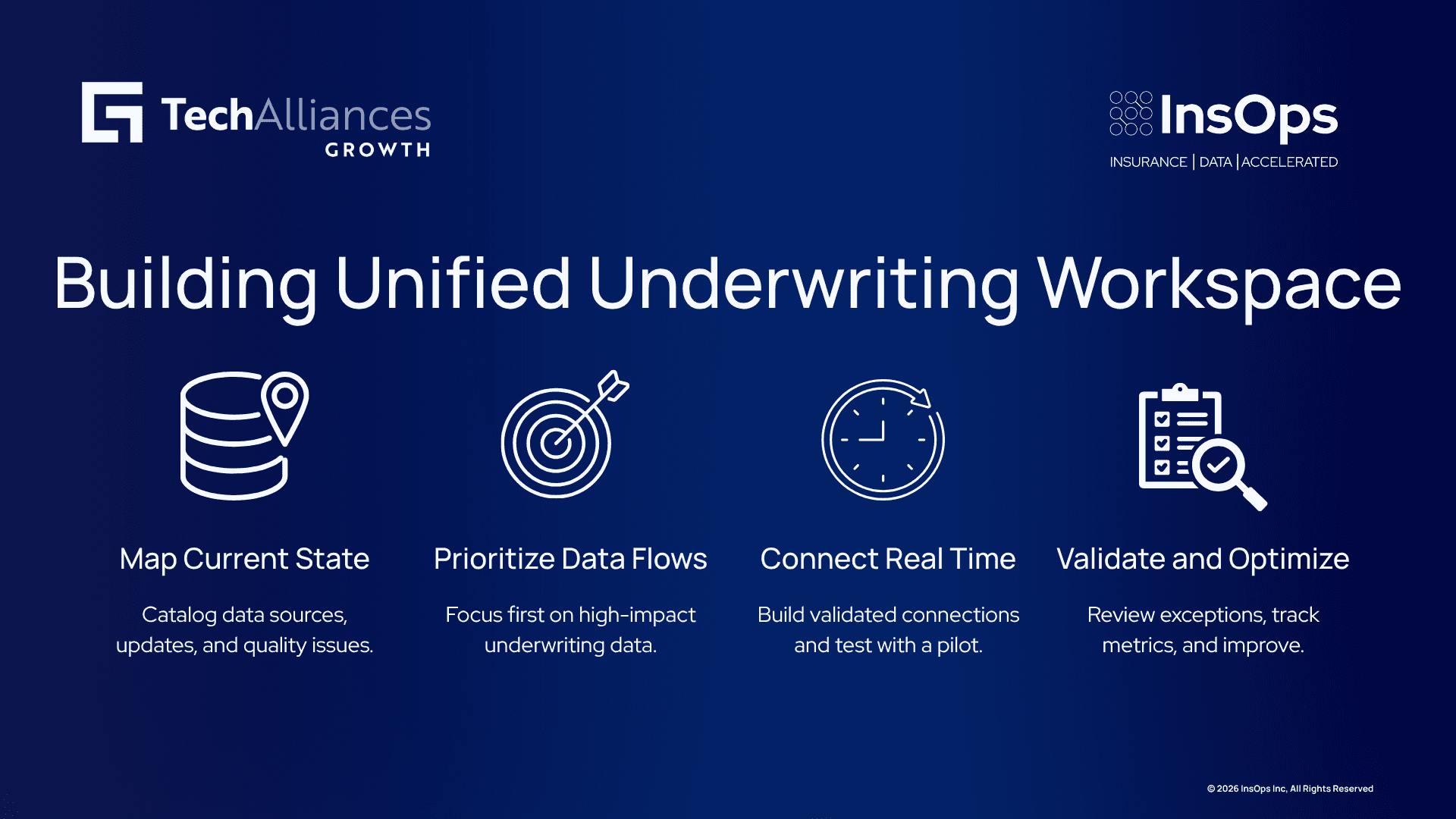
Phase 1: Map Your Current State
Identify all data sources. Underwriting, policy, claims, risk feeds, internal systems. Catalog what data lives where, how often it updates, and what quality issues exist. Don't skip this. Many consolidation programs stumble because they skip discovery and start integrating before they understand what they're connecting.
Phase 2: Identify High-Impact Data Flows
Not all data is equally important. Policy and risk data are needed for every quote. Claims history drives loss-based pricing. Third-party sources add context. Prioritize the flows that underwriters ask for most. Start there.
Phase 3: Set Up Real-Time Connections
Use APIs or managed integration services to establish connections between sources and PolicyCenter. Configure validation at the point of entry. Test with a pilot line first—auto commercial, for example. Pilots reduce risk and build organizational confidence.
Phase 4: Implement Human-in-the-Loop Validation
Configure alerts when data quality drops, conflicts occur, or unusual patterns emerge. Underwriters review and approve. Start with manual review. Automate gradually as data quality stabilizes and patterns become clearer.
Phase 5: Measure and Optimize
Track quote turnaround, pricing consistency, error rates. Adjust data priorities based on impact. Dashboard tracking of key metrics keeps focus on outcomes, not just effort.
Key Metrics to Track
Quote turnaround time: Target <4 hours (vs. 2-3 days currently)
Manual data entry steps per submission: Target 0
Pricing variance between underwriters: Target <5%
Data completeness score: Target 95%+
Audit findings: Target 0 related to decision consistency
How InsOps Helps
InsOps builds an insurance-trained AI model (LiLa) that assists with data mapping, validation, and real-time flow orchestration. LiLa runs inside your environment, so policy, claims, and customer data never leave controlled infrastructure.
Our Integration Gateway connects to Guidewire PolicyCenter, ClaimCenter, BillingCenter, and UnderwritingCenter. LiLa automatically maps payloads from any source into Guidewire structures. A person reviews and validates every mapping before it goes live.
The difference from generic AI or manual integrations: LiLa understands insurance domain logic. It knows NAIC compliance rules. It understands how data relationships work across policy, claims, and billing.
InsOps migrates legacy data into Guidewire and keeps it flowing in real time.
If you are evaluating how to consolidate underwriting data without a 12-month migration project or building custom pipelines, contact us to talk through what real-time data consolidation could look like for your operation.
Frequently Asked Questions
What is a data silo in insurance underwriting?
A data silo occurs when information (policies, claims, customer data, risk scores) remains trapped in separate, disconnected systems. Underwriters manually piece together information instead of accessing a unified view.
How do data silos affect underwriting speed and accuracy?
Silos add 1-2 days to quote turnaround through manual compilation time, increase error rates from duplicate data entry, and lead to inconsistent pricing decisions across underwriters.
What's the difference between consolidation and migration?
Consolidation creates real-time connections between existing systems without moving data off the legacy core. Migration replaces the legacy system entirely—a 12-18 month, high-risk, high-cost project. Consolidation is faster and lower-risk.
How long does it take to consolidate underwriting data?
API-based integration typically takes 3-6 months. Managed integration with pre-built connectors is faster, 2-4 months. Full data warehouse/lake projects take 12-18 months.
What are the key metrics to track after consolidation?
Quote turnaround time, data completeness, pricing consistency between underwriters, manual steps per submission, and audit findings related to decision consistency.
Can AI help with data consolidation?
Yes. Insurance-trained AI can assist with mapping disparate data into consistent structures, detecting quality issues, and flagging conflicts. A person always reviews and approves before data flows to production.
What's the role of Guidewire in data consolidation?
Guidewire (PolicyCenter, ClaimCenter, etc.) often serves as the central hub. Integration solutions connect legacy systems and third-party data sources into Guidewire via APIs, creating a unified data platform for underwriting.
Do I need to move data into a cloud data lake?
Not necessarily. Many insurers achieve consolidation through API-layer integration and real-time connections without building a separate data warehouse. Start with operational integration first, add analytics infrastructure later if needed.