

Experienced underwriters carry years of decision logic in their heads. They know which risk profiles to approve, which policy wordings prevent claims disputes, and which cases need underwriting committee review. But that expertise dies with every departure.
The cost is immediate and measurable. New underwriters take 3 to 6 months to reach productivity. During that ramp period, they make different decisions than experienced peers on identical applications. Some decisions get caught in claims, triggering late-discovered errors, higher reserves, and litigation. Others sail through, creating silent portfolio drift that accumulates until underwriting quality audits flag inconsistencies.
This article covers how insurers build underwriter copilots—AI assistants trained on historical underwriting decisions and policy guidelines—to surface relevant precedents and recommendations at the moment of decision. We'll walk through how to capture underwriting knowledge, deploy copilots without adding manual review burden, and measure success.
The Underwriter Knowledge Gap
Underwriting expertise sits in decisions. An experienced underwriter reviews an application and approves it at a lower premium than a junior peer would quote for the same risk. That delta is institutional knowledge. It reflects years of seeing how similar cases played out, which risk factors matter most, and how to price uncertainty.
When underwriters leave, that knowledge leaves with them. Successors inherit a blank template and learn by doing—which means the first 100 or 200 cases they underwrite are training. Mistakes get expensive fast. A single underwriting error in commercial auto can cascade across a portfolio: an underpriced risk becomes claims, claims trigger coverage disputes, disputes trigger litigation, litigation bleeds into defense costs and settlement.
Manual Onboarding Is Costly and Inconsistent
Today's underwriter onboarding relies on shadowing and rule books. A junior underwriter sits with an experienced peer for a few weeks, watching decisions unfold. The experienced underwriter explains reasoning verbally but rarely codifies it. Rules get written down—"Deny theft if prior loss history >2 in 5 years"—but rules don't capture the grey zone where underwriting judgment lives. A senior underwriter might approve a similar risk because she recognizes a risk profile that data alone misses.
This inconsistency surfaces everywhere. Two underwriters on the same team quote different premiums for identical applications. Risk committee reviews get inconsistent decisions, requiring escalation. New hires take twice as long to achieve velocity because they're re-discovering patterns that should have been visible in precedent.
Expertise Retention Failures Surface in Claims
Underwriting errors don't announce themselves at issue. They emerge in claims. A risk that was underpriced takes losses faster than reserve models expected. A risk that had competing coverage language gets disputed when the claim is denied. An underwriting decision that ignored a red flag becomes a litigation cost two years later.
Claims teams then have to reverse-engineer why the original underwriting decision was made—and often can't, because documentation was sparse or the deciding underwriter has left. This forces claims to either overpay (to close quickly) or litigate (to defend the decision), neither of which is low-cost.
How Underwriter Copilots Work
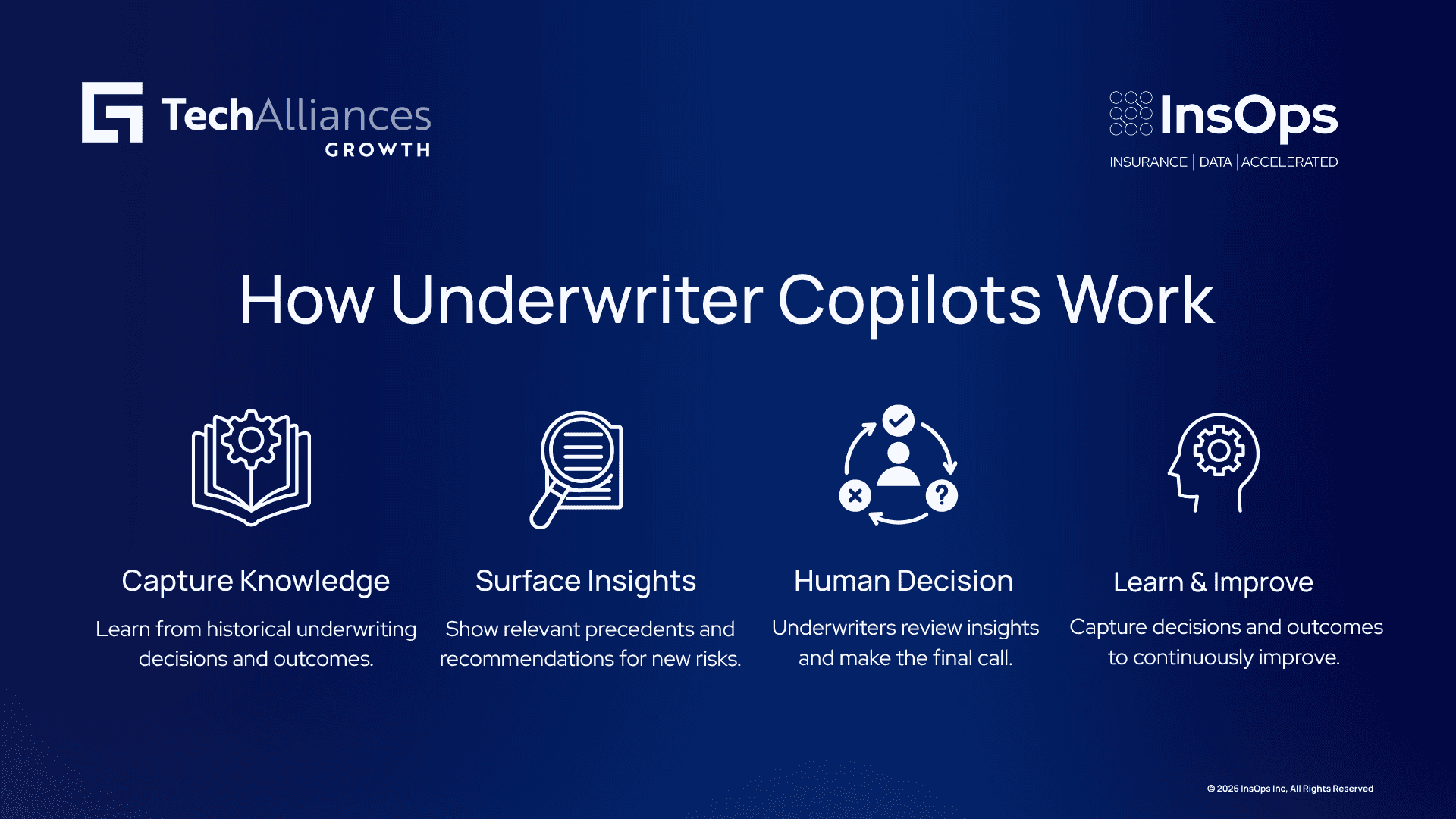
An underwriter copilot captures underwriting knowledge and surfaces it at the moment a new application lands. The flow has three steps: Capture, Surface, Validate.
Step 1: Capture Underwriting Knowledge
Start by ingesting historical underwriting decisions. This includes approved and declined applications with final underwriting action, premium adjustments and relativity assignments per risk, underwriting guidelines and policy exclusions used per decision, risk scoring factors and classification logic, and committee escalation reasons and outcomes.
The captured data trains the copilot on patterns: "Applications with theft history >2 claims in 5 years were approved 15% of the time. When approved, they received 25% premium loadings. When declined, the reason was code 42 (loss history exceeds appetite)."
This isn't a complete rulebook. It's a compressed view of institutional decision-making. The copilot learns what experienced underwriters actually do, not what the manual says they should do.
Step 2: Surface Recommendations at Point-of-Decision
When a new application arrives, the copilot surfaces relevant precedents. It shows similar historical cases, recommends a risk score and premium adjustment based on closest matches, and highlights policy language that applies to the specific risk profile. It can also flag risk factors that typically trigger committee review.
The underwriter sees this in real-time while reviewing the application. They're not being told what to do. They're being shown what similar cases looked like and how they were decided.
Step 3: Underwriter Reviews and Decides
The underwriter retains full authority. They review the application, see the copilot's recommendations, and make their own decision. If they approve at a different premium, that decision gets logged. If they decline when the copilot suggested approval, that reason gets captured.
Over time, the copilot learns from feedback. It updates its recommendation model based on outcomes the underwriter selects. This is human-in-the-loop learning: the AI assists, the human decides, the model improves.
Building Copilots Inside Insurance Data
Underwriter copilots aren't generic chatbots. They need to understand underwriting data deeply. They must recognize risk classification fields, understand policy language semantics, and identify decision factors that matter in P&C insurance.
This is where a domain-specific AI makes a difference. Generic large language models trained on web text don't understand that a "scheduled limit" field in a commercial property policy affects underwriting decisions, or that a "loss history" field encoded cryptically in a legacy system carries meaning that column names alone won't reveal.
LiLa Learns Underwriting Semantics
InsOps' insurance-trained AI model, LiLa, understands underwriting data structures from the ground up. It recognizes policy data relationships—how premium adjustments relate to risk classification, how endorsements cascade through policy language, how loss history correlates with underwriting appetite.
When LiLa ingests historical underwriting decisions, it doesn't just see rows and columns. It interprets field meaning in insurance context. It learns that a "liab_limit" field in one carrier's schema and a "gen_agg_limit" field in another encode similar underwriting logic. It recognizes which fields are decision-drivers and which are noise.
This semantic understanding is what turns historical data into a predictive copilot. Without it, a generic model would surface recommendations based on surface-level pattern-matching instead of underwriting logic.
Human-in-the-Loop Validation
Every recommendation the copilot makes goes to an underwriter for validation. The underwriter reviews it, accepts it, modifies it, or rejects it. That validation feedback trains the copilot to improve.
This is critical. Copilots that run without human review accumulate errors silently. A recommendation that seemed reasonable based on historical data but misses context can be approved by the system and cause damage downstream.
Human-in-the-loop also keeps the underwriter in the decision-making seat. The copilot doesn't decide. It assists. The underwriter decides. This maintains accountability and ensures decisions stay grounded in professional judgment, not just statistical pattern-matching.
Copilot Deployment: Start Small, Expand
Don't roll out an underwriter copilot across your entire book at once. Start with a single class of business, measure impact, then expand to others.
Phased Implementation
Week 1–2: Ingest historical underwriting decisions for your pilot class of business. Extract structured data from underwriting files, decisions, and policy language.
Week 3–4: Train the copilot on decision patterns. Surface high-confidence recommendations only initially. Test recommendations against historical decisions to confirm accuracy.
Week 5–6: Pilot with 2–3 junior underwriters. Measure whether copilot recommendations accelerate their decision-making and improve consistency with experienced underwriter benchmarks.
Week 7+: Measure success metrics. If onboarding time drops and decision consistency improves, scale to other junior underwriters and other classes of business.
Measuring Success
Track these metrics to know if the copilot is working:
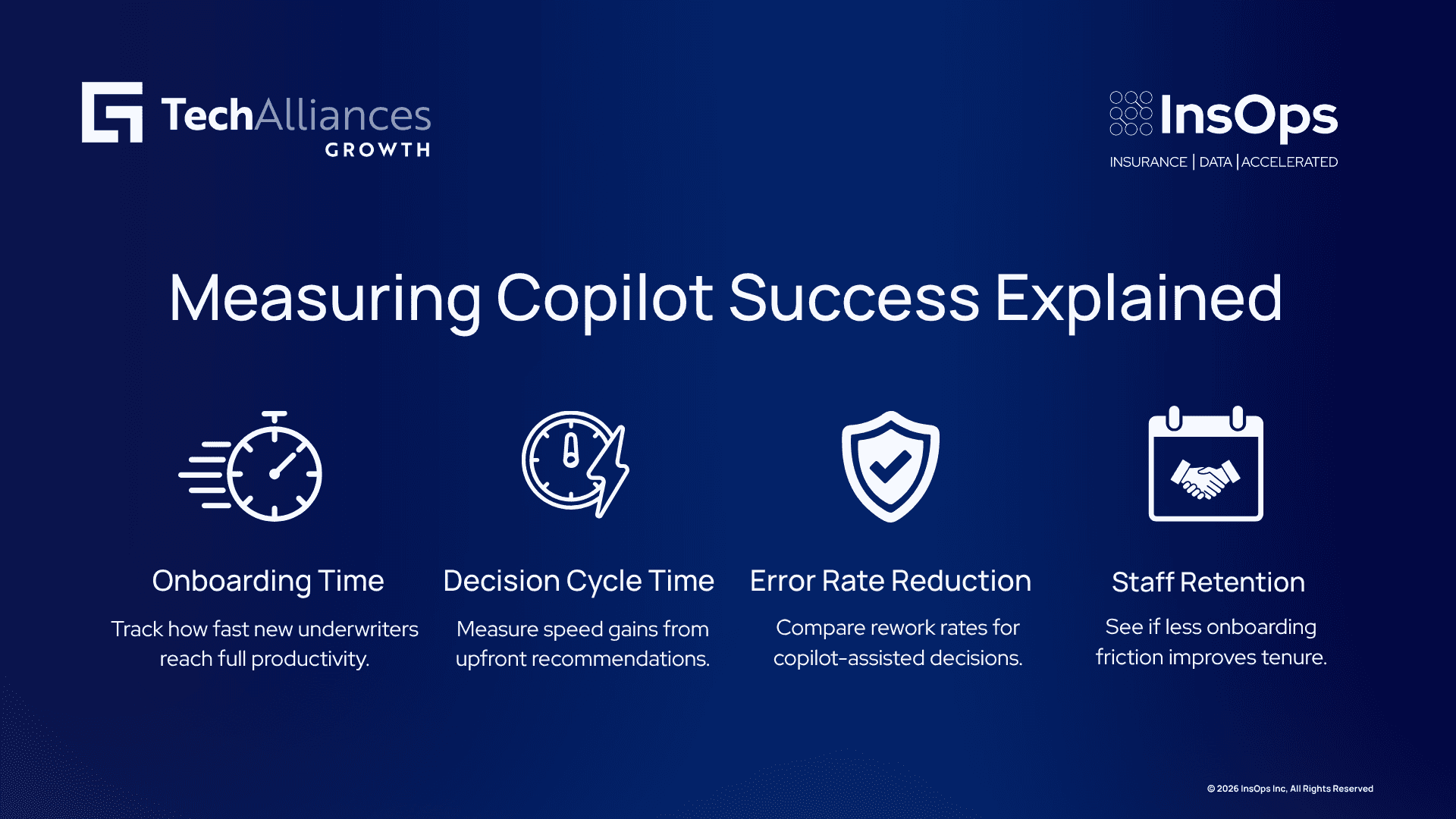
Onboarding time: How long until a new underwriter reaches productivity parity with experienced peers?
Decision cycle time: How much faster do applications move through underwriting when recommendations are surfaced upfront?
Error rate reduction: Do copilot-assisted decisions have lower rework rate in claims?
Staff retention: Does reduced onboarding friction improve tenure?
Expect 30–50% reduction in onboarding time within the first 6 months of pilot. Decision consistency should improve measurably within the first month.
How InsOps Helps
InsOps builds an insurance-trained AI that assists underwriters with knowledge capture and recommendation. LiLa, our insurance-trained AI model, ingests historical underwriting data and learns decision patterns specific to P&C insurance. It runs inside your own environment, so policy data never leaves controlled infrastructure.
When a new application arrives, LiLa surfaces relevant precedents and recommends risk scores based on similar historical cases. An underwriter reviews every recommendation and makes the final decision. The system learns from that feedback, improving recommendations over time.
InsOps is building toward copilot capabilities that integrate directly into your underwriting workflow—surfacing recommendations at the point of decision without adding manual steps. If you're evaluating how to capture and scale underwriter expertise without waiting for new hires to learn by doing, contact us to talk through what this could look like for your operation.
Frequently Asked Questions
What data does an underwriter copilot need to work?
Historical underwriting decisions, approved and declined applications, premium adjustments, and policy language used in decisions. If you have 3–5 years of decision history, you have enough to train an effective copilot.
How do you prevent the copilot from making bad recommendations?
Every recommendation goes to an underwriter for review before it's used. The underwriter makes the final decision. If the recommendation is bad, the underwriter rejects it, and the system learns. Human validation is non-negotiable.
How long does it take to deploy an underwriter copilot?
A pilot on a single class of business typically runs 6–8 weeks from data ingestion to first measurable results. Full rollout across multiple classes takes 3–6 months depending on data complexity.
Can a copilot replace underwriter judgment?
No. A copilot assists underwriters. It doesn't replace them. An underwriter makes the final call on every application. The copilot's job is to make their decision faster by surfacing relevant precedents and risk patterns.
What's the ROI on an underwriter copilot?
The primary benefits are onboarding speed (cutting ramp time by 30–50%) and decision consistency (reducing portfolio drift). Secondary benefits include fewer claims surprises from underwriting errors and lower staff turnover because new underwriters reach productivity faster.
How does the copilot learn from my underwriters' decisions?
After each decision, the underwriter confirms or rejects the copilot's recommendation. This feedback retrains the model, making future recommendations more accurate. The system improves continuously.
Do I need to replace my underwriting guidelines?
No. The copilot learns from historical decisions, which already reflect your guidelines implicitly. You don't need to rewrite anything. You ingest past decisions, the copilot learns, and you're ready to pilot.
What happens to the copilot when I hire an experienced underwriter?
The copilot gets better. Experienced underwriters' decisions feed back into the model, making it more accurate. New underwriters learn from the copilot, which learns from experienced underwriters. This closes the training cycle.