

When a broker submits a risk and the quote takes three days instead of three hours, the delay rarely comes from the underwriter's judgment. It comes from everything that happens before judgment can start: reading documents, retyping data into a rating system, checking whether the risk fits appetite, chasing missing information, and waiting on a referral that's sitting in someone's inbox.
The underwriter's actual pricing decision might take thirty minutes. The pre-underwriting work that surrounds it can take days.
What actually slows down a commercial quote?
Most of the delay in a commercial quoting workflow happens before the underwriter evaluates the risk. The submission arrives as a bundle of PDFs, emails, and spreadsheets. Someone has to open every attachment, identify what each document is, extract the fields that matter, and enter them into the policy administration system. If a loss run is missing or a schedule doesn't reconcile, the file stalls while someone follows up with the broker.
Once the data is assembled, someone has to check whether the risk fits the carrier's appetite. That check might involve looking up class codes, reviewing geographic restrictions, or confirming that the limits requested fall within the carrier's authority. If it doesn't fit, the file either gets declined or referred to a senior underwriter or specialist, adding more queue time.
Capgemini's survey of P&C insurance executives and underwriters found that 41% of underwriter time goes to administrative and operational tasks like these. That leaves less than a third of the day for the work that actually requires underwriting expertise: assessing the risk, setting the price, and managing the book.
Why does this matter beyond the individual quote?
Slow quoting changes which risks a carrier sees. Brokers typically market to multiple carriers at once. The carrier that responds first with clear terms becomes the anchor quote, and every later response is measured against it. A carrier that consistently takes days to respond doesn't just lose individual deals. Over time, brokers adjust their behavior: they send fewer submissions to the slow carrier, or they send only the risks no one else will take.
That creates a selection problem. The carrier's pipeline gradually shifts toward harder-to-place risks, not because of an appetite decision, but because the best risks already bound somewhere faster. Slow turnaround, in other words, doesn't just cost premium volume. It reshapes the portfolio.
Internally, the pressure compounds. When backlogs build, underwriters start triaging by urgency instead of by profitability. They skip steps like documenting rationale or confirming classifications. The process gets faster in the wrong way: by cutting corners rather than by removing the bottleneck.
What would it take to quote faster without cutting corners?
Three things need to happen before the file reaches the underwriter.
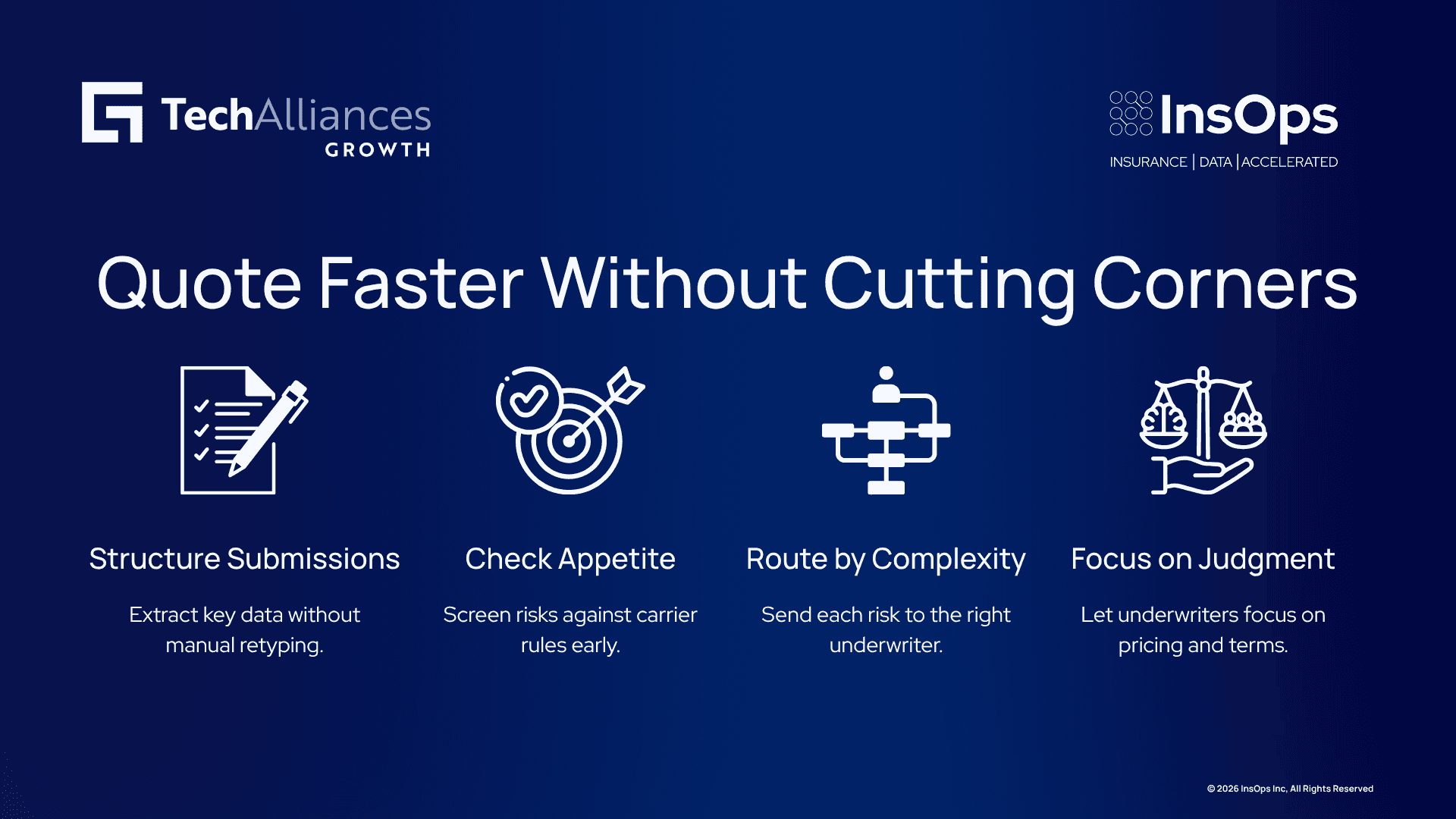
First, the submission data needs to be extracted and structured. That means pulling the named insured, class, limits, effective date, and exposure bases out of the ACORD forms, schedules, and loss runs without someone retyping them.
Second, the risk needs an appetite check against the carrier's rules. If the class, state, or limit falls outside appetite, the file should be declined or rerouted before an underwriter spends time on it.
Third, the file needs to be routed to the right person. A standard small-commercial risk shouldn't sit in the same queue as a complex specialty submission that needs a referral. Routing by complexity and authority level keeps underwriters working on the risks that match their expertise, and it keeps simpler risks from waiting behind complex ones.
When all three happen before the underwriter opens the file, the only work left is judgment: evaluating the risk, setting the price, and deciding terms. That's the work an underwriter is trained for, and it's the work that should fill their day.
How InsOps helps
InsOps has this kind of capability inside LiLa: extracting submission data from broker documents, checking risks against appetite rules, and routing files so underwriters receive structured, validated submissions ready for pricing. Because LiLa is trained on insurance data models, it understands what fields like class code, TIV, and deductible mean in a P&C context rather than treating them as generic text.
Contact us to talk through what this could look like for your quoting operation.
FAQ
Does faster quoting mean less thorough underwriting?
Not if the speed comes from better data preparation rather than skipping steps. When the submission data is already extracted, validated, and checked against appetite before the underwriter sees it, the underwriter actually has more time for judgment, not less. The risk is when speed comes from pressure to cut corners, skipping documentation, ignoring mismatches, or pricing without a full picture. That kind of speed creates problems at audit and at claim time.
Why do brokers stop sending submissions to slow carriers?
Brokers work on commission and manage dozens of accounts simultaneously. When a carrier consistently takes days to respond, the broker learns to route their best risks to faster carriers first. The slow carrier still gets submissions, but they tend to be the ones no one else wanted, risks that are harder to place, lower margin, or both. Over time, the carrier's new business pipeline shifts without anyone making a deliberate portfolio decision.