

Two underwriters on the same team look at two similar contractor accounts in the same state. One prices aggressively to win the business. The other adds a surcharge because they remember a bad loss on a similar account two years ago. Neither is wrong, exactly. But the carrier now has two different prices for two risks that should have been treated the same way.
This kind of inconsistency doesn't usually come from bad judgment. It comes from missing context. The underwriter who priced aggressively didn't see the loss history the other one remembered. The one who added the surcharge didn't know the carrier's current guidelines had changed since that loss.
Where does inconsistency actually come from?
Underwriting guidelines exist at every carrier. The problem is where they live and how they reach the underwriter at the moment a decision is being made.
At many carriers, guidelines sit in a shared drive, a PDF manual, or a set of emails from the chief underwriting officer. They're updated when something changes, but there's no mechanism to surface the right guideline at the right time. An underwriter working a contractor submission doesn't get prompted to check the latest authority limits for that class. They check if they remember to, and they find the document if they know where to look.
Historical decisions are even harder to access. How the carrier priced a similar risk last quarter, what terms were offered, whether it was profitable, that information lives in the policy administration system or in an underwriter's memory. When the underwriter who handled it leaves, the institutional knowledge leaves with them.
Risk models add a third layer. Even when a carrier has invested in predictive scoring or portfolio analytics, those outputs don't always reach the underwriter's screen during review. The model runs in one system. The underwriter works in another. The connection between the two is manual, if it exists at all.
Why does this matter more in a soft market?
In a hard market, pricing discipline comes partly from scarcity. Capacity is tight, brokers have fewer options, and underwriters can afford to be selective. In a soft market, that cushion disappears. Carriers compete on speed and price, and the margin for error shrinks.
As WaterStreet Company noted in their 2026 underwriting trends analysis, carriers that rely on inconsistent underwriting guidelines will struggle as the market softens, while those with consistent decision-making frameworks are better positioned to stay profitable through the cycle.
When two underwriters price the same risk differently in a soft market, one of them is leaving money on the table and the other may be taking on risk the carrier didn't intend to accept. Neither outcome is visible until the book matures and loss ratios start telling the story. By then, the decisions that shaped the portfolio are months or years old.
What would consistent risk selection actually require?
Three things need to be true at the moment the underwriter reviews a submission.
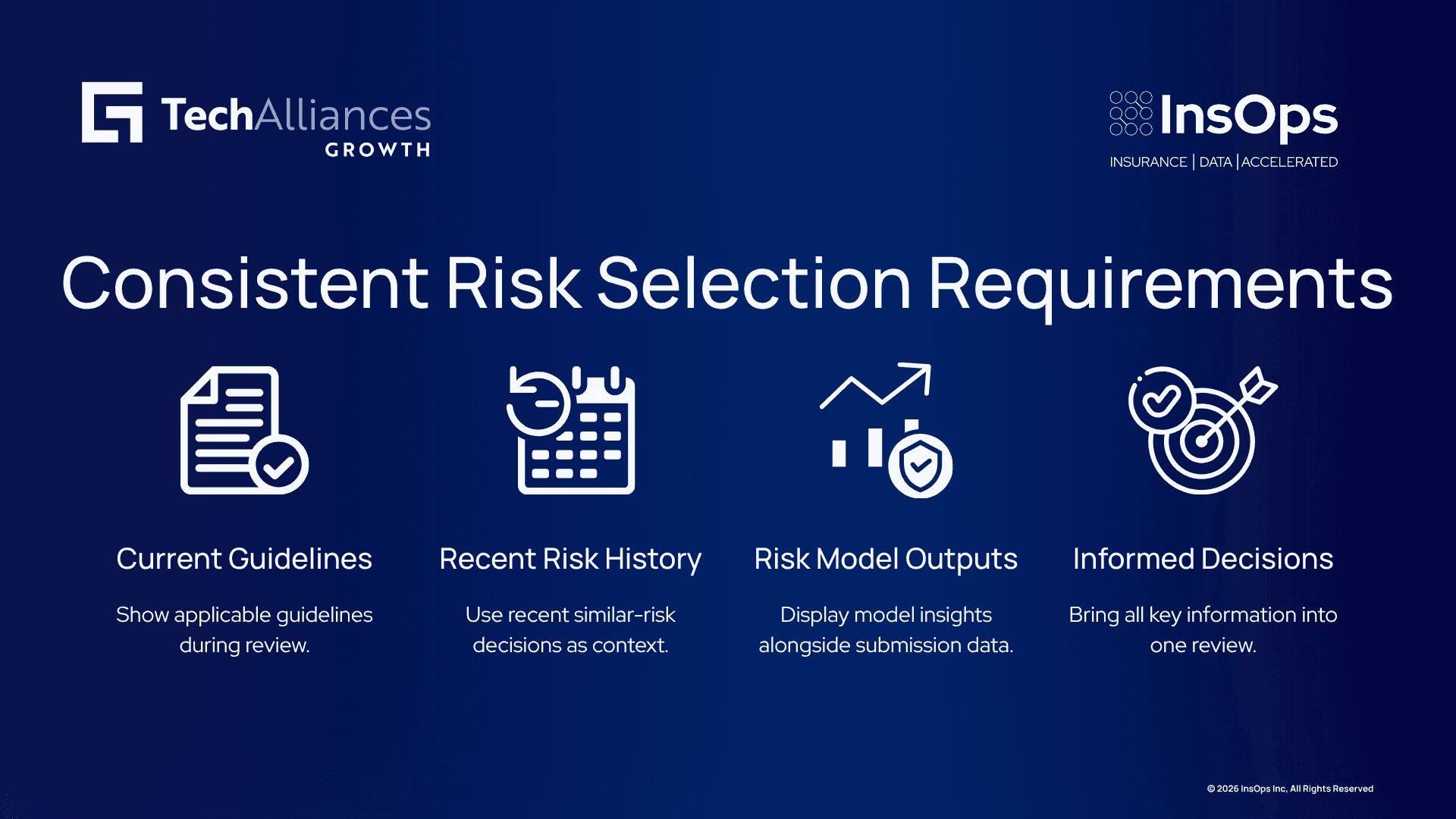
First, the carrier's current guidelines for that specific class, state, and limit need to be visible, not in a separate document the underwriter has to go find, but surfaced as part of the review. If the authority limit for a class changed last month, the underwriter should see that before they price it, not after.
Second, the underwriter should be able to see how the carrier has handled similar risks recently. What price was offered, what terms were set, and whether the account performed. This isn't about removing judgment. It's about making sure judgment is informed by what the carrier already knows rather than by what one person happens to remember.
Third, if the carrier uses risk scoring or predictive models, those outputs should appear alongside the submission data during review, not in a separate dashboard the underwriter checks afterward.
When all three are present at the point of decision, consistency becomes a natural outcome of better information rather than a compliance exercise imposed from above.
How InsOps helps
InsOps has this kind of capability inside LiLa: surfacing underwriting guidelines, historical decisions, and risk model outputs at the point of review so underwriters have the full picture before they price a risk. Because LiLa is trained on insurance data models, it can interpret what fields like class code, territory, and loss history mean in a P&C underwriting context rather than treating them as generic data.
Contact us to talk through what this could look like for your underwriting operation.
FAQ
Does consistent underwriting mean every risk gets the same price?
No. Consistency means similar risks get evaluated against the same guidelines, the same historical context, and the same risk signals. Two risks that look alike on paper might still get different prices if one has a loss trend the other doesn't, or if one operates in a higher-hazard jurisdiction. The point is that the difference should come from the risk itself, not from which underwriter happened to review it or whether they remembered to check the latest guidelines.
How does inconsistency lead to premium leakage?
Premium leakage happens when the price charged doesn't match the risk accepted. When one underwriter applies a discount that another wouldn't, or when a class code gets misapplied because the guideline wasn't consulted, the carrier collects less premium than the risk warrants. That gap shows up later as adverse loss experience on accounts that looked correctly priced at bind.