

When experienced adjusters retire or leave, their institutional knowledge walks out the door with them. New claims handlers struggle with complex case patterns, policy edge cases, and best practices that lived only in the heads of veterans. This creates inconsistent decision-making, longer claim cycle times, and frustrated junior staff who feel unprepared for the work they're asked to do.
Knowledge silos aren't just a retention problem—they're a performance problem. This article covers why expertise gets locked away, what it costs your operation, and how insurance-trained AI can make expert guidance instantly available to every member of your claims team.
The Hidden Cost of Knowledge Locked in Silos
Valuable litigation expertise, claims handling best practices, and policy interpretation frameworks reside with experienced adjusters and attorneys. When this knowledge stays in individual heads instead of flowing through your organization, newer staff and mid-career professionals handle complex cases less consistently than veterans. That inconsistency compounds into longer claim cycle times, quality variance, and preventable claim overspending.
Consider onboarding. The industry faces significant staff pressure—the U.S. insurance sector lost over a thousand adjuster positions in a single summer month of 2025. At the same time, 70% of new hires decide whether a job is the right fit within the first month. When onboarding new claims staff, most carriers rely on shadowing and mentorship from busy senior adjusters. That approach doesn't scale and consumes senior staff bandwidth that could go toward high-value claims work.
The cost is threefold: slower ramp-up for new hires, inconsistent quality across your claims portfolio, and senior staff burnout from constantly answering the same training questions.
Expertise Concentration and Retention Risk
In any claims organization, 10-20% of your adjusters handle 80% of your most complex cases. When one of those experts leaves, you lose not just headcount—you lose years of pattern recognition and decision-making frameworks that took them years to develop. A new adjuster in that seat will take 12-18 months to develop comparable judgment, during which your complex claims are handled less effectively.
Carriers that have invested in capturing and organizing that expertise report dramatically faster onboarding. New staff reach productive decision-making speed in weeks instead of months because they have instant access to frameworks that took veterans years to build.
Inconsistent Quality Across Claims
Without a structured way to access expert guidance, claims handlers make decisions based on incomplete information and individual judgment. Two adjusters handling similar claims in the same month may reach different conclusions about coverage, severity classification, or settlement strategy. That variance isn't always harmless—sometimes it's expensive.
Claims that get misclassified as lower-complexity early on often experience scope creep and budget overruns later. Conversely, premature complexity ratings can drive unnecessary investigation costs. Consistent access to expert reference materials and case precedent helps new staff classify correctly on the first pass.
Building an Expert-Accessible Knowledge Foundation
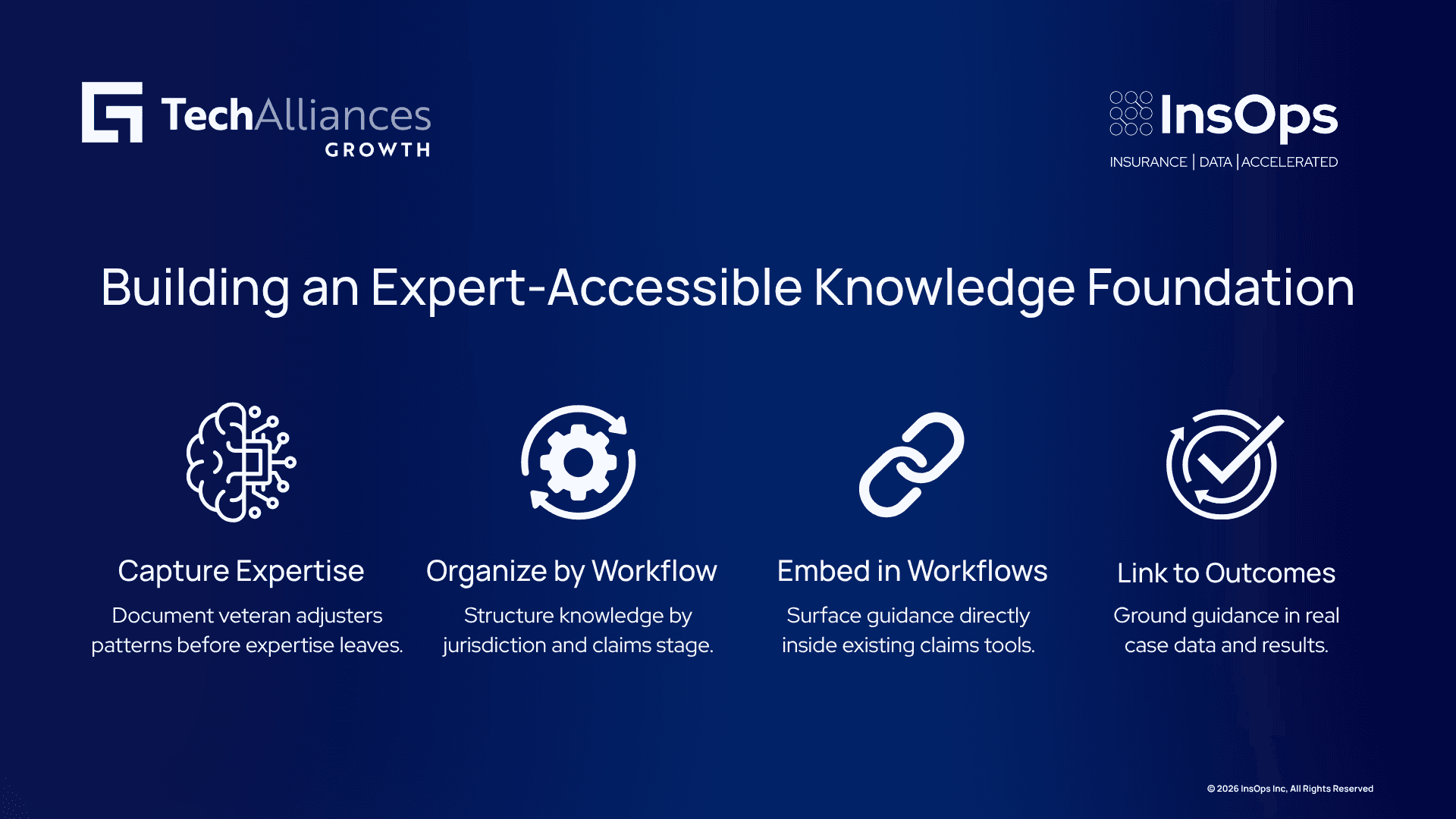
Effective knowledge sharing in claims requires four building blocks: capturing expertise from your veterans, organizing it by use case, making it instantly searchable, and connecting it to real claims workflows.
Capturing Institutional Knowledge Before It Leaves
The first step is structured interviewing and documentation of your most experienced adjusters and counsel. Focus on the patterns they've learned to recognize: which claim types escalate to litigation most often, which policy language creates coverage disputes, which claimant behaviors signal fraud risk.
Document this as frameworks, not just raw notes. For instance, "When a homeowners claim involves disputed coverage and the claimant retains counsel before day 30, 85% of cases litigate" is actionable. "Coverage disputes can be tricky" is not. Quantify the patterns and connect them to decision logic.
Pair this documentation with audio or video captures of senior adjusters walking through actual claim examples. Video is particularly powerful for onboarding because it shows decision-making in real time, not just the conclusion.
Organizing by Claims Workflow and Jurisdiction
Random knowledge repositories don't get used. Organize expertise by the moments when claims staff actually need it: at first notice intake, during severity classification, at the point of settlement authority decision, during litigation review.
Jurisdiction matters enormously in insurance. A coverage interpretation that holds in Connecticut may not apply in California. Organize your knowledge base by jurisdiction first, then by claim type within each jurisdiction. This helps staff quickly surface the guidance relevant to their specific file.
Making Expertise Instantly Discoverable in Workflows
Knowledge that requires staff to navigate a separate system won't be used. The most effective knowledge architectures embed guidance directly into claims handling tools—in Guidewire ClaimCenter, in your email system, in your case management platform.
When an adjuster opens a homeowners claim involving water damage, context-aware search should surface relevant guidance without requiring a separate search. If a claimant's demand exceeds policy limits in a covered loss, that decision point should trigger instant access to settlement authority frameworks and litigation risk patterns from similar claims.
Connecting Knowledge to Prior Case Outcomes
The strongest knowledge is knowledge grounded in your own data. When guidance is linked to how similar claims actually resolved in your portfolio, it carries credibility and predictive power.
Link case guidance to outcomes: "When coverage disputes involve policy language interpretation and the claimant retains counsel by day 30, litigation probability is 87% based on 143 similar claims from 2020-2025. Average defense cost: $52K. Median settlement: $45K." That specificity is worth far more than generic best practices.
How InsOps Helps
InsOps builds an insurance-trained AI that assists with surfacing expert guidance and claim history instantly for every adjuster, appraiser, and claims handler. LiLa, our insurance-trained AI model, runs inside your own environment, so claim data and PII never leave controlled infrastructure. A person reviews and validates every recommendation before it influences claims decisions.
Our Integration Gateway connects to Guidewire ClaimCenter, so claim history, prior outcomes, and institutional knowledge flow directly into LiLa's analysis engine. When an adjuster opens a claim, LiLa surfaces relevant guidance from your historical case patterns, links it to similar closed claims, and provides context from prior litigation outcomes.
LiLa assists with providing instant access to claim history, best practices, policy guidance, and litigation outcome patterns—turning expert knowledge into a shared resource available to every member of your claims team. This accelerates onboarding of new staff and helps junior adjusters handle complex cases with the confidence and consistency of veterans.
If you are evaluating how to democratize expert guidance across your claims operation without depending on mentorship from stretched senior staff, contact us to talk through what this could look like for your operation.
Frequently Asked Questions
What is a knowledge silo in insurance claims?
A knowledge silo exists when valuable expertise—litigation patterns, policy interpretation, case outcomes—lives primarily in the minds of experienced adjusters or counsel rather than being organized and shared across the organization. This creates inconsistent decision-making and slows onboarding of new staff.
Why does knowledge capture matter for claims organizations?
Capturing expertise allows new and mid-career adjusters to access frameworks that took veterans years to develop. This accelerates onboarding, improves consistency, and reduces dependence on senior staff for mentorship. It also protects against expertise loss when experienced staff leave.
How long does it take to onboard a new claims adjuster?
In most organizations, new adjusters reach productive decision-making speed in 12-18 months when relying on shadowing and mentorship. Organizations that have structured knowledge systems report accelerating that timeline to 4-8 weeks for routine claims and 12-16 weeks for complex work.
What should you capture from your most experienced adjusters?
Focus on patterns: which claim types escalate to litigation, which policy language creates disputes, which claimant behaviors signal fraud risk, which jurisdictions have different legal environments. Connect these patterns to actual outcomes from your closed claims.
How do you make knowledge discoverable in claims workflows?
Integrate guidance into the systems adjusters already use—Guidewire ClaimCenter, case management tools, email. Use context-aware search so that relevant guidance surfaces automatically based on the claim being reviewed, without requiring a separate search process.
What role does claim outcome data play in knowledge management?
Outcome data gives guidance credibility. When you can link a recommendation to actual results from similar claims in your portfolio—"cases matching your profile had an 87% litigation rate and averaged $52K in defense costs"—that carries far more weight than generic best practices.
How does AI assist with knowledge management in claims?
Insurance-trained AI analyzes your claims portfolio, identifies patterns, surfaces relevant guidance from prior cases, and connects it to decision points in current claims. It doesn't make decisions—it makes expert guidance instantly accessible so adjusters can leverage institutional knowledge without waiting for a senior person to be available.
What's the connection between knowledge management and adjuster retention?
New adjusters who have instant access to expert guidance feel more confident and supported. This improves job satisfaction and retention. Additionally, knowledge systems reduce the burden on senior adjusters to constantly mentor junior staff, protecting them from burnout.