

Litigation can drag on for months or years, and during that time your reserves shift. A new development surfaces. A settlement offer lands. An expert report arrives. Your initial reserve estimate from day one of the claim suddenly doesn't match reality anymore. Yet many teams still rely on manual reviews and spreadsheets to flag when reserves need adjustment. The result: you miss critical signals, reserves drift away from true exposure, and your financial forecasts suffer.
This article walks through how modern insurers are rethinking reserve management for litigated claims, and how AI-powered monitoring can surface the adjustment triggers you need to close the reserve accuracy gap.
The Reserve Accuracy Problem in Litigation
Litigation reserves are estimates, but they carry enormous weight. They sit on your balance sheet. They affect your financial reporting. They influence your loss ratios and your pricing discipline for the next underwriting cycle.
The challenge is that litigation is inherently unpredictable. What starts as a straightforward property damage claim can transform into a high-exposure bodily injury dispute with multiple defendants and years of depositions ahead. Your initial reserve set on day 30 of the claim was never meant to be static, it was your best guess with incomplete information.
Why Reserves Drift
Industry data shows that since 2019, commercial casualty lines have experienced persistent adverse reserve development, with preliminary 2025 disclosures signaling the trend is not reversing. Social inflation and extended litigation timelines are primary drivers. A 2025 Sedgwick report reveals that funded litigated auto bodily injury claims run 9.6 times longer in duration, with total incurred costs running 361% higher than non-funded claims.
When reserve reviews happen quarterly or only on audit cycles, you're working with outdated facts. Judges rule on motions. New medical evidence emerges. Settlement demand letters arrive with higher valuations than your reserve assumes. Your reserve becomes siloed information, separated from the active developments in the claim file.
The Manual Review Bottleneck
Traditional reserve management relies on adjusters and supervisors manually reviewing files, pulling facts from claim notes and litigation files, and updating reserves based on judgment and experience. That process works when case volumes are manageable, but it doesn't scale. It's also prone to gaps and critical developments get missed simply because no one flagged them for review on the exact right day.
How Litigation Develops and Drives Reserve Changes
Understanding what changes a reserve means understanding the lifecycle of litigation itself. Reserves adjust at predictable inflection points in a claim's journey.
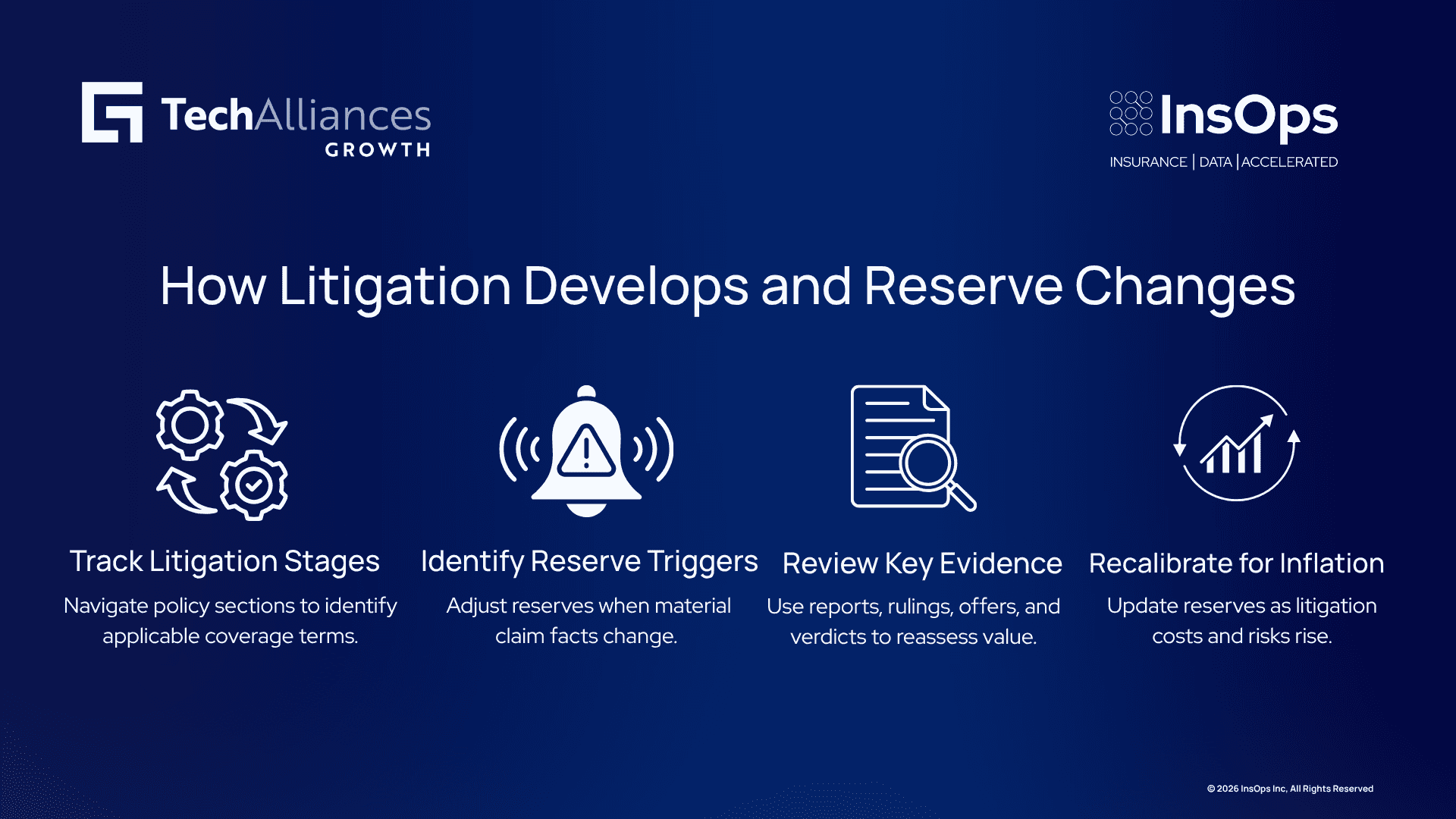
Litigation Timeline and Pressure Points
Most litigated claims follow a recognizable arc. Early investigation determines liability and damage scope. Then discovery begins, often surfacing evidence that changes exposure. Mediation attempts may signal settlement momentum or reveal intransigence. Expert reports, motion rulings, and settlement offers all land at different stages, each bringing new information about true claim value.
Adjusters typically review reserves at intake (within 30 days), during early investigation, after discovery completion, during mediation or pre-trial conference, and following major motion rulings. But that's a reactive calendar, not a data-driven one. It assumes you already know when those milestones occur, or that they'll occur on schedule.
Key Reserve Adjustment Triggers
A reserve adjustment should happen when material facts change. That includes settlement offers that land below your reserve, expert reports that expand damages scope, adverse motion rulings that shift liability odds, comparable verdicts that reframe case value, or discovery findings that alter medical prognosis.
Research from CLM and insurance operations teams identifies best practice reserve management as requiring front-end new reserve and reserve adjustment approval at key monetary levels, mandatory six-month reserve reviews by an adjuster and supervisor, and an 18-month ultimate reserve review with formal documentation. When those reviews run on calendar alone, you'll miss the true triggers.
Social Inflation and Litigation Cost Escalation
General liability losses increased to about $45 billion in 2024 from $18 billion in 2015, far exceeding real economic growth and inflation during that period. That trend directly pressures reserves downward. Actuarial assumptions built on historical loss data no longer predict true claim resolution costs. Litigation costs themselves are rising. Extended attorney involvement delays settlements. Third-party litigation funding has grown at an average annual rate of 44% since 2022, a factor that correlates with longer claim duration and higher ultimate costs.
These macro trends mean your reserve tables need continuous recalibration, not annual updates.
Using Case Data and Comparables to Inform Reserve Decisions
Smart reserve management combines individual case facts with comparable claim and litigation data. AI makes that comparison fast and systemic.
Building a Comparable Verdict and Settlement Database
Litigation analytics platforms now make historical verdict and settlement data queryable. You can filter by jurisdiction, claim type, plaintiff counsel, defense counsel, judge, injury type, and outcome. That database becomes your reality check on whether your reserve is aligned with what similar claims actually cost to resolve.
When you set a reserve at $200,000 on a general liability bodily injury claim, you can query: "How did comparable claims in this jurisdiction, with this type of injury, with this plaintiff counsel, actually resolve?" The comparable outcomes give you a statistical distribution, not just a point estimate. If 80% of similar claims settle between $180,000 and $320,000, and yours is reserved at $200,000, you have confidence. If comparable claims consistently settle at $400,000+, your reserve is underwater, and adjustment is urgent.
Judge and Counsel Analytics
Litigation outcomes are not uniformly distributed across jurisdictions or judges. A state court judge with a track record of ruling for defendants on summary judgment motions will shift your risk calculus compared to a judge known for denying those same motions. Similarly, some defense counsel consistently outperform peers in settlement negotiations. Others settle faster but at higher values.
Predictive analytics platforms like NexLaw TrialPrep, Lex Machina, and CLARA Analytics now track these patterns and fold them into case assessment. When your claim lands in front of a specific judge or faces a specific plaintiff counsel, that institutional knowledge becomes a data input to your reserve decision. You're not guessing based on gut—you're calibrating against evidence.
Case Progression Signals
As discovery unfolds, new information arrives. Expert reports quantify damages. Deposition transcripts reveal credibility issues or expert vulnerabilities. Motion rulings narrow or expand the disputed issues. Mediation settlement demand letters signal where plaintiffs believe case value lies.
All of this is data. Manually logging it into a spreadsheet means critical signals get delayed or missed. A system that monitors case progression continuously can flag the moments when reserve adjustment logic kicks in.
AI-Powered Monitoring for Litigation Reserve Management
AI systems designed for insurance can continuously monitor open litigation claims and surface the conditions that warrant reserve adjustment. This is not about making decisions automatically, it's about ensuring decisions get made with complete information.
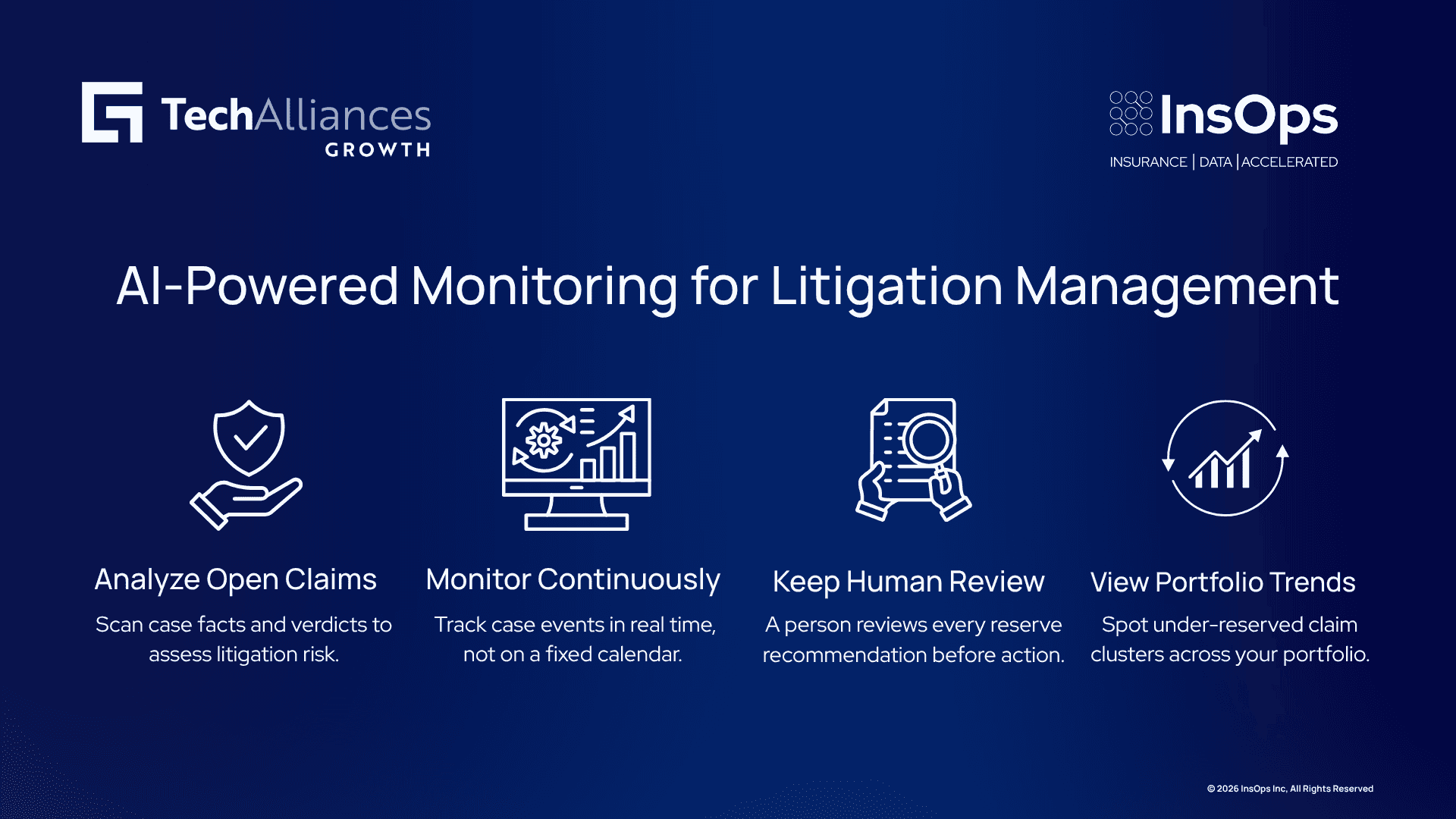
How LiLa Analyzes Open Claims
InsOps' LiLa, our insurance-trained AI model, analyzes open claims and historical claim data to surface litigation risk probability per claim. It scans case facts, discovery documents, expert reports, comparable verdicts in similar matters, and historical outcomes from the same jurisdiction and judge. From that analysis, LiLa surfaces a litigation risk assessment and recommends whether a reserve adjustment is warranted.
The model runs inside your own environment, so claim data and litigation files never leave controlled infrastructure. That matters for claims marked confidential, claims involving medical details, or litigation strategy documents you don't want exposed externally. Everything stays in house.
Continuous Case Monitoring vs. Calendar-Based Review
Instead of waiting for a scheduled six-month or 18-month review cycle, LiLa monitors claim files and case development continuously. When a new motion ruling is logged. When a settlement offer arrives. When a medical expert report gets added to the file. When discovery reaches completion. Those events trigger automated case assessment.
That doesn't mean your reserve updates automatically. A person reviews LiLa's recommendation. Your litigation counsel may have information not in the system. Your claim settlement strategy may deliberately hold reserves high for financial reporting reasons. Human judgment remains central. But the recommendation surfaces the information that human should be using to make that decision.
Reserve Adequacy Across Portfolio
LiLa also aggregates reserve data across your litigation portfolio. It flags claims where reserve development is trending unfavorable relative to comparable claims. It identifies clusters of claims in the same jurisdiction that may be impacted by a shared risk factor—a judge known for plaintiff-friendly rulings, for instance, or a specific injury type that's trending toward higher awards.
Portfolio visibility prevents the scenario where 40% of your claims in a line of business are individually under-reserved but that pattern goes unnoticed because reviews happen in isolation.
Implementing Reserve Monitoring Without Disrupting Workflow
Adding AI to your reserve management process doesn't mean replacing your adjusters or your approval workflows. It means augmenting them with information you're not currently seeing.
Integrating with Existing Claims Systems
Most P&C carriers run claims on Guidewire ClaimCenter or similar platforms. LiLa integrates with those systems through InsOps' Integration Gateway, which connects to ClaimCenter and pulls claim data, litigation file attachments, and case status information without custom engineering.
The workflow remains familiar: your adjuster works the claim in ClaimCenter as normal. On a schedule you define—daily, weekly, or triggered by specific events—InsOps analyzes the claim against your reserve and litigation data. A recommendation flows back into your system with a confidence level and explanation. Your adjuster or supervisor sees the recommendation, reviews it alongside their own case knowledge, and approves, adjusts, or rejects it.
Setting Thresholds and Approval Gates
You control the approval workflow. Small adjustments (under $5,000) might auto-approve once a supervisor confirms the logic. Large adjustments (over $50,000) might require claims director sign-off. Adjustments on claims over your catastrophe threshold might require separate legal review. You define the gates.
That keeps your governance intact while giving you the data infrastructure to make faster, more accurate decisions.
Training Adjusters on New Data Inputs
Your team is accustomed to setting reserves based on case facts and experience. Adding comparable verdict data and judge analytics changes the conversation. It's not a replacement for experience—it's a complement. A 15-year litigation adjuster will still make the final call on whether a reserve adjustment makes sense. But now they're making it with access to data on how 50 comparable cases resolved, instead of relying on memory of 2 or 3 similar claims they've handled personally.
Expect a ramp-up period where adjusters learn to interpret and trust the new data. That's normal. The payoff comes quickly: reserve accuracy improves, portfolio visibility increases, and reserve reviews that used to take 8 hours per batch now take 90 minutes.
Reserve Reductions and Risk Mitigation Results
Carriers implementing litigation reserve monitoring report measurable improvements in reserve accuracy and portfolio control.
Accuracy Improvement Benchmarks
A 2025 case study from LexCapital, a litigation management firm using predictive justice analytics on an insurance company's disputed claims portfolio, reported that over 16 months of operation with 181 managed claims, the system surfaced settlement recommendations that resulted in approximately €7.6 million in reserved funds being released or reduced without adverse development.
That's not a perfect match to your operation—LexCapital managed claims on a run-off basis, not ongoing daily claims intake. But it illustrates the magnitude of reserve redundancy that can exist when claims are monitored with comparative data versus managed in isolation.
Insurance Operations research suggests that claim leakage, meaning preventable overspend, represents 5 to 10 percent of total claims costs for many insurers. Reserve monitoring doesn't eliminate leakage entirely, but correctly identifying when a high reserve is no longer justified prevents a subset of that overspend.
Time Savings in Reserve Review Cycles
Manual reserve reviews—pulling files, reading notes, comparing to memory of similar claims, updating reserves, documenting decisions—consume substantial adjuster and supervisor time. A Sedgwick report on claims operations efficiency estimates that AI tools can augment 36% of working hours in insurance. Reserve monitoring is a high-impact application of that augmentation. Adjusters spend less time searching for comparable data and more time on complex liability determinations or settlement negotiations.
Financial Reporting and Regulatory Benefit
NAIC reserve adequacy standards require that reserve tables based on credible experience be adjusted regularly to maintain reasonable margins. Automation helps you demonstrate that adjustments are data-driven and defensible, not ad hoc. Your audit trail shows which comparables informed the adjustment, which judge or jurisdiction factors were considered, and which claim-specific facts tipped the decision. That's valuable when regulators or auditors review your reserve methodology.
How InsOps Helps
LiLa automatically analyzes case progression against comparable verdicts, settlement data, and historical outcomes, then surfaces adjustment recommendations to your team for approval.
If you are evaluating how to close reserve accuracy gaps and reduce the time your team spends on manual data pulls and comparables research, contact us to talk through what this could look like for your operation.
Frequently Asked Questions
What exactly does LiLa analyze when it reviews a claim for reserve adjustment?
LiLa scans case facts documented in your claims system, litigation file attachments, discovery status, expert reports, motion rulings, comparable verdicts and settlements in similar matters, judge history in your jurisdiction, plaintiff counsel performance data, and historical claim resolution timelines. From that mix, it surfaces a litigation risk assessment and recommends whether adjustment is warranted.
Who makes the final decision on reserve adjustments?
Your adjuster or supervisor makes the decision. LiLa surfaces a recommendation with supporting data and confidence level. Your team reviews the recommendation, considers internal strategy factors not in the system, and approves, adjusts, or rejects it. This is human-in-the-loop oversight—AI assists, people decide.
How long does it take to see reserve accuracy improvement after implementation?
Most carriers see measurable improvement within the first 60-90 days as the system establishes baseline comparable data for your claims mix and jurisdiction distribution. Significant portfolio-wide accuracy gains typically emerge over 6-12 months as the system learns patterns specific to your underwriting and settlement practices.
Does this require replacing our claims system or retraining adjusters on new software?
No. Integration Gateway connects to your existing Guidewire instance and pulls data without custom coding. Reserve recommendations surface in your existing workflow. Your adjusters' day doesn't change dramatically—they receive recommendations flagged for review, alongside their normal case work.
How does this handle confidential litigation strategy or settlement authority that's not in the claims file?
LiLa makes recommendations based on case facts and public comparable data. Your team may have strategic reasons—litigation hold strategy, settlement authority limits, or defendant instruction—to hold a reserve higher or lower than analytics suggest. You always retain override authority. The goal is to surface data-driven recommendations, not to override human judgment.
What if our litigation portfolio is small or concentrated in one jurisdiction?
LiLa can work with smaller datasets, though comparable verdict databases are most powerful with higher claim volumes. Even with smaller portfolios, judge history analysis and motion ruling patterns provide valuable calibration. Reach out to discuss your specific portfolio composition.
How is this different from litigation management vendors or defense counsel analytics?
Those vendors advise on settlement and trial strategy, typically working the claim directly. LiLa is a data layer that sits behind your own adjuster and supervisor decision-making. It doesn't replace counsel or manage claims on your behalf. It gives your internal team the comparable data and risk intelligence they need to make faster, better-informed reserve decisions.