

Litigation adjusters are drowning in paperwork. Every open claim requires multiple documentation layers: claim summaries synthesizing investigative findings, diary notes tracking activity timelines, litigation updates for management review, reserve justifications supporting financial decisions, and outbound correspondence to counsel and claimants. These tasks don't determine case outcomes, managing complexity and staying organized does. Yet they consume 50-60% of adjuster working hours, leaving only 40-50% for actual judgment and strategy.
When adjusters spend most of their day writing, formatting, and organizing reports, litigation risk increases. Important patterns are missed. Settlement windows are missed. Documentation gaps create exposure when cases do go to trial. The core problem is not the volume of work; it's that the same people evaluating risk are also performing administrative work that could be handled differently.
This article covers how insurance-trained AI can generate claim documentation at scale, what happens when human judgment stays in control, and how to preserve audit trail integrity while cutting administrative burden in half.
The Hidden Cost of Manual Documentation
Litigation adjusters operate under constant time pressure. Documentation demands have intensified as claims grow more complex and litigation risk has become harder to predict. Social inflation is real: nuclear verdicts, defined as jury awards exceeding $10 million,reached 135 cases in 2024, with total award value hitting $31.3 billion, more than double the prior year. The median nuclear verdict climbed from $25 million to $51 million in the same period.
These numbers are not abstractions. They show up in case files as higher stakes and tighter deadlines. Adjusters must document more carefully, justify reserves more rigorously, and build defensible case narratives faster. Yet the tools available to them have not changed proportionally.
Where Time Actually Goes
Studies show that adjusters spend roughly half their working hours on administrative tasks: writing reports, formatting evidence, checking compliance, and organizing files. This leaves only 40-50% of their day for investigation, discovery analysis, and settlement negotiation—the high-judgment work that actually moves cases toward resolution.
Within that administrative time, the breakdown looks like this:
Claim Summaries synthesize investigative findings into a narrative that shows progression, identifies weak points in the plaintiff's case, and flags reserve implications. A typical summary requires reviewing 20-50 source documents and integrating findings into a coherent story. Time: 2-3 hours per claim.
Diary Notes and Activity Logs record every action taken on the file: calls made, documents received, expert opinions ordered, deadlines set. These notes become the audit trail during discovery. Time: 30-45 minutes per working day, across multiple claims.
Litigation Updates are status reports for management, counsel, or reinsurers covering case progression, settlement posture, and risk assessment. These must be clear and defensible. Time: 1-2 hours per claim, depending on complexity.
Reserve Justifications document the rationale behind reserve levels: claim history analyzed, comparable cases reviewed, expert input considered. When litigation risk changes, justification must be updated. Time: 45 minutes to 2 hours per reserve adjustment.
Correspondence includes drafts to counsel, settlement position letters, and emails to experts and third parties. Each piece of correspondence shapes perception and creates discoverable evidence. Time: 1-2 hours per day, across a caseload.
Across a typical caseload of 40-60 active litigation claims, this adds up quickly. The adjuster who spends 25 hours per week on documentation is spending only 15 hours on analysis, strategy, and high-value decision-making.
Why Documentation Quality Matters More in Litigation
Documentation in litigation claims is not just administrative. It is evidence. Every note, email, and summary may be discovered and reviewed by opposing counsel. Gaps in documentation create inferences about negligence. Inconsistencies between notes undermine credibility.
At the same time, documentation pressure creates risk in the opposite direction: rushed, incomplete notes leave important case patterns invisible until too late. An adjuster managing 50 claims cannot hand-craft claim summaries that catch subtle risk signals in 20 source documents. The result is either incomplete documentation or an unsustainable workload—often both.
What Insurance-Trained AI Brings to Documentation
Insurance-trained AI models understand domain context that generic language models do not. They recognize the semantic relationships between policy language, claim data, investigative findings, and reserve logic. They can ingest a claim file and generate documentation that maintains consistency with prior notes, aligns with reserve decisions, and flags gaps for human review.
This is different from generic AI. A general-purpose model trained on internet text has no framework for understanding NAIC compliance rules, state-specific prompt payment deadlines, or the litigation data patterns that correlate with high-value outcomes. Insurance-trained models carry 25+ years of domain expertise encoded in their parameters.
How LiLa Generates Claim Documentation
InsOps' insurance-trained AI model, LiLa, is built specifically for P&C insurance workflows. When connected to a claim file, LiLa assists with multiple documentation tasks:
Automated Claim Summary Generation ingests all claim documents (investigation reports, discovery responses, expert opinions, medical records, prior correspondence) and generates a narrative summary showing claim progression, key evidentiary markers, and identified risk factors. The summary organizes information by timeline and legal relevance. An adjuster reviews the draft, adds judgment calls, and finalizes it. Time for adjuster review and approval: 15-20 minutes instead of 120-180 minutes spent writing from scratch.
Litigation Update Drafting synthesizes recent case activity, reserve changes, and settlement posture into a management update. The model maintains consistency with prior updates and flags changes that signal shifting risk. An adjuster edits for tone and judgment, approves, and sends. Turnaround: 15 minutes of adjuster time instead of 60-90 minutes.
Diary Note Expansion transforms brief note entries ("Spoke to plaintiff's counsel, settlement discussion opened at $X") into detailed diary entries that include context, next steps, and compliance flags. The adjuster reviews for accuracy and approves before the entry is finalized in the claims management system. This ensures audit trail completeness without consuming adjuster time on formatting and narrative elaboration.
Reserve Justification Documentation analyzes comparable cases in the claims history, recent settlement outcomes, litigation cost trends, and expert opinions to generate a reserve justification narrative. The model shows the reasoning path: what factors support the current reserve, what risks justify the level, and what triggers would warrant adjustment. An adjuster reviews the logic, adds judgment about market conditions or case-specific factors, and approves. Result: a fully defensible justification in 30 minutes instead of 120 minutes.
Correspondence Drafting creates settlement position letters, responses to counsel discovery requests, and status emails to third parties. The drafts maintain tone consistency with prior correspondence and include appropriate legal caveats. An adjuster reviews, adds case-specific judgment, revises as needed, and sends. Time savings: 40-50 minutes per correspondence piece.
Accuracy and Audit Trail Protection
LiLa is not making decisions. The adjuster reviews every generated document, confirms accuracy, and approves before it becomes part of the claim file. This human-in-the-loop process preserves the audit trail: the adjuster's name is attached to all finalized documentation, just as it would be if they wrote it manually. The generated draft is a first pass, not a final decision.
For litigation claims, this matters profoundly. If a summary or reserve justification is ever deposed or reviewed for bad faith, the claim file shows that an experienced adjuster reviewed and approved it. The documentation is defensible because a human made the final call.
Real-World Impact on Litigation Workflows
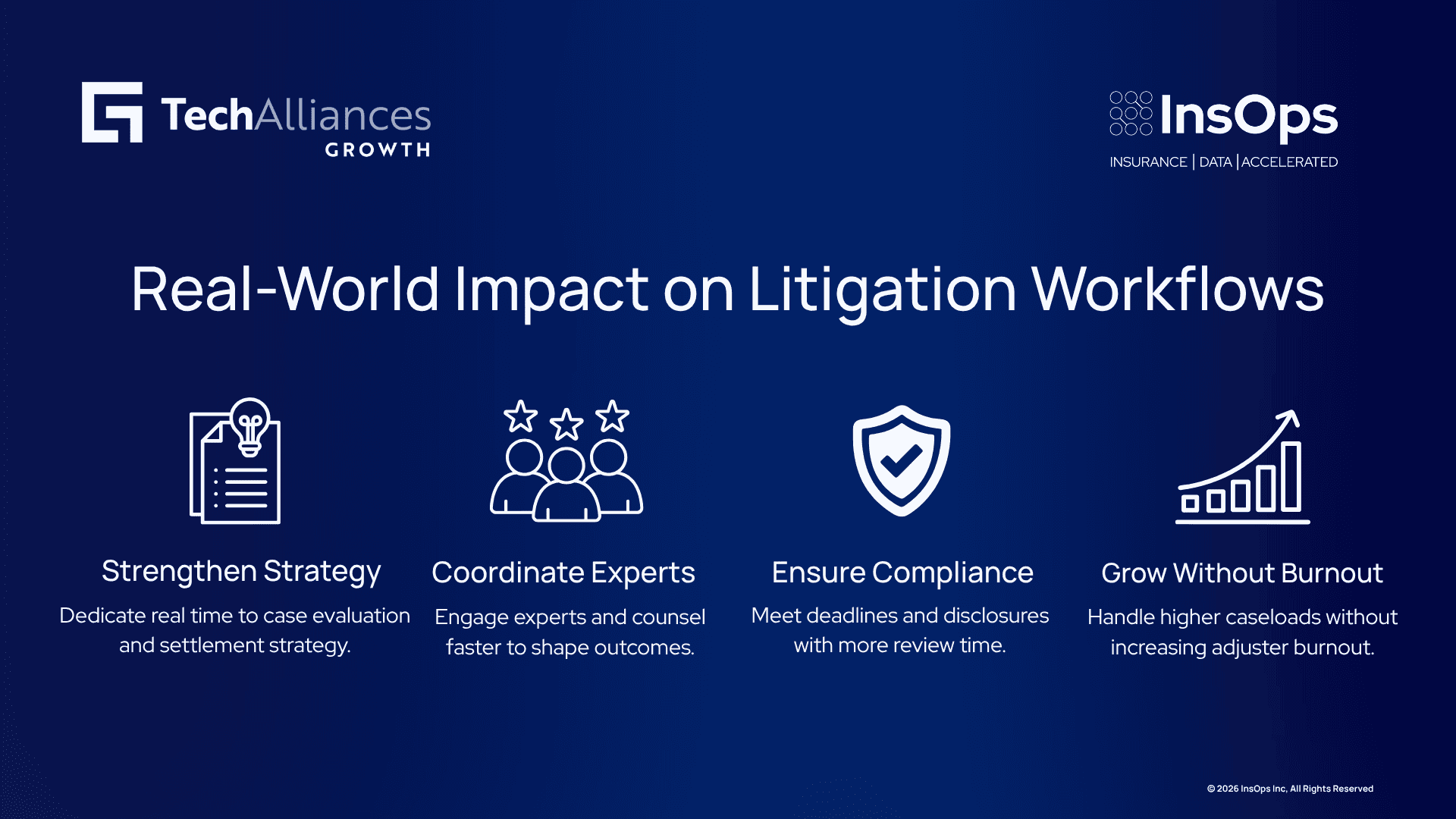
When adjusters reduce documentation time from 50-60% of their workday to 25-30%, the freed capacity shifts to high-value activity. A litigation adjuster managing 50 claims can now dedicate meaningful time to:
Case Evaluation and Settlement Strategy means each claim gets a dedicated strategy review session, not a rushed assessment between documentation tasks. Settlement windows are identified earlier. Risk factors are analyzed more thoroughly.
Expert Coordination lets adjusters be more responsive to expert opinions, engage in deeper dialogue with counsel, and incorporate specialized input into strategy faster. This is where case outcomes are decided.
Regulatory and Compliance Review ensures all prompt payment deadlines are met, all required disclosures are complete, and claims handling aligns with state-specific rules. Compliance risk drops when adjusters have time to focus on it.
Caseload Growth Without Burnout allows teams to maintain current caseloads while handling 20-30% higher volume, or reduce caseloads to give adjusters more time for complex cases. Retention improves when documentation burden lifts.
The calculus is straightforward: adjuster time is the scarcest resource in litigation management. Every hour spent on documentation is an hour not spent on judgment and strategy.
Integration with Claims Management Systems
LiLa integrates with existing claims management platforms through InsOps' Integration Gateway. The model connects to Guidewire ClaimCenter and reads the claim file: all documents, prior notes, reserve history, and correspondence. Generated documentation flows back into the platform and lands in the adjuster's work queue for review before finalization.
No custom code is required. The integration uses InsOps' pre-built connectors to understand ClaimCenter's data structure, and LiLa's domain expertise handles the semantic mapping. An adjuster can request a claim summary, litigation update, or reserve justification from within ClaimCenter, and the AI-assisted draft appears within minutes.
Data Privacy and Infrastructure
All claim data remains inside your environment. InsOps' insurance-trained AI model runs on your infrastructure, so PII and PHI never leave your controlled systems. This matters for litigation claims: sensitive information about injuries, medical history, and settlement posture stays protected.
How to Implement Documentation Assistance
Deployment starts with a pilot caseload: 10-20 active litigation claims across diverse practice areas (auto liability, workers' comp, commercial general liability). InsOps works with the litigation team to:
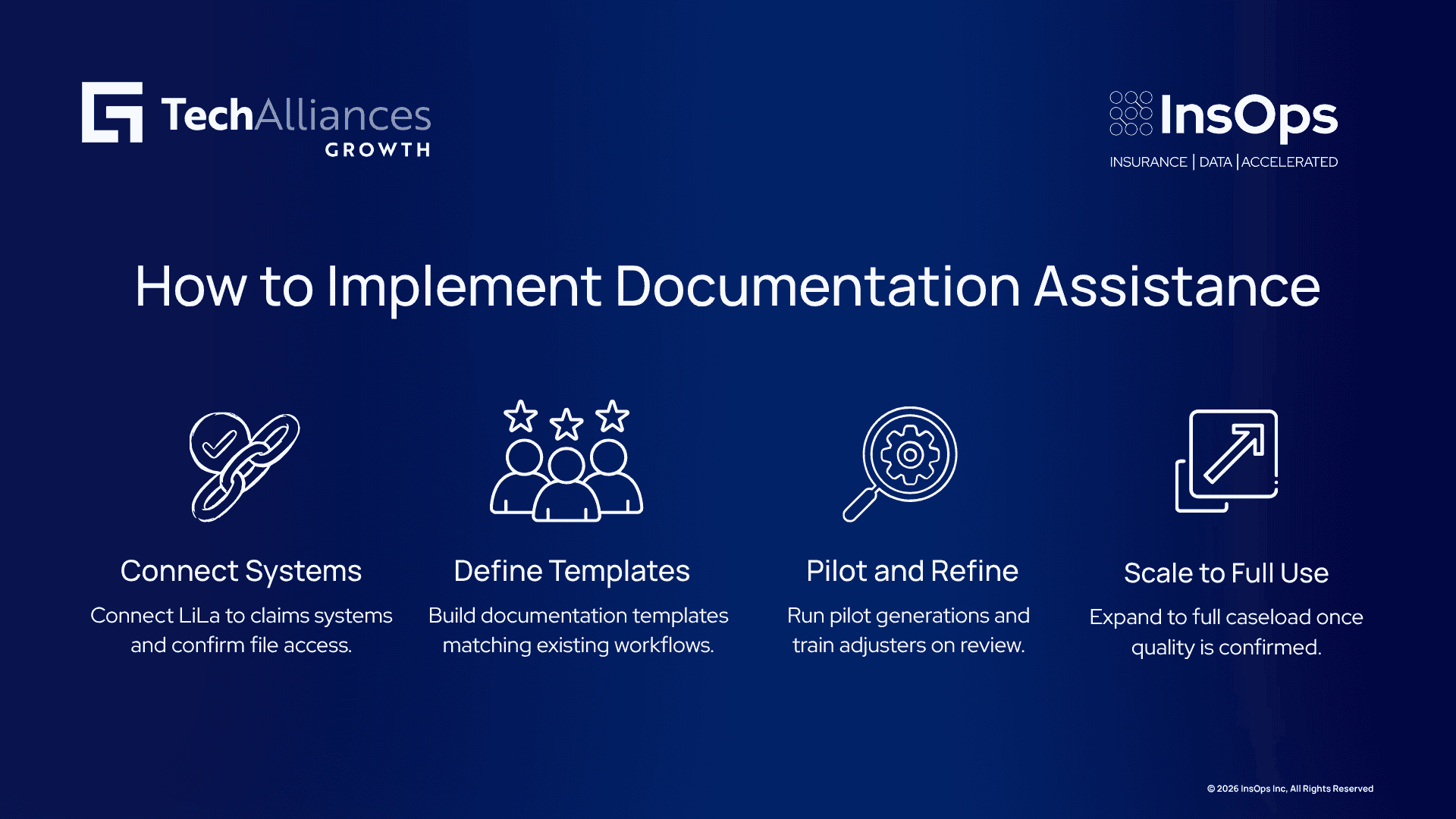
Connect LiLa to your claims management system and confirm access to claim files
Define documentation templates that match your existing workflows
Run pilot generations on sample claims and refine output quality
Train adjusters on the review and approval process
Scale to full caseload once quality and workflow integration are confirmed
The timeline is typically 4-6 weeks from connection to full production use. The key variable is adjuster adoption: teams that engage in pilot refinement and treat generated drafts as first-pass work (not final output) see the fastest gains in efficiency.
How InsOps Helps
Our insurance-trained AI that assists with claim documentation tasks that consume litigation adjuster time without requiring human judgment about case strategy or reserve levels.
If you are evaluating how to reduce manual documentation burden without compromising case strategy or audit trail integrity, contact us to talk through what this could look like for your litigation teams.
Frequently Asked Questions
Can AI-generated claim summaries withstand discovery?
Yes, if a human adjuster reviews and approves the summary before it enters the claim file. The adjuster's name is attached to the finalized document, just as it would be for a manually written summary. Discovery shows adjuster review and approval, which makes the document defensible.
What if the AI generates inaccurate information?
The adjuster review process catches inaccuracies before finalization. Adjusters compare generated text against source documents and make corrections in the claims management system. The draft is a first pass, not a final product. Accuracy improves with feedback: LiLa learns adjuster corrections and improves future generations for the same team.
Does this change how reserves are documented?
No. Reserve levels remain the adjuster's decision. The AI assists by drafting a justification narrative that explains the reserve logic. The adjuster reviews the draft, confirms it aligns with their reserve decision, and approves before it becomes part of the claim file.
How much time do adjusters actually save?
Industry data shows that adjusters spend 50-60% of working hours on documentation. When AI assists with drafting, adjuster review time for a claim summary drops from 2-3 hours to 20-30 minutes. Over a caseload of 50 claims, that compounds to 5-10 hours per week freed for case strategy and settlement work.
Does the AI need insurance-specific training?
LiLa is already trained on insurance domain data and P&C claim workflows. It does not require additional training on domain context. Implementation focuses on integrating the model with your claims management system and aligning generated output with your internal documentation standards.
What happens to claim file formatting and compliance?
InsOps' Integration Gateway ensures that generated documentation meets your claims management system's formatting standards and compliance requirements. All finalized documents are time-stamped and attributed to the reviewing adjuster, preserving audit trail integrity.
Can this work for complex litigation claims?
LiLa performs best on documentation tasks that synthesize information rather than making strategic decisions. For straightforward claim summaries, litigation updates, and reserve justifications, the model handles complexity effectively. For claims involving unique legal issues or novel coverage questions, the AI assists by organizing existing information, and the adjuster provides the judgment layer.
How does this integrate with existing vendor workflows?
LiLa connects through InsOps' Integration Gateway to Guidewire ClaimCenter. Generated documentation lands in your existing workflow queue for adjuster review. If you use other claims systems, contact us to discuss integration options.