

Missed litigation deadlines are the fastest way to turn a defensible claim into a liability nightmare. A single missed court date, discovery deadline, or mediation window can tank a case, expose your carrier to bad faith claims, and land your firm in the dock. The worst part: it often happens while the claim is actively being worked. Your team is focused on investigation, negotiation, and file development. That focus can mean the litigation calendar falls through the cracks until it's too late.
The financial damage is severe. Defense costs spiral. Indemnity awards jump. Settlement negotiations break down when the opposing counsel knows your deadline just expired. For litigation adjusters managing dozens or hundreds of open claims with overlapping court jurisdictions and policy-specific filing windows, the only reliable defense is a system that surfaces every deadline before it matters, not after.
This article walks you through how litigation deadlines work in P&C claims, why they get missed, and how to build a process that catches every deadline before your team is left explaining to coverage counsel why a case went into default.
How Litigation Deadlines Create Cascading Risk
When a claim moves into litigation, the calendar stops being advisory. It becomes the difference between winning and losing the case.
Litigation deadlines come from three places: court rules, policy language, and contractual agreements between the insurer and outside counsel. Different states have different statute of limitations. Different policy types have different suit limitation periods. A general liability claim in New York plays by different rules than a commercial auto claim in Texas. Your litigation adjusters live in this complexity. If the claim goes sideways on deadline, they own it.
The Timeline Problem
Here's how it typically goes wrong. A claim enters litigation in March. Coverage counsel begins investigation and discovery. Your adjuster is juggling five other files. By May, the opposing party files a motion to compel. Court-ordered discovery responses are due in 30 days. Mediation is tentatively scheduled for late June. Somewhere in that sequence, a critical date gets missed. Maybe it's the discovery cutoff. Maybe it's the mediation session itself. By the time anyone realizes the deadline passed, the judge has already struck the response or the insurer has been marked in default for failing to appear.
The claim doesn't just move backward. It collapses. The other party knows your deadline expired. Leverage evaporates. Settlement negotiations that could have closed the file for half the exposure now go sideways. The case goes to trial. Defense costs multiply. Indemnity awards increase.
Why Litigation Adjusters Miss Deadlines
It's not negligence. It's architecture. Your adjuster manages 40–100 open claims. Each claim lives in a different system. One claim's discovery deadline is logged in your case management system. Another is in an email from coverage counsel. A third is buried in a court filing PDF your IT team forwarded. There's no single calendar. There's no alert that fires across all systems when a deadline is 14 days away.
Coverage counsel sends a deadline reminder—sometimes. But counsel manages dozens of carriers and hundreds of files. Your claim is one of many. The reminder often lands in the adjuster's inbox the day before the deadline, creating triage chaos instead of planning time.
Meanwhile, your team is investigating, settling other claims, managing reserve recommendations, and handling policyholder communication. The litigation calendar gets squeezed to the margins.
The Compliance and Financial Impact
Missing a litigation deadline can trigger several cascading costs:
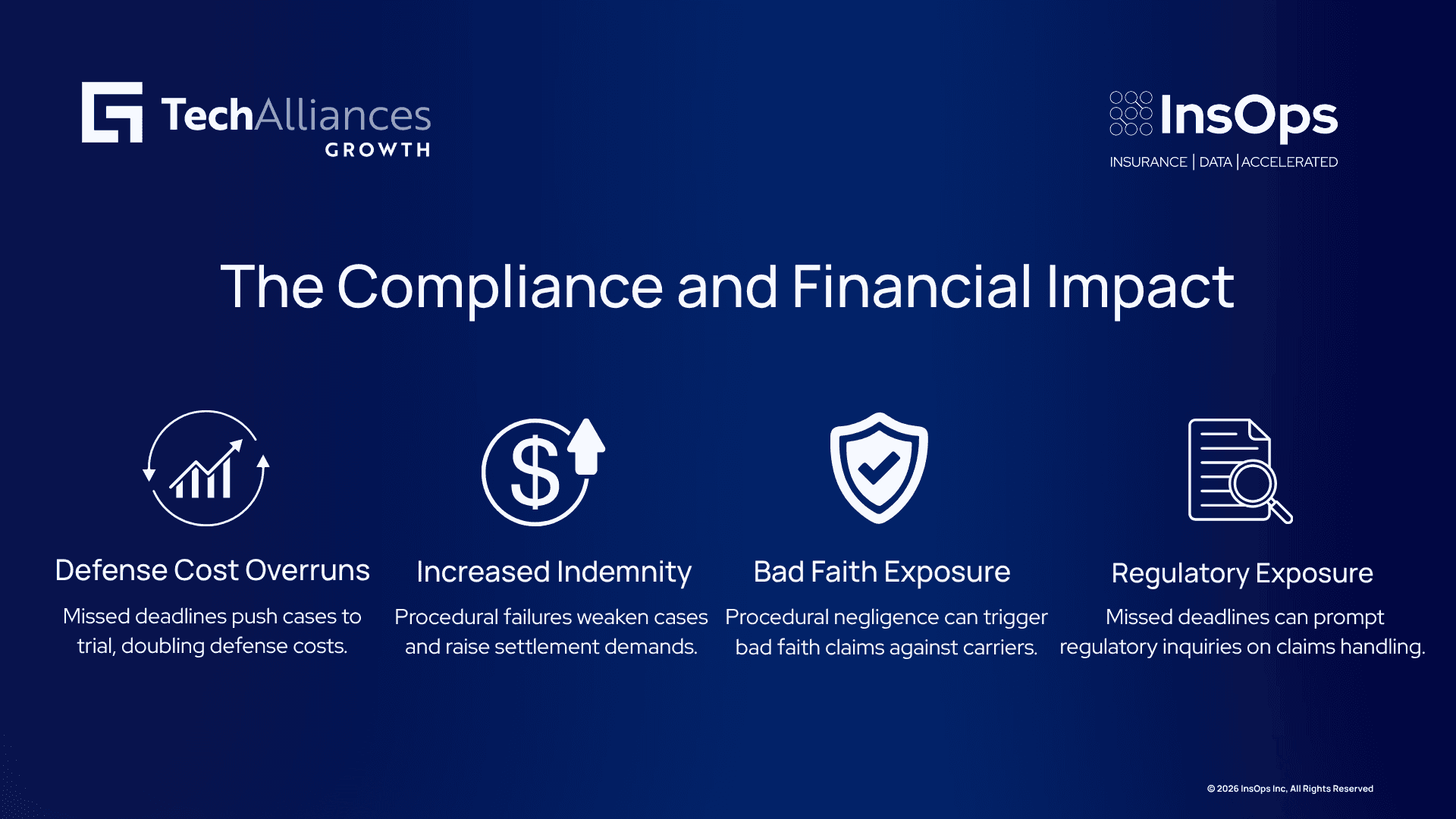
Defense cost overruns. When a case goes to trial instead of settling at mediation, defense costs often double or triple. A claim that could have closed for $150K in indemnity plus $50K in defense costs instead goes to trial, racking up $200K+ in defense alone before any verdict.
Increased indemnity. Courts and juries penalize insurers for procedural failures. A defaulted response or missed deadline weakens your case. Jury awards and settlement demands rise.
Bad faith exposure. In some jurisdictions, failing to defend a policyholder due to procedural negligence can trigger bad faith claims. Your carrier becomes the defendant.
Regulatory exposure. State insurance regulators review closed files. A pattern of missed litigation deadlines can prompt a regulatory inquiry into your claims handling practices.
The financial impact across a book of business is staggering. If your litigation team misses deadlines on even 2–3% of open files, the cumulative cost in additional defense spending, elevated settlements, and reserve increases runs into millions annually.
Litigation Deadline Categories and Tracking Requirements
Not all deadlines are equal. Some are hard stops. Others have flexibility built in. Understanding which is which is the first step to building a reliable tracking system.
Litigation deadlines in P&C claims fall into five main categories, each with different tracking requirements and escalation protocols.
Court-Ordered Deadlines
Court deadlines are non-negotiable. A discovery cutoff, motion deadline, or trial date ordered by the court has zero flexibility. Missing it typically results in sanctions, default judgment, or dismissal. These are the highest-risk deadlines.
Common court deadlines include discovery cutoffs (typically 30–120 days from case filing), motion deadlines (14–28 days from filing), and mandatory mediation or trial dates set by the judge.
Your tracking system must flag these 21 days before the deadline. That gives your coverage counsel time to gather materials and submit responses without last-minute panic. A 7-day reminder should go to your litigation adjuster and the assigned coverage counsel simultaneously. A 2-day reminder should trigger an escalation to your litigation manager.
Policy-Specific Suit Limitation Periods
Many policies include contractual deadlines that are shorter than the state's statute of limitations. A commercial general liability policy might require that any lawsuit be filed within two years of the loss, even if the state allows four years. These suit limitation periods are embedded in the policy language and vary by carrier, state, and coverage type.
Policy suit limitations are easy to miss because they're not on any court calendar. They live in your policy file. If your system doesn't flag them automatically by cross-referencing policy documents, they get forgotten until discovery uncovers them during coverage counsel's review.
Your tracking system must pull the policy suit limitation on the day the claim is reported and flag it automatically. No exceptions.
Discovery Deadlines and Interrogatory Responses
Discovery deadlines typically come in two forms: court-ordered (non-negotiable) and stipulated (agreed between parties but still binding). Both require careful tracking because a single missed response can result in sanctions.
Interrogatory responses, document requests, and deposition scheduling requests all have specific due dates. These deadlines often stack. You might have interrogatories due on July 15, documents due on August 1, and depositions scheduled for August 15–20.
Your tracking system should map all discovery deadlines on a single calendar per claim, color-coded by type and risk level. A 30-day reminder for interrogatory responses gives coverage counsel time to gather information from your claim file and coordinate with the policyholder or third parties.
Mediation and Alternative Dispute Resolution (ADR) Sessions
Mediation deadlines are often softer than court deadlines because both parties can agree to reschedule. However, missing a scheduled mediation session without cause can damage settlement negotiations and trigger a continuance that extends the litigation timeline.
Mediation sessions are typically scheduled months in advance. Your tracking system should flag these 60 days out (to allow scheduling flexibility) and then escalate at 14 days, 7 days, and 1 day before the session.
Appeals Deadlines
Appeals deadlines are among the most time-sensitive in the litigation cycle. Most jurisdictions allow only 30 days from judgment to file a notice of appeal. Missing this deadline typically forecloses any right to appeal.
If trial occurs in your jurisdiction or a case is decided on summary judgment, your coverage counsel must immediately flag the appeals deadline. Your tracking system should send automatic reminders at 21 days, 14 days, 7 days, and 3 days before the deadline.
Building Your Litigation Deadline Calendar
A single source of truth for all litigation deadlines is non-negotiable. Your adjuster shouldn't have to hunt through email, case management system entries, and PDF filings to know what's due when.
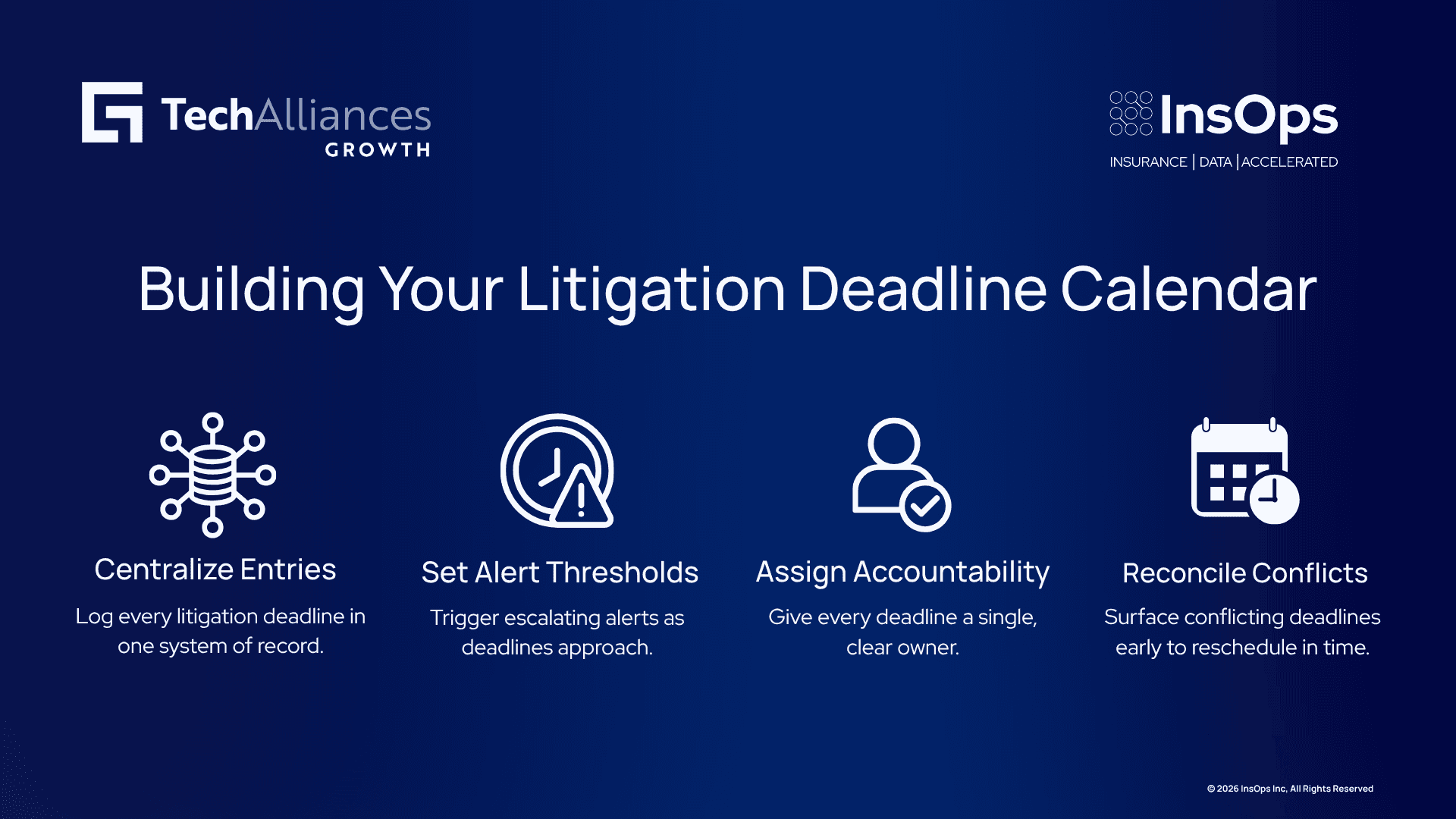
Step 1: Centralize Deadline Entry
Every litigation deadline should be entered into a single system of record on the day it is identified. That entry should capture:
Deadline date and type (court-ordered, policy suit limitation, discovery, mediation, appeal)
Responsible party (your carrier, coverage counsel, policyholder, third party)
Jurisdiction and court (if applicable)
Associated claim number and file reference
Any notes on special circumstances (e.g., the deadline is tied to another deadline)
Coverage counsel should be required to log deadlines immediately upon receipt of court orders or stipulated agreements. Your claim handler should log policy suit limitations when the claim is first reported. Your case management system should have a dedicated "Litigation Deadlines" view that surfaces all open deadlines sorted by date.
Step 2: Set Alert Thresholds
Not all alerts need to be the same. A discovery deadline 90 days away requires a different action than one 7 days away.
Recommended alert schedule for each deadline:
60-day alert: Summary alert to adjuster and coverage counsel (mediation/ADR sessions only)
21-day alert: Detailed summary with escalation to litigation manager (all deadlines)
14-day alert: Confirmation email to coverage counsel requesting deadline confirmation (all deadlines)
7-day alert: Escalation to litigation manager with required status update (all deadlines)
2-day alert: Executive escalation (high-risk deadlines only; critical appeals, trial dates, court-ordered responses)
Step 3: Assign Accountability
Every deadline must have a single owner—either coverage counsel or your adjuster. Shared accountability is diffused accountability. Coverage counsel owns the substantive response (filing motions, responses, appearances). Your adjuster owns tracking, receiving the response from counsel, and logging it in the claim file.
If coverage counsel misses a deadline, your adjuster should have a clear protocol to escalate immediately to your litigation manager. If your adjuster misses a deadline alert, your litigation manager should have clear authority to remove the adjuster from litigation files and reassign the workload.
Step 4: Reconcile Conflicting Deadlines
Sometimes discovery deadlines from different parties land on the same date. Sometimes mediation is scheduled during a deposition. Your tracking system should surface conflicts at least 30 days in advance so coverage counsel can request extensions or reschedule.
How InsOps Helps Surface and Track Litigation Deadlines
Manually tracking litigation deadlines across hundreds of open claims is prone to failure. The calendar fills up. New claims arrive. Your team gets focused on investigation and reserve adjustments. Deadlines slip.
Our AI removes the manual work of hunting through files, emails, and documents to find dates that matter.
If you are evaluating how to prevent missed litigation deadlines without adding headcount to your claims team, contact us to talk through what this could look like for your operation.
Frequently Asked Questions
What's the difference between a statute of limitations and a suit limitation period?
A statute of limitations is set by state law and defines how long a claimant has to file suit after a loss occurs. A suit limitation period is set by policy language and often is shorter than the statute. If your policy says "any lawsuit must be filed within two years of loss" but your state allows four years, you must honor the policy language. Missing a policy suit limitation is a coverage issue that can expose your carrier to bad faith claims.
Can we just rely on coverage counsel to remind us of deadlines?
Coverage counsel has dozens of clients and hundreds of files. They will send reminders, but those reminders often come late or go to the wrong person in your organization. Building your own deadline tracking system ensures you have control and visibility. Your adjuster should never be surprised by a deadline reminder; they should have seen it in your system days in advance.
How do we handle deadlines when coverage counsel is unreachable?
This is a red flag. If outside counsel is not responsive to deadline reminders, you need an escalation protocol. Assign a backup counsel immediately or consider moving the file to a more responsive firm. A missed deadline due to counsel non-responsiveness can still be your carrier's liability.
What happens if we miss a deadline?
Escalate immediately to your coverage counsel and your legal department. Depending on the deadline, you may be able to file a motion to excuse the tardiness, request an extension, or seek relief from sanctions. In some cases, the harm is done and the case is lost. Document everything. This will become a regulatory file and possibly litigation file within your organization.
How often should we review and update our deadline tracking system?
Weekly. Your litigation manager should run a weekly report of all deadlines due in the next 21 days, review status, and confirm that coverage counsel has submitted responses or court filings. This weekly review catches slippage before it becomes a crisis.
Can we automate deadline extraction from court documents?
Partially. AI can extract dates and deadline language from court orders and policy documents, but human judgment is required to interpret what the deadline means in context. Is it a response deadline or a trial date? Which policy language controls? A person must always validate before a deadline is flagged in your system.
What's a reasonable escalation timeline for a missed deadline?
The moment you realize a deadline has been missed, notify coverage counsel and your litigation manager. Do not wait 24 hours. In some cases, a same-day motion to excuse the tardiness can still succeed. Every hour counts.