

P&C carriers face an unprecedented rise in coverage litigation. Business liability coverage disputes jumped steeply since 2021, with federal courts seeing over 3,000 cases filed in 2024. That's the busiest year since 2010. The core problem: adjusters spend days or weeks manually reviewing policy language, cross-referencing claim facts, and identifying exclusions. By the time coverage is determined, litigation risk is already escalating.
Claims adjusters need to complete coverage analysis fast and accurately. A single misinterpreted exclusion, missed endorsement, or jurisdictional oversight can turn a routine claim into a costly dispute. Almost 60% of policyholders have unidentified or misunderstood exclusions in their coverage, leaving them at risk for unexpected exposures. Your adjusters face the same challenge when working backward from a claim fact to policy language.
This article covers the coverage analysis workflow adjusters rely on, common pitfalls that create litigation risk, and how InsOps helps accelerate the process without sacrificing accuracy.
Why Coverage Analysis Drives Claims Outcomes
Coverage analysis is a crucial aspect of the insurance industry, involving careful examination of policy language and provisions to determine the scope of coverage. For adjusters, this task directly impacts claim settlement accuracy and litigation risk.
Adjusters conduct thorough investigations of the claim and policy wording to determine what the policy will and will not cover. The adjuster's duty is to look for coverage, not denials. That discovery requires discipline, precision, and systematic methodology.
Policy Language as Liability Exposure
Policy documents contain multiple layers: insuring agreements, exclusions, conditions, and endorsements. Each layer can limit or expand coverage. When adjusters miss a relevant provision or misinterpret its scope, the result is either incorrect claim denial (triggering a lawsuit) or unintended coverage expansion (eroding margins).
Coverage analysis requires extreme discipline, interpretative skills, and understanding of language and its usage. Courts construe ambiguous language against the insurer. If the policy is silent on a given aspect, courts will usually find in favor of the insured. That means incomplete analysis or missed provisions expose the carrier to litigation.
Litigation Risk Concentration in Coverage Disputes
Disputes over business liability coverage have risen steeply since 2021, with factors including rising social costs, shifts in insurers' approaches to coverage denials, and emerging technological risks. Adjusters making coverage calls on novel exposures such as cyber incidents, ESG-related claims, and social engineering fraud often lack precedent and must rely entirely on precise policy language interpretation.
The cost of getting it wrong extends beyond the claim itself. Notable trends in 2025 include disputes over property coverage for wildfire and smoke damage, treatment of interrelated claims under successive D&O policies, and general liability coverage issues such as construction exclusions and limits on losses tied to the opioid crisis. Each category involves coverage language ambiguity that escalates into litigation.
The Coverage Analysis Workflow
Professional adjusters follow a systematic approach to coverage analysis. This workflow removes emotion from the decision and creates a clear path for interpreting policy language correctly.
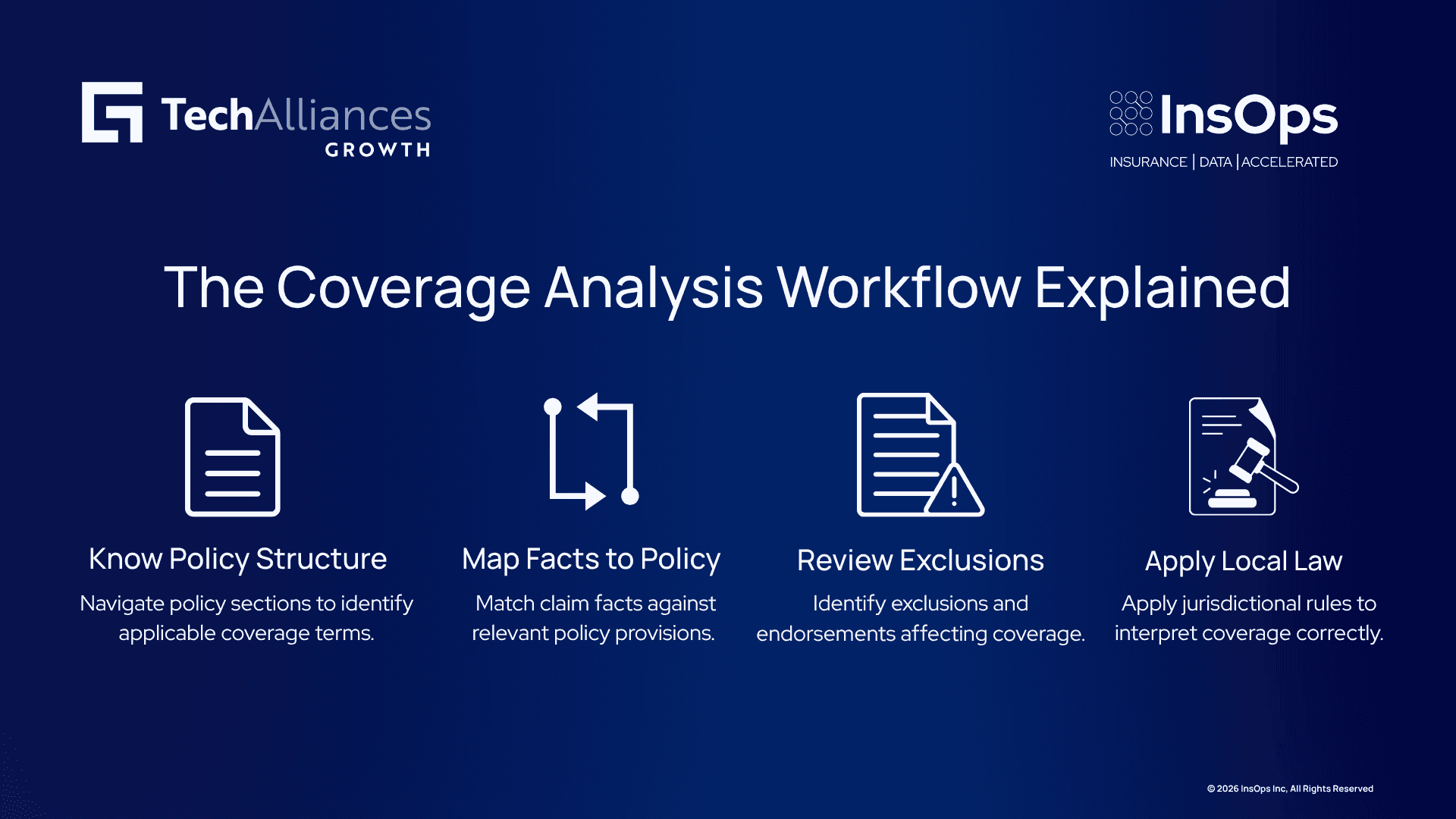
Step 1: Know the Policy Structure
Insurance policies have a consistent internal architecture. Insurance policies typically consist of various sections, each addressing different aspects of coverage, including declarations, insuring agreements, definitions, exclusions, and conditions. Adjusters familiar with this structure can navigate quickly to relevant sections without overlooking interconnected provisions.
The declarations page sets the scope for coverage types, limits, deductibles, and effective dates. The insuring agreement states what the policy covers. Definitions clarify key terms. Exclusions carve out specific perils or scenarios. Conditions set requirements for coverage to apply (proof of loss, timely notice, duty to cooperate). Endorsements modify or expand base coverage.
A single claim may implicate language across all sections. An adjuster who reads only the insuring agreement will miss exclusions that apply. One who reads exclusions but not endorsements may miss coverage restoration language.
Step 2: Map Claim Facts to Policy Language
Policy language can be digitally structured and mapped against a comprehensive list of incidents so that sections of the policy which may be impacted by variables of a specific incident are identified. This approach of matching claim facts to policy provisions is the foundation of sound coverage analysis.
Start with the loss itself: What triggered it? When did it occur? Who was affected? Where did it happen? Then cross-reference these facts against the insuring agreement: Does the policy cover this type of loss? Next, apply exclusions: Does any exclusion apply to this fact pattern? Finally, review conditions: Are all conditions satisfied (notice given, cooperation provided, etc.)?
This systematic pairing prevents the adjuster from making a coverage call in isolation. A claim might fall within the insuring agreement but be excluded, or excluded but restored by an endorsement.
Step 3: Identify Relevant Exclusions and Endorsements
Exclusions are the most litigation-prone section of any policy. The ISO commercial general liability coverage form contains seventeen (17) exclusions applicable to coverage for bodily injury and property damage claims. Some of these exclusions will rarely apply to construction risk claims, but others will often apply to limit or preclude coverage.
Each exclusion has specific language and scope. An exclusion for "contractual liability" does not necessarily exclude all liability arising from a contract. It excludes liability assumed by contract, not liability that would have existed regardless. Adjusters who misread exclusion scope create incorrect denials.
Endorsements complicate the analysis further. An endorsement may restore coverage carved out by an exclusion, or add a new exclusion entirely. Endorsements must be read in order of attachment; later endorsements can override earlier ones.
Step 4: Apply Jurisdictional Law
Understanding these shifts is essential for navigating the next phase of coverage litigation and managing risk in an increasingly complex claims landscape. Jurisdictional law affects coverage interpretation, particularly around ambiguity, waiver, and estoppel doctrines.
Some states require strict construction of policy language against the insurer. Others apply a "reasonable expectations" doctrine, asking whether a reasonable insured would expect coverage despite literal policy language. A few states impose heightened duties on insurers to investigate coverage before denying claims. Adjusters must know the controlling jurisdiction for each claim.
Common Coverage Analysis Pitfalls
Adjusters and claims teams repeatedly encounter three high-risk errors: misinterpreted exclusions, overlooked endorsements, and jurisdictional misalignment. Each creates litigation risk.
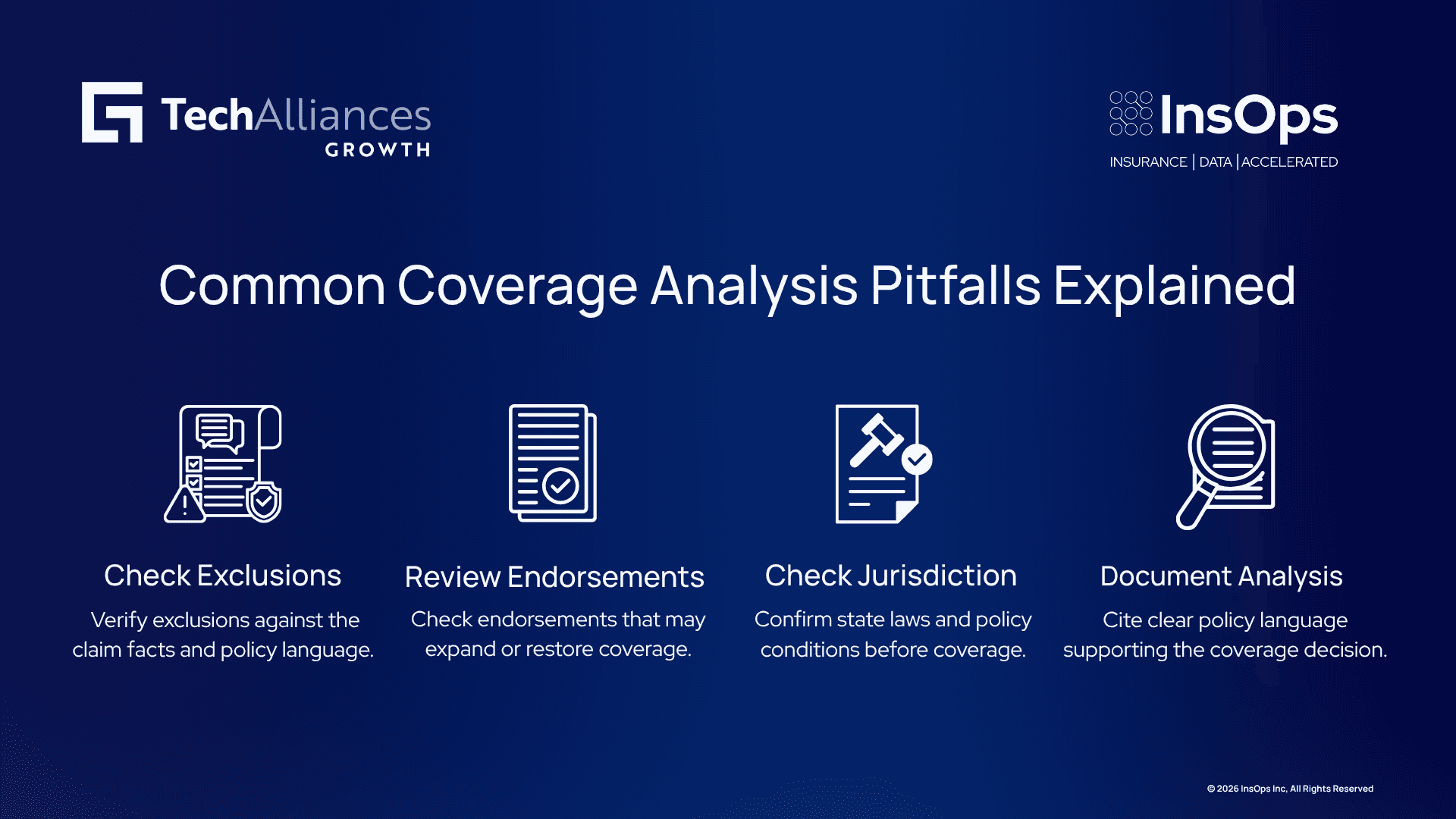
Misinterpreted Exclusions
The language of exclusions is notoriously precise and narrow. "Exclusion for loss from water" typically means water damage from external sources (flooding, storm surge, groundwater intrusion), not internal water damage from plumbing failures. An adjuster who interprets "water" broadly may incorrectly deny a claim for a burst pipe.
Conversely, an adjuster who interprets an exclusion too narrowly may leave coverage uncapped. "Exclusion for intentional acts" applies only when the insured's act was deliberate. It does not apply when the insured was negligent or reckless. A claim arising from gross negligence may still be covered if intent is not proven.
Strong claims practice requires expressing coverage analysis in writing, citing the specific policy language that supports coverage. This discipline forces the adjuster to articulate the exclusion language and explain precisely why it does or does not apply to the specific claim facts.
Overlooked Endorsements
Endorsement stacking creates complexity. A policy may have 5, 10, or even 20 endorsements. Some expand coverage. Others add exclusions. Some conflict. Adjusters who conduct a cursory review often miss a relevant endorsement that changes the coverage landscape.
A common miss: an endorsement restoring coverage that an exclusion denied. An adjuster reviews the base policy, sees an exclusion, and issues a denial. They do this without checking if an endorsement (often paid for specifically to restore that coverage) negates the exclusion.
Jurisdictional and Condition Misses
Coverage analysis exists within a legal context. A claim might be covered under policy language but barred by state law (e.g., punitive damages are uninsurable in many states). A condition might require proof of loss within 90 days; if the proof arrives on day 91, some carriers incorrectly deny coverage.
Courts largely enforced clearly drafted policy exclusions while continuing to analyze whether injuries truly arose from vehicle use. The takeaway: ambiguity in policy language gets resolved against the insurer, but clear exclusions are enforced. An adjuster's job is to ensure the exclusion language is genuinely clear and unambiguous before relying on it.
How Early Coverage Analysis Prevents Litigation
The window to prevent litigation is narrow. Once a claim is denied, the insured often retains counsel. Litigation becomes the default path to resolution. The adjuster who completes accurate, documented coverage analysis before issuing a decision has a powerful advantage: the ability to correct course if the analysis was wrong.
Adjusters operating under time pressure often skip steps or abbreviate the analysis. This creates downstream litigation risk. Conversely, adjusters who invest time upfront in systematic coverage analysis including policy structure review, claim-to-language mapping, and exclusion scope documentation reduce litigation cost and speed settlement.
Early coverage analysis also surfaces coverage counsel's role. Complex claims involving novel exposures or significant litigation risk should be escalated to coverage counsel during the analysis phase, not after a denial has been issued. Coverage counsel can provide jurisdictional context and help the adjuster interpret policy language correctly before a decision hardens into a denial letter.
How InsOps Helps
InsOps’ insurance-trained AI assists with coverage analysis. LiLa, our insurance-trained LLM, understands policy language, claim data relationships, and regulatory frameworks (NAIC, HIPAA, GDPR) at a level generic LLMs cannot match.
LiLa can analyze policy language, compare it with claim facts, identify potential coverage issues, and summarize relevant endorsements for adjusters. A person reviews and validates every coverage determination before it is finalized.
If you are evaluating how to accelerate coverage analysis without sacrificing accuracy or exposing claims to litigation risk, contact us to talk through what this could look like for your operation.
Frequently Asked Questions
What's the difference between exclusion scope and exclusion application?
Exclusion scope is what the exclusion language covers (e.g., "Exclusion for water" covers water damage). Exclusion application is whether that exclusion applies to your specific claim facts. An adjuster must determine both before relying on the exclusion to deny coverage.
Why do courts construe ambiguous policy language against the insurer?
Insurance policies are contracts drafted by the insurer, not negotiated with the insured. Courts apply the rule of construction contra proferentem to discourage insurers from hiding coverage limitations in vague language.
How can adjusters track endorsements when a policy has 20+ of them?
Systematic indexing and digital storage are non-negotiable. Endorsements must be read in order of attachment. Any digital system should flag endorsement conflicts automatically and highlight coverage-restoring endorsements before an adjuster issues a denial.
What role does coverage counsel play in coverage analysis?
Coverage counsel interprets policy language in jurisdictional context. On claims with litigation risk, novel exposures, or significant dollar exposure, adjusters should escalate to coverage counsel during analysis, not after denial.
Why is "look for coverage, not denials" the core instruction for adjusters?
Insurers have a duty to investigate and determine coverage fairly. An adjuster biased toward denial will miss coverage. The adjuster's mindset should be: "How can this claim be covered?" not "How can I deny this claim?"
How does continuous documentation of coverage analysis protect the carrier in litigation?
Litigation discovery will require the carrier to produce coverage analysis files. A file containing clear, dated documentation of the analysis steps, policy sections reviewed, and the logic supporting the decision demonstrates good-faith coverage review and is far harder to attack in litigation than a cursory denial letter.
What should adjusters do when a claim involves novel or precedent-poor exposures?
Escalate immediately to coverage counsel and risk management. Cyber claims, ESG-related losses, and AI-liability claims often lack precedent. Adjusters should not make solo decisions on novel exposures; these claims require specialized expertise and jurisdictional analysis that coverage counsel can provide.