

Adjusters face a brutal math problem: verdicts are surging, juries are younger and angrier at corporations, and the stakes of guessing wrong on settlement value have never been higher. In 2024 alone, nuclear verdicts (awards exceeding $10 million) jumped 50% year-over-year to more than 130 cases. The median value of these verdicts has more than doubled since 2016. At the same time, 76% of Americans now believe damage awards are too low, up from just 58% a decade ago.
The gap between settlement offers and what a jury might award has become a minefield. Adjusters who rely on intuition, historical comparables, or spreadsheet formulas are flying blind. They lack the pattern recognition tools to flag which claims are actually headed for trial and which can be resolved fairly. This costs carriers billions annually in both over-settlements and catastrophic verdicts.
The Settlement Problem: Data Blindness in a High-Risk Environment
Adjusters review claims one at a time. They pull injury severity from medical records, check liability, look at policy limits, and make an offer. But they're missing the context that drives modern jury behavior: what happened to similar claims in the same court system, how other jurors viewed comparable injuries, what verdict ranges actually landed in the last five years, and whether this particular claimant profile tends to recover differently than others.
Why Traditional Settlement Evaluation Breaks Down
Traditional methods rely on internal loss runs, outdated verdicts from other carriers, and adjuster judgment. This approach misses the structural forces reshaping liability claims. Social inflation, the mismatch between how much jurors think damages should be and what insurers have historically paid, has driven a 57% increase in liability claims over the past decade. Younger jurors (83% of those under 40 believe damages are too low or fair) are entering jury pools faster than older, more conservative cohorts leave them. Third-party litigation funding now enables cases that would have died for lack of money, extending litigation timelines and increasing the likelihood of trial. These aren't random noise; they're systematic shifts that break backward-looking models.
The Cost of Undervaluation and Overvaluation
Undervalue a settlement, and the claimant refuses to settle. The case proceeds to trial. A jury awards what they consider fair, often far above the insurance company's offer. The result is a nuclear verdict that destroys the loss ratio for that year and signals to other claimants in similar circumstances that trials pay better than settlement discussions.
Overvalue a settlement, and the carrier hemorrhages money on one claim while setting expectations for others. Adjusters who are told to "just settle it" to avoid trial risk begin settling everything at inflated rates, destabilizing the entire reserve strategy.
How Settlement Evaluation Works: The Core Factors
Settlement evaluation requires answering four questions with precision, not guesses. Each question draws on different data sources; when those sources are fragmented or missing, the final answer is unreliable.
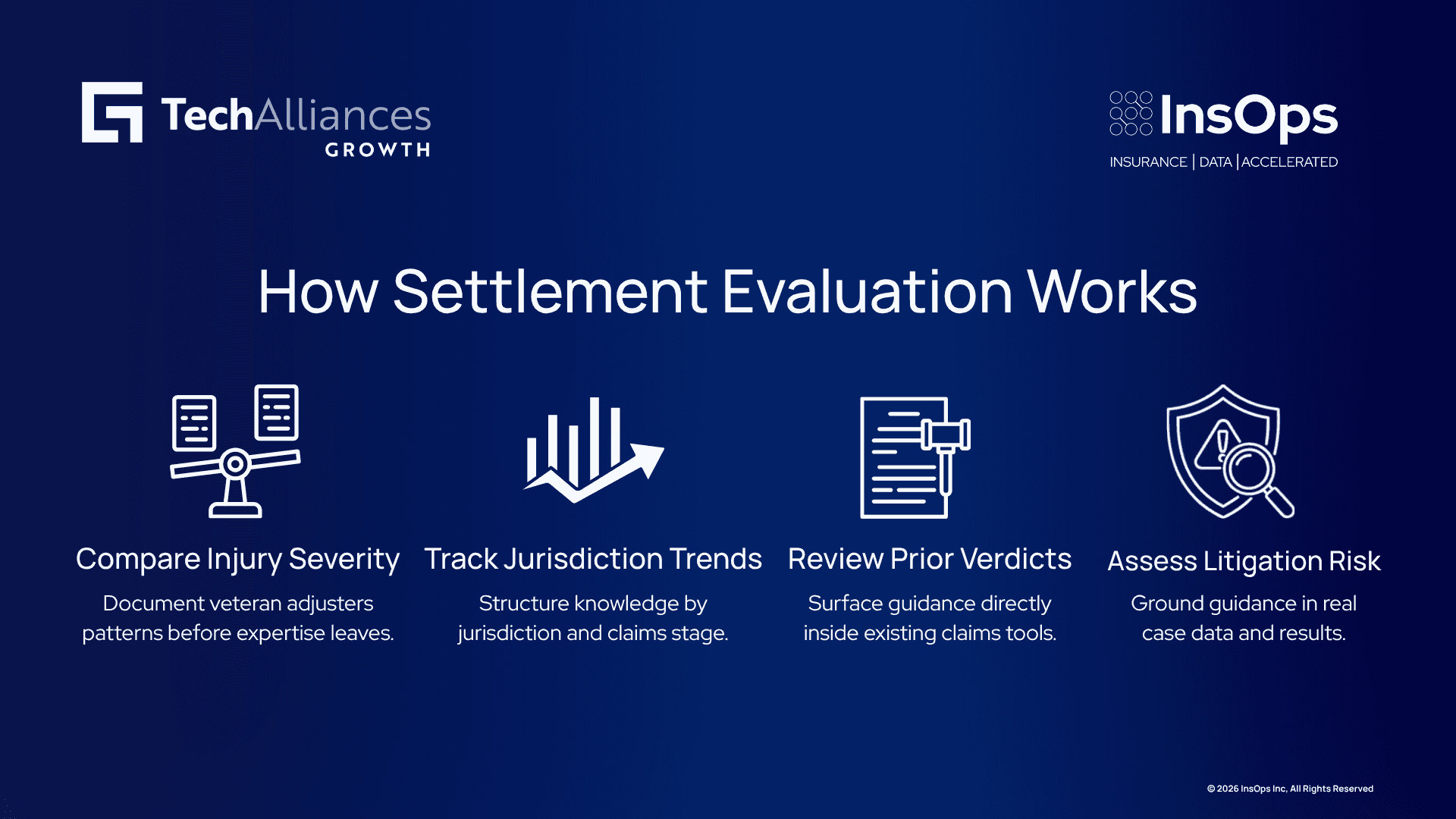
Question 1: What Is the Injury Severity Relative to Similar Claims?
Injury severity alone doesn't drive settlement value. Pattern does. A severe burn injury in a workplace claim might settle for $500K in one jurisdiction and $2M in another, depending on jury demographics, verdicts in that court system, and how similar claimants have fared before.
The adjuster needs to see historical claims with matching characteristics: same body part, same type of injury, same line of business (auto liability, premises liability, product liability), same jurisdiction, and the same time period (because inflation and jury attitudes shift). When this data is siloed across departments or buried in old claim files, the adjuster can only guess at the relevant comparison set.
Question 2: What Are Jurisdictional Trends in Damages and Verdicts?
Courts are not interchangeable. Nevada recorded $8.4 billion in verdicts during 2024, more than any other state, largely due to contamination cases. Pennsylvania, California, and Texas followed, each with multi-billion-dollar verdict totals. But within those states, even individual counties vary wildly. A plaintiff in Cook County, Illinois sees very different jury profiles than one in rural downstate Illinois.
Adjusters need to know: In the court where this case would be tried, what's the median verdict for this injury category in the last three years? What's the 75th percentile? What percentage of cases go to trial versus settling? How do defense verdicts break down by injury type?
Without this data, an adjuster is essentially picking a settlement number out of thin air.
Question 3: What Are Prior Verdicts and Settlements in Comparable Cases?
Prior verdicts function as gravity. They anchor what juries expect and what plaintiffs' attorneys demand. When a case with similar injuries settled for $1.2 million three years ago, and another with nearly identical facts settled for $2.8 million two years ago, that range becomes the negotiation floor.
The problem is that these verdicts are scattered. Some sit in trial transcripts. Others are buried in confidential settlement agreements. Many are never recorded at all. Even when collected, they're hard to search by injury type, jurisdiction, and recency. Adjusters end up relying on outdated case law, competitor intelligence (which is biased), or assumptions that haven't held up in years.
Question 4: What Is the Claimant's Litigation Risk Profile?
Not all claimants are equally likely to accept a settlement. Some have occupational or demographic profiles strongly associated with trial outcomes. Younger claimants recover differently than older ones. Claimants with pre-existing conditions may have lower awards, or higher ones if liability is clear. Claimants who've already rejected one offer are statistically more likely to reject the next one unless it crosses a meaningful threshold.
Modern adjusters need to know: Given this claimant's age, income level, injury type, and litigation history, what's the probability they'll accept this settlement offer, and what's the probability a jury returns a verdict if we go to trial?
How InsOps Helps
InsOps builds an insurance-trained AI that assists with settlement evaluation by analyzing similar claims, jurisdictional trends, injury severity, and prior verdicts to surface a recommended settlement range. LiLa, our insurance-trained LLM, runs inside your own environment, so PII and PHI never leave controlled infrastructure. A person reviews and validates every settlement recommendation before it is finalized.
Our Integration Gateway connects to Guidewire ClaimCenter, so claimant data, injury codes, and historical claim patterns flow directly into the settlement evaluation workflow without custom engineering or manual data pulls.
InsOps reduces litigation risk by analyzing case patterns and claim history to surface high-risk claims. Early identification lets adjusters intervene proactively by either offering a settlement that reflects what a jury would likely award, or by investing in defense strategies that actually change the outcome, instead of hoping to get lucky at trial.
If you are evaluating how to predict settlement value and jury behavior without relying on gut feel and outdated benchmarks, contact us to talk through what this could look like for your operation.
The Mechanics of Better Settlement Evaluation
Accurate settlement evaluation requires three layers: data integration, comparative analysis, and risk modeling.
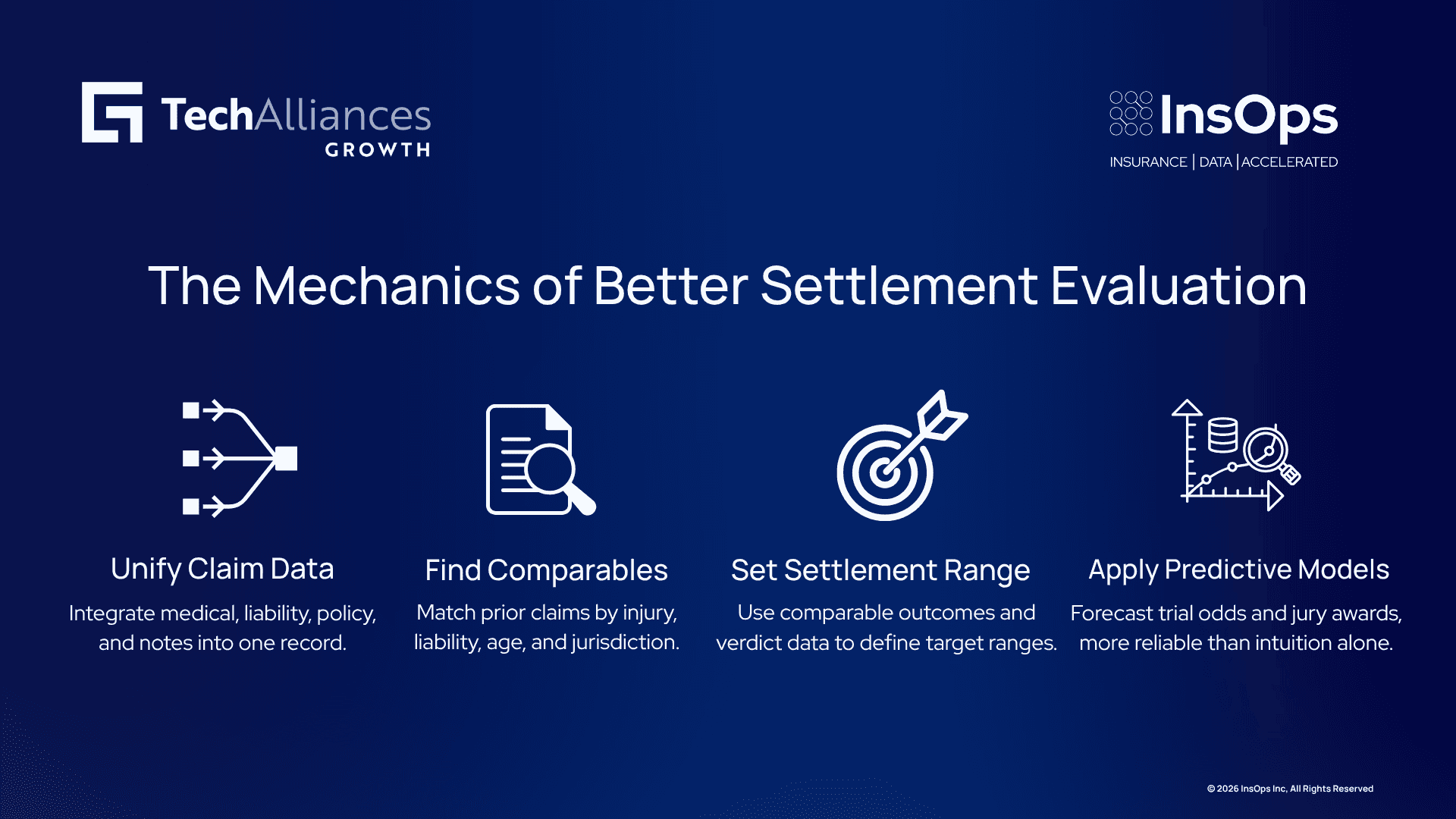
Layer 1: Unifying the Claim Record
Settlement decisions require access to the entire claim file: medical records, liability assignments, policy details, prior communications with the claimant, and the claims adjuster's own assessment notes. When this data lives in separate systems (EMR in one place, liability tracking in another, reserve history in a third), an adjuster can't see patterns.
The first step toward better settlement evaluation is making sure all this data is accessible in one place and formatted consistently. ClaimCenter typically holds most of this; the challenge is connecting it to external benchmarks: verdict databases, settlement history, and jurisdictional rules.
Layer 2: Finding Comparable Cases
Once the core claim data is integrated, the next step is searching for precedent. Which prior claims in your own history most closely resemble this one? Filter by injury type, body part affected, line of business, liability percentage, claimant age range, and jurisdiction. Then look at how those claims settled: what was the reserve, what was the final paid amount, how long did it take, and did it go to trial?
This comparative set becomes the foundation for the settlement recommendation. If your own history shows that similar claims settle between $800K and $1.4M, that's the range an adjuster should be working within. External verdict databases add the second layer: what are juries in this jurisdiction actually awarding for comparable injuries?
Layer 3: Applying Settlement Science
Modern insurance carriers are increasingly using predictive models to forecast settlement outcomes. These models take the claim characteristics (injury severity, liability, claimant age, jurisdiction) and predict the probability of trial, the distribution of possible jury awards, and the likelihood of claimant acceptance at various settlement amounts.
The models are not perfect. No model can predict individual jury behavior. But they're far more reliable than intuition, especially when social inflation, litigation funding, and demographic shifts are reshaping the litigation landscape faster than historical data can capture.
Jurisdictional Trends Driving Settlement Pressure Upward
The geography of verdicts is shifting, and settlement strategies must shift with it.
The Rise of "Nuclear" Verdicts and Social Inflation
A nuclear verdict is an award exceeding $10 million. For decades, these were rare. Now they're the new normal. In 2023, there were 89 nuclear verdicts totaling $14.5 billion. By 2024, that number had jumped to more than 130. The average value of these verdicts has more than doubled since 2016.
This isn't inflation in medical costs or wage loss. It's social inflation: a fundamental shift in what Americans believe is fair compensation. In 2016, 58% of consumers thought damage awards were too low. By 2025, that figure had jumped to 76%. This change is happening generationally. Among Americans under 40, 83% believe damages are too low or fair. Among those 60 or older, only 41% agree.
As younger jurors enter jury pools, this sentiment is being amplified in courtrooms. Plaintiffs' attorneys have learned to leverage it. Tactics like "reptile theory" (positioning defendants as a threat to the community) and anchoring (suggesting an outrageously high initial damages amount to influence the final award) have become standard. These strategies work, especially with younger, more socially conscious jurors.
Courtroom Concentration: Where Verdicts Actually Land
Verdicts are not evenly distributed. In 2024, Nevada led all states with $8.4 billion in total verdicts, primarily from contamination cases. California followed with $6.9 billion, Pennsylvania with $3.4 billion, Texas with $3 billion, and New York with $2.1 billion. Together, these five states account for more than half of all major verdicts in the country.
Within these states, individual courtrooms matter enormously. Some judges attract plaintiffs' attorneys because juries in those courts are known to be generous. Defense counsel avoids certain counties. A case tried in downtown Los Angeles carries different risk than the same case tried 40 miles north in suburban venues.
Adjusters need jurisdiction-specific settlement guidance. A settlement range that makes sense in Kansas may be dangerously low in Philadelphia. Standard multipliers (settlement = medical expenses × 2 or 3) break down when applied across different jury populations.
Early Litigation Indicators: Flagging High-Risk Claims Before Trial
Not all claims that go to litigation result in nuclear verdicts. But some characteristics are strongly associated with higher trial risk and higher awards. Adjusters who identify these early can intervene.
Claimant Factors That Predict Trial Risk
Younger claimants are more likely to go to trial and, when they do, tend to receive higher awards. This is partly demographic. Younger people have longer earnings horizons, so medical malpractice or permanent disability cases carry higher damages. But it's also sociological. Younger claimants have grown up expecting to challenge large institutions, and they're less satisfied with traditional settlement offers.
Claimants who reject an initial settlement offer are statistically more likely to reject the next one, unless the new offer crosses a meaningful threshold (typically at least 20-30% higher). This creates a decision point: either increase the offer significantly, or accept the probability of trial.
Claimants with prior litigation history (prior claims, prior lawsuits) are higher trial risk. They know what to expect, they're comfortable with legal process, and they have experience with attorneys who encourage litigation.
Injury and Liability Factors That Drive Up Awards
Permanent injuries (scarring, amputation, chronic pain) command higher settlements than acute injuries, and this gap has been widening. Jury awards for permanent injuries have outpaced inflation significantly.
Catastrophic injuries (spinal cord damage, traumatic brain injury, blindness) trigger what researchers call the "empathy premium." Juries award dramatically higher damages for injuries that fundamentally alter the claimant's life. The curve is non-linear. A claim involving partial paralysis settles much higher than one involving severe burns, even if medical costs are similar.
Liability clarity matters. When the defendant is clearly at fault (unambiguous negligence, evidence of recklessness), settlement pressure increases and jury awards increase. When liability is disputed, the dynamics flip: claimants and their attorneys are less willing to settle because uncertainty favors plaintiffs at trial.
How Adjusters Are Evolving Settlement Strategy
The insurance industry is slowly shifting toward more data-driven, predictive approaches to settlement.
From Intuition to Comparative Analytics
Forward-thinking carriers are building internal databases of prior verdicts and settlements, organized by injury type, jurisdiction, and time period. When an adjuster receives a new claim, they search this database for comparable cases and use the distribution of prior outcomes to set a settlement range.
This approach is straightforward but labor-intensive. It requires someone to maintain the database, to classify each claim accurately, and to regularly update verdict information as new cases resolve. Many carriers still don't do this; they rely on a core group of experienced adjusters who remember "how things usually turn out."
Adding External Benchmarks
Some carriers are subscribing to external verdict and settlement databases. These services collect verdicts from court dockets, settlement databases, and confidential sources, then organize them by injury type, jurisdiction, and time period. An adjuster can search for "permanent spinal cord injury, motor vehicle accident, Illinois state court, 2022-2024" and see a distribution of verdicts and settlements.
External benchmarks add context that internal data can't provide. An individual carrier's claim experience is too limited to show what's typical; external databases show the broader market. This helps calibrate settlement offers to actual jury behavior.
The Frontier: Predictive Modeling
The frontier is predictive models that forecast trial outcomes. These models take claimant characteristics, injury details, liability factors, and jurisdiction, then estimate: (1) the probability the case goes to trial, (2) the probability the defendant loses at trial, (3) the distribution of jury awards conditional on losing, and (4) the claimant's likely reaction to various settlement amounts.
These models are built on statistical analysis of prior cases. They're not perfect. Individual jury behavior is inherently unpredictable. But they're far more reliable than subjective judgment, especially when applied to large portfolios where random variation averages out.
Frequently Asked Questions
What is a nuclear verdict, and why should adjusters care?
A nuclear verdict is an award exceeding $10 million. In 2024, more than 130 nuclear verdicts were recorded in the United States. These verdicts set expectations for future claimants and attorneys in the same jurisdiction, so a single high award can trigger a cascade of higher settlement demands in similar cases.
Why have settlement values been rising faster than inflation?
Social inflation (the gap between what jurors believe damages should be and what insurance companies historically paid) accounts for an estimated 60% of liability claims growth over the past decade. Public attitudes have shifted fundamentally. 76% of Americans now believe damage awards are too low. This sentiment is strongest among younger jurors, who now comprise a larger share of jury pools.
How do I know if a claimant is likely to accept a settlement offer?
Claimant acceptance depends on their perception of what a jury would award. If your settlement offer is below what they believe a jury would give, they'll reject it. Prior litigation history, claimant age, and attorney reputation also matter. Claimants with prior claims experience are more likely to reject low offers and go to trial.
What does "reptile theory" mean, and how does it affect settlements?
Reptile theory is a trial strategy where plaintiffs' attorneys appeal to jurors' primal instincts of safety, positioning the defendant as a threat to the community. It's designed to motivate jurors to award higher damages as a form of punishment and deterrence. When used effectively, it increases jury awards. Adjusters need to be aware that some trial teams use this strategy systematically.
How does jurisdiction affect settlement value?
Jurisdiction dramatically affects settlement value. Nevada, California, Pennsylvania, Texas, and New York have the highest verdict totals and widest ranges. A case that settles for $800K in a conservative jurisdiction might command $2M in a plaintiff-friendly one. Within states, individual counties vary wildly. Adjusters need jurisdiction-specific benchmarks.
Can AI predict what a jury will award?
No AI can predict individual jury behavior. But predictive models can estimate the probability of trial, the probability of losing at trial, and the distribution of possible jury awards based on historical cases. These models are far more reliable than intuition, especially for large claim portfolios where individual randomness averages out. A person should always review and validate the recommendation before it is finalized.
How far ahead should I evaluate settlement risk?
Settlement evaluation should begin when a claim is first reported, not when trial is imminent. Early identification of high-risk claims lets adjusters intervene by either offering a competitive settlement or by investing in defense strategies that actually change the outcome. Waiting until trial is scheduled severely limits your options.
What metrics should I track to know if my settlement strategy is working?
Track three metrics: (1) the ratio of average jury verdicts to average settlements in your jurisdiction over a trailing 12-month period (verdicts should generally be higher), (2) the trial rate (the percentage of claims that go to trial rather than settling), and (3) the gap between your final settlement offer and the claimant's final demand (smaller gaps indicate better prediction). Over time, these trends should stabilize and improve.