

It is difficult to consistently evaluate law firms based on litigation outcomes, legal spend, settlement effectiveness, and cycle times. Equally difficult: predicting which claims will go to litigation before attorney involvement escalates costs.
Most P&C carriers lack visibility into the early signals that separate routine claims from those headed for defense counsel engagement. Without that visibility, adjusters make settlement calls based on judgment rather than pattern analysis. The result: missed opportunities to resolve claims before litigation enters the picture.
This article covers how to surface litigation risk early using claim pattern analysis, historical claim data, and case prediction models.
The Hidden Cost of Late Litigation Detection
Most claims resolve without litigation. But the ones that don't account for a disproportionate share of total spend. When attorney involvement arrives late in the claim lifecycle, defense counsel costs, settlement uncertainty, and extended cycle times compound. The data shows why early intervention matters.
Litigation Leakage Drains Profitability
For P&C insurers, leakage tied to litigated claims can represent 7-14% of total carrier spend—a significant drag on profitability for carriers managing thousands of open files. This leakage does not come from a handful of outlier cases. Rather, it results from systematic failure to identify high-risk claims before attorney involvement makes settlement more expensive and time-intensive.
The economics are straightforward. Closed litigated claims represented only 5.5% of all closed claims, yet they accounted for 65% of total paid costs. And the cost acceleration is steep: litigated claims run 14.5 times higher in incurred value than claims closed without attorney involvement.
Why Early Identification Changes the Outcome
Early detection creates intervention windows that late detection misses. When an adjuster flags a claim as high-risk before a plaintiff's attorney is retained, the carrier can pursue settlement with claimant directly. Once attorney involvement occurs, settlement dynamics shift: legal fees add to the tab, posture hardens, and resolution timelines lengthen.
Sedgwick data shows that 64% of general liability and 75% of auto liability claims that will be litigated have legal representation within two weeks of claim assignment. Two weeks is the window. After that, the case moves toward litigation strategy.
What Drives Litigation Risk: Core Factors
Litigation risk is not random. Certain claim characteristics, claimant profiles, and case dynamics make attorney involvement more likely. Understanding these signals is the first step to building a prediction model.
Attorney Involvement Signals and Claim Characteristics
The presence of attorney representation is the strongest predictor of litigation. But which claims attract attorney involvement in the first place? A 2024 Lexis Nexis study found that 85% of auto accident victims were contacted by at least one attorney, and 60% by two or more. Attorney outreach is aggressive and early.
Claims with certain injury profiles are contacted more frequently. Catastrophic injuries, multiple-party fault, disputed liability, and claims with policy limit implications all signal high litigation potential. Medical complexity also raises the risk: surgery, ongoing treatment, and permanent disability claims attract legal representation because settlement value is unclear and medical cost projections are uncertain.
Beyond injury type, claim characteristics matter. Claims with favorable venue for plaintiffs' attorneys (certain states and jurisdictions), missing medical causation links, or ambiguous coverage language all increase the likelihood that a claimant will retain counsel.
Venue, Case Complexity, and Settlement Patterns
Venue dynamics significantly influence litigation likelihood. In 2024, nuclear verdicts reached 52% more frequently than the prior year, with the median verdict amount increasing by 15.9%. In jurisdictions where large verdicts are common, plaintiff's attorneys push harder to try cases rather than settle.
Case complexity also predicts litigation risk. Claims involving multiple defendants, subrogation questions, or third-party liability increase legal involvement. Simple bodily injury claims with clear liability and adequate coverage settle more easily. Complex claims with disputed causation or coverage language invite attorney interpretation.
Settlement patterns in historical data reveal venue and complexity effects. Claims that should have settled but did not often share characteristics: jurisdiction, injury type, insured profile, or opposing counsel patterns. A model trained on historical data can flag new claims matching these profiles.
Claims History and Predictive Signals
Historical claim data holds predictive power if mined correctly. Carriers with 10+ years of claims and litigation history can identify patterns that correlate with litigation risk.
Example patterns include: adjusters who settle early have lower litigation rates than those who delay; claims with documented attorney contact in notes have higher litigation rates than claims without; claims where settlement was rejected have higher litigation rates than claims where no settlement was offered. These patterns are correlational, not causal. But they are predictive.
Timing signals also matter. Claims with long delays before the first settlement offer correlate with higher litigation risk, suggesting adjuster uncertainty. Similarly, claims with multiple reserve adjustments signal uncertainty which attorneys exploit to push for trial.
Building a Litigation Risk Scoring System
A practical litigation risk model does not require perfect prediction. It requires segmentation: grouping claims into risk tiers so adjusters allocate effort where it matters most.
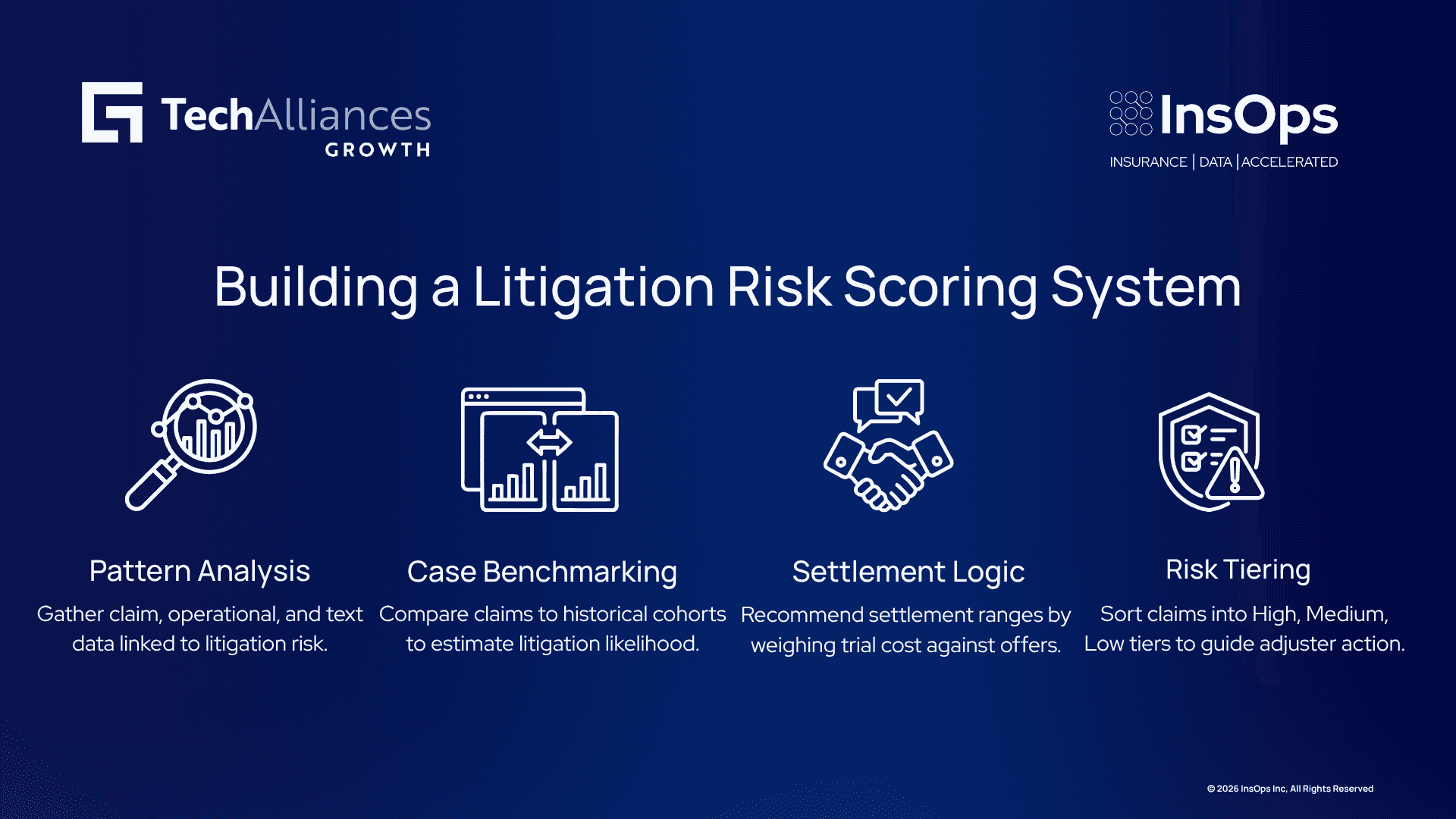
Claim Pattern Analysis: What to Look For
Start with structured data. Collect the claim elements that correlate with litigation: claimant age and jurisdiction, injury type, claimed loss amount, policy limits, time elapsed since incident, whether an attorney was mentioned in initial notes, whether subrogation applies, and whether causation is disputed.
Combine those with operational data: adjuster caseload, days to first reserve, reserve changes over time, previous settlement offers, and whether the claim has been flagged for compliance or coverage review. Each of these signals contributes to litigation risk.
Then layer in text data. Claim notes often contain early clues: mentions of medical complexity, family members arguing about fault, references to similar prior claims at this claimant's address, or notes that the adjuster is uncertain about coverage. Natural language processing can extract these signals at scale, converting narrative text into quantitative features for the model.
Case History Evaluation: Benchmarking Against Past Outcomes
Once data is structured, compare the current claim to historical cohorts. For a new commercial auto bodily injury claim in Florida with $50K claimed loss, surgery mentioned, and no attorney contact yet, ask: what percentage of claims matching these criteria (same line of business, jurisdiction, injury type, claimed amount range) went to litigation in the past three years?
If the historical benchmark is 8% litigation rate for this cohort, and the current claim's other signals push that estimate higher (e.g., adjuster has poor settlement outcomes in prior cases, jurisdiction is known for nuclear verdicts), the model can adjust the baseline up to 12-15%.
Benchmarking also reveals outliers. A claim that appears routine on the surface but shares characteristics with historically litigated cases deserves escalation, even if the adjuster thinks it will settle.
Settlement Recommendation Logic
With a risk score calculated, the system generates a settlement recommendation. High-risk claims (e.g., predicted litigation probability > 25%) should be offered settlement pre-suit, before attorney involvement. Medium-risk claims should be monitored for attorney contact signals. Low-risk claims can proceed through standard workflow.
The settlement recommendation also suggests a target settlement range. If the claim's predicted litigation cost (including defense counsel, trial preparation, and verdict risk) is $150K, and a settlement offer of $90K resolves it, the economics favor settlement even at that level. The model should compare predicted trial cost to proposed settlement cost and recommend the lower option.
Assigning Risk Tiers for Decision-Making
Effective triage requires clear risk tiers that map to adjuster actions. A three-tier system works well:
High Risk (Predicted Litigation Probability > 25%): Escalate immediately to senior adjuster or legal team. Pursue settlement negotiation now, before attorney involvement. Document the decision and settlement offer. These claims need hands-on management and executive attention.
Medium Risk (Predicted Litigation Probability 10-25%): Flag for monitoring. Set alerts for attorney contact signals (notes mentioning attorney calls, formal discovery requests, medical expert reports). Prepare settlement authority but do not offer immediately. These claims may resolve with close monitoring.
Low Risk (Predicted Litigation Probability < 10%): Proceed through standard claims workflow. Monitor for settlement trends but no special intervention needed. These claims have low litigation probability and should resolve within normal timelines.
Real-World Application: From Risk Flag to Settlement Strategy
Translating risk scores into action requires clear processes and decision rules. Here's how the model works in practice.
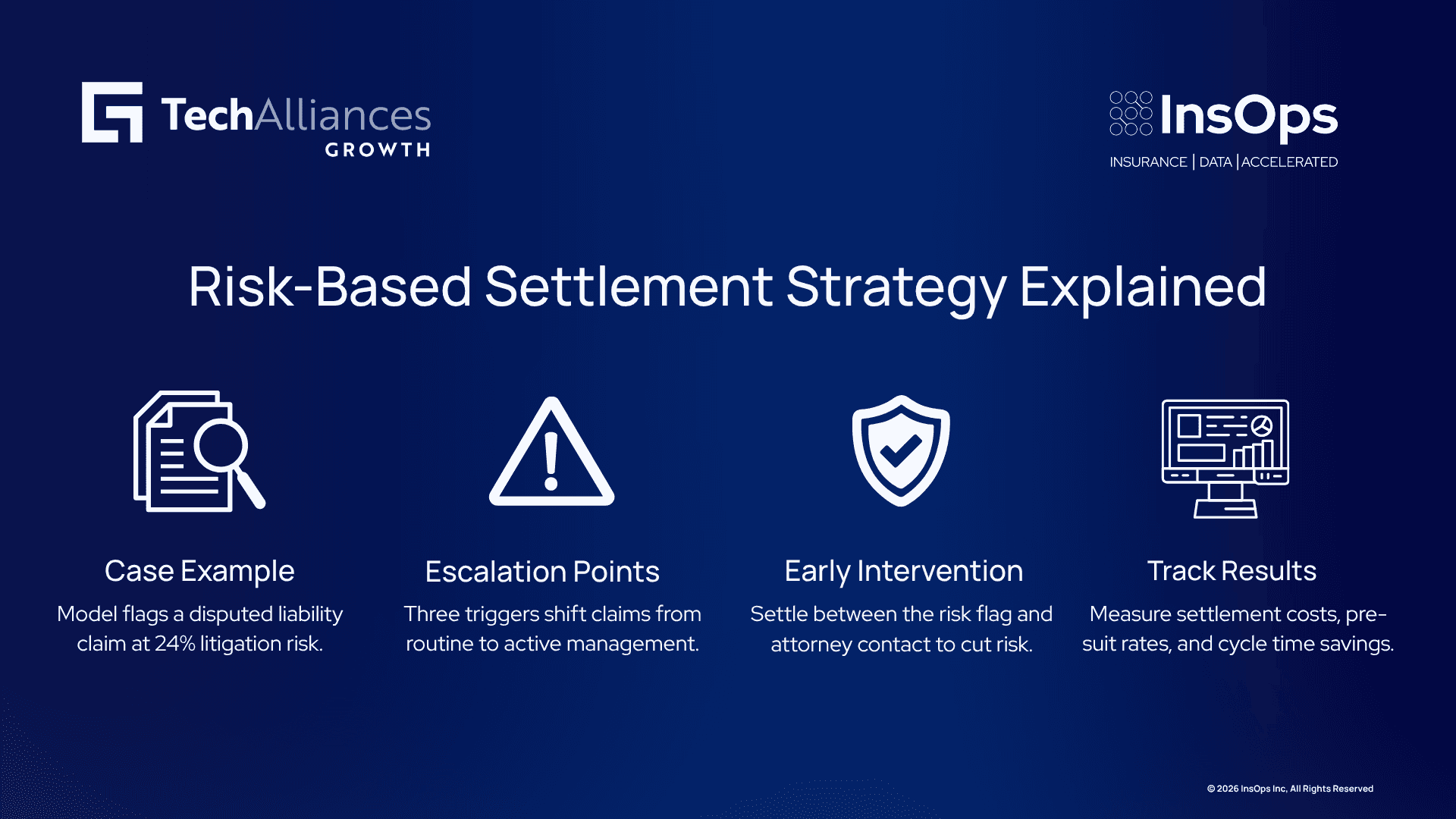
Example Scenario: Identifying High-Risk Claims Early
A regional P&C carrier in the Southwest processes a commercial general liability claim: contractor injured at jobsite, $85K medical and lost wage claim, multiple contractors on site, and liability is disputed between General Contractor and Subcontractor. The claim is now 10 days old.
Initial adjuster assessment: "Liability seems shared, case should settle around $60K." No attorney mentioned in the initial notice.
Litigation risk model analysis: The claim matches several high-risk patterns. Jobsite injuries with multiple parties involved historically litigate at 18% rate. Disputed liability cases litigate at 22%. The claimant is age 34, employed (suggesting ongoing wage losses), and the jurisdiction (Arizona) has experienced growth in nuclear verdicts. The model predicts a 24% litigation probability.
Recommended action: Escalate to senior adjuster, authorize $75K settlement authority, and contact claimant to propose structured settlement before legal counsel is retained. Document offer within 72 hours.
Intervention Points: When to Escalate or Settle
Escalation points are triggers that shift claim management from routine to active. The first escalation point is the risk flag itself: any claim scoring above 25% predicted litigation probability gets moved to specialized handling.
The second escalation point is attorney contact. Notes mentioning that claimant has "talked to a lawyer" or "consulted with an attorney friend" move the claim into medium-risk active monitoring, even if formal representation has not been retained. At this point, pursue settlement aggressively, as attorney involvement is imminent.
The third escalation point is formal discovery or demand letter. Once a demand letter arrives (especially if it includes medical narratives, expert reports, or reserve demands), the claim has entered litigation posture. At this point, settlement negotiation typically moves to defense counsel, and outside legal costs begin accumulating.
The goal is to intervene before the third point. Most litigation risk reduction comes from settling claims between the first escalation point (risk flag) and the second (attorney contact).
Measuring Success: Tracking Litigation Cost Reductions
Success is measurable. Track three metrics: (1) percentage of high-risk claims that settle pre-suit, (2) average settlement cost versus baseline litigation cost, and (3) days from claim receipt to settlement.
Example: high-risk claims historically cost $150K incurred value (defense counsel, trial prep, verdict). With early intervention, the same cohort settles for $85K. That's $65K savings per claim. For a carrier flagging 200 high-risk claims annually, that's $13M in leakage reduction.
Additionally, track cycle time. Early settlement claims close within 60-90 days. Litigated claims take 18-36 months. Faster closure improves cash flow and reduces reserve uncertainty.
How InsOps Helps
InsOps assists carriers with litigation risk analysis through LiLa, our insurance-trained AI model. LiLa analyzes open claims and historical claim data to surface litigation risk probability per claim.
LiLa runs inside your own environment, so your claims data and claimant records never leave controlled infrastructure. The model understands insurance domain logic, claims data structures, and regulatory requirements—unlike generic AI tools.
Here's how it works in practice. Your claims system data feeds into LiLa, which segments each open claim by litigation risk tier. LiLa flags patterns in claim narratives that correlate with historical litigation (mentions of injury severity, attorney contact, complex causation). It recommends settlement thresholds based on predicted litigation costs versus settlement costs.
A person reviews and validates every recommendation before it is finalized. Your adjuster retains full authority over settlement decisions. LiLa assists with data analysis and pattern matching; your team makes the final call.
If you are evaluating how to identify litigation risk early without months of manual file review and statistical analysis, contact us to talk through what this could look like for your operation.
Frequently Asked Questions
What is litigation risk in insurance claims?
Litigation risk is the probability that a claim will involve attorney representation and proceed to defense counsel engagement, litigation discovery, or trial. Early identification of high-risk claims allows carriers to intervene with settlement before attorney involvement raises costs.
How do you measure litigation risk?
Litigation risk is measured as a probability score (e.g., 0-100%) based on claim characteristics, claimant profile, historical benchmarks, and venue. This score assigns claims to risk tiers (high, medium, low) to guide adjuster prioritization.
What factors contribute most to litigation risk?
Key factors include: injury severity and type (catastrophic injuries attract more attorney outreach), claimed loss amount (higher claims invite legal scrutiny), jurisdiction (certain venues have higher litigation rates), presence of multiple parties (fault disputes increase complexity), and adjuster response time (delays correlate with higher litigation risk).
How can predictive analytics reduce litigation costs?
Predictive analytics identify high-risk claims early, before attorney involvement. Carriers then offer settlement pre-suit, avoiding defense counsel fees, trial preparation costs, and verdict uncertainty. Settlement cost is typically lower than predicted litigation cost, creating immediate savings.
What is litigation leakage?
Litigation leakage is the excess cost of litigated claims compared to non-litigated claims. For P&C insurers, litigated claims leakage can represent 7-14% of total carrier spend. Reducing leakage through early settlement saves millions annually for large carriers.
What is a litigation risk index (LRI)?
A litigation risk index is a scoring mechanism that classifies claims into risk tiers based on predicted litigation probability. High-risk claims (LRI > 25%) go to specialized handling and settlement authorization. Medium-risk claims receive monitoring. Low-risk claims proceed through standard workflow.
How long does it take to implement a litigation risk model?
Implementation typically takes 3-6 months, depending on data availability. Carriers need 2-3 years of historical claims and litigation data to train accurate models. Once in place, the model can score new claims in real time, providing guidance within days of claim receipt.
Can AI assist with litigation risk analysis without replacing adjuster judgment?
Yes. AI assists by flagging high-risk claims, benchmarking against historical patterns, and recommending settlement ranges. Adjusters retain full decision authority. The AI provides data-driven signals; your team makes the final settlement call. This human-in-the-loop approach balances data insights with professional judgment.