

The cost of litigation keeps climbing. In 2024, liability claim costs jumped 7% (the highest annual increase in two decades) driven by larger jury verdicts, expanding settlements, and a litigation environment that continues to deteriorate. Adjusters are drowning in file volume while courts move slower. Claims that could settle early instead drag through discovery, depositions, and trial preparation, bleeding dollars into defense costs the entire time.
The problem is timing. By the time an adjuster flags a claim as litigation-prone, the file has already aged months in the system. Patterns that predict disputes (inconsistent damage assessments, missing documentation, red flags from prior loss history) sit buried in police reports, medical records, and scattered adjuster notes. Extracting those signals manually takes hours per file.
This article covers how to identify high-litigation-risk claims early, what data signals matter most, and how to build a process that surfaces disputes before they become expensive courtroom battles.
Understanding Litigation Risk in Modern Claims
Adjusters and claims managers face a litigation landscape that has fundamentally shifted. Social inflation (fueled by litigation-funding firms, larger jury awards, and changing attitudes toward settlement) has made disputes more frequent and more costly.
Third-party litigation funding is now reshaping how claims are valued and negotiated. Litigation funders finance plaintiff claims in exchange for a percentage of the settlement or award, which changes incentive structures entirely. Claims that might have resolved for a modest amount now get pushed toward trial because a funder is bankrolling the case. The dynamic plays across product liability, professional liability, medical malpractice, and general liability lines.
The financial pressure is immediate. Litigation defense costs, expert fees, depositions, and discovery drag out settlement timelines. Meanwhile, reserves accumulate. A 90-day claim that goes to trial becomes an 18-month claim. That extended tail compounds across hundreds of files, distorting IBNR estimates and straining claims operations budgets.
The most effective response is early triage. Claims that signal high litigation risk need proactive intervention at day 30 or 45, not day 180. That requires a way to synthesize claim file data (historical patterns, current case details, policy language, and claimant behavior) into a structured risk signal that adjusters can act on immediately.
What Data Signals Predict Litigation Risk
High-litigation claims share recognizable patterns. Understanding those patterns allows adjusters to flag files before disputes become entrenched.
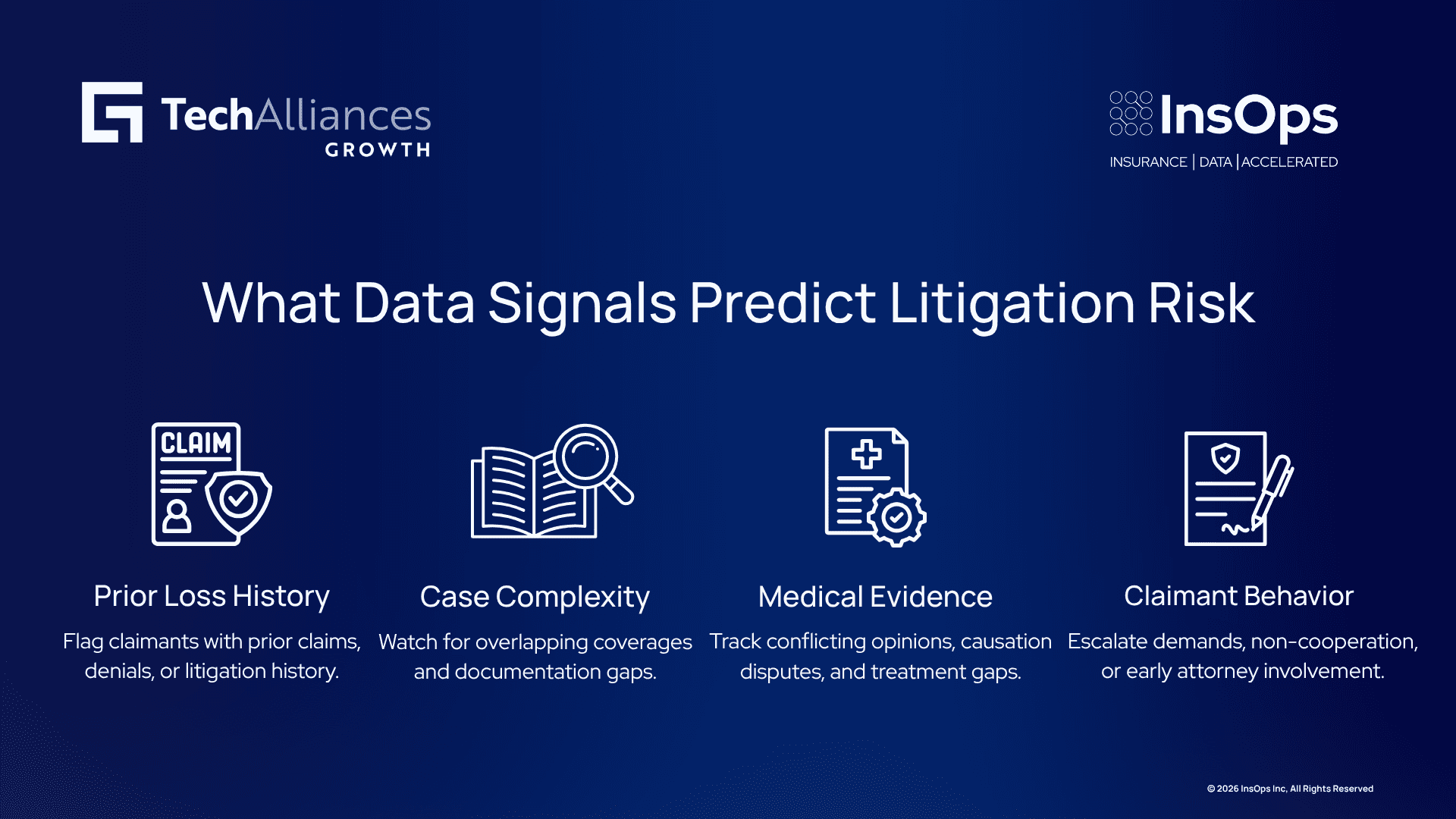
Claim History and Prior Loss Activity
One of the strongest predictors is prior loss frequency. Claimants with multiple prior claims are statistically more likely to litigate. The combination of prior claims plus a gap in coverage history (or prior denials) dramatically increases litigation probability. So does a history of litigation in previous claims or a pattern of claims that were originally denied and later reopened.
Adjusters need this context immediately upon assignment. The file summary should surface prior loss records, dates of prior incidents, whether prior claims were litigated, and settlement or verdict outcomes. That baseline determines whether the current claim is a routine matter or a red flag.
Case Complexity and Documentation Gaps
Complex claims litigate more often because they create interpretation disputes. A multi-line loss with overlapping coverages (property damage plus business interruption, or auto liability plus umbrella) leaves room for disagreement about which coverage applies and how much the insurer owes.
Documentation gaps are a separate risk. Missing initial statements, incomplete damage documentation, or adjuster notes that contradict medical evidence create leverage for plaintiff counsel. If the claimant's expert can point to gaps in the insurer's investigation, the litigation risk multiplies.
Adjusters should know at assignment whether the claim triggers overlapping coverages, requires coordination with other carriers, or involves significant uncertainty about the extent of loss. That complexity needs a higher-touch review process and more robust documentation from the outset.
Medical and Expert Evidence
In liability and workers' compensation claims, medical evidence drives settlement value. Claims with conflicting medical opinions (where an independent medical examination contradicts the treating physician's assessment, for instance) are litigation red flags. So are claims involving catastrophic injury, permanent partial disability, or disputed causation.
Temporal patterns matter too. A delay between the date of loss and the first medical treatment, or inconsistent medical treatment patterns, can become evidence in trial. The litigation risk isn't the medical facts themselves; it's the narrative gaps that plaintiff counsel can exploit.
Adjusters reviewing files should have a structured summary of all medical evidence, a timeline of treatment, and any conflicts between expert opinions flagged at the top level. That prevents the scenario where inconsistencies get discovered three years later during depositions.
Claimant Behavior and Communication Patterns
Claimant conduct signals litigation intent. Patterns like repeated demands for payment without supporting documentation, refusal to cooperate with the investigation, threats of legal action, or engagement of an attorney early in the claim lifecycle are all strong litigation indicators.
Similarly, claims involving disputes over causation (e.g., the insured claims a loss was accidental while investigation suggests negligence or fraud) are higher-risk. So are claims where the claimant disputes the adjuster's authority or coverage determination before the investigation is complete.
These behavioral signals should trigger escalation to a senior adjuster or claims manager. Early involvement of defense counsel or a settlement specialist (before litigation is filed) often prevents expensive courtroom battles.
How Large & Complex Claim Files Drive Litigation
Many claims become litigated not because the merits are weak, but because the file itself becomes unwieldy and the story gets lost.
Large claim files accumulate hundreds of documents over months. Police reports, medical records, repair estimates, photographs, correspondence, adjuster notes, expert reports, and coverage counsel opinions pile up across the case lifecycle. Each document lives in isolation, rarely synthesized into a coherent narrative.
When an adjuster opens that file at month four, they face a wall of material. Key facts are buried. Timelines are implicit, not explicit. Contradictions between documents go unnoticed. That lack of clarity becomes a liability. Settlement decisions get made on incomplete information. If a dispute goes to trial, opposing counsel exploits every gap and inconsistency.
The adjuster's time pressure makes this worse. An adjuster carrying 100 files cannot afford to spend three hours reading and synthesizing a complex claim file. So they work from the most recent note, or a quick summary, and miss critical context. That context gap (between what the file actually contains and what the adjuster believes it contains) is where litigation risk concentrates.
Adjusters need help surfacing the signal in the noise. They need claim files that have been analyzed across all documents to extract key facts, generate a structured timeline, identify missing documentation, and flag risks. That summary becomes the operational ground truth for settlement and coverage decisions.
Building an Early Intervention Workflow
Effective litigation risk management requires a workflow, not just a risk flag.
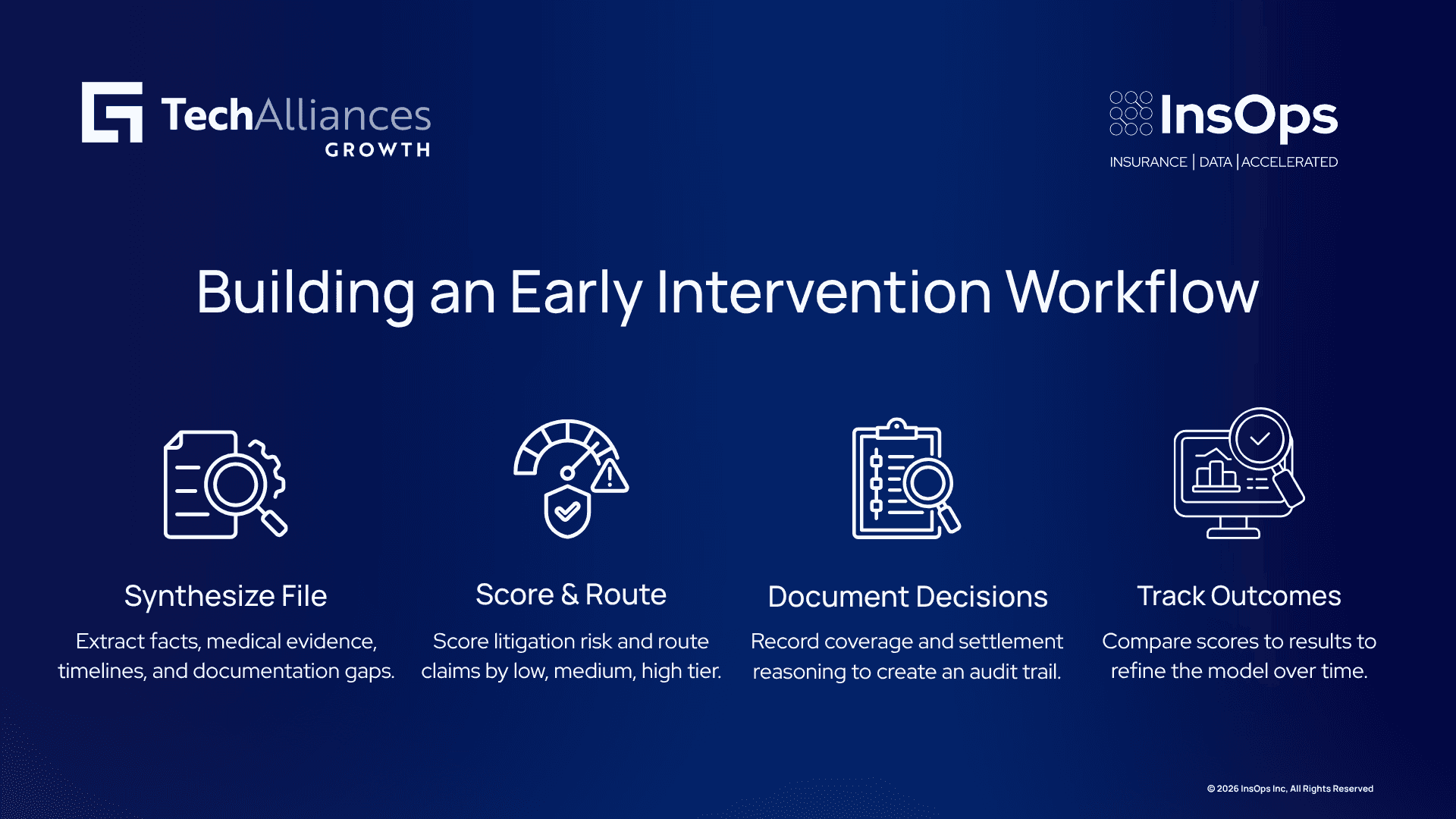
Step 1: Synthesize the claim file. At assignment or at a key review point (30, 60, or 90 days into the claim), run an analysis across all documents in the file. Extract claim facts from police reports and adjuster notes. Identify and organize medical evidence. Build a timeline of key events and decisions. Flag documentation gaps or inconsistencies.
Step 2: Score litigation probability. Apply a scoring model that combines claim characteristics (complexity, injury severity, overlapping coverages) with claimant behavior signals (attorney engagement, demands, cooperation level) and claim history (prior losses, prior litigation). This produces a risk score: low, medium, or high.
Step 3: Route by risk level. Low-risk claims proceed through standard handling. Medium-risk claims get escalated to a senior adjuster with a documented review at 90 days. High-risk claims get immediate involvement of a settlement specialist or defense counsel, and weekly or bi-weekly review checkpoints.
Step 4: Document the decision. The adjuster reviews the risk summary and makes an explicit coverage and settlement decision. That decision gets documented with the reasoning and the risk score. This creates an audit trail that protects the carrier if the claim later litigates.
Step 5: Track outcomes. Over time, compare litigation probability scores to actual outcomes. Claims that were scored high and later litigated validate the model. Claims scored high that settled without litigation show where early intervention worked. This feedback loop improves the scoring model over time.
How InsOps Helps
InsOps’ insurance-trained AI assists adjusters with analyzing claim files and surfacing litigation risk. LiLa, our insurance-trained AI model, reads through large and complex claim documents (police reports, medical records, repair estimates, photos, correspondence, and adjuster notes) and synthesizes that information into a structured summary.
LiLa can extract key facts, generate timelines of critical events, identify missing documentation, and surface risk signals that warrant escalation. A person reviews every summary and risk assessment before it reaches the adjuster. That human-in-the-loop approach ensures accuracy and accountability.
Because LiLa runs inside your own environment, claim documents and sensitive data never leave your controlled infrastructure. Unlike generic AI tools, LiLa understands insurance domain logic, claim structures, and regulatory requirements specific to P&C claims.
If you are working to reduce litigation costs without adding claims staff or slowing claim resolution, contact us to talk through what early litigation risk identification could look like for your operation.
Frequently Asked Questions
How early can litigation risk be identified?
Effective triage happens at 30 to 45 days into a claim. By that point, initial investigation is complete, key documents have been collected, and claimant behavior patterns are starting to emerge. Earlier identification allows intervention before dispute dynamics harden.
Can a single risk score predict litigation?
No single factor determines litigation probability. A high-risk score combines multiple signals: claim complexity, prior loss history, medical evidence conflicts, claimant behavior, and documentation completeness. Each signal narrows the risk estimate.
What should adjusters do when a claim is flagged as high-risk?
Escalate to a settlement specialist or defense counsel immediately. Do not wait. Early involvement of a negotiator or attorney changes the dynamic and often prevents expensive litigation. Document the escalation decision and the reasoning.
How much time does claim file analysis save?
Manually synthesizing a large, complex claim file takes 2 to 4 hours of adjuster time. Automated synthesis with AI assistance reduces that to 15 to 30 minutes, freeing adjusters to focus on coverage decisions and claimant communication.
Can litigation risk scoring work for all claim types?
The strongest signals appear in liability and workers' compensation claims, where injury severity, expert evidence, and prior litigation history are predictive. Property claims, where loss assessment is more objective, benefit less from risk scoring.
How does human review fit into litigation risk assessment?
A person must review and validate every risk score and claim summary before it is finalized. The AI surfaces the risk signal, but the adjuster makes the coverage and settlement decision. This preserves professional judgment and protects the carrier's defensibility.
How long does it take to build a litigation risk model?
Building an accurate model requires historical data from 500 to 1,000 prior claims, including those that litigated and those that settled. A 6 to 12-month implementation timeline is typical for carriers evaluating this type of capability.