

Medical records are the foundation of defensible claims decisions. But when those records span decades of treatment across multiple providers, extracting the signals that predict litigation risk becomes a manual bottleneck that delays decisions and exposes insurers to costly disputes.
Insurance adjusters spend significant time manually reviewing medical chronologies, identifying pre-existing conditions, and spotting documentation gaps that could support a plaintiff's case. These records hold the patterns that matter most: conflicting diagnoses, treatment inconsistencies, timeline gaps, and undisclosed medical history. Yet without a structured way to surface those patterns early, many high-risk claims slip through to litigation before intervention happens.
This article explains how to extract actionable signals from medical records at the point of claim intake, why early detection matters for litigation mitigation, and how AI-assisted analysis accelerates the manual review process without requiring adjusters to become medical experts.
Why Medical Records Hold Litigation Risk Signals
Courts consistently prioritize what was written in contemporaneous medical records over reconstructed testimony, as demonstrated in 2025 litigation cases that shaped how healthcare providers document clinical decisions. For claims handlers, this principle cuts both ways. Clear, consistent documentation supports an insurer's defensibility. Gaps, contradictions, and undisclosed prior treatment create exposure.
For P&C insurers, leakage tied to litigated claims can represent 7-14% of total carrier spend. This is a significant drag on profitability. Only a fraction of claims ever reach litigation, but the financial impact is disproportionate. The real challenge isn't managing litigation once it happens. It's spotting the claims most likely to escalate early enough to intervene.
Medical records reveal the signals that separate routine settlements from litigation-prone claims. Pre-existing conditions that weren't disclosed, treatment timelines that don't align, and diagnosis shifts across providers all appear first in the medical record. Identifying these signals at first notice of loss gives claims teams a window to triage high-risk cases before claimant positions harden or legal representation escalates.
Why Manual Review Delays Intervention
Most medical record reviews take 30 to 60 days, but complex cases may take longer. During that review window, no triage decision can be made. The claim sits in standard workflow while high-risk signals remain buried in unstructured records.
When records arrive incomplete, the adjuster pauses review, requests additional documentation, waits for another response, and revisits the file later. Each delay extends the decision window and increases the likelihood that external legal representation becomes involved.
Creating and configuring extensive information into a concise format is often time-consuming, taking time away from the important task at hand: analyzing and making decisions by these industry professionals. Adjusters with strong investigative instincts are held back by the mechanics of document organization, not by their clinical knowledge.
The Medical Records Workflow Bottleneck
Manual medical record review creates delays across three specific workflow areas. Understanding where time is lost helps explain why early signals go undetected and why intervention windows close before claims teams can act.
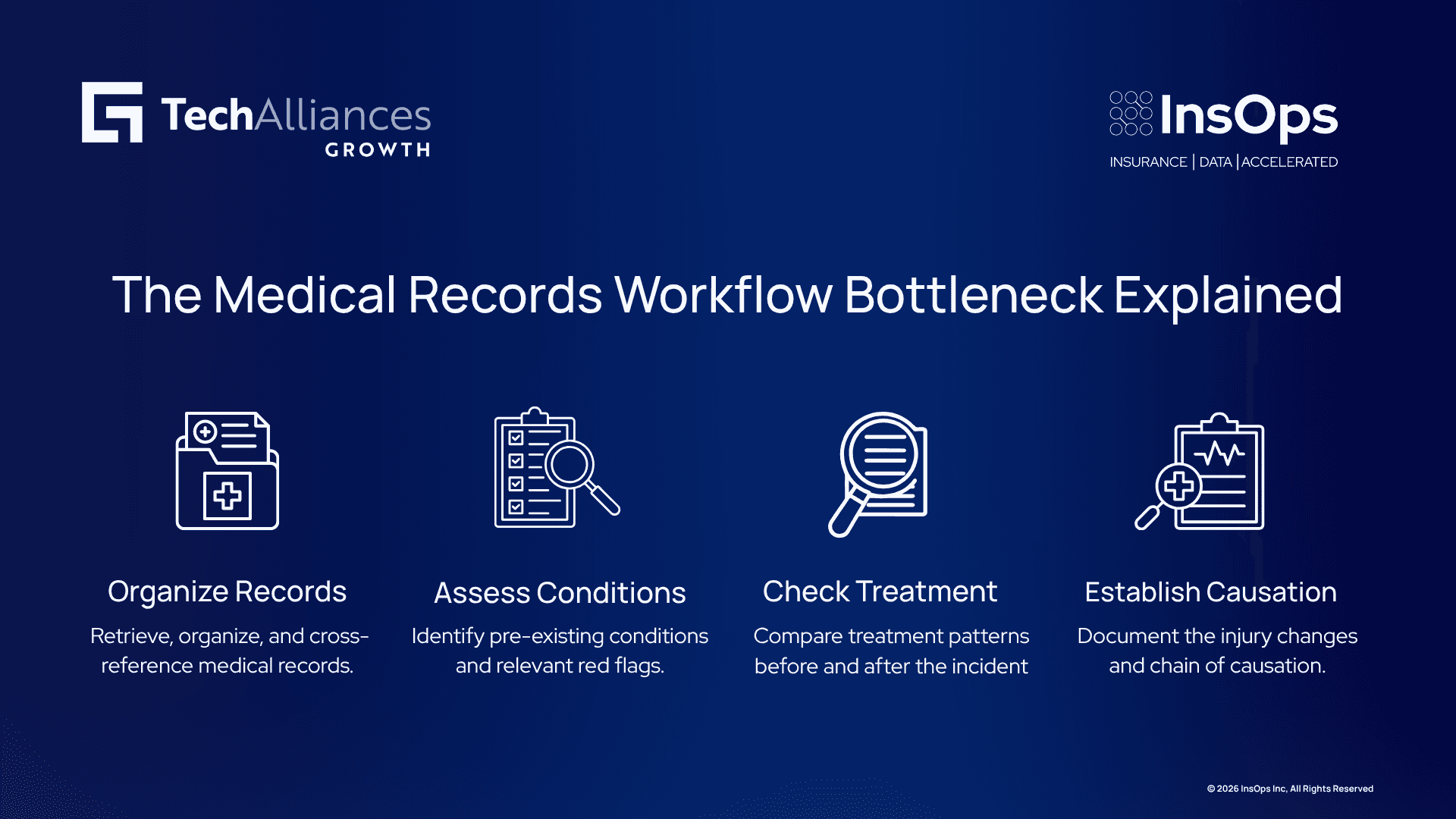
Records Retrieval and Initial Organization
Insurance teams usually lose time in three places: unclear intake, poor status visibility, and incomplete documentation. Retrieval becomes harder when documentation is split across multiple custodians. Clinical notes may sit with the treating provider, billing records may come from a business office, imaging may require a different workflow, and itemized statements may follow another process.
Once records arrive, they must be organized chronologically, deduplicated, and cross-referenced against the claim facts. In injury claims involving months or years of prior treatment, this step alone can consume 20-40 hours of adjuster time.
Pre-Existing Condition Assessment
Most insurance companies request medical records covering the three to five years preceding an accident when evaluating personal injury claims, allowing adjusters to identify any pre-existing conditions that might relate to current injuries. But identifying a pre-existing condition and determining its relevance to the claim injury are two different problems.
Reviewers examine the medical record to determine whether a condition was documented, diagnosed, or treated prior to coverage beginning, and look for red flags such as conflicting diagnoses across providers, billing for services not reflected in clinical notes, or a medical history that contradicts statements made on the application.
Each of these findings requires interpretation. A reviewer must read across multiple documents, understand clinical terminology, and connect dots that span years of treatment. The risk isn't just that signals are missed. It's that they're identified too late, after legal positions have already formed.
Treatment Consistency and Causation Disputes
Medical records show what was treated, when, and by whom. But they don't automatically explain why treatment patterns matter for a particular claim. Often, detailed medical records prove critical in showing how a condition or injury has changed since the incident. But proving that an accident worsened a pre-existing condition can be challenging when insurance companies and defendants try to claim a connection between a pre-existing condition and current injuries based on previous medical treatment or records.
An adjuster must compare pre-incident medical records to post-incident records, identify which symptoms are new and which are aggravations of prior conditions, and document the chain of causation. This comparison is the foundation of defensible reserve decisions and settlement recommendations. When it's done manually, even skilled adjusters can miss inconsistencies that a plaintiff's attorney will later highlight in discovery.
How AI-Assisted Medical Record Analysis Works
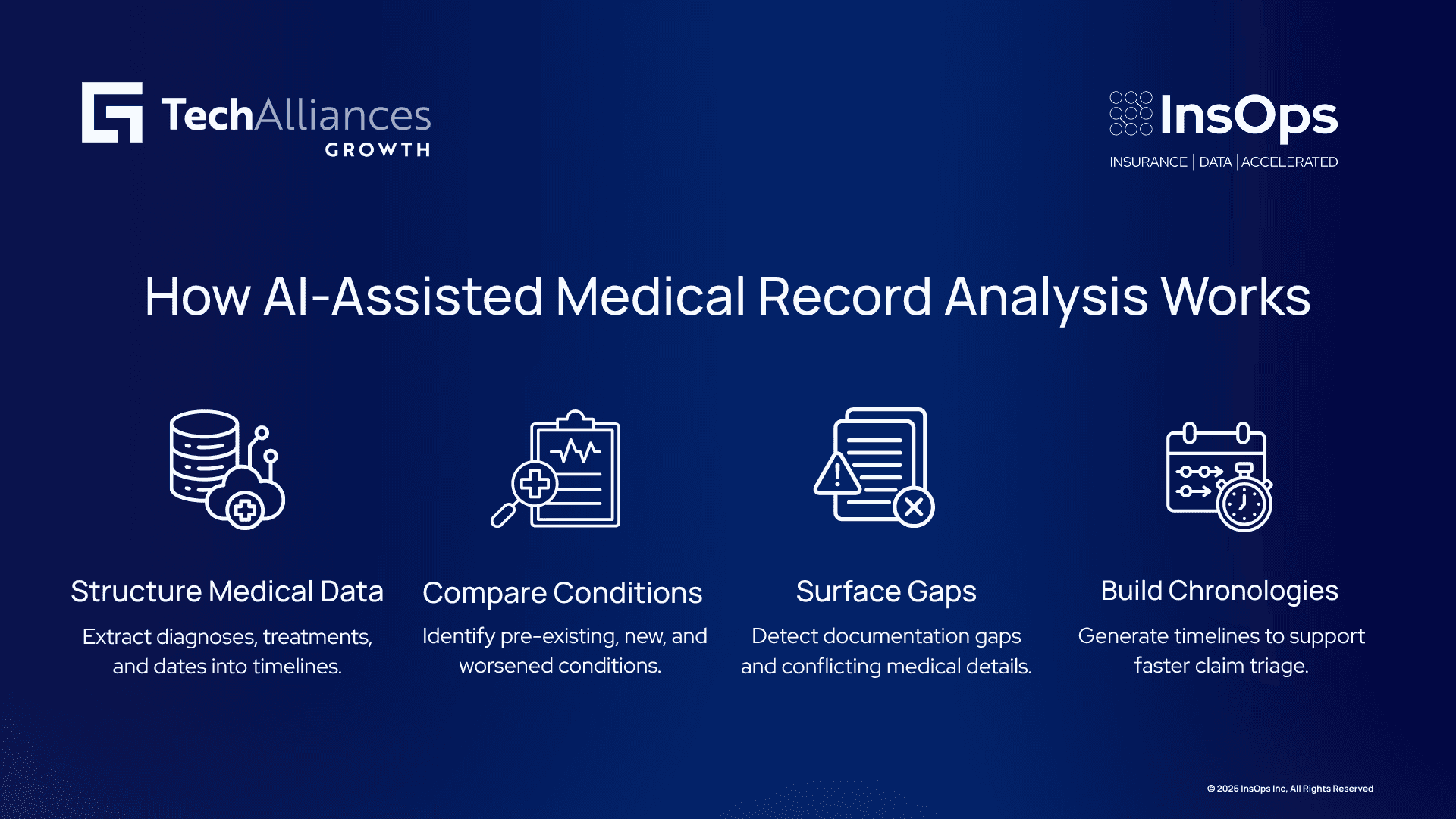
AI-assisted analysis changes how claims teams approach medical records by automating organizational work and surfacing patterns that manual review would miss or delay. Rather than spending days organizing documents, adjusters gain immediate visibility into pre-existing conditions, documentation gaps, and timeline inconsistencies. Here's how the process works.
Extracting and Structuring Medical Data
AI trained on insurance data understands medical record structure and field semantics in ways generic tools don't. Rather than treating medical records as unstructured text, insurance-trained AI reads across multiple document types, identifies key fields, and organizes them into a structured timeline.
Diagnoses, treatment dates, medications, procedures, imaging results, and specialist referrals are extracted and mapped to standard medical coding schemes. Pre-existing conditions are surfaced alongside their first documented date. Gaps between appointments are flagged. The output is a machine-readable structure that an adjuster can query and compare, rather than a PDF pile that requires human interpretation.
Identifying Pre-Existing and New Conditions
Once records are structured, AI can compare pre-incident and post-incident medical history to surface the patterns that matter for litigation risk assessment. Conditions documented before the injury date are flagged. Conditions that first appeared after the injury are isolated. Conditions that existed before but worsened after the injury are marked with severity changes.
The AI doesn't make the causation call. An adjuster or medical reviewer does. But it eliminates the manual work of reading across dozens of documents to find each piece of evidence. A person reviews and validates every finding before it becomes part of the claim record.
Surfacing Documentation Gaps and Inconsistencies
Medical records often contain gaps: periods where no treatment occurred, specialist visits that weren't documented in the primary record, or imaging ordered but results not filed. AI can flag these gaps based on the patterns in the claim facts and medical history.
Similarly, AI identifies contradictions: a diagnosis coded in billing records that doesn't appear in clinical notes, treatment billed under one body part but documented under another, or medication lists that shift across provider visits without clinical explanation. These inconsistencies don't prove fraud or malingering. But they are the patterns that litigation risk models use to flag claims for early intervention.
Generating Structured Medical Chronologies
Instead of waiting for a medical review firm to produce a chronology weeks later, AI can generate an initial chronology from the records received. The chronology lists all documented events in order, cross-references provider notes, and highlights gaps in the timeline.
An adjuster can then review the chronology in hours rather than days, identify missing records, and make an early triage decision. A claim that shows complex pre-existing conditions, multiple specialty involvement, and timeline inconsistencies can be flagged for experienced handling or early reserve discussion before case costs escalate.
When Medical Record Signals Matter Most for Litigation Risk
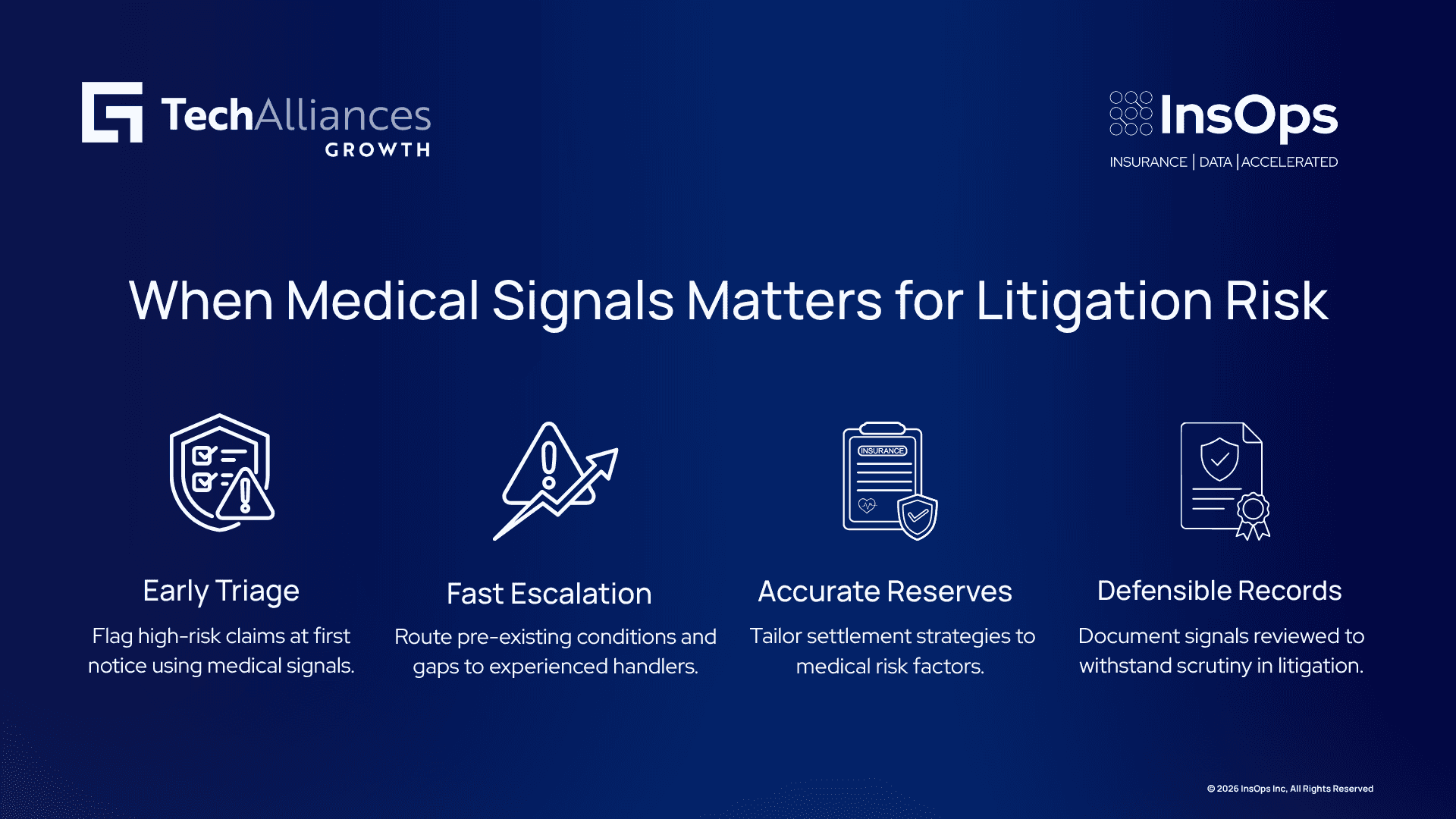
Early detection of litigation risk signals creates the opportunity for intervention before claims escalate. Medical records are the richest source of these signals, but only if they're surfaced at the right time in the claim lifecycle. Understanding when and how to use medical record analysis to support litigation risk mitigation requires looking at three distinct phases of claims management.
Early Identification and Triage
An early litigation risk prediction system can flag high-risk claims as early as first notice of loss (FNOL), giving insurers the ability to act before costs spiral. Medical records are one of the earliest sources of litigation risk signals. When a claim is reported, retrieval can begin immediately.
Rather than waiting for records to arrive and then for review to complete weeks later, AI-assisted analysis allows adjusters to triage claims based on medical signals within days. High-risk signals (significant pre-existing conditions, documentation gaps, diagnosis conflicts) trigger immediate escalation to experienced handlers or early reserve discussions.
Reserve Accuracy and Settlement Strategy
Insurers using predictive litigation analytics have reported reductions in legal spend, improved reserve accuracy and faster resolution of complex claims. Better early insight into medical complexity translates directly to more accurate reserves and more informed settlement strategies.
A claim with clear, consistent medical records and minimal pre-existing condition exposure can be handled routinely. A claim with fragmented records, multiple pre-existing conditions, and timeline inconsistencies requires different reserve levels and more conservative settlement targets. AI-assisted analysis makes that differentiation visible at triage, rather than after legal costs have already accrued.
Defensibility in Discovery and Litigation
If a claim does proceed to litigation, adjusters who used AI-assisted medical record analysis have a clear, documented record of what signals were identified and how early they were flagged. This defensibility matters. Plaintiffs' attorneys look for evidence that an insurer made claim decisions without reviewing key medical records or that high-risk signals were overlooked.
AI-assisted analysis creates a transparent audit trail: what records were reviewed, what medical conditions were identified, when signals were first flagged, and how that information informed the claim decision. That record is defensible in discovery.
How InsOps Helps
InsOps assists claims teams in extracting, structuring, and analyzing medical records to surface litigation risk signals at the point of claim intake. LiLa, our insurance-trained AI model, reads medical records the way an insurance professional would. It understands diagnosis and treatment terminology, recognizes pre-existing condition patterns, and identifies documentation gaps and inconsistencies.
LiLa runs inside your own environment, so medical records and claimant data never leave controlled infrastructure. A person reviews and validates every finding before it becomes part of the claim record.
Our integration with Guidewire ClaimCenter connects directly to your claims workflow, so medical record analysis surfaces automatically when records are uploaded. Signal detection happens at intake, not weeks later after review bottlenecks have already delayed decisions.
InsOps reduces litigation risk by analyzing case patterns and claim history to surface high-risk claims early. If your claims team is manually reviewing medical records across multiple systems or waiting weeks for medical review firms to produce chronologies, contact us to talk through what AI-assisted analysis could look like for your operation.
Frequently Asked Questions
How does AI-assisted medical record analysis differ from standard medical review?
Standard medical review produces a clinical opinion on diagnosis and treatment appropriateness, typically weeks after records are received. AI-assisted analysis structures and flags the records themselves at intake. It identifies pre-existing conditions, documentation gaps, and timeline inconsistencies immediately. A person still reviews every finding. The AI accelerates the manual work of organizing and comparing documents.
Does AI understand medical coding and clinical terminology well enough to be reliable?
Insurance-trained AI models are trained on thousands of real insurance claim records with documented diagnoses, treatments, and outcomes. This training gives the model an understanding of medical field semantics that generic LLMs lack. The model can recognize diagnosis synonyms, map billing codes to clinical notes, and understand treatment sequences. But the AI assists. It doesn't make clinical decisions. Claims professionals review and validate every finding.
Can AI identify pre-existing conditions that weren't disclosed by the claimant?
AI can surface conditions documented in medical records prior to the claim date. But whether a claimant knowingly failed to disclose a condition or simply didn't think it was relevant is a determination that requires human judgment and often legal input. The AI flags the records. A person decides how to interpret the gap between what was documented and what was disclosed.
What happens if medical records are incomplete or disorganized?
AI-assisted analysis flags gaps explicitly. If an adjuster requests records for a three-year period but receives records only for the first two years, that gap is visible in the chronology. Similarly, if imaging was ordered but results aren't in the file, the AI flags that the imaging was requested but the results are missing. This visibility allows adjusters to request specific records rather than asking for resubmission of everything.
How does litigation risk prediction work if it's based on medical records?
Litigation risk prediction combines multiple signals from claim facts, claimant behavior, medical records, and historical case outcomes. Medical record analysis contributes specific signals: complexity of pre-existing conditions, documentation consistency, timeline gaps, and clinical pattern match to prior high-litigation cases. These signals feed into broader predictive models. No single signal determines litigation risk on its own.
Can adjusters use AI-assisted medical analysis without changing their current workflow?
InsOps integrates directly into Guidewire ClaimCenter, so analysis happens automatically when records are uploaded. No new systems or processes are required. Adjusters see structured findings alongside the original records in their existing claims file. The information is added to the workflow, not replacing it.
How long does medical record analysis take compared to manual review?
AI-assisted initial analysis of a typical medical record set takes minutes. Manual chronology production by a medical review firm typically takes weeks. But the goal isn't to replace medical review, it's to accelerate triage so that experienced adjusters can review the records more efficiently and focus on analysis rather than document organization.
Is there a risk that AI analysis of medical records could violate patient privacy?
InsOps processes medical records inside your environment; the data never leaves your infrastructure. Analysis of PII and PHI is governed by your existing data governance policies. No training or external use of claimant data occurs without explicit consent, same as any internal claims process.