

When a claims operations lead sees their team spending most of the day opening, sorting, and rekeying documents instead of investigating claims, they want to understand whether a better way exists to turn police reports, medical records, and repair estimates into structured, usable data without creating new compliance risks, so they can get adjusters back to adjuster work and stop losing claims to processing delays.
Your adjusters were hired to investigate claims, evaluate coverage, and negotiate fair settlements. Instead, they spend the first hours of every file reading PDFs, finding the right page in a medical record, and typing claim numbers into a system that should already have them. The problem is not lazy adjusters or poor training. It is a document-to-decision gap that grows wider with every new claim, every new carrier format, and every new state requirement. This article explains what that gap looks like, why it persists after years of scanning and OCR investment, and what a better intake path looks like without adding compliance risk.
What Actually Arrives in a Claims Inbox?
Every claim generates a packet of documents, and no two packets look the same.
A single auto claim might include a police report scanned at the precinct, a repair estimate from a body shop using its own form, photos from the policyholder’s phone, and an invoice for a rental car.
A bodily injury claim adds medical records from one or more providers, each with its own layout, coding system, and page numbering. A property claim brings contractor estimates, adjuster notes, and correspondence from the mortgagee. Claims arrive through inboxes, portals, brokers, agents, third parties, PDFs, images, forms, and attachments.
The document types alone tell part of the story:
Police reports, often handwritten or scanned in low resolution
Medical records, frequently spanning dozens of pages with mixed typed and handwritten notes
Repair estimates, each shop using a different format and line-item structure
Invoices and receipts, some itemized and some not
Photos of damage, with metadata that may or may not include date and location
Adjuster notes, sometimes typed, sometimes dictated and transcribed
FNOL forms, which vary by carrier and line of business
Coverage documents and correspondence
Each carrier, each state, and each line of business uses different forms. A police report from one county looks nothing like a police report from the next. A medical record from one hospital system uses different section headers than another. No template covers them all, which is why teams still open each document by hand.
Where Does the Time Actually Go?
Before an adjuster can evaluate a claim, someone has to identify what arrived, find the right page, and type the details into the system.
Breaking down a typical Medicare Set-Aside review process, Insurance Thought Leadership found in 2025 that roughly 30% to 40% of that time is spent on manual document organization and navigation. This includes sorting pages, identifying document types, and locating relevant information across hundreds of pages.
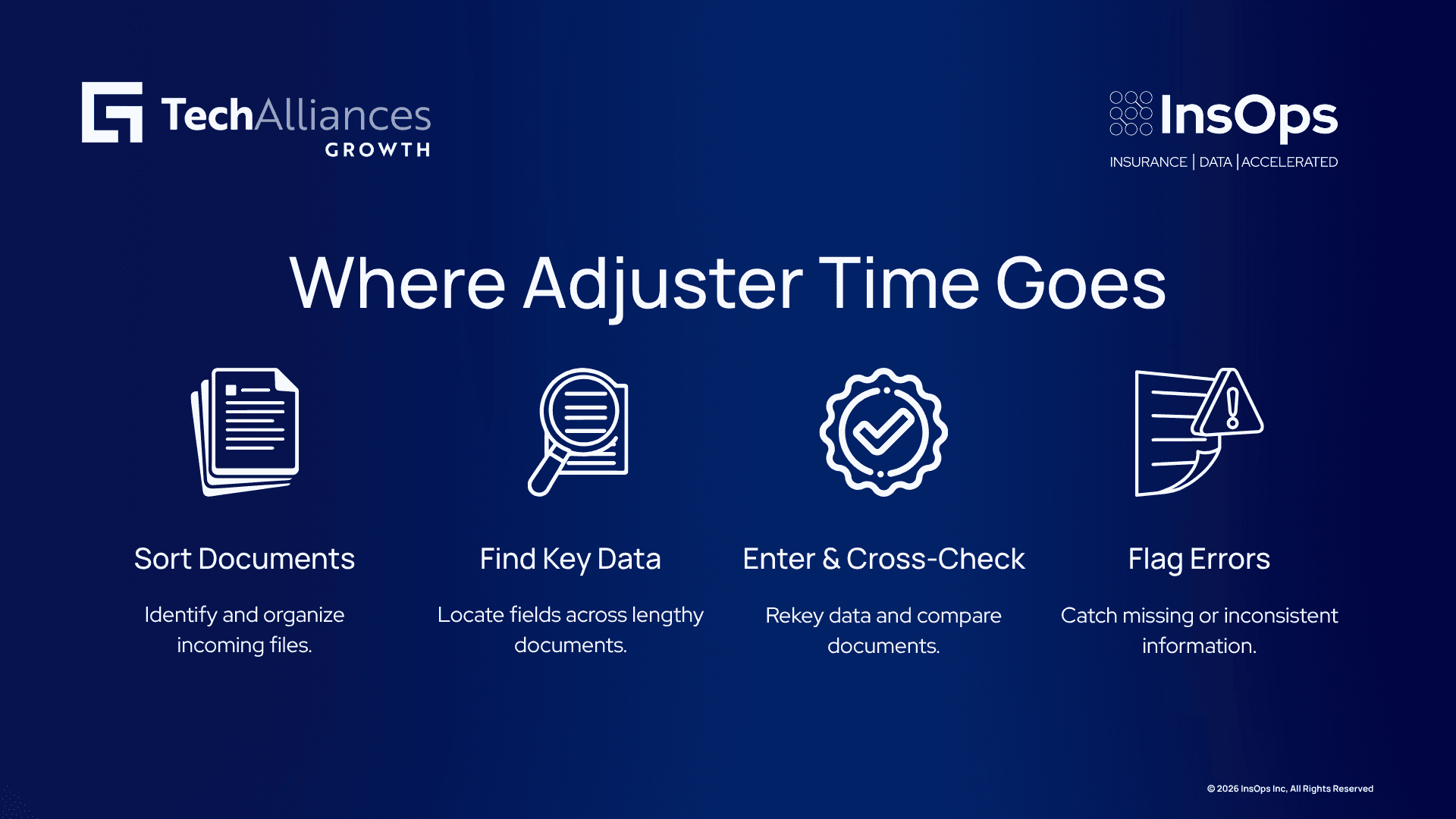
That is just the organization phase. The full manual workflow includes:
Opening each document and identifying what it is
Finding the relevant fields (date of loss, policy number, claimant name, damage description)
Rekeying those fields into the claims system
Cross-referencing information across documents (does the police report date match the repair estimate?)
Flagging missing or inconsistent information
Correcting errors found during validation
A documented case from DXC Technology illustrates the scale. AltexSoft reported in 2025 that a team of twenty operators manually rekeyed workers’ compensation claim information into legacy databases, averaging 4.5 minutes per claim.
At 4.5 minutes per claim, a team handling 500 claims daily spends more than 37 hours just on data entry. That is nearly five full-time employees doing nothing but reading and typing. And that figure does not include the time spent on document sorting, error correction, or chasing missing pages.
The result is a backlog that compounds. Adjusters cannot begin meaningful work until the file is complete and accurate. Every minute spent on document handling is a minute not spent on investigation, negotiation, or customer communication.
Why Traditional OCR Hasn’t Fixed This
OCR can read text from a scanned page, but it cannot tell a claim number from a policy number without a rigid template for every document type.
Traditional OCR follows a straightforward process. It preprocesses the image, recognizes characters by matching shapes to letters, and outputs a block of machine-readable text. Unstract noted in 2026 that it works well for clean scans, standardized forms, and consistent layouts.
The moment documents get messy, OCR starts to struggle. Claims documents are almost always messy:
Handwritten fields on police reports and medical notes
Scanned copies with poor lighting, tilted pages, or stamps covering text
Forms with checkboxes and radio buttons that OCR sees as random marks
Tables where rows and columns must stay aligned for the data to make sense
Multiple document types mixed in a single PDF
Unstract also found that traditional OCR requires consistent templates and predictable layouts. When documents deviate, and they always do, OCR produces errors that cascade downstream. Teams then spend hours manually reviewing OCR output, correcting mistakes, and reformatting data before it can feed into business systems.
The deeper problem is that OCR stops at text extraction. It does not classify document types. It does not understand that a date on a police report and a date on a repair estimate refer to the same event. It does not validate that the billed amount matches the fee schedule. It does not route incomplete files to the right reviewer. It reads the words and stops.
Indico Data explained in 2026 that OCR captures text from documents, while intelligent document processing goes further by classifying document types, extracting structured data across multiple documents, handling emails and attachments together, and supporting document intake workflows rather than just text capture.
Most carriers invested in OCR years ago and saw real gains in digitization. But digitization is not the same as decision-ready data. The gap between a scanned PDF and a structured claim file is where the time still goes.
The Document-to-Decision Gap Framework
The gap between document arrival and claim decision has five stages. Most carriers have solved stage one. Stages two through five remain manual or fragmented.
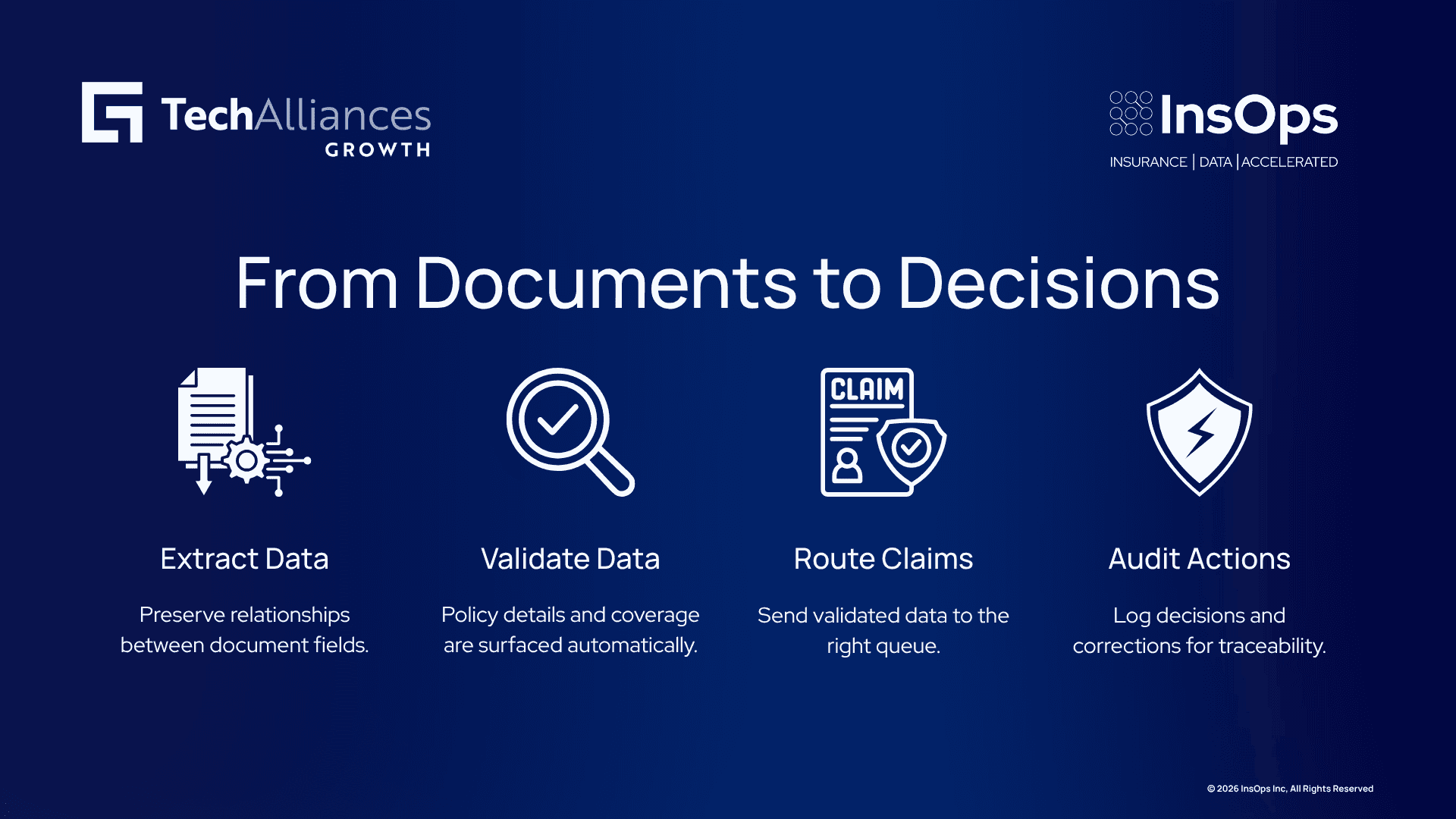
1. Ingest
Documents arrive through multiple channels in inconsistent formats. Email attachments, portal uploads, physical mail, fax, and mobile photos all land in different places. Someone has to collect, sort, and standardize them before anything else can happen.
2. Extract
Data is pulled from each document. The key is preserving relationships between fields. A billed amount must stay linked to its procedure code. A diagnosis must stay linked to its date of service. A policy number on page one of a submission must match the policy number on page twelve. Extraction that treats every field as independent produces fragmented data that cannot be validated or used.
Modern systems combine machine learning, computer vision, and layout-aware parsing to interpret documents at multiple levels. LlamaIndex described in 2026 how text detection identifies regions of interest, while layout analysis determines how those regions are organized into sections such as headers, tables, and key-value fields.
3. Validate
Extracted data is checked against business rules, policy terms, and cross-document consistency. A date of loss on a police report should match the date on the repair estimate. A billed amount should fall within the fee schedule range for the claimed loss value. Missing or inconsistent information is flagged before the claim moves forward.
4. Route
Validated, structured data moves to the right downstream system or queue. Unvalidated or low-confidence data routes to a human reviewer with the original document visible. The reviewer confirms, corrects, or rejects the extraction, and the system learns from the correction.
5. Audit
Every extraction, validation decision, and human correction is logged with timestamp and user ID. This creates the audit trail that compliance and legal teams need, and it provides the feedback loop that improves extraction accuracy over time.
Most carriers have solved Ingest with scanning and basic OCR. Extract is partially solved for the most standardized forms. Validate, Route, and Audit remain largely manual. That is the gap.
What Does “Insurance-Trained” Actually Mean?
A generic model can read the words on a police report. An insurance-trained AI knows that “DOI” means date of injury in one context and Department of Insurance in another.
Insurance documents contain domain-specific language, codes, and relationships that generic AI tools miss. A model trained on general text might extract “CPT 99213” accurately but not know it represents an established patient office visit. It might read “ACV” as a random acronym rather than Actual Cash Value in a property context. It might miss that a “reservation of rights” letter changes the coverage status of a claim.
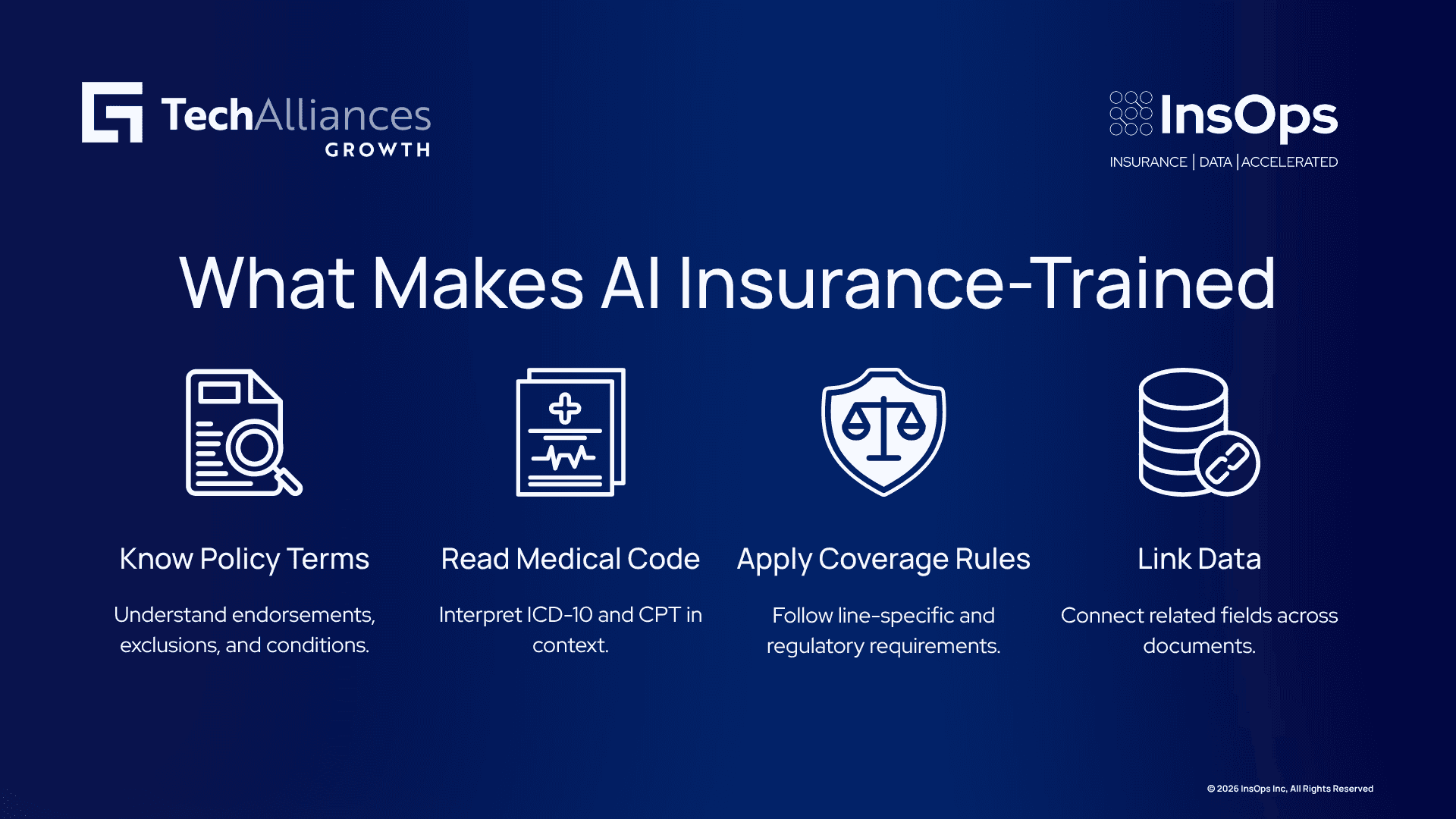
An insurance-trained model understands:
Policy language, including endorsements, exclusions, and conditions
Medical codes (ICD-10, CPT) and their relationship to procedures and diagnoses
Coverage rules and fee schedules by line of business
Regulatory requirements including NAIC standards, HIPAA, and state-specific rules
Data relationships across documents, such as linking a police report incident number to a claim file
This domain understanding matters because extraction without context produces data that looks correct but means the wrong thing. A generic tool might extract a date accurately but not know whether it is the date of loss, the date reported, or the date of a subsequent medical visit. An insurance-trained model knows the difference and flags when the dates do not align.
How InsOps Helps
InsOps builds an insurance-trained AI, called LiLa, that understands insurance domain logic, data relationships, and regulatory requirements. LiLa runs inside the insurer’s own environment, so PII and PHI never leave controlled infrastructure.
Our insurance-trained AI has assisted extraction capabilities. Our AI helps claims teams move from manual document handling to a workflow where insurance-trained AI identifies, extracts, and structures claim data from police reports, medical records, repair estimates, and invoices, with a human reviewing and confirming every output before it enters the claims system.
If your team is spending its day on documents instead of claims, contact us to talk through what this could look like for your operation.
Frequently Asked Questions
What is intelligent document processing in insurance?
Intelligent document processing for insurance is the use of AI to ingest, classify, and extract data from documents across underwriting and claims workflows. Indico Data explains that it automates how insurers ingest, review, and extract data from documents, eliminating manual inbox triage and standardizing submission intake across teams.
What is the difference between OCR and IDP?
OCR extracts text from documents. IDP understands, classifies, and validates the data, and it supports document intake workflows rather than just text capture. According to Indico Data, IDP can classify document types, extract structured data across multiple documents, handle emails and attachments together, and flag missing or inconsistent information.
How does AI extract data from insurance documents?
AI reads documents, identifies fields by context rather than template position, extracts structured data, and routes low-confidence extractions for human review. Lido noted in 2026 that AI reads claim numbers, policy numbers, dates of loss, claim amounts, adjuster notes, and coverage details from any insurer’s format. LlamaIndex added that modern systems use layout-aware parsing to preserve relationships between fields, reconstructing tables, headers, and key-value fields into structured representations.
Can AI read handwritten notes on insurance claim forms?
Advanced systems use ICR, or Intelligent Character Recognition, to read handwriting. AltexSoft reported in 2025 that ICR applies deep learning networks to process poor-quality scans and handwritten text, though accuracy varies by writing style and document quality.
How much time do adjusters spend reviewing documents manually?
Industry estimates suggest a significant portion of review time goes to document organization alone. Insurance Thought Leadership found in 2025 that 30% to 40% of MSA review time is spent on manual document organization and navigation. In one documented workflow, AltexSoft reported that manual rekeying averaged 4.5 minutes per claim for a team of twenty operators. The full document handling workflow, including sorting, field identification, cross-referencing, and error correction, consumes substantially more time before any investigation begins.