

Suspicious claims are rising. AI-generated fake photos, synthetic documents, and shallowfakes made with smartphone apps are flooding FNOL queues. Meanwhile, your rules-based fraud system flags more claims than your team can review. Only 7% of anti-fraud professionals say their organization is more than moderately prepared to detect AI-generated fraud, even though 98% of insurers agree that AI-powered editing tools are fueling a rise in digital insurance fraud. This article explains what AI-assisted fraud detection actually does, how it changes the day-to-day workflow, and what to look for when deciding whether it fits your operation.
Why Is Insurance Fraud So Hard to Detect Right Now?
Insurance fraud has always been a moving target. Fraudsters adapt faster than rules-based systems can be rewritten. Three structural limits make the current environment especially difficult.
First, rules-based detection only catches known patterns. A rule flags a claim because it matches a previously identified scheme: a recent policy inception, a high-dollar loss, a claimant with prior claims. When fraudsters switch tactics, the rules do not adapt until an analyst writes a new one. This creates a permanent lag.
Second, AI-generated fraud now bypasses traditional verification. Deepfake images, synthetic medical records, and AI-doctored repair estimates look authentic to human reviewers. Insurance claims involving deepfakes have surged approximately 2,137% over the last three years. Shallowfakes, simple edits made with free smartphone apps, are now the fastest-growing category. A claimant can exaggerate damage in a photo in under two minutes.
Third, SIU capacity is fixed while flag volume grows. Rules-based systems are optimized for recall, not precision. They mark anything suspicious to avoid missing fraud. The result is a high volume of alerts that investigators cannot process. Approximately 75% of flagged claims never receive full investigation because manual capacity tops out at roughly 10 cases per investigator per month. The remaining claims close with abbreviated review or no review at all.
These three limits are not separate problems. They compound. More AI-generated fraud means more flags. More flags mean more overwhelmed staff. More overwhelmed staff means more fraud slips through.
How Does AI Spot Fake Insurance Claim Photos and Documents?
AI-assisted detection analyzes images and documents at a level of detail human reviewers cannot match. It does not replace visual inspection. It adds four technical layers beneath it.
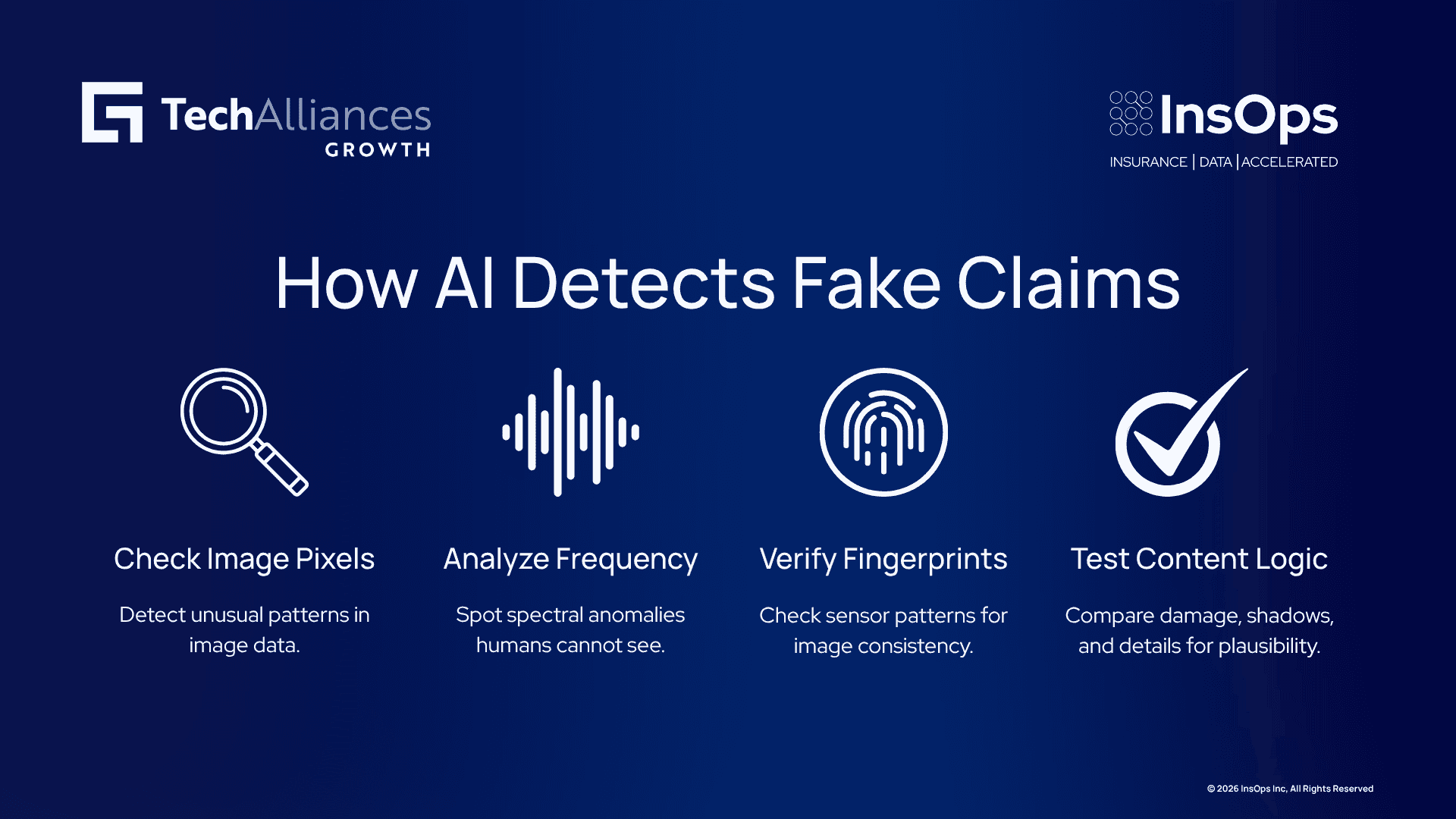
Pixel-level forensics examine the statistical patterns in an image file. Every camera sensor leaves a unique noise fingerprint on every photo it takes. Real photographs carry this signature. AI-generated images or heavily manipulated photos typically do not, or they carry inconsistencies that reveal synthetic origin.
Frequency domain analysis transforms images into spectral data. Real photographs and AI-generated images have subtly different frequency signatures. These anomalies are invisible to the human eye but detectable to trained algorithms.
Camera fingerprint analysis checks whether the sensor noise pattern is consistent across the image. If a photo claims to be from a smartphone but carries no valid sensor fingerprint, or if part of the image has a different fingerprint than the rest, the system identifies it.
Semantic consistency checking verifies whether the content of the image is physically plausible. Is the damage pattern consistent with the claimed cause? Is the water line in a flood photo consistent with the reported depth? Does the shadow geometry match the lighting?
For documents, the system checks font consistency, spacing irregularities, formatting deviations from legitimate templates, and metadata mismatches. A forged medical record may use a slightly wrong font or spacing pattern that a generic OCR tool misses but a forensic document analyzer catches.
These methods work together. A shallowfake that passes visual inspection may fail camera fingerprint analysis. A deepfake with a valid sensor fingerprint may still fail semantic consistency checking. The layered approach is what makes the detection robust.
What Makes AI Fraud Detection Better Than Rules-Based Systems?
The core difference is adaptation. Rules-based systems flag what analysts have already coded as suspicious. AI-assisted detection learns from historical claims and surfaces anomalies that do not match any known pattern.
This difference shows up in five concrete ways:
Dimension | Rules-Based Detection | AI-Assisted Detection |
|---|---|---|
Signal count | ~30 signals per claim | 200+ signals per claim |
False positive rate | 60-85% by design | Lower when layered with human review |
New scheme detection | Lags until rules are rewritten | Adapts from historical pattern learning |
Document/image analysis | Limited or manual | Automated pixel-level and semantic analysis |
Investigator throughput | ~10 cases/month | 800+ cases/month with evidence automation |
The false positive rate is the most immediate pain point for SIU teams. When 60-85% of flagged claims are legitimate, investigators develop alert fatigue. They triage by claim size, not by signal quality. High-volume, low-severity fraud rings slip through because analysts are busy clearing false alarms.
AI-assisted detection does not eliminate false positives entirely. It changes what investigators receive. Instead of a numeric risk score with limited context, staff get a structured evidence packet: annotated inconsistencies, cross-referenced documents, and recommended next steps. They triage by signal quality, not by dollar amount.
What Does an End-to-End AI-Assisted Fraud Detection Workflow Look Like?
A complete workflow has four layers. Each layer handles a distinct part of the process. The fourth layer is the most important, and it is not a caveat. It is a structural requirement.
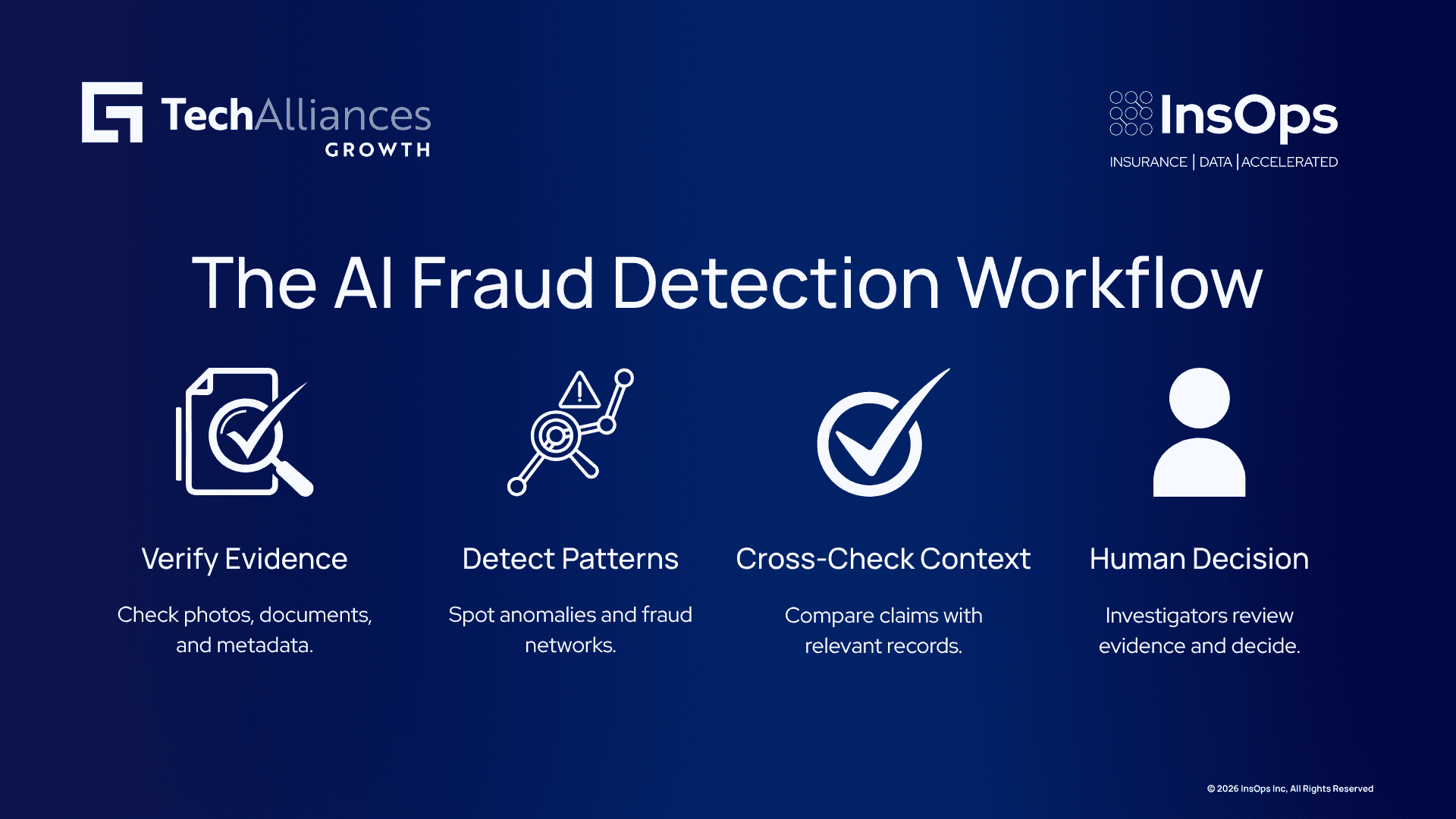
Layer 1: Evidence Verification. The system analyzes submitted photos, documents, and metadata for signs of manipulation, synthetic generation, or reuse. It runs pixel-level forensics, camera fingerprint analysis, and cross-claim matching to detect whether the same image has appeared in prior submissions.
Layer 2: Pattern and Anomaly Detection. Insurance-trained AI models score claims against historical fraud patterns, policy data, and behavioral baselines. They surface statistical outliers and network relationships that suggest organized fraud rings.
Layer 3: Cross-Reference and Context Check. The system compares claim narratives against external data sources and internal policy records. Does the weather data match the claimed storm damage? Does the police report timeline align with the FNOL? Does the claimant’s prior history show similar patterns?
Layer 4: Human-Led Decision. Flagged claims route to SIU investigators with structured evidence packets, not just scores. The team reviews the findings, decides whether fraud occurred, and documents the determination. State DOI rules and NAIC model regulations require human authority on fraud determinations. AI assists. Humans decide.
This four-layer stack is what separates detection from investigation. Detection finds suspicious claims. Investigation confirms whether fraud occurred. Most carriers have invested heavily in detection and underinvested in investigation. The gap between those two designs is the capacity crisis.
How Do You Evaluate AI Fraud Detection Tools for Your Operation?
When you evaluate tools, look for four specific capabilities, not marketing language.
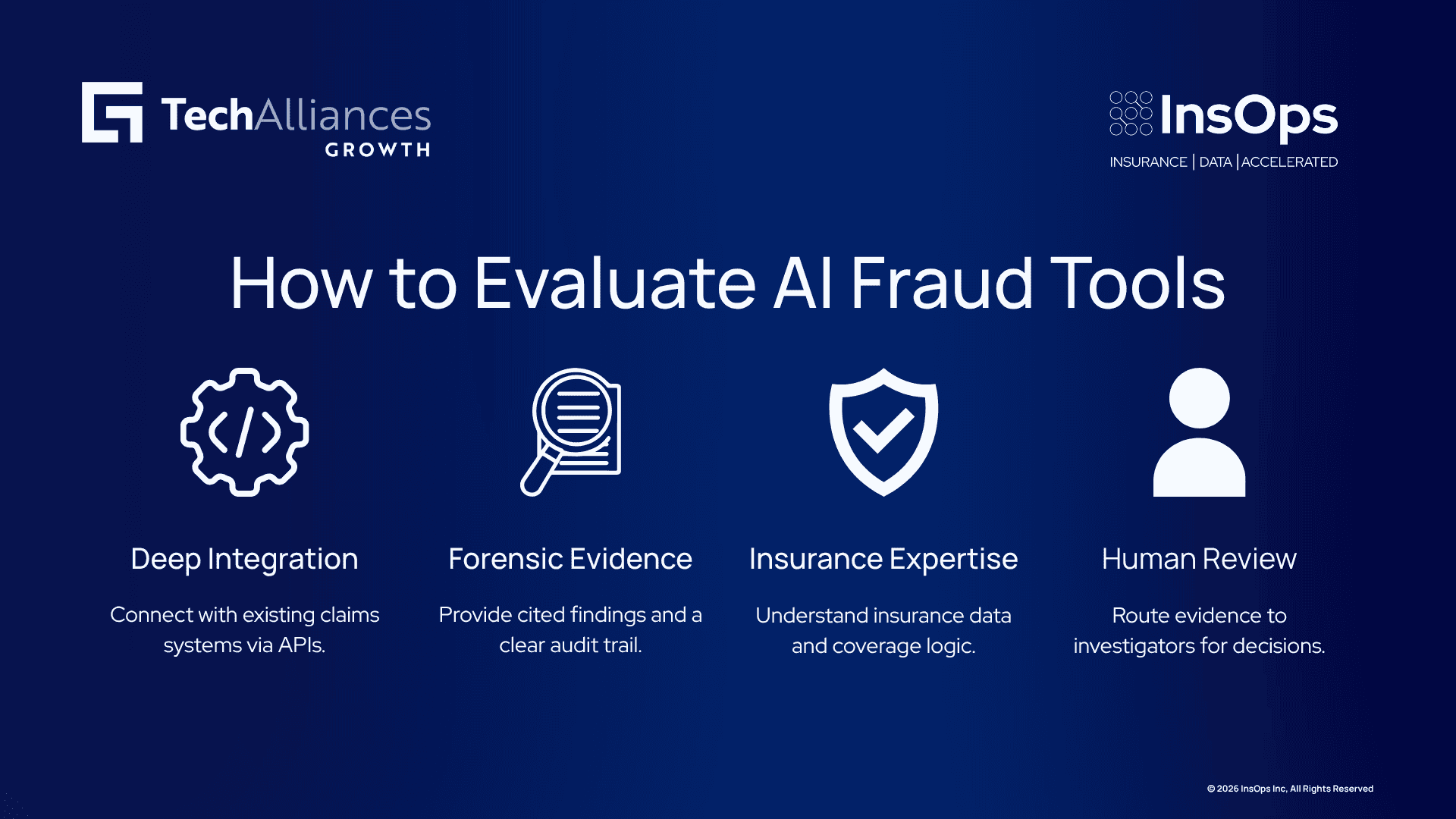
Integration depth. The tool should connect to your existing claims platform through standard APIs. It should not require replacing your claims management system or retraining your entire team on a new interface.
Forensic evidence output. The system must produce detailed reports with cited evidence, not just a binary “fraud/no fraud” score. For claims that proceed to litigation or regulatory review, you need an audit trail: the signals evaluated, the sources queried, the findings surfaced, and the decisions made.
Insurance domain knowledge. Generic AI models trained on internet text do not understand insurance data relationships, regulatory requirements, or coverage logic. The tool should be trained on insurance-specific data and understand the difference between a bodily injury claim and a property claim.
Human-in-the-loop workflow design. The system should route structured evidence to investigators for review and decision. Any tool that claims to autonomously deny claims is operating outside compliance with state DOI rules. The final fraud determination must remain human.
Ask vendors for a sample investigation report on a claim similar to yours. If they cannot show you one, that is a red flag.
How Does AI Fraud Detection Handle the Human Side?
The biggest change for investigators is not what they do. It is what they stop doing.
Manual workflows leave investigators spending roughly 12% of their time on analysis and decision-making. The rest goes to evidence gathering, report writing, and administrative coordination. AI-assisted detection shifts this ratio. When evidence gathering and initial analysis are automated, analyst time on analysis rises to roughly 80% of their workload.
Day-to-day, the change looks like this. An investigator receives a flagged claim not as a numeric score in a queue, but as a structured packet. The packet includes: a risk score with explainable reason codes, an annotated transcript or document analysis showing exactly where inconsistencies appear, cross-referenced external data confirming or contradicting the claim, and recommended next steps based on historical case patterns. The investigator reviews the packet, decides whether to escalate, and documents the rationale.
Time per investigation compresses from 14 or more days to 2-4 hours per case. Throughput rises from roughly 10 cases per investigator per month to 800 or more. The investigator does not work faster. They stop spending days on tasks that a machine can do in minutes.
Alert fatigue drops because staff triage by signal quality. A claim with a high score but weak evidence drops in priority. A claim with a moderate score but strong documentary inconsistencies rises. The system surfaces what matters, not just what is large.
How InsOps Helps
InsOps builds an insurance-trained AI that runs inside your own environment. Your PII and PHI never leave your controlled infrastructure. The system understands insurance domain logic, data relationships, and regulatory requirements, unlike generic models.
Additional fraud detection capabilities inside LiLa include: forensic image analysis to detect synthetic and manipulated photos, automated claim note drafting to accelerate investigator documentation, and AI-generated fake document detection to flag synthetic evidence at intake. These capabilities are in development. Contact us to talk through what this could look like for your operation.
Frequently Asked Questions
What is the difference between AI fraud detection and traditional rules-based fraud detection?
AI fraud detection uses machine learning and natural language processing to identify novel patterns and conversational red flags. Rules-based detection only flags claims that match pre-written criteria. Rules systems break on any scheme the analyst did not anticipate. These models generalize from prior fraud cases and surface anomalies a rules engine would never catch.
How accurate is AI insurance fraud detection in 2026?
Accuracy varies by layer and use case. Mature deployments that combine structured detection with automated investigation routinely compress identification time from weeks to days. The precision gain comes not from eliminating false positives entirely, but from changing what investigators receive: structured evidence packets instead of numeric scores. This lets them triage by signal quality rather than claim size.
Can AI fraud detection replace human SIU investigators?
No. AI fraud detection augments investigators rather than replacing them. The system handles evidence gathering, structured analysis, and report generation. Human investigators handle case strategy, witness interviews, regulatory coordination, and the legal judgment calls that AI cannot make. State DOI rules require human determination on fraud. Any vendor claiming full replacement is operating outside compliance.
What capabilities should fraud detection tools have?
Four capabilities matter most: deep integration with your claims platform via API; detailed forensic evidence output with cited findings, not just scores; insurance domain knowledge trained on P&C data relationships and regulatory requirements; and a human-in-the-loop workflow that routes structured evidence to investigators for decision, never autonomous denial.
How do you measure ROI on AI fraud detection?
Measure against four metrics: investigation coverage rate (percentage of flagged claims that receive full review), time per investigation, investigator productivity (cases closed per investigator per quarter), and claim leakage reduction (dollars saved from fraud detected that would have been missed). The most defensible measurement compares a control group using legacy workflows against a treatment group with AI-assisted detection over two full quarters.
How widespread is insurance fraud in 2026?
The threat is both large and growing. Insurance claims involving deepfakes have surged approximately 2,137% over the last three years. Shallowfakes, made with free smartphone apps, are now the fastest-growing category. Meanwhile, 75% of flagged claims never receive full investigation because SIU capacity is fixed. The gap between detection volume and investigation capacity is the defining operational challenge for fraud teams this year.