

When claim volume jumps beyond normal intake capacity and adjusters are already working at full load, the queue becomes a liability. A first-in-first-out approach means a complex bodily injury claim with attorney involvement sits behind three routine fender benders. The result is not just slower resolution times. It’s missed early intervention windows, rising costs, and adjusters burning out while high-impact cases wait their turn.
This article explains how to sort incoming claims by severity, complexity, and urgency so the highest-impact cases reach experienced adjusters immediately instead of sitting in a first-in-first-out queue.
What Happens When Too Many Insurance Claims Come In at Once?
The U.S. insurance industry lost 1,400 claims adjuster positions in August 2025 alone, according to Celent. And it reflects a broader trend that claims leaders have been reporting for years: they are perpetually understaffed, often relying on the same stretched teams to handle increasingly volatile workloads.
At the same time, the claims themselves are becoming more demanding. According to NCCI, lost-time claim frequency dropped 5% in 2024, while medical and indemnity severity both rose by 6%. Fewer claims are coming in, but each one requires more time and resources.
The compounding effect is this: the same teams are being asked to handle more complex files with fewer people. When a CAT event or seasonal surge hits, the gap between volume and capacity becomes visible immediately.
Claims that should have been flagged for senior review within hours sit in standard queues for days. Early intervention windows close. Costs start climbing before anyone has assigned the file.
How Does Insurance Claims Triage Work Step by Step?
Claims triage is the evaluation and routing of incoming claims based on risk, severity, and potential cost exposure. It typically happens at intake and again at escalation points throughout the claim lifecycle as new information changes how the claim should be handled.
The purpose is resource allocation. High-severity, complex claims require prompt attention from experienced professionals, whereas lower-complexity claims can move through standard workflows without consuming the same level of time and expertise.
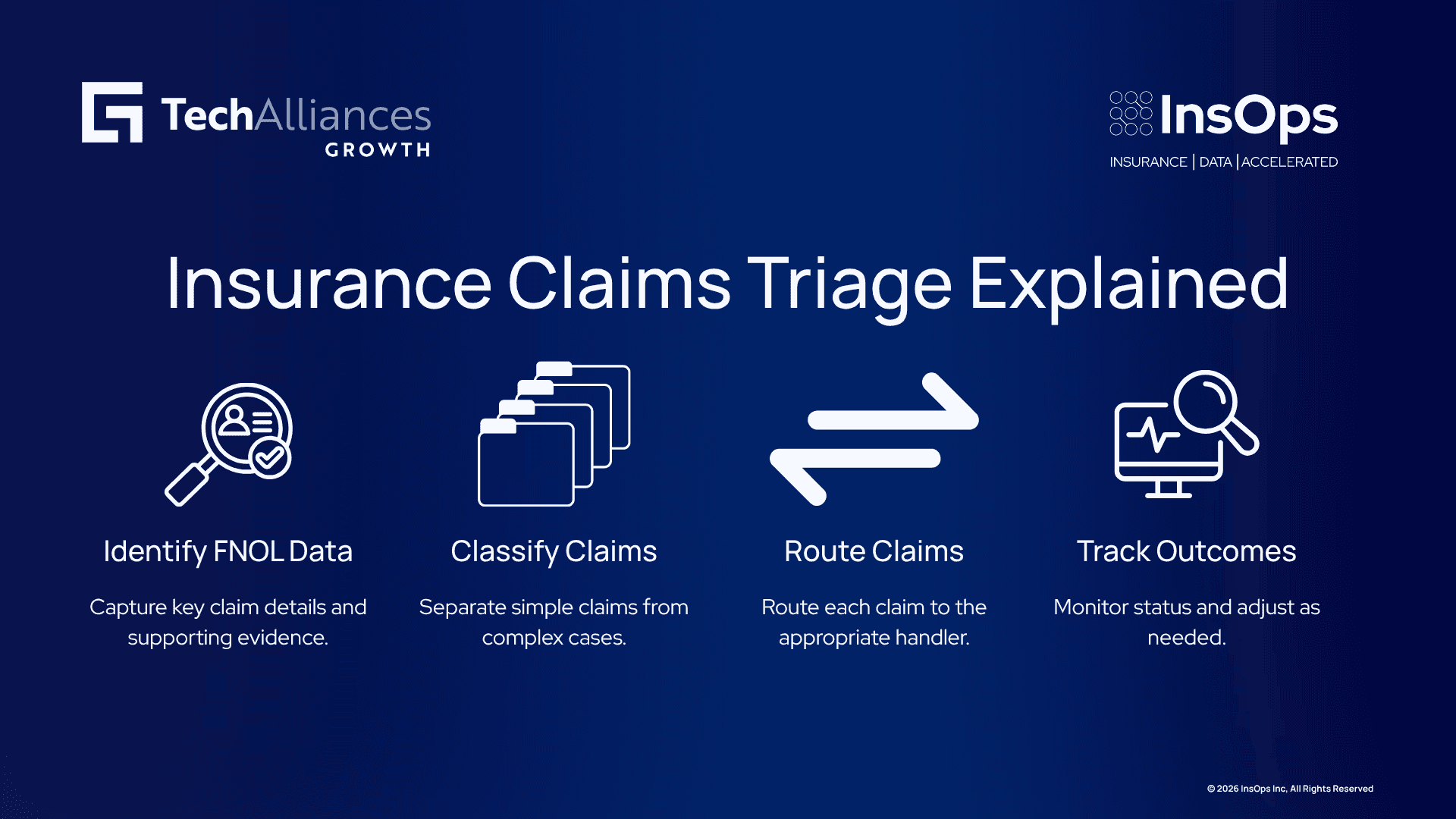
The core steps are:
Identify FNOL data. The first notice of loss provides the initial information needed to begin triage. This includes both structured information (policy numbers, dates, claim types) and unstructured elements (descriptions, photos, notes).
Segment simple versus complex claims. Not all claims require the same level of attention. Segmentation separates straightforward claims from those needing specialized handling.
Route to the right teams. Once classified, claims need to reach the right handlers. Some claims go to specialized units, while others follow standard processing paths.
Monitor progress and outcomes. Triage is not a one-time event. Effective systems continue to monitor claims as they progress, allowing for adjustments if new information emerges.
What Makes an Insurance Claim High Priority vs. Low Priority?
Most carriers evaluate claims along three dimensions. We call this the Severity-Complexity-Urgency (SCU) Triage Framework.
Severity is the potential financial exposure and bodily injury scope. A multi-vehicle collision with structural property damage scores high. A single-vehicle fender bender with no injuries scores low.
Complexity is the number of variables requiring specialized expertise. Attorney involvement, multiple coverages, disputed liability, and prior claims history all raise complexity. Clear liability and single coverage lower it.
Urgency is the time-sensitivity of the claim. Regulatory deadlines, policyholder hardship, and litigation risk all raise urgency. Routine repairs with no occupancy impact lower it.
A claim scoring high on any one dimension gets routed to experienced adjusters. A claim scoring low on all three dimensions routes to fast-track processing.
This framework prevents the common error of routing by severity alone. A slip-and-fall with minor injuries but attorney involvement is low-severity, high-complexity.
Without the complexity check, it might route to a junior adjuster and sit untouched for weeks while the attorney builds a case.
Where Does Manual Triage Fall Short?
Two adjusters can look at the same claim and route it differently. Regional practices vary, and high volume creates time pressure that leads to inconsistency. When decisions hinge on individual experience rather than consistent criteria, claims that need the most attention sometimes do not get flagged until weeks into the lifecycle.
The data supports this. Risk & Insurance found that 58% of complex workers’ comp claims include at least one comorbidity, and comorbidities increase the likelihood of claim complexity by 33%. A manual reviewer might catch one comorbidity and miss another. Or they might catch it in one claim but not in the next because they are working through a surge and have 40 files to review before lunch.
The cost of delayed identification is real. A complex claim identified at day three looks very different at resolution than the same claim identified at week six. Early intervention matters, and the window for effective action closes quickly.
How Can Insurance Companies Handle Sudden Claim Surges?
Organizations that stabilize quickly during surges have built the muscle memory to respond. They know how to assess capacity in real time, activate flexible staffing, streamline workflows, maintain quality, and communicate transparently.
The five steps are:
Assess real-time capacity and prioritize triage. Evaluate current adjuster bandwidth against incoming volume. Establish clear triage criteria so team leads can make faster, more confident prioritization decisions.
Activate flexible staffing models. Surge staffing options like contract adjusters or cross-trained internal team members can step in during high-volume periods. The goal is to add capacity that integrates smoothly, rather than creating more work for existing teams.
Streamline workflows and remove friction. Look at where manual handoffs happen, which approval steps create delays, and whether duplicative tasks could be consolidated. Technology can help by handling routine tasks, freeing up skilled staff to focus on complex claims.
Maintain quality and compliance standards. When volumes spike, there is pressure to move faster. Speed and accuracy do not have to be at odds. Reinforce quality assurance checkpoints during surge periods, especially for high-risk or high-value claims.
Communicate transparently with customers and stakeholders. During a surge, silence creates anxiety. Setting realistic expectations and providing proactive updates builds trust and reduces escalations.
How Does AI Help With Claims Triage?
InsOps builds an insurance-trained AI that assists with claims triage by evaluating severity, complexity, and urgency indicators at intake, the same indicators an experienced adjuster would weigh, but applied consistently across every file rather than varying by individual judgment.
The difference between traditional and AI-assisted triage is significant:
Aspect | Traditional Triage | AI-Assisted Triage |
|---|---|---|
Speed | Hours or days | Minutes |
Consistency | Varies by adjuster | Uniform application of criteria |
Data analysis | Limited to structured fields | Includes unstructured data |
Volume handling | Struggles with spikes | Scales automatically |
AI excels at processing both structured data (policy numbers, dates) and unstructured information (descriptions, photos, notes). This comprehensive analysis leads to more accurate triage decisions.
Three key technologies drive this:
Machine learning identifies patterns in historical claims data
Natural language processing interprets written descriptions and notes
Computer vision analyzes photos and documents
However, not everything should be automated. In a human-in-the-loop model, AI handles routine evaluation while flagging unusual cases for human review. This approach leverages the strengths of both automated and manual processes. Adjusters still play a vital role, focusing on cases where their expertise adds the most value rather than spending time on routine sorting.
How Do I Set Up a Claims Triage System That Actually Works?
A phased implementation helps minimize disruption. Starting small lets you validate your criteria, test your routing rules, and measure whether the system is actually improving outcomes before you expand.
Common implementation challenges include:
Integrating with legacy systems. Many insurers operate on older claims management systems not designed for AI integration. API-based approaches allow new tools to communicate with existing systems without major restructuring.
Ensuring data quality. AI systems depend on good data. Inconsistent, incomplete, or inaccurate information leads to poor triage decisions. Addressing this requires a combination of data cleaning, standardization protocols, and training for staff who enter initial claim information.
Balancing AI efficiency and human expertise. The most effective approach combines AI efficiency with human judgment for complex decisions. AI handles routine triage while flagging unusual cases for human review.
What Should I Measure to Know If My Triage Process Is Actually Improving Things?
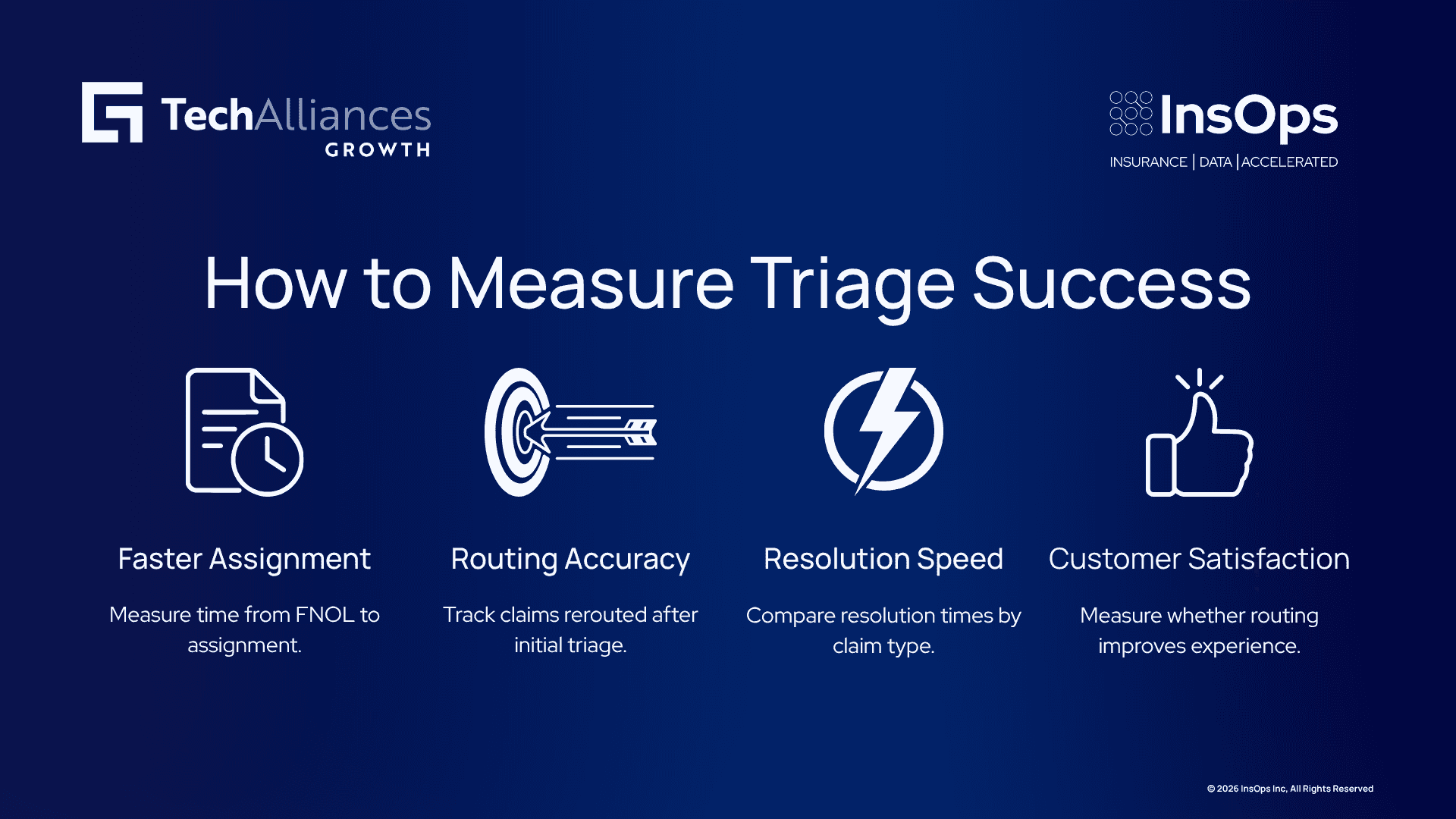
Key metrics for measuring triage effectiveness include:
Time from FNOL to assignment. How quickly a claim reaches the right handler after intake.
Percentage of claims rerouted after initial triage. Whether the first routing decision was correct.
Average resolution time by claim type. Whether claims are closing faster after triage improvements.
Customer satisfaction scores. Whether faster, more accurate routing is improving the policyholder experience.
These metrics tell you whether your triage system is identifying the right claims for the right paths, or whether it is just adding another layer of process without improving outcomes.
How InsOps Helps
InsOps builds an insurance-trained AI that assists with claims triage by evaluating severity, complexity, and urgency indicators at intake. LiLa, our insurance-trained LLM, runs inside your own environment, so PII and PHI never leave controlled infrastructure. A person reviews and validates every routing recommendation before it is finalized.
Our Integration Gateway connects to Guidewire ClaimCenter, PolicyCenter, BillingCenter, and other core systems, so triage decisions flow directly into your existing workflow without custom engineering.
InsOps migrates legacy data into Guidewire and keeps it flowing in real time.
If you are evaluating how to handle claim volume spikes without adding headcount, contact us to talk through what this could look like for your operation.
Frequently Asked Questions
What is claims triage in insurance?
Claims triage is the sorting of insurance claims by urgency, severity, and complexity to determine how each claim will be handled. Like medical triage in hospitals, it identifies which cases need immediate attention and which can follow standard processing.
Why is claims triage important?
Inefficient claims triage creates bottlenecks that affect the entire claims process. When claims are not sorted quickly and accurately, insurers may assign the wrong resources or miss early warning signs of complex issues. Research from J.D. Power shows that customer satisfaction drops significantly when claims take longer than three weeks to resolve.
Why do insurance claims get delayed?
The most common causes are incomplete FNOL submissions, manual routing and assignment, siloed systems requiring data re-entry, unclear escalation paths for complex cases, and poor real-time visibility for managers. Fixing these issues addresses the majority of cycle time problems.
How does AI improve claims triage?
AI reduces the initial triage phase from hours to minutes. It identifies patterns in historical claims data, interprets written descriptions and notes through natural language processing, and analyzes photos and documents through computer vision. This leads to more accurate routing decisions and more consistent application of criteria.
Can AI triage handle both structured data and unstructured stuff like adjuster notes and photos?
Yes. AI-powered triage processes both structured data (policy numbers, dates, claim types) and unstructured information (descriptions, photos, notes). Natural language processing interprets written text, and computer vision analyzes images and documents.
What is a realistic timeline for implementing AI triage, and what are the common failure points I should avoid?
A phased approach starting with one line of business or claim type is most effective. Common failure points include poor data quality, inadequate integration with legacy systems, and trying to automate too much too soon without human review checkpoints