

Carriers that implement full claims workflow automation cut average cycle time from 23 days to under 14 days. Yet the industry average from first notice to final payment still sits at 40.7 days, because manual intake alone adds 24 to 48 hours of delay before an adjuster even sees the claim.
That gap between what is possible and what most carriers experience is not a technology problem. It is a handoff problem. Delay does not accumulate in one place. It accumulates at five specific points between the moment a loss is reported and the moment a payment is issued. Understanding those handoffs, and which ones an insurance-trained AI can address without replacing your core system, is the first step toward building a realistic case for where automation belongs and where human judgment still matters.
How Long Should a Claim Take? (And What “Average” Actually Hides)
The 40.7-day average from the J.D. Power 2026 U.S. Property Claims Satisfaction Study is a useful anchor, but it hides more than it reveals. Most carriers do not have a single bell-curve distribution of cycle times. They have a bimodal one: simple claims that should close in days are stuck in the same queues as complex claims that legitimately need weeks. The result is an average that makes the operation look uniformly slow when the real problem is a routing problem.
The 23-day manual baseline and the under-14-day automated target come from the same underlying data. The difference is not better adjusters or more of them. It is whether the claim arrives structured, routed, and pre-validated, or whether it arrives as an email with attachments that someone has to read, retype, and chase.
The 24 to 48 hours of manual FNOL delay is not theoretical. It is the time between a customer reporting a loss and an adjuster opening a structured claim file. In that window, a CSR or intake specialist reads the submission, downloads attachments, fills in fields, and often sends follow-up requests for missing information. Every error in that first pass compounds downstream.
The Intake-to-Payment Handoff Map: Five Places Where Delay Accumulates
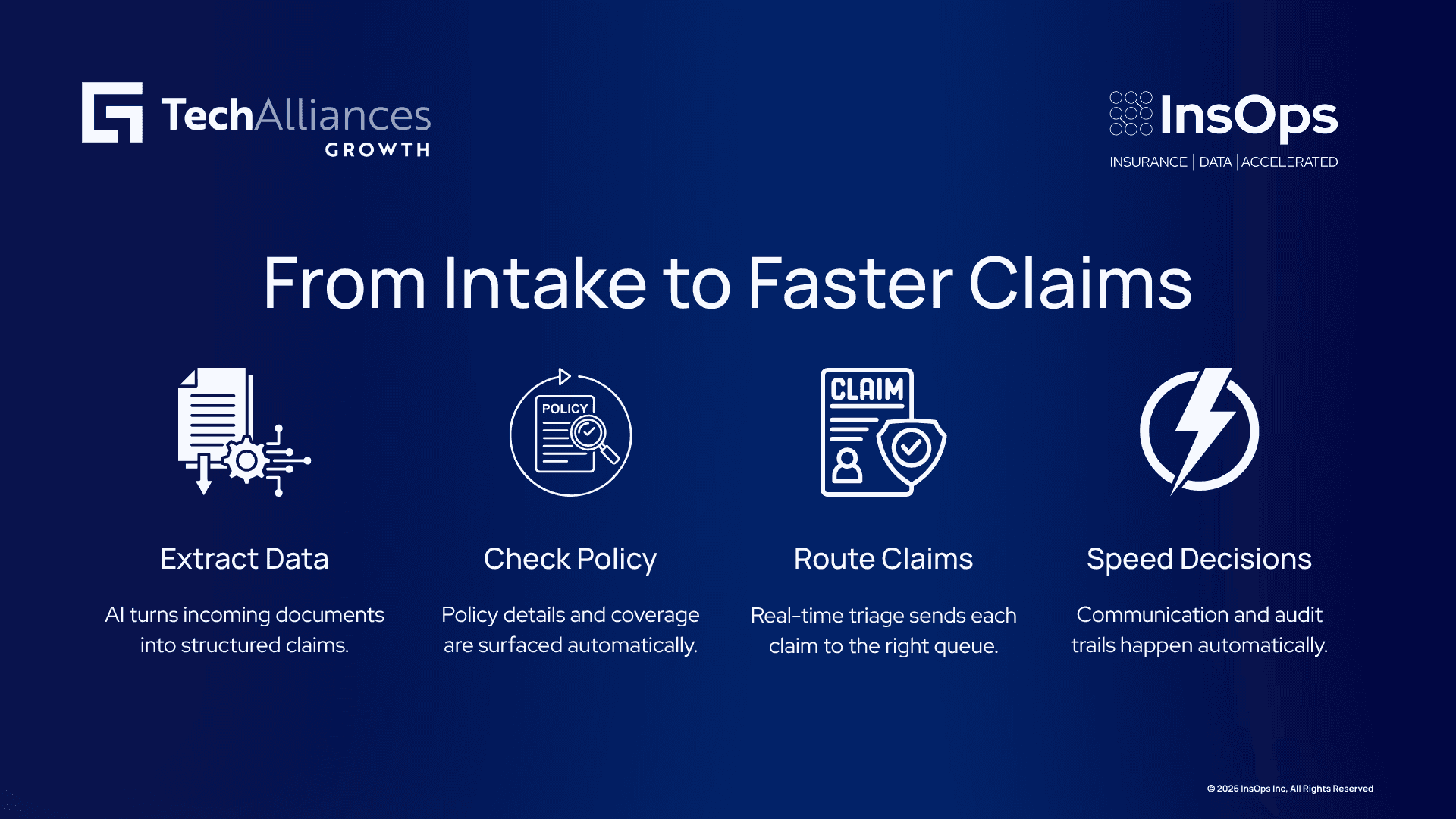
The Intake-to-Payment Handoff Map describes where delay actually accumulates in a P&C claims operation, and which handoff points an insurance-trained AI can address without replacing the core system.
First Handoff: Unstructured-to-Structured
Claims arrive as emails, photos, handwritten forms, and phone transcripts. A human retypes the relevant data into the claims system. A 500-FTE carrier processing 40,000 claims per year with a 20-minute-per-claim manual intake burden burns approximately 13,300 adjuster hours on data entry work. That is the equivalent of roughly seven full-time adjuster positions funded to type numbers into a system.
The fix at this handoff is not faster typing. It is reading the documents as they arrive and extracting the fields automatically. An insurance-trained AI can read the email text, categorize attachments, extract every field from a claim form, and populate the claims system before a human is involved. The adjuster sees a structured claim file, not a folder of unread attachments.
Second Handoff: Data-to-Policy
Once the claim is in the system, the adjuster pulls the policy, verifies it is active, checks whether the loss date is within coverage, reads the terms and conditions, and identifies exclusions. For a single claim this is a 5-to-10-minute task. For a 40,000-claim annual volume, it is roughly 3,300 to 6,700 hours of adjuster time doing nothing but policy lookups.
An adjuster earning $95,000 loaded who spends 40% of their day resolving intake errors represents $38,000 per year of labor going to work that should have been done by software. Multiply that across a 50-adjuster team and you are looking at $1.9 million per year in hidden inefficiency.
The fix at this handoff is automated policy lookup that pulls status, verifies dates, reads terms and conditions, identifies relevant clauses, and surfaces exclusions. The adjuster sees a pre-filled decision screen with the policy language already highlighted. They are deciding, not researching.
Third Handoff: Claim-to-Queue
A human scheduler sorts claims by complexity and assigns them to adjusters. Simple claims wait behind complex ones. High-value claims may sit unassigned while the scheduler works through the stack. Claims with incomplete or inaccurate intake data require adjuster time spent correcting data that should have been right on day one.
The fix at this handoff is real-time triage that scores claim complexity and routes each claim to the right queue immediately. A $500 windshield replacement and a $2 million property loss should not wait in the same line. InsOps is building toward this kind of capability inside LiLa. Contact us to talk through what this could look like for your operation.
Fourth Handoff: Adjuster-to-Payment
The adjuster drafts correspondence, requests missing documents, and waits for approval chains. Status silence frustrates customers and generates inbound calls. J.D. Power 2025 data shows satisfaction scores are twice as high, 777 versus 337 on a 1,000-point scale, when customers say it is very easy to communicate with their insurer than when communication is difficult.
The fix at this handoff is proactive communication at every milestone: claim received, under review, approved, payment sent. Automated, accurate, in the customer’s preferred channel, sent within minutes rather than hours or days. InsOps is building toward this kind of capability inside LiLa. Contact us to talk through what this could look like for your operation.
Fifth Handoff: Decision-to-Audit
Regulators and internal audit need to understand why a claim was handled a certain way. Manual documentation and retroactive explanation create delay and compliance risk. The NAIC Model Bulletin on AI, adopted December 4, 2023, now in force in 24 US states as of August 2025, requires explainability from day one. Retrofitting explainability later is two to three times more expensive than building it in from the start, and it often produces weaker explanations that do not hold up to DOI scrutiny.
The fix at this handoff is logging every action with reasoning and source documentation attached as claim notes from day one. Every AI-extracted field, every policy check, every routing decision is recorded with its source and its reasoning. The audit trail is not an afterthought. It is a byproduct of how the system works.
What Does an Insurance-Trained AI Actually Do at Each Handoff?
An insurance-trained AI reads the same documents an adjuster would read, extracts the same fields an adjuster would type, and surfaces the same policy checks an adjuster would run. The difference is speed and consistency, not judgment. A person still reviews and approves every output before it moves forward.
At the first handoff, LiLa extracts data from emails, PDFs, photos, and handwritten forms, then populates the claims system. At the second handoff, LiLa pulls policy status, verifies loss dates, identifies relevant clauses, and surfaces exclusions. The adjuster sees a pre-filled decision screen. At the fifth handoff, LiLa logs every action with reasoning and source documentation attached as claim notes from day one.
These are confirmed, shipped capabilities through the Insurance AI for Claims use case, which auto-maps and transforms payloads from any source into Guidewire structures, with a person reviewing and validating every output before deployment.
At the third and fourth handoffs, automated triage and proactive communication, InsOps is building toward those capabilities inside LiLa. Contact us to talk through what this could look like for your operation.
What a Realistic Implementation Looks Like (And What Blows Up Timelines)
A realistic implementation for a mid-to-large P&C carrier with a Guidewire or Duck Creek core takes 14 months from assessment to full rollout across multiple lines of business. The six-month timelines some vendors propose either miss their deadline by a factor of two or ship with known quality gaps that become compliance liabilities within 12 months.
Months 1 to 3: Data audit, use case prioritization, vendor selection, compliance framework design with legal and risk teams, and adjuster advisory group formation. The single biggest adoption risk is treating adjusters as end users rather than co-designers.
Months 4 to 7: Pilot development and parallel run on one line of business, typically personal auto or simple property claims. The AI system processes in parallel with the existing workflow while adjusters compare outputs.
Months 8 to 10: Production go-live on the pilot line with human oversight. Track straight-through processing rate, cycle time, error rate, and adjuster time per claim.
Months 11 to 14: Expansion to additional lines of business. Each new line needs four to six weeks of tuning against line-specific edge cases. Target go-live window: November through February, to avoid hurricane season.
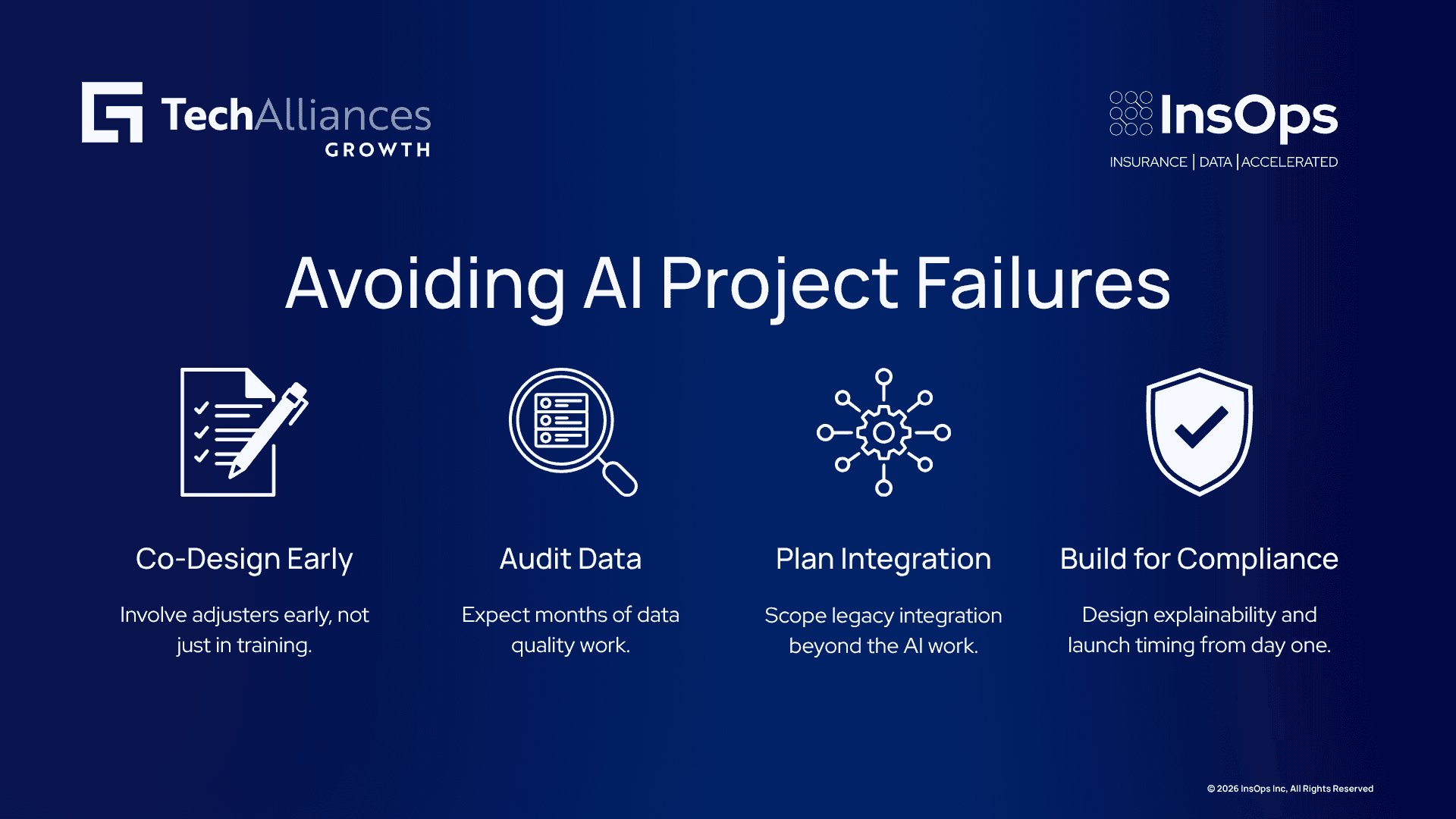
The five failure modes that kill projects:
Adjuster adoption treated as a training exercise, not co-design from month three.
Data quality assumed rather than audited. Four to six months of the timeline goes to data engineering.
Integration underscoped. Custom legacy cores can integrate with modern AI, but the integration work can exceed the AI work in hours.
Explainability treated as phase two. The NAIC Model Bulletin requires explainability from day one.
CAT timing ignored. Going live between April and October is asking for trouble.
How InsOps Helps
LiLa is an insurance-trained AI that runs inside the insurer’s own environment. PII and PHI never leave controlled infrastructure. It understands insurance domain logic, data relationships, and regulatory requirements, unlike a generic model.
Our Insurance AI for Claims auto-maps and transforms payloads from any source into Guidewire PolicyCenter, ClaimCenter, BillingCenter, UnderwritingCenter, PricingCenter, and Quoting Services structures.
Contact us to talk through what this could look like for your operation.
FAQ
How long does an insurance claim take?
The industry average from first notice to final payment in US P&C is 40.7 days according to the J.D. Power 2026 U.S. Property Claims Satisfaction Study. But that average hides a bimodal distribution where simple claims that should close in days are stuck in the same queues as complex claims that legitimately need weeks.
What causes insurance claims to be delayed?
Delay accumulates at five handoff points: unstructured-to-structured intake, data-to-policy verification, claim-to-queue routing, adjuster-to-payment communication, and decision-to-audit documentation. The first two handoffs alone account for the majority of pre-adjudication delay.
Does automation really speed up insurance claims?
Carriers that implement full claims workflow automation cut average cycle time from 23 days to under 14 days. Manual FNOL alone adds 24 to 48 hours of delay before an adjuster sees the claim. The speed gain comes from structured intake, not from removing human judgment.
What is straight-through processing in insurance?
Straight-through processing is when a claim flows from first notice to settlement payment without human intervention. Eligibility depends on claim type and data completeness. Auto glass claims are the most straightforward, while commercial lines and liability claims require more review.
Can small and mid-size insurers afford claims automation?
Yes. Modern AI claims processing integrates with existing core systems via API rather than requiring core replacement. A composable approach lets you start with one line of business, measure results, and expand. The alternative is not cost-free either: manual document handling and intake error correction consume adjuster hours that scale linearly with claim volume.
What happens to complex claims that cannot be auto-triaged?
They route to human review with the specific uncertainty flagged. This is typically 10 to 20 percent of claims in early production, dropping to 5 to 10 percent as the model learns from exceptions. The goal is not to remove the adjuster. It is to make sure the adjuster’s time goes to the claims that need it.