

Claims work has always involved documentation. But the volume keeps growing: more photos to label, more line items to validate, more notes to write up after every call.
The result is that adjusters spend a growing share of the day on administrative work instead of the analysis that actually needs their judgment.
Where an Adjuster's Time Actually Goes
Three tasks eat up an outsized share of the day: labeling and organizing photos, looking up the right line item or reference in a large catalog, and turning notes, calls, or inspection audio into a written summary.
None of these tasks require an adjuster's judgment. They just take time that judgment-heavy work doesn't get.
What AI-Assisted Support Actually Looks Like Here
The shift that matters isn't replacing the work, it's changing what an adjuster does with it. Instead of writing a summary from scratch, an adjuster reviews and refines a draft. Instead of hunting through a catalog, they get a suggestion to check.
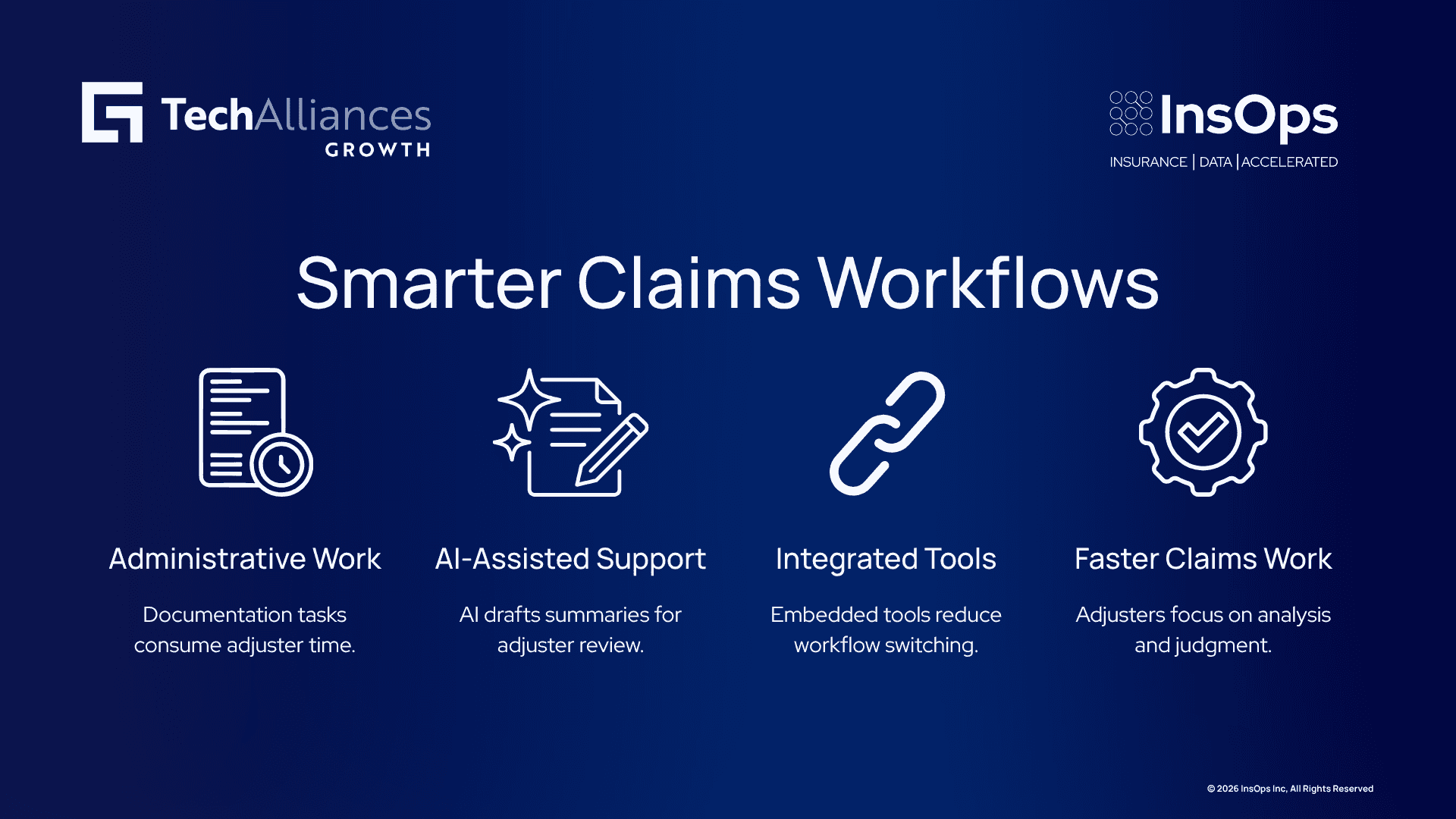
As one industry piece described it, the goal is "freeing adjusters to focus on the claim, not the paperwork." The adjuster still reviews and approves everything before it goes anywhere.
Why Standalone Tools Often Fall Short Here
A tool that adds a new login and a new workflow often cancels out its own time savings. Adjusters end up switching between systems instead of saving time in one.
The tools that actually stick are the ones that show up inside the systems an adjuster already uses, not next to them.
How InsOps Helps
InsOps is building toward this kind of capability inside LiLa: helping surface claim summaries and correspondence drafts for an adjuster to review, so less of the day goes to writing things up from scratch.
This isn't a shipped feature today, and it wouldn't send anything without an adjuster reviewing it first. Contact us to talk through what this could look like for your team.
FAQ
Does AI-assisted documentation mean an adjuster stops writing notes and correspondence themselves?
No. The pattern that actually works is AI producing a first draft or summary, with the adjuster reviewing, correcting, and approving it before it's used.
Why don't standalone AI documentation tools always deliver the time savings they promise?
Because a tool that requires a separate login and a new workflow often creates enough friction to cancel out the time it saves.
What kind of tasks take up the most non-investigative time in an adjuster's day?
Photo labeling and organization, looking up reference information in large catalogs, and turning notes or calls into written summaries.