

When a broker submission lands with missing loss runs or exposure figures that don't match across the application, schedule, and narrative, an underwriter can't start pricing it. The file gets set aside, not out of frustration, but because there's nothing solid yet to evaluate.
Why do underwriters keep asking for information that was already sent?
A submission usually can't move forward until the loss runs, exposure details, and application agree with each other. That's why underwriters send it back instead of pricing it as-is.
It isn't personal, and it isn't a sign the broker did something wrong. It's a workflow reality: an underwriter's job is to price uncertainty, and a file with gaps or contradictions has more uncertainty than one without. Rather than guess, the underwriter asks again, and the file loses its place in the queue.
What makes an insurance submission complete?
Loss runs are requested on nearly every commercial submission because they're the one document that shows actual claims history, not a self-reported estimate. Carriers require them before binding new General Liability, Property, Workers' Compensation, or Professional Liability coverage.
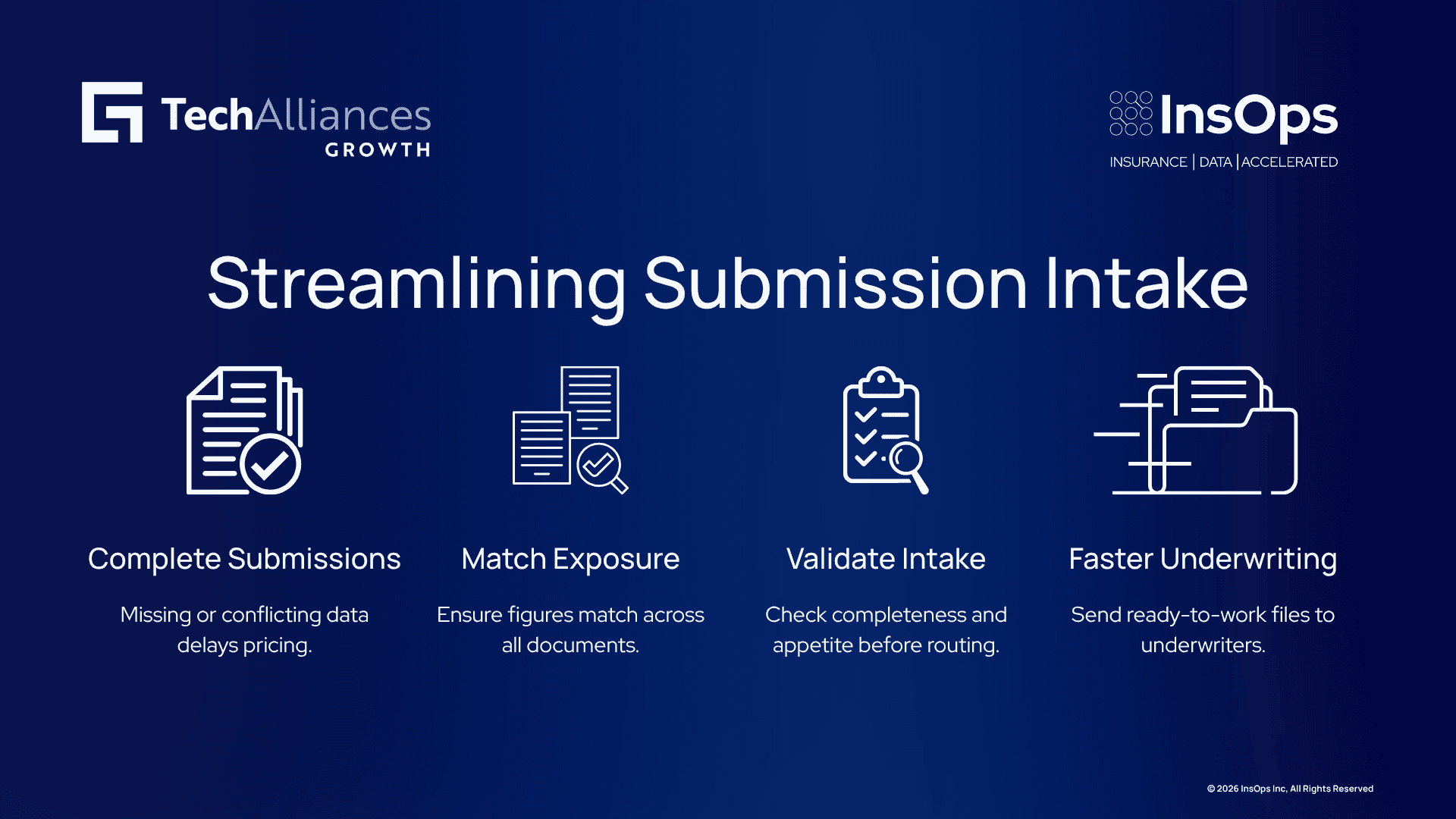
Beyond loss runs, a complete submission needs a clear description of operations, a location schedule when the business has more than one site, and figures that reconcile across every document in the packet. Payroll on the application should match payroll on the schedule. Revenue in the narrative should match revenue used to calculate class code premium. When these don't line up, the underwriter has to assume the worst until someone clarifies it.
Why does inconsistent exposure data matter more than missing data?
Missing data has an obvious fix: ask for what's absent. Inconsistent data is harder, because it isn't clear which number is right.
When a schedule total doesn't match the stated exposure, or the narrative describes different operations than the supplemental questionnaire, the underwriter can't just fill in a blank. They have to figure out which source to trust, and until they do, every downstream step, classification, pricing, and terms, stays uncertain.
How carriers are approaching this today
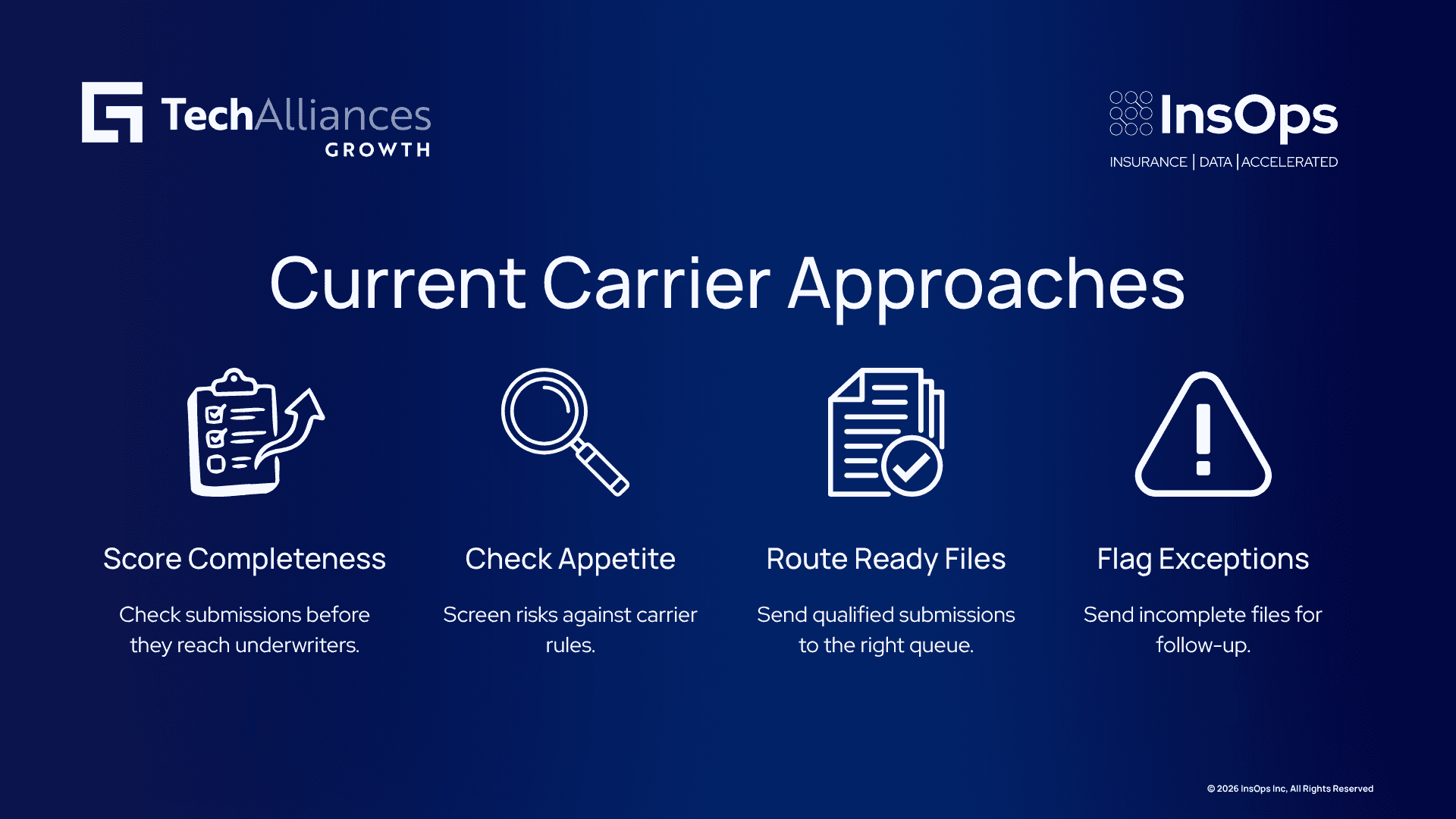
Most of the approaches carriers and MGAs are testing right now share the same basic shape: score each submission for completeness before it reaches an underwriter, check it against appetite rules, and route only the ready-to-work files into the underwriting queue. The submissions that fail those checks get flagged for follow-up instead of sitting in an underwriter's inbox untouched.
This pattern shows up across a lot of current tooling in the space, and it reflects a broader industry finding. Capgemini's Top Trends 2025 report on P&C insurance names data integration as one of the persistent gaps underwriters face in their existing workbenches, even as AI capabilities inside those workbenches improve efficiency and reduce response times.
How InsOps helps
InsOps has this capability inside LiLa: validating submission data at intake, flagging missing loss runs, and surfacing where exposure figures don't reconcile across a broker packet, before the file ever reaches an underwriter. See where this fits into broader insurance AI for underwriting work, or contact us to talk through what this could look like for your operation.
FAQ
Can a poor submission affect coverage terms even if the risk is otherwise good?
Yes. Underwriters price uncertainty. When details are missing or inconsistent, the underwriter often has to make conservative assumptions to protect against adverse selection, which can mean higher premiums, lower limits, or narrower terms, even for a risk that's genuinely well managed.
How can brokers and insureds reduce back-and-forth questions and speed up quoting?
Keep entity names, addresses, and schedules consistent across every document in the packet. Provide currently valued loss runs with claim descriptions rather than bare totals. If something is estimated or unknown, say so directly instead of leaving it to be discovered later. Predictable, consistent submissions move through triage faster because there's less for the underwriter to reconcile before they can start evaluating the risk itself.