

Fifty-eight percent of incoming broker submissions are missing at least one mandatory underwriting field on first receipt. That's not a minor data-entry issue. It's a submission acceptance bottleneck that costs carriers time, frustrates brokers, and delays quotes. When underwriting receives incomplete submissions, the workflow stalls. Someone has to flag the gap, contact the broker, wait for a response, re-validate, and then move forward. On average, carriers see 1.4 follow-up touchpoints per submission—each one a handoff delay. By the time a broker corrects and resubmits, competitive advantage vanishes. Quote timelines slip. Broker satisfaction drops.
Real-time submission validation changes that dynamic. Instead of discovering gaps in underwriting, an AI-powered submission portal flags missing data instantly as the broker completes the form. The broker fixes it right then. Underwriting receives clean data on first receipt. No back-and-forth. No delays. This isn't theoretical. It's the shift carriers and MGAs are implementing right now to compress quote timelines and improve broker experience.
This article walks through why submission quality matters, what errors brokers most commonly make, how real-time validation catches them, and what human-in-the-loop review looks like in practice.
Why Submission Quality Matters for Quote Speed and Accuracy
Submission quality directly affects how fast a carrier can move from intake to quote. When submissions arrive complete and clean, underwriting can proceed without delays. When they're missing data, underwriters have two choices: make conservative assumptions or ask for clarification. Either path slows the process and introduces inconsistency. The carriers that compete effectively on speed aren't just hiring more underwriters—they're preventing submission problems before they reach underwriting.
The True Cost of Incomplete Submissions
Incomplete submissions don't just slow processing. They introduce variability into underwriting decisions. When a broker submits missing data, underwriters either make conservative assumptions about what wasn't provided or circle back for clarification. Either way, the outcome is the same: longer review cycles and inconsistent pricing.
A commercial lines carrier processing 3,000+ submissions per month discovered that 58% of incoming submissions lacked at least one required field. Each missing field triggered an average of 1.4 broker follow-up touchpoints. That's not a single email. That's multiple rounds of clarification, resubmission, and re-validation. Over a month, that adds up to hundreds of hours spent on rework that could have been prevented at intake.
The carriers solving this problem aren't adding staff. They're adding intelligence to the submission portal.
How Submission Variability Undermines Underwriting Accuracy
Underwriting environments are becoming increasingly structured and automated. As carriers rely more on defined data standards, API integrations, and rule-based workflows, the quality of submissions at intake directly determines how consistently a risk is evaluated. Submissions that align with defined standards move through review with predictability. Submissions that require reformatting or clarification introduce delays and decision variability.
Brokers aren't trying to send incomplete submissions. Most of the time, they don't know which fields matter most to a specific carrier. A broker submits what they think is sufficient. Underwriting rejects it because a required exposure schedule is missing. The broker re-reads the submission guidance, finds the section they missed, and resubmits. By then, another account has bumped it in the queue.
Common Broker Submission Errors and Why They Happen
Brokers aren't trying to send incomplete submissions. In most cases, they don't realize what data a specific carrier needs. Requirements vary across carriers, lines of business, and risk profiles. A broker learns the hard way when a submission bounces back. Understanding the most common errors helps you design portal guidance and validation rules that prevent them at intake rather than catching them in rejection emails.
Missing Mandatory Fields
The most frequent submission error is simple: the broker didn't know a field was required. ACORD forms exist for standardization, but carriers often ask for fields that fall outside the standard template. A loss run date range, a specific payroll breakdown, a detailed equipment schedule, a prior coverage affidavit. Brokers learn these requirements through trial and error, or worse, through rejection emails.
Carriers that implement real-time validation on submission forms catch this immediately. The broker sees a visual indicator that a field is required, submits the form, and the portal flags the gap before it leaves the broker's screen. No email ping-pong. No delay.
Inconsistent Data Formatting and Naming Conventions
Different brokers format data differently. One submits a loss run as a PDF spreadsheet. Another sends it as an Excel file with custom columns. One lists a named insured as "ABC Manufacturing LLC." Another enters it as "ABC Mfg." These inconsistencies seem minor, but they multiply across thousands of submissions. Extraction systems struggle with variation. Underwriters end up doing manual comparisons to verify that the loss run dates actually match the policy period, or that the named insured in three different documents refers to the same entity.
AI-powered intake systems handle format variation better than rule-based automation. But they still need clear data. Validation at the submission point prevents format chaos from ever reaching underwriting.
Duplicate or Conflicting Data Across Documents
Brokers often attach multiple versions of the same document. A loss run from the insured, then a loss run from the prior carrier, each with different date ranges or loss totals. A policy schedule that contradicts the ACORD application on payroll or locations. These conflicts don't resolve themselves. Underwriting has to spend time investigating which version is correct.
Real-time validation can flag obvious conflicts on submission. If a broker uploads two loss runs with different total-loss amounts for the same year, a data quality check can surface that conflict and ask the broker to clarify which is authoritative before submission proceeds.
How Real-Time Validation in AI-Powered Portals Works
Real-time validation shifts the moment of error detection from after submission to during submission. Instead of a broker hitting submit, waiting for a response, and then getting an email about what's missing, validation catches gaps as they're being entered. This requires three layers of checking: structural validation at the form level, AI-assisted pattern detection across documents, and human review for complex cases. Here's how each works.
Validation Rules Run as Data Enters the Portal
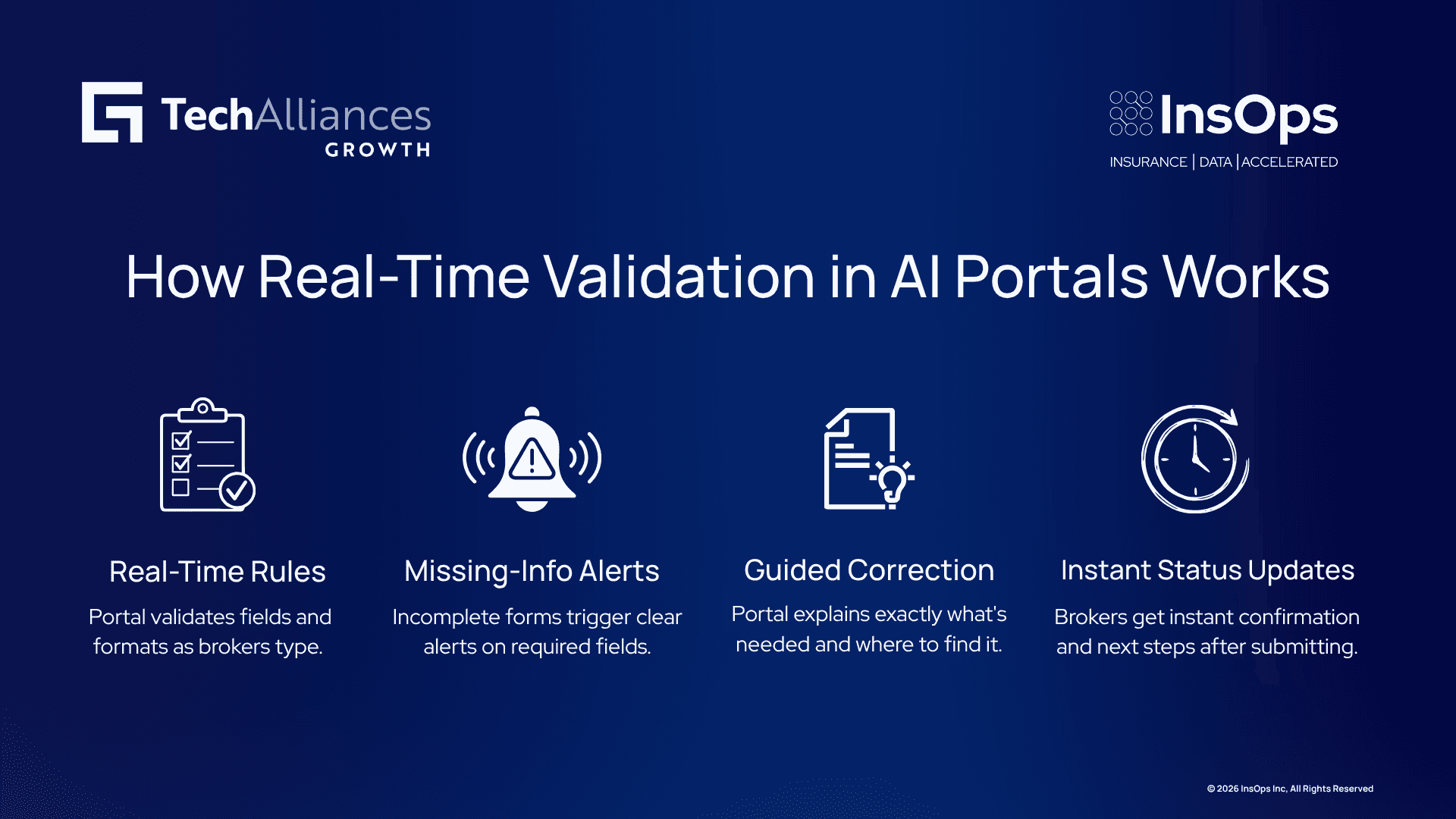
Instead of validating submissions after they're completed and uploaded, modern portals validate as brokers fill in fields. Required fields get marked. Data formats get checked (e.g., dates in MM/DD/YYYY format, phone numbers with area codes, TINs formatted correctly). Lookups validate that a ZIP code matches the state, or that a driver's license number is plausibly formatted.
This isn't complex. It's guardrails. Brokers appreciate it because they get immediate feedback. They fix errors in real time instead of discovering them in a rejection email hours later.
Missing-Information Alerts and Next Steps
When a broker tries to submit an incomplete form, the portal doesn't accept it. Instead, it shows a clear alert: "Required field: Annual payroll for primary location." The broker either provides the data or, in rare cases, provides a reason why it's not available. That reason becomes part of the submission record. Underwriting sees it immediately and doesn't have to wonder why payroll is blank.
Some portals go further and offer guided correction. If a broker is missing a payroll number, the portal might say: "We need total annual payroll for your primary location. This should be found on your payroll records or your accountant's summary. Upload or type the amount here." The guidance removes ambiguity about what information is actually needed.
Instant Status Updates for Brokers
After a broker submits, they see immediate confirmation of what was received and any issues that need attention. "Your submission has been received and is in validation. Status: Awaiting confirmation on Item 3 (Loss Run Dates). You should receive feedback within 1 business day." Brokers know exactly where their submission stands. They're not left wondering whether it got lost in an email inbox.
Human-in-the-Loop Validation: Why Automation Alone Isn't Enough
Validation systems that rely entirely on automation miss important context. A number might be correctly formatted and pass every structural check but still be implausible. A document might be complete but inconsistent with another part of the submission. These situations require judgment, not just rule-checking. This is why the strongest submission systems pair automation with human review at key decision points.
Why AI Needs a Person in the Room
Real-time validation at the portal catches structural data issues. It doesn't catch judgment calls. A broker submits a loss history with one year of claims totaling $50,000 and another year with $5,000. The portal validates that the format is correct and the numbers are plausibly large. But is $50,000 in losses reasonable for a business of this size? Does the decline in loss experience represent genuine risk improvement or statistical noise? Those questions require domain knowledge and context that a validation rule can't answer alone.
This is where human-in-the-loop review becomes essential. After data passes validation at the portal level, a person reviews submissions flagged for complexity, inconsistency, or high loss amounts. They can spot patterns that an automated system might miss and catch errors that structured validation rules can't detect.
How LiLa Assists with Data Validation
InsOps' insurance-trained AI, LiLa, assists with submission validation by understanding insurance domain logic and data relationships. When a broker submits a vehicle fleet schedule that lists 10 vehicles but the exposure summary states 12 vehicles, LiLa flags that inconsistency. When loss history shows a claim for "water damage" but the insured operates a manufacturing plant with no obvious water-exposure exposure, LiLa surfaces that as a question for the underwriter. LiLa doesn't make decisions. A person reviews every flagged item and decides whether it's a genuine inconsistency or a documentation gap that needs clarification.
LiLa runs inside your environment, so all data stays within your controlled infrastructure. PII and PHI never leave. The AI learns from your submissions, your underwriting rules, and your feedback, making validation more precise over time as it encounters more of your business.
Audit Trails and Compliance
As more states adopt AI governance frameworks (23 states and DC had adopted the NAIC Model Bulletin on AI by early 2026), carriers deploying automated intake need documented justification for every data decision. That means recording why a submission was flagged, what data triggered the flag, and what action was taken as a result. Human-in-the-loop validation creates that audit trail naturally. A person reviews, approves, or rejects a flag. That decision is logged. If a regulator asks why a submission was processed a certain way, you have a clear record showing that a person evaluated it.
Building Broker Trust Through Transparency
Broker satisfaction isn't just about speed. It's about clarity. Brokers want to know what's happening to their submissions, what's expected of them, and what comes next. Opacity breeds frustration. Transparency builds trust. A well-designed portal keeps brokers informed at every step, reduces unnecessary follow-up questions, and demonstrates that their work is being reviewed carefully and progressing on schedule.
Real-Time Visibility Into Submission Status
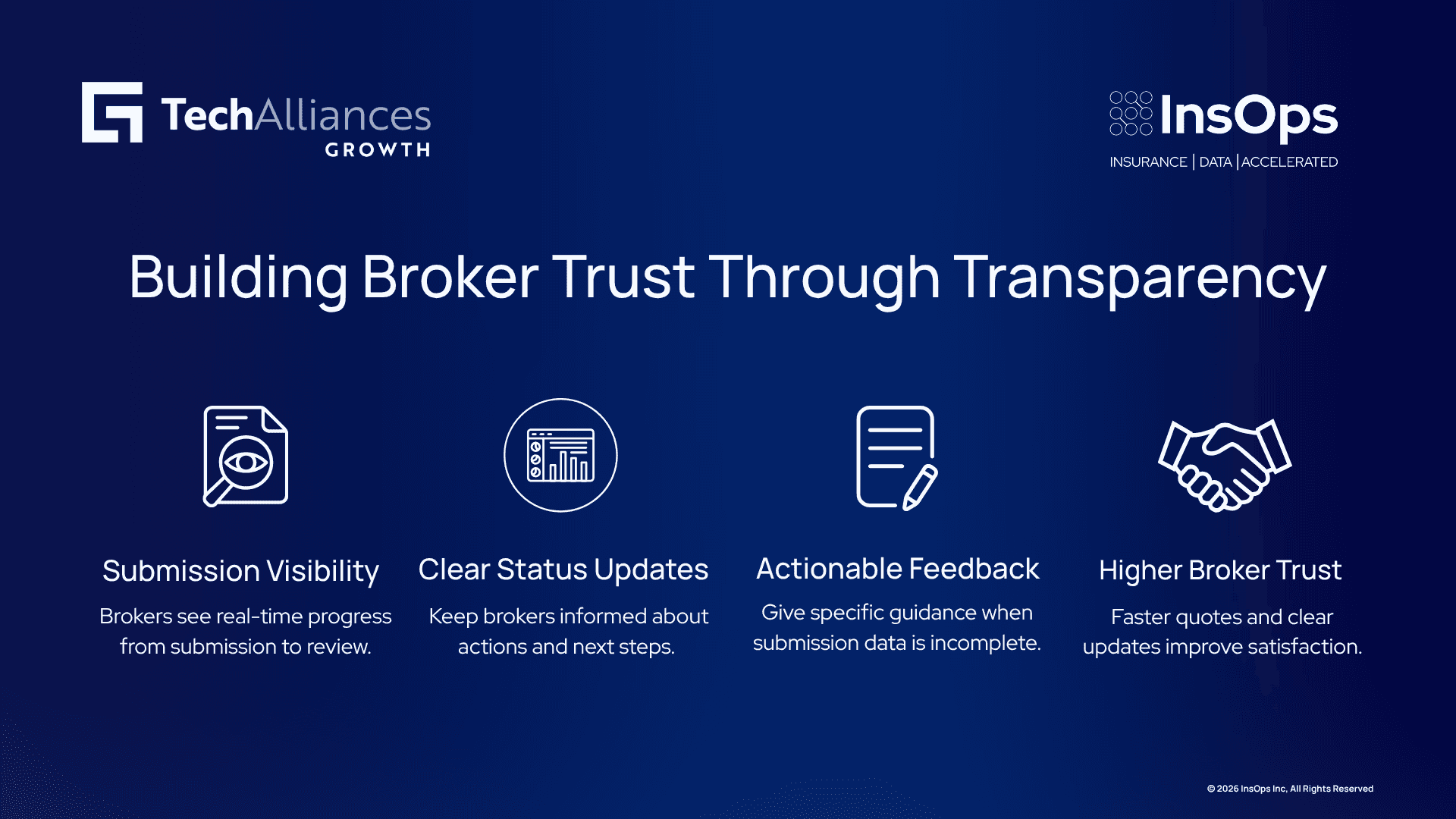
Brokers want to know what's happening to their submissions. Traditional carrier workflows leave brokers in the dark. They email a submission and wait. Days pass. They follow up. The underwriter responds: "Still reviewing." Brokers hate that. They have clients asking for updates and no information to give.
Broker portals with real-time status change that dynamic. A broker submits and immediately sees: "Submission received. Status: In validation (est. 1 business day)." If a data issue is found, the status updates: "Action required: Please confirm loss run dates." Once confirmed, it updates again: "Submission complete. Forwarded to underwriting (est. 2-3 business days for review)." Brokers and their clients see progress happening in real time. Uncertainty drops. Satisfaction rises.
Clear Feedback When Data Is Incomplete
When a submission is rejected or flagged as incomplete in a portal, the feedback has to be specific. Not "Please resubmit with complete information." Instead: "Your ACORD form is missing the business classification code. You can find this by contacting your state's insurance commissioner or using the NCCI classification lookup tool. Once you have the code, resubmit and we'll proceed immediately."
Specific, actionable feedback means brokers can fix problems without playing phone tag. They know exactly what to do and why it matters.
Broker Satisfaction Metrics
Carriers that implement real-time submission validation report measurable improvements in broker satisfaction. Quote-to-bind timelines compress because submissions are complete on first receipt. Broker follow-up emails drop because status is visible and feedback is specific. Broker Net Promoter Scores rise because the experience feels collaborative instead of adversarial.
How InsOps Helps
InsOps builds an insurance-trained AI that assists with submission data validation and mapping. When brokers submit to your portal, LiLa validates submissions against your required fields, checks for data inconsistencies, and flags items that need underwriter review. A person validates every significant finding before it proceeds. Our Integration Gateway connects directly to your Guidewire PolicyCenter, BillingCenter, UnderwritingCenter, and Quote Process systems, so validated submission data flows directly into your underwriting workflow without manual re-entry or custom engineering.
InsOps runs LiLa inside your own environment. PII and PHI never leave your controlled infrastructure. Unlike generic AI tools, LiLa understands insurance domain logic, data relationships, and regulatory frameworks (NAIC, HIPAA, GDPR), so validation is accurate and defensible.
If you're building or improving a broker submission portal and want real-time validation without custom AI development, contact us to talk through what this could look like for your operation.
Frequently Asked Questions
What percentage of broker submissions have errors on first receipt?
Research from Perceptive Analytics (2026) found that 58% of incoming submissions to a commercial lines carrier were missing at least one mandatory underwriting field on first receipt. Missing fields generated an average of 1.4 follow-up touchpoints per submission.
How long does real-time validation take?
Data validation happens as the broker completes the form, typically in milliseconds per field. The broker sees feedback instantly. If the data passes all validation rules, the entire submission can be validated and ready for underwriting in seconds.
Can AI validation catch all submission errors?
Real-time validation catches structural errors (missing fields, format issues, obvious inconsistencies). It doesn't replace human judgment. Complex questions about risk quality, loss severity, or business context require underwriter review. The best approach is validation at intake (catching obvious gaps) plus human-in-the-loop review (catching judgment calls).
What's the difference between a rule-based submission system and an AI-powered one?
Rule-based systems validate against pre-defined rules (dates in format MMDDYYYY, required fields marked required). AI-powered systems handle complexity and variation. They detect patterns across documents, spot data conflicts, and flag inconsistencies that a fixed rule can't catch. AI systems also learn from feedback, becoming more accurate over time as underwriters flag false positives or missed errors.
How do you ensure data is validated before it reaches underwriting?
Multi-layer validation. First, structural validation at the portal (required fields, format checks). Second, AI-assisted review flagging data conflicts and inconsistencies. Third, human-in-the-loop approval for any flagged submissions before they proceed to underwriting. Every step is logged for audit.
What happens if a broker can't provide a required field?
The broker has the option to note that the field is not applicable or provide a reason why it's not available. That notation becomes part of the submission record. Underwriting sees it immediately and doesn't have to guess whether the data is missing or not required.
How does this improve broker satisfaction?
Brokers see their submissions validated instantly. No waiting for rejection emails. No guessing what went wrong. Clear feedback means they can fix issues in real time. Real-time status visibility means they're never left wondering where their submission stands. The overall result is faster processing and a more collaborative experience with underwriting.
Is AI validation HIPAA and GDPR compliant?
Compliance depends on implementation. AI systems that process PII or health data must do so inside a controlled environment with documented governance. InsOps runs LiLa inside your environment, so all sensitive data stays under your control and your compliance framework applies. The AI doesn't send data to external cloud services. We document our validation logic and decision trails for regulatory review.