

Social inflation is reshaping casualty insurance. Liability claim costs driven by social inflation—litigation costs, changing jury attitudes, expanding awards—grew approximately 7% in 2024, the highest increase in two decades. Yet most carriers can't predict which claims will become disputes until it's too late.
When adjusters identify litigation-prone claims early (in the first 30-60 days) and act, they keep claims on track. The action is concrete: assign experienced staff, engage defense counsel sooner, or refine settlement strategy. The constraint is speed. Can you flag these claims fast enough to intervene?
This article covers how to spot litigation signals, why early action cuts costs, and how AI helps identify at-risk claims before disputes spiral.
What Litigation Risk Actually Means in Claims
Litigation risk is the probability that a claim will escalate into legal action. It's not about whether settlement will eventually happen, it's about whether the path becomes adversarial, involving plaintiff attorneys, discovery, depositions, and courtroom costs.
Why it matters: Rising jury awards and litigation costs continue to strain casualty reserves, particularly for excess casualty and umbrella liability. A litigated claim costs 3–5x more than one settled early. Defense counsel, expert witnesses, and trial prep add real expense. Longer cycles tie up adjuster time and capital.
The challenge is predictability. Not every claim with attorney involvement will litigate. Claims that look routine at FNOL can become expensive surprises weeks later. Carriers need visibility into risk early, when intervention options are still available.
Why Early Signals Matter
Risk concentrates in specific patterns. When an adjuster knows a claim has high litigation potential at FNOL, they can assign it to senior staff, engage defense counsel before discovery begins, schedule settlement meetings before demand anchors, and set appropriate reserves.
The later you act, the fewer options remain. Once an attorney is retained and discovery starts, claim dynamics shift. The window for quick resolution narrows. That's why carriers now focus on litigation risk identification as a foundational triage function, you act when you still can.
Key Signals That Predict Litigation Risk
Litigation risk isn't random. Specific claim characteristics, claimant situations, and external factors stack to predict whether a claim becomes a lawsuit.
Attorney Involvement and Demand Patterns
Attorney representation is the single strongest signal. Litigation propensity scoring for P&C claims is based on claim type, injury severity, venue, attorney involvement, policy limits, and historical outcomes.
Claims with retained plaintiff attorneys are significantly more likely to escalate. But timing matters: early notification (attorney retained at FNOL) and specific demand behavior predict litigation differently than late attorney entry or vague demand language.
Adjusters experienced in litigated claims learn to read demand signals. Anchor demands that are inflated relative to comparable settled claims, refusal to negotiate, or aggressive tone often precede litigation filing.
Injury Severity and Claimant Circumstances
Serious injuries carry higher litigation risk than minor ones. Permanent disability claims, multi-party injury, and significant medical treatment attract attorney representation. But severity alone isn't predictive, a severe injury with clear liability can settle faster than a minor one with disputed causation.
Jurisdiction matters equally. Claims in high-nuclear-verdict venues (California, Texas urban areas, certain Florida pockets) carry baseline litigation risk that differs from conservative jurisdictions. An adjuster in a plaintiff-friendly forum must start with higher assumed risk.
Claim History and Patterns
Adjusters with access to historical claims can spot patterns. Claims from the same policyholder with prior litigation, claims involving specific injury types known to litigate frequently, or claims where related prior matters settled only after discovery all signal elevated risk.
Claims that don't move in the first 30-60 days also matter. "Sleeper" claims that look minor at FNOL but surge in medical treatment, frequency of visits, or reserve adjustments after several weeks are red flags for underlying disputes about causation or liability.
How AI Detects Litigation Risk Patterns
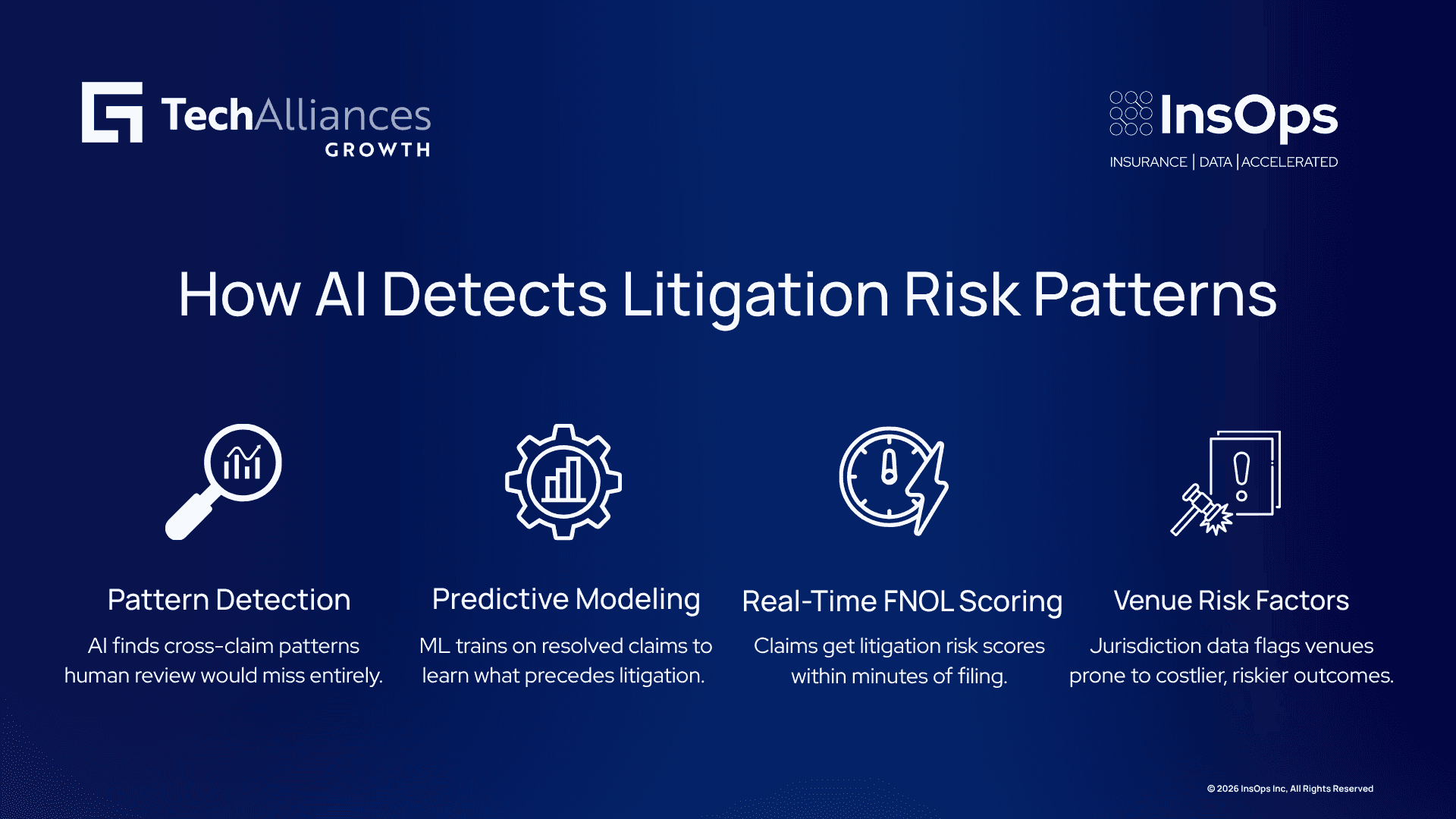
Humans can read individual claim indicators. AI can do something different: find patterns across thousands of claims that human review would miss, then score new incoming claims against those patterns in real time.
Building Predictive Models from Claims History
Litigation risk scoring uses machine learning trained on historical claims data. The model analyzes resolved claims: which litigated, which settled early, and what characteristics preceded each outcome.
It learns interactions humans would miss manually. In workers' comp, attorney involvement + occupational disease diagnosis + non-emergency treatment pattern might predict 72% litigation risk. Substitute emergency-room trauma for occupational disease, and the same attorney involvement drops risk to 44%.
These patterns emerge only when analyzing thousands of claims at once.
Real-Time Scoring at FNOL
Once trained, the model scores incoming claims automatically. Within minutes of FNOL entry, the system assigns a propensity score: "This claim has 68% estimated probability of litigation."
This shifts timing. Instead of discovering risk after 6 months of file development, adjusters see signals at FNOL, when the full intervention playbook is still available. High-scoring claims get routed to senior staff or flagged for early counsel engagement.
Jurisdiction and Venue Factors
AI models also incorporate jurisdictional data. Courts and jury pools in certain venues have track records for higher awards, stricter liability standards, or favorable treatment of specific injury types.
A model trained on claims data can detect these patterns: claims filed in Venue X settle 18% faster than identical claims in Venue Y, and when they do litigate, awards are 22% higher. New claims in Venue Y get flagged for more conservative reserve recommendations and earlier defense counsel engagement.
Early Intervention Strategies for High-Risk Claims
Identifying litigation risk is the first step. The second is acting on it.
Triage and Assignment Strategy
Once high-risk claims are identified, assignment changes. Instead of round-robin routing, senior adjusters get flagged files. They spot escalation patterns early and have experience with similar disputes.
This frees junior adjusters to handle routine claims and reserves the best resources for complex, expensive work.
Engaging Defense Counsel Earlier
Traditional practice is to engage counsel only when litigation appears imminent. High-risk scoring justifies earlier engagement: counsel review at 30-60 days—advising on liability positioning and reserve adequacy before the claim hardens—is far cheaper than bringing counsel in at 9 months.
Early review also catches gaps: missing statements, incomplete police reports, or unclear liability that, when corrected early, matter before the other side's investigation.
Targeting Settlement Negotiations
AI scoring also estimates settlement ranges. Historical data shows how similar claims—same injury, jurisdiction, policy limits, litigation history—have resolved. A model can estimate: "Claims matching this profile settle for $65K–$145K, median $95K."
Armed with historical ranges, adjusters and counsel anchor settlement discussions realistically, avoiding the wide gap between inflated demands and minimal offers that lengthens cycles.
The Role of Litigation Risk Scoring in Claims Operations
Litigation risk prediction isn't a standalone tool—it's a foundation for claims triage, assignment, and strategy across the entire organization.
Integration with Claims Management Workflows
Modern claims systems flag high-risk claims at entry. Assignment logic routes them to appropriate resources. Reserve recommendations adjust for higher-risk scores. Settlement authority escalates if needed. These workflows run automatically when litigation risk data is available.
The adjuster sees the score, explanation, and recommended next steps but still makes the decision with better information.
Continuous Learning and Recalibration
As claims resolve, outcome data flows back into the model. Did a claim predicted as 75% litigation risk actually litigate? The model learns from each outcome, improving future predictions. Monthly or quarterly recalibration ensures the model stays aligned with current market conditions and claim trends.
Measuring Impact: What Better Litigation Risk Prediction Delivers
Organizations that implement scoring and follow through on intervention typically see:
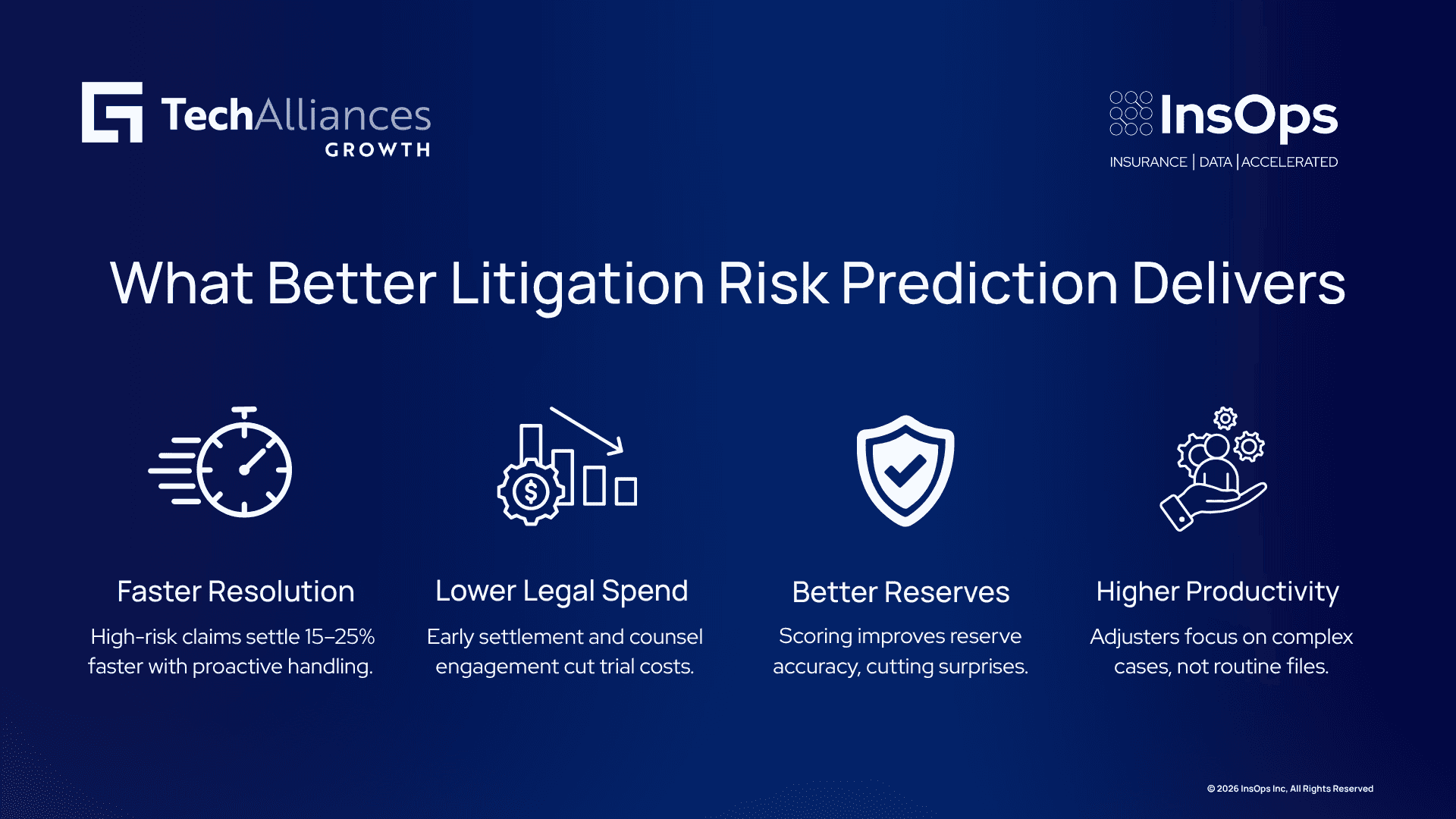
Faster resolution: High-risk claims settle 15–25% faster when addressed proactively.
Lower legal spend: Early settlement and better counsel engagement cut trial-related costs.
Better reserves: Scoring informs adequacy, reducing surprise strengthening.
Higher adjuster productivity: Experienced staff focus on genuinely complex cases, not routine files.
The net result is a shift from reactive management to proactive management built into intake and triage.
How InsOps Helps
InsOps builds an insurance-trained AI that assists with litigation risk prediction. LiLa, our insurance-trained AI model, analyzes claim characteristics including injury severity, attorney involvement, jurisdiction, and historical claims data to surface high-risk litigation candidates.
A person reviews and validates every risk assessment before it is finalized. LiLa runs inside your own environment, so claim data never leaves controlled infrastructure. This means your claims team can trust the predictions with confidence that sensitive information stays protected.
Our Integration Gateway connects directly to Guidewire ClaimCenter, so litigation risk scores flow into your existing claims workflow without custom engineering. Adjusters see the scoring right where they work, enabling faster triage and intervention decisions.
InsOps helps carriers modernize legacy systems or establish real-time data flows into Guidewire with AI-powered mapping and transformation. If you are evaluating how to surface litigation risk and trigger early intervention without manual review overhead, contact us to talk through what this could look like for your operation.
Frequently Asked Questions
How accurate are litigation risk predictions?
Predictive accuracy depends on the quality and volume of historical claims data used to train the model. Models trained on 10,000+ resolved claims typically achieve 70–85% accuracy in identifying high-risk claims at FNOL. Accuracy improves when the model is recalibrated quarterly as new outcomes arrive.
Do I need to replace my claims management system to use litigation risk scoring?
No. Litigation risk scoring can be bolted onto most modern claims systems via API integration. The scoring happens in a separate analytics platform, and results are passed back to your claims system for display and routing decisions.
What data does a litigation risk model need?
The model needs resolved claims data with outcomes (litigated yes/no), claim characteristics (injury type, attorney involvement, jurisdiction, reserves, settlement amount), and any available adjuster notes or assessment narratives. Most carriers have 5–15 years of claims data available.
Can litigation risk scoring help with reserve adequacy?
Yes. High-risk claims typically require higher reserves. By identifying litigation-prone claims early, you can set reserves more conservatively for those files, reducing surprise reserve strengthening later.
How does early intervention actually work?
Once a claim is flagged as high-risk, you assign it to a senior adjuster, engage defense counsel sooner, or schedule an early settlement conference with all parties. The goal is to move the claim toward resolution before attorney positioning hardens. Early settlement is typically 40–60% cheaper than litigated resolution.
What's the typical timeline for seeing ROI from litigation risk scoring?
Most carriers see measurable savings within 6–12 months. The model needs 3–4 months to be trained and integrated into your workflow, then 6–8 months of live operation for outcomes to accumulate and demonstrate impact.
Can AI replace human judgment in litigation decisions?
No. AI assists by surfacing patterns humans would miss. Adjusters and counsel still make final decisions. The model provides better information and risk context; it doesn't make the decision for you.