

Workers compensation claims with attorney involvement cost an average of $77,807. Unrepresented claims average $15,936. That gap, nearly four to one, is why litigation risk prediction matters. Most claims close without ever seeing a courtroom. The ones that do drive the majority of legal spend.
The problem is not managing litigation after it happens. It is spotting the claims most likely to escalate before attorney fees, expert witnesses, and discovery costs start climbing.
Why Do Some Insurance Claims End Up in Court When Most Don’t?
Most claims close without litigation. A small percentage drives the bulk of legal costs. The difference comes down to a handful of predictable factors.
Injury severity is the most visible signal. A soft-tissue claim with a short treatment window rarely litigates. A claim involving surgery, permanent impairment, or disputed causation is more likely to attract attorney representation. Claimant behavior matters too. A policyholder who disputes the initial valuation, requests multiple supplements, or switches providers mid-treatment is sending early warning signs.
Attorney involvement itself is a strong predictor. Once a claimant retains counsel, the claim’s trajectory changes. The same injury with an attorney costs substantially more than without one. Jurisdiction plays a role as well. Some venues see higher filing rates, larger awards, and longer cycle times. Coverage complexity adds another layer. Multi-party claims, ambiguous policy language, and overlapping limits all increase the chance of a dispute.
Adjusters with deep experience can spot these patterns. The challenge is scale. A senior adjuster handling hundreds of claims cannot give every file the same scrutiny. By the time red flags surface, the window for early intervention has often closed.
How Does AI Predict Which Insurance Claims Will End Up in Litigation?
Insurance-trained AI predicts litigation risk by analyzing case patterns and claim history to surface high-risk claims. It works the same way an experienced adjuster spots trouble signs, but across the entire portfolio at once.
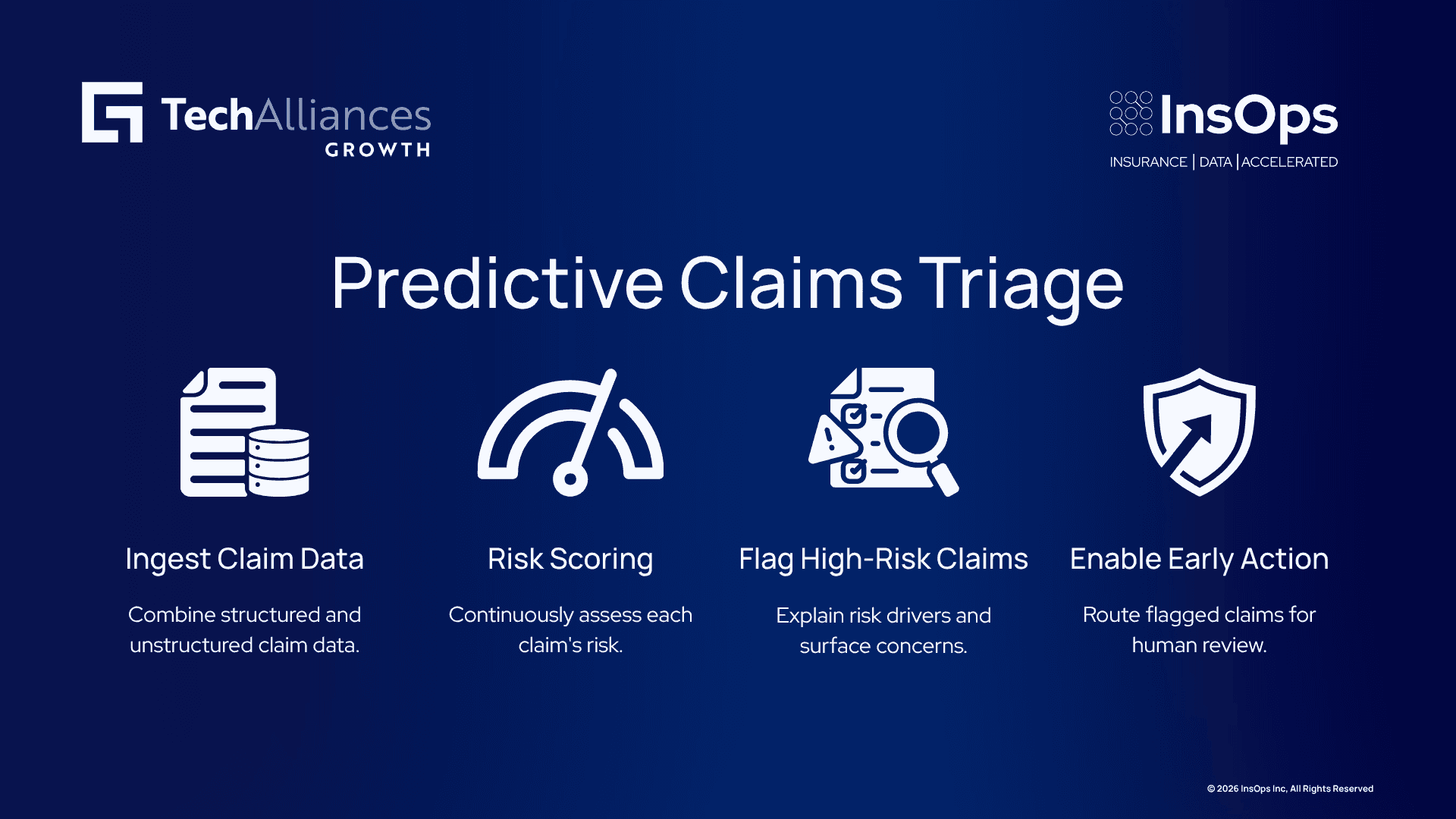
The process follows five steps.
Ingest. The system pulls structured data like policyholder profiles, claim history, injury type, and geography. It also reads unstructured data: adjuster notes, call transcripts, claimant narratives, and demand letters.
Score. Using litigation propensity modeling, the system computes a risk score at first notice of loss. The score updates continuously as new information arrives. A claim that looked routine on day one might score differently after a claimant switches attorneys or a new medical report surfaces.
Surface. The system flags high-risk claims with explainable risk drivers. An adjuster sees not just a score, but why the score changed. This might be a pattern of similar claims in the same jurisdiction, a claimant behavior signal, or a coverage complexity indicator.
Intervene. Flagged claims route to senior adjusters or legal specialists for proactive handling. Early settlement discussions, specialized negotiation, or reserve adjustments happen before attorney involvement hardens positions.
Learn. Outcomes feed back into the model. Closed claims inform future predictions. The system gets sharper over time without manual rule updates.
A human reviews every flagged claim before any action is taken. The AI surfaces candidates. The adjuster decides what to do with them.
What Data Predicts Whether an Insurance Claim Will Litigate?
Effective prediction draws from both structured and unstructured sources.
Structured data includes policyholder profiles, prior claim history, injury type and severity codes, coverage limits, deductible levels, and geographic jurisdiction. These fields are already in the claim system. They just need to be read in context rather than in isolation.
Unstructured data is where the richer signals live. Adjuster notes capture tone, rapport, and claimant behavior. Call transcripts reveal how a claimant describes their injuries and expectations. Demand letters show settlement posture. Medical narratives document treatment patterns and disputed causation.
The combination matters. A claim with high injury severity but cooperative claimant behavior might score lower than a moderate injury with an adversarial claimant and prior claims history. The model reads both signals together rather than relying on any single trigger.
How Expensive Is It When an Insurance Claim Goes to Litigation?
Workers compensation claims with attorney involvement cost an average of $77,807, compared to $15,936 for unrepresented claims. That is not just legal fees. Litigated claims run longer, require more adjuster touch, tie up reserves, and frustrate policyholders.
The broader picture is equally stark. Ernst & Young reports that for P&C insurers, leakage tied to litigated claims can represent 7 to 14 percent of total carrier spend. That is a significant drag on profitability for a relatively small slice of the portfolio.
Social inflation is compounding the problem. Nuclear verdicts, awards exceeding $10 million, reached a 15-year high in 2023. Marathon Strategies tracked 89 such verdicts totaling $14.5 billion that year. The average trucking litigation award hit $27.5 million, according to the U.S. Chamber of Commerce Institute for Legal Reform. These numbers affect reserving, pricing, and carrier appetite for certain lines.
How Can Insurers Prevent Claims From Becoming Lawsuits?
The shift from reactive to proactive means flagging high-risk claims at first notice of loss and routing them to specialists before attorney involvement, rather than waiting for red flags to appear weeks later.
Early intervention takes several forms. Proactive settlement discussions with high-risk claims can close files before positions harden. Specialized adjuster assignment puts experienced handlers on complex claims from the start. Reserve accuracy improves when litigation risk is visible early rather than adjusted after a suit is filed.
Timing matters. Once a claimant retains an attorney, the dynamic changes. Settlement ranges widen, cycle times lengthen, and policyholder satisfaction drops. The goal is to reach the right outcome before that threshold.
How InsOps Helps
InsOps reduces litigation risk by analyzing case patterns and claim history to surface high-risk claims. Our insurance-trained AI, LiLa, reads the same files an adjuster would read, but across the entire portfolio, and flags the claims that need attention before costs escalate.
Contact us to talk through what early litigation risk prediction could look like for your operation.
FAQ
Why do insurance claims take so long to process?
Litigated claims extend timelines significantly. Discovery, depositions, and court scheduling add months or years to a file that might have closed in weeks. Even before litigation, incomplete files, multiple document sources, and manual reconciliation slow the process.
What is litigation risk scoring in insurance and how does it work?
Litigation risk scoring uses historical claim patterns to predict the likelihood that a specific claim will end in litigation. The model evaluates structured data like injury type and jurisdiction alongside unstructured data like adjuster notes and claimant communications. It produces a risk score that updates as new information arrives, allowing adjusters to intervene early.
How can insurers reduce litigation costs?
The most effective approach is predicting which claims will escalate and intervening before attorney involvement. Early settlement discussions, specialized adjuster assignment, and accurate initial reserves all help. Once a claim is in litigation, costs are largely determined by external factors like jurisdiction, opposing counsel, and court scheduling.
What are nuclear verdicts and why are they getting bigger?
Nuclear verdicts are jury awards exceeding $10 million. In 2023, 89 such verdicts totaled $14.5 billion, the highest count in 15 years. Social inflation, driven by third-party litigation funding, reptile theory tactics in court, and changing jury attitudes, is pushing these awards higher. The average trucking litigation award reached $27.5 million.
How can I use AI to prevent claims from becoming lawsuits without replacing my adjusters?
AI-assisted litigation risk prediction does not replace adjusters. It surfaces candidates for review so adjusters can focus their expertise on the claims that matter most. The adjuster still decides on settlement strategy, reserve levels, and whether to engage counsel. The AI handles the portfolio-wide scanning that would be impossible to do manually.