

Your claims handler opens a policy record to check coverage limits. The data lives in the policy administration system. They switch to the claims system to log the loss details. Then they open a third screen, the billing system, to confirm the premium status. The same customer name, policy number, and address get typed three separate times. No single screen shows the full picture.
This is not an IT abstraction. It is the daily reality at most P&C carriers. Policy data, claims history, and billing records sit in systems that were built decades apart, on different technology stacks, with no native way to talk to each other. Teams re-key data by hand. Reports run on stale snapshots. Underwriters make decisions without seeing the claims history on the same risk.
The fix is not always a full system replacement. Most carriers cannot afford the timeline, the budget, or the operational risk of ripping out a core system that holds 20 years of regulatory filing logic and in-force policies. There are two independent paths to break these silos. One is a one-time migration for systems you are retiring. The other is an ongoing, real-time integration for systems that must stay live. These are separate decisions, not steps in a single journey.
What Are Data Silos in P&C Insurance, Really?
In P&C insurance, a data silo is not a storage problem. It is an operational problem. Your claims system holds the loss details. Your policy system holds the coverage terms. Your billing system holds the payment history. No single person can see all three without logging into three separate applications.
The root cause is usually historical. The policy system was built in the 1990s. The claims system was added in the 2000s. The billing module came from an acquisition in 2010. Each system was designed to do one job well. None were designed to share data with the others. Over time, carriers added point-to-point integrations, nightly batch files, and manual workarounds to paper over the gaps. The result is a web of connections that nobody fully documents and that breaks whenever any one system changes.
The cost shows up in daily friction. A claims adjuster spends time hunting for policy endorsements in a separate system. A billing clerk re-enters payment data into the general ledger by hand. An underwriter prices a renewal without seeing the claims that happened mid-term. Each instance is small. Across thousands of transactions per week, the drag is material.
Why Most P&C Carriers Cannot Just Rip Out Their Legacy Systems
Full replacement sounds clean. Buy a modern platform, migrate the data, turn off the old system. In practice, this path fails more often than it succeeds for mid-to-large P&C carriers.
Four barriers make replacement unrealistic for most carriers.
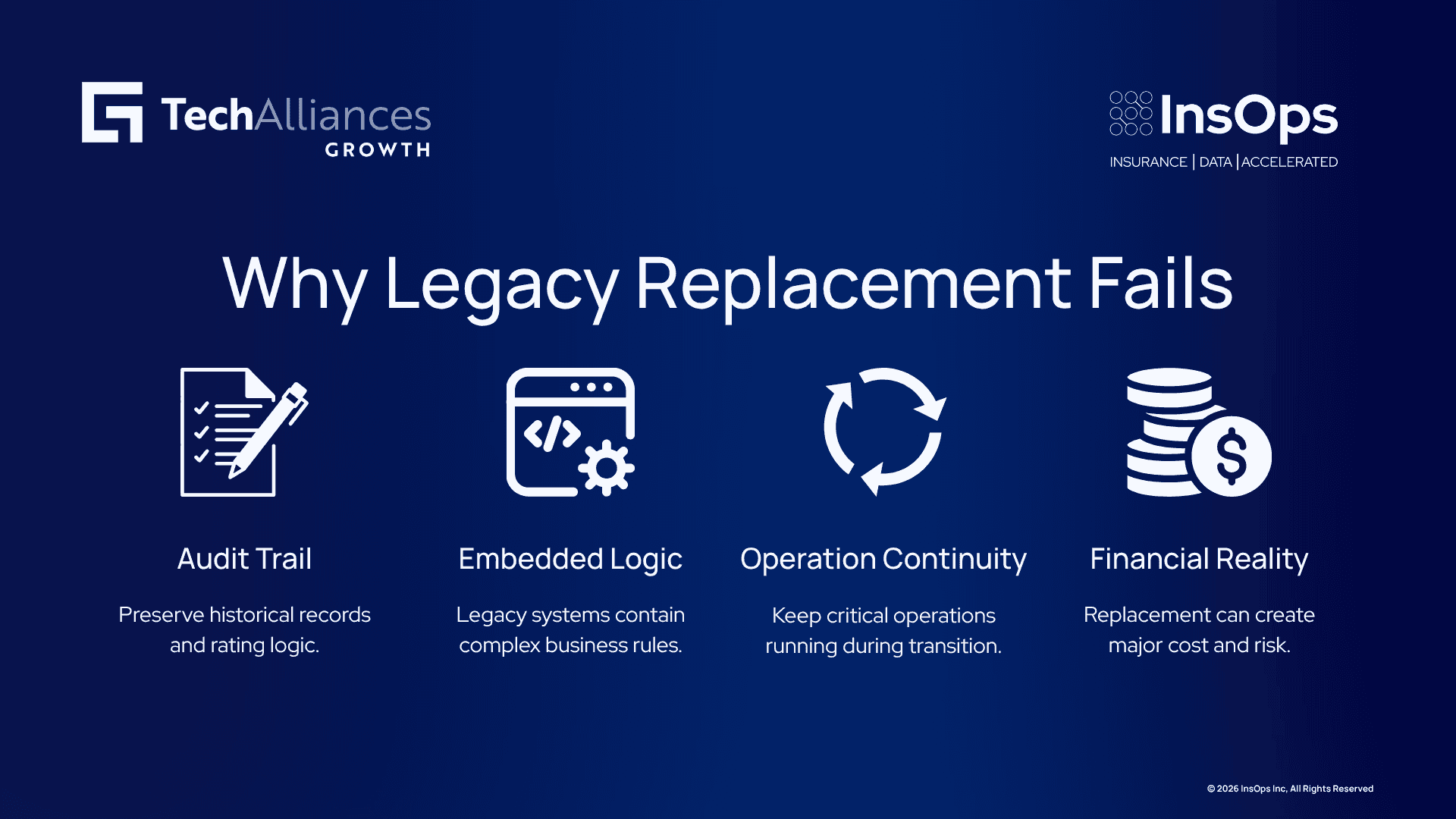
First, the regulatory audit trail. State Departments of Insurance require complete, time-stamped records of every rating change, every endorsement, every claims decision. A policy calculated three years ago must be reproducible today, with the rules that were in effect then. Migrating this history without corruption is not a data transfer problem. It is a compliance archaeology problem.
Second, embedded business logic. Decades of state-specific rating rules, bureau rate deviations, and underwriting exceptions are encoded in the legacy system, often without documentation. The engineers who wrote this logic have retired. Replicating it in a new platform means reverse-engineering decisions that were made 15 years ago and approved by regulators at the time.
Third, operational continuity. A retailer can close for a weekend to cut over to a new system. A P&C carrier in hurricane season cannot. Claims handlers, underwriters, and agents must keep working through any transition. A failed cutover that drifts into Monday morning creates a regulatory paper trail and a customer service crisis.
Fourth, the financial reality. Industry estimates suggest that the majority of insurance IT budgets go to maintaining legacy systems. That spend is locked in by regulatory requirements, policy data continuity, and operational workflows that depend on the legacy system being available around the clock. A carrier that assumes the legacy system can be turned off in 12 months is signing up for a project that will likely fail well before the planned cutover.
The evidence is not theoretical. Boston Consulting Group has documented cases where replacement programs ran for eight years and produced write-offs exceeding $500 million. Other programs completed 500 percent over budget because the new platform could not replicate the embedded logic the legacy system contained. Both systems kept running simultaneously. The carrier absorbed the cost of two platforms while neither fully served the book of business.
The Two-Lane Strategy: Migration and Integration Are Separate Decisions
A P&C insurer facing fragmented data has two independent paths, not a single journey.
Lane 1: Migrate. This is a one-time move of historical policy and claims records from a retiring system into a modern platform. The source system is decommissioned after the move. The work is batch-oriented, project-based, and finite.
Lane 2: Integrate. This is an ongoing, real-time connection between systems that both stay live. Data flows continuously from the legacy system into the modern platform through connectors and APIs. Both systems remain operational.
The lanes never merge into one another. A carrier can run Lane 1, Lane 2, both, or neither, depending on which systems are retiring and which must stay live. Choosing one does not commit you to the other.
Lane 1: Migrate | Lane 2: Integrate | |
Timing | One-time, project-based | Ongoing, continuous |
Data direction | Historical records, bulk transfer | Real-time payloads, event-driven |
Source system fate | Retired after cutover | Stays live indefinitely |
Human review step | Validation of field mappings before cutover | Validation of payload mappings before deployment |
Typical trigger | End-of-life vendor announcement, merger, platform consolidation | Need for unified view without disrupting live operations |
InsOps product | GenGrate | Integration Gateway |
Understanding which lane you need is the first decision. Everything else, vendor selection, timeline, budget, follows from that choice.
When to Choose Migration (and What It Actually Involves)
Choose migration when the source system is being retired. The vendor ended support. The hardware is past end-of-life. The carrier merged with another and must consolidate onto a single platform. In these cases, the data must move because the system that holds it will disappear.
Migration is broader than moving files. It includes data quality remediation, schema transformation, parallel operation during cutover, and sign-off against regulatory retention rules. A policy is not a single row in a database. It is a temporal entity with quote, application, in-force, endorsement, cancellation, reinstatement, renewal, and claim states, each with its own audit trail. Generic enterprise data migration software treats this as one table with a state column. That model breaks under endorsement chains and retroactive corrections.
The timeline is not short. For mid-to-large carriers, expect a multi-year program end-to-end, depending on approach. Big bang programs that move everything in a single cutover often slip when unexpected data quality issues surface. Phased programs that migrate line by line run longer but carry less operational risk. Strangler fig programs, where new capabilities run alongside the legacy and gradually take over, are the architect-preferred default for large carriers with deep legacy cores.
The risk is well-documented. Large-scale data migration projects across industries frequently exceed budget and timeline. For insurance, the risk is higher because of regulatory complexity, ACORD standards, and 7-to-10-year data retention requirements.
The mitigation is discipline. A 90-day pre-migration readiness phase is where most success or failure is decided. This means building a complete data dictionary, profiling source data for quality issues, naming a business owner for every major data domain, selecting a cutover window that avoids CAT season, writing a tested rollback plan, and defining numerical success criteria that the COO signs off on.
When to Choose Integration (and How It Keeps Data Flowing in Real Time)
Choose integration when the source system must stay live. The policy administration system is stable and compliant, but underwriters need claims history visible at the point of quote. The billing system is accurate, but finance needs real-time premium data in the reporting warehouse. The legacy system is not the problem. The problem is that the data it holds cannot reach the people who need it.
Integration connects systems through pre-built connectors that speak the language of insurance. ACORD XML and AL3 formats are the standard data interchange contracts in U.S. P&C. Every legacy system implements ACORD slightly differently. A field that is mandatory in one carrier's instance is optional in another. Mapping ACORD to ACORD is not a copy operation. It requires understanding the insurance domain logic, the data relationships, and the regulatory requirements that govern each field.
The modern preferred pattern is an API gateway with contract-first design. New systems publish APIs with explicit contracts. Legacy systems get wrapped in adapters that expose the same API surface. The gateway handles authentication, rate limiting, and routing. This replaces the older enterprise service bus approach that dominated insurance integration through the 2000s and 2010s but created middleware lock-in.
For P&C carriers specifically, integration must handle four characteristics that generic enterprise integration misses. Regulatory continuity means every transaction must be auditable for the retention period. ACORD standards mean the integration must speak insurance data formats natively. Multi-system policy lifecycle means a single policy touches the PAS, the underwriting workbench, the claims system, and the billing system, and the integration must keep all of them coherent. State-by-state variation means each jurisdiction has slightly different data requirements that the integration must respect without forcing the carrier to maintain 50 different pipelines.
Can You Run Both Lanes at Once?
Yes. A carrier can migrate one retiring system while integrating another live system. The two programs are independent.
For example, a carrier might migrate historical claims data from a retiring legacy claims system into Guidewire ClaimCenter using a one-time migration. At the same time, it might integrate its live policy administration system with Guidewire PolicyCenter through real-time connectors so underwriters see current coverage data without re-keying. The migration project has its own timeline, its own validation gates, and its own cutover date. The integration project has its own connectors, its own mapping rules, and its own deployment schedule. Neither project waits for the other.
What you cannot do is treat migration as Phase 1 and integration as Phase 2 of the same program. Migration is for retiring systems. Integration is for live systems. A system that is being migrated will eventually go dark. A system that is being integrated must stay available. The architecture, the staffing, and the risk profile are different.
How InsOps Helps
InsOps migrates legacy data into Guidewire and keeps it flowing in real time. The distinction matters because the two jobs require different tools, different timelines, and different validation steps.
GenGrate is the migration workbench for Lane 1. It assists with mapping historical policy and claims data from retiring legacy systems into Guidewire structures. A person reviews and validates every field mapping before cutover. The insurance-trained AI understands ACORD standards, policy lifecycle states, and regulatory retention requirements, so the mapping is not starting from scratch.
Integration Gateway is the real-time connector set for Lane 2. It provides pre-built connectors for Guidewire PolicyCenter, ClaimCenter, BillingCenter, UnderwritingCenter, PricingCenter, and Quoting Services. The insurance-trained AI auto-maps and transforms payloads from any source into Guidewire structures. A person reviews and validates every mapping before deployment. Both the source system and Guidewire stay live.
Both products run inside the insurer's own environment. PII and PHI never leave controlled infrastructure. The AI understands insurance domain logic, data relationships, and regulatory requirements, including NAIC, HIPAA, and GDPR. It is not a generic model trained on the open internet.
GenAnonymize handles PII and PHI masking during either lane. If migration or integration involves moving sensitive data through a staging environment or a testing pipeline, the Data Privacy wrapper anonymizes it before it leaves the secure perimeter.
A human reviews every output before it goes live. That is not a caveat. It is how the system is designed.
FAQ
Why do insurance companies still use legacy systems?
Legacy systems persist because replacement is complex and risky. They hold decades of regulatory filing logic, state-specific rating rules, and in-force policies that must remain auditable. The engineers who built them are retiring, and the knowledge of how they work often exists only in their heads. Full replacement programs have documented failure rates and cost overruns that make leadership cautious.
What's the difference between data migration and data integration in insurance?
Data migration is a one-time move of historical records from a retiring system to a new one. The source system is decommissioned after cutover. Data integration is an ongoing, real-time connection between systems that both stay live. Data flows continuously through connectors and APIs. These are independent use cases, not phases of the same project.
How long does an insurance data migration project typically take?
For mid-to-large carriers, expect a multi-year program end-to-end. Big bang programs that move everything in a single cutover often slip when unexpected issues surface. Phased programs that migrate line by line run longer but carry less risk. Strangler fig programs, where new capabilities gradually replace the legacy, are the architect-preferred default for large carriers with deep legacy cores. Add 90 days of pre-migration readiness on the front end.
Can you migrate during CAT season?
For P&C carriers, no. Major cutover windows during June through November create unacceptable compounding risk. Hurricane, wildfire, or severe convective storm events during a cutover create a crisis the COO cannot accept. Plan cutovers for late February through late May, or December into January.
Do I need to replace my legacy system to use Guidewire?
No. You can connect legacy systems to Guidewire through real-time integration without replacing the source system. Pre-built connectors map data from the legacy system into Guidewire structures. Both systems stay live. Replacement is a separate decision that depends on whether the legacy system is end-of-life or whether its maintenance cost exceeds the replacement cost over a five-year horizon.
Can AI help map our legacy data fields to a new system without us doing it manually?
An insurance-trained AI can assist with mapping data fields from any source system into Guidewire structures. It understands ACORD standards, policy lifecycle states, and regulatory requirements. A person reviews and validates every mapping before cutover or deployment. The AI does not map autonomously. It drafts the mapping, and a human confirms it.