

Most P&C core systems were built for a world where change happened once a year, at renewal. That world is gone. Carriers now need to launch products faster, connect to more distribution partners, and respond to real-time data, and monolithic, tightly coupled architectures simply can't keep pace.
The shift underway isn't a single upgrade. It's a structural move toward composable, API-first, cloud-native architecture, built on reusable services and event-driven integration. For CTOs, this is the difference between an IT organization that supports the business and one that constrains it.
The Problem With Monolithic Core Systems
Traditional insurance architecture bundles policy, claims, billing, and underwriting logic into tightly interdependent systems. That design made sense when systems changed rarely. It creates real constraints now:
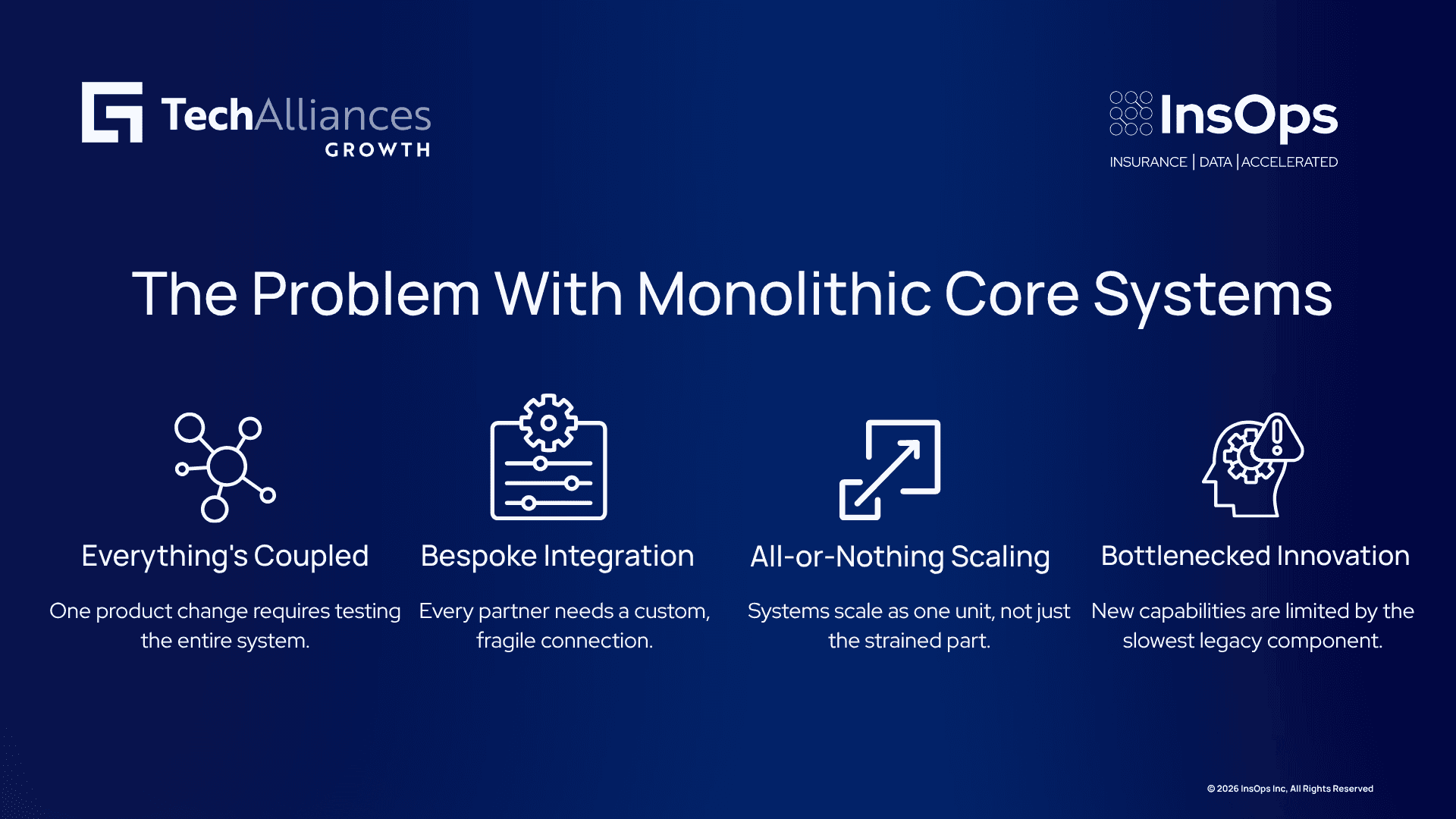
Every change touches everything. A single product update or rating change can require testing across the entire system, because logic isn't isolated into independent services.
Integration is bespoke, every time. Without APIs built for real-time exchange, each new partner, vendor, or distribution channel means another custom, point-to-point connection, and another thing that breaks when an upstream system changes.
Scaling is all-or-nothing. Monolithic systems scale as a single unit. A spike in claims volume during a catastrophe event, or growth in a specific line of business, can't be handled by scaling just the piece under pressure.
Innovation moves at the speed of the slowest component. New capabilities, AI-driven underwriting, real-time claims triage, dynamic pricing, get bottlenecked by the parts of the stack that can't be touched without risking the whole system.
What Composable, API-First Architecture Actually Means
Composable architecture breaks core insurance functions into independent, reusable services that communicate through APIs and events instead of being hardwired together. In practice, this looks like:

Modular services for discrete functions (rating, underwriting rules, claims triage) that can be updated, replaced, or scaled independently
API-first design, where every service exposes standard interfaces from the start, rather than integration being retrofitted after the fact
Event-driven integration, where systems react to data changes in real time (a new claim, a policy update, a payment) instead of relying on scheduled batch jobs
Cloud-native infrastructure that scales resources based on actual demand rather than fixed, worst-case capacity planning
The advantage isn't just technical elegance. It's speed. Composable architecture lets carriers launch new products, connect new partners, and adopt new capabilities without a multi-year re-platforming project every time something needs to change.
Why This Matters More Now Than It Did Five Years Ago
Three shifts are driving urgency here:
Distribution is more complex. MGAs, brokers, TPAs, and surplus lines operators all expect real-time data exchange, not batch files delivered overnight.
AI needs live, structured data. AI and analytics initiatives depend on systems that can expose clean data in real time. Batch-oriented, tightly coupled architecture can't support that, no matter how good the underlying model is.
Core system migrations are already underway industry-wide. Carriers moving to modern platforms like Guidewire have a narrow window to build API-first, event-driven integration in from the start, rather than bolting it onto a new system the same way it was bolted onto the old one.
The carriers building composable architecture now aren't just solving today's integration problems. They're avoiding a repeat of the same rigid, hard-to-change systems on a newer platform.
How InsOps Helps
InsOps is built to make API-first, event-driven integration achievable without a from-scratch integration build for every core system and partner.
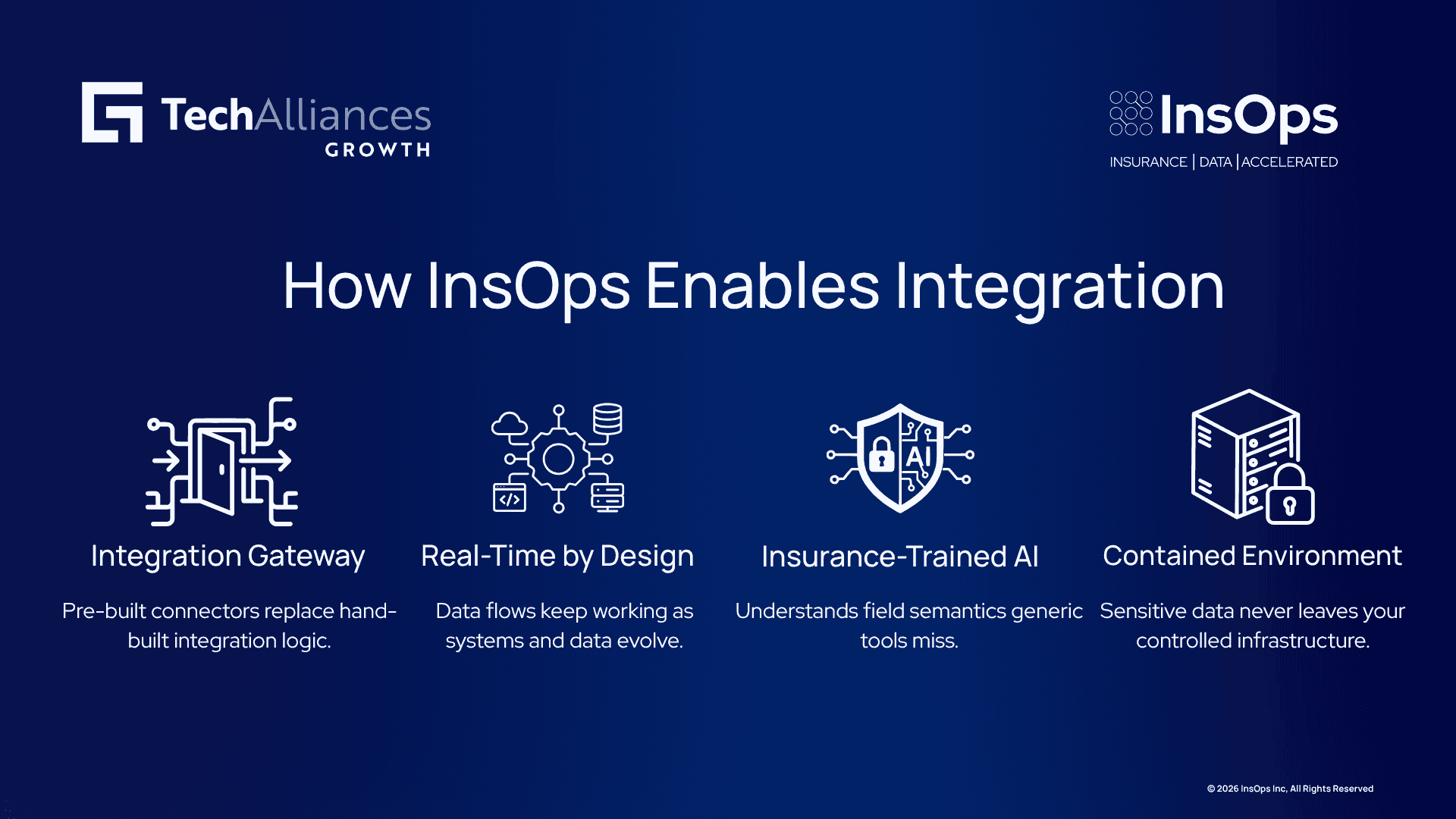
Integration Gateway. Pre-built connectors for Guidewire PolicyCenter, ClaimCenter, BillingCenter, UnderwritingCenter, and PricingCenter mean carriers don't have to hand-build integration logic for each core module. Our insurance-trained AI model automatically maps data payloads between systems, with human review at every step, enabling real-time data flow instead of batch-based exchange.
Built for real-time, not just migration. InsOps establishes real-time data flows into Guidewire with AI-powered mapping and transformation, so integration keeps working as systems and data evolve, not just at the point of initial connection.
Insurance-trained data understanding. Generic integration tools don't understand insurance-specific field semantics or data interdependencies across policy, claims, and underwriting. InsOps's model is trained specifically on insurance domain logic and regulatory frameworks like NAIC, HIPAA, and GDPR, which matters when data is moving between systems in real time and errors compound quickly.
Runs inside your environment. Because InsOps operates inside the carrier's own controlled infrastructure, sensitive data never has to leave for mapping or transformation, an important consideration as event-driven architecture increases the volume and speed of data movement.
For CTOs building toward composable architecture, InsOps removes one of the biggest bottlenecks: the manual, custom integration work that otherwise has to be repeated for every core system and every partner connection.
FAQ
What does "composable architecture" mean in insurance IT specifically? It means breaking core insurance functions, like rating, underwriting rules, and claims triage, into independent services that can be updated, scaled, or replaced without affecting the rest of the system. Services communicate through APIs and events rather than being hardwired together.
Why is event-driven integration better than batch processing for insurance data? Event-driven integration reacts to data changes (a new claim, a policy update) as they happen, rather than waiting for a scheduled batch job. This matters for use cases like real-time claims triage or dynamic pricing, where waiting for the next batch cycle creates delays the business can't absorb.
Is API-first architecture only relevant for carriers migrating to a new core system? No. While core system migrations are a natural point to build API-first architecture in from the start, carriers can also expose existing core systems through APIs and event-driven integration without a full replacement, particularly for connecting to distribution partners or enabling real-time data exchange.
How does composable architecture affect AI initiatives? AI and analytics tools need structured, real-time data to function well. Composable, API-first architecture makes that data accessible as it's created, rather than requiring AI initiatives to wait on batch exports or manual data pulls.
Does moving to composable architecture require replacing core systems like Guidewire? No. Composable architecture is about how systems integrate and exchange data, not necessarily replacing the underlying core system. Carriers can build API-first, event-driven integration into and around existing core platforms.
What's the biggest obstacle carriers face when adopting API-first integration? Building and maintaining custom, point-to-point integrations for every core system and partner connection. Each one is built manually, and each one breaks independently when an upstream system changes, which is why pre-built, maintained connectors reduce both the initial effort and the ongoing maintenance burden.