

Every CTO in P&C insurance is competing for the same shrinking pool of talent, engineers who understand both modern software architecture and decades-old insurance systems. That combination is rare, and it's getting rarer as experienced legacy system experts retire and modern developers show little interest in learning COBOL or AS/400.
Hiring alone won't close this gap. The carriers managing the talent shortage effectively are treating it as a tooling and process problem as much as a recruiting problem, investing in upskilling, AI-assisted development, strategic partnerships, and reusable frameworks that reduce how much specialized talent each project actually requires.
Why Insurance Has a Uniquely Hard Talent Problem
The talent shortage isn't generic. It has specific characteristics in P&C insurance:
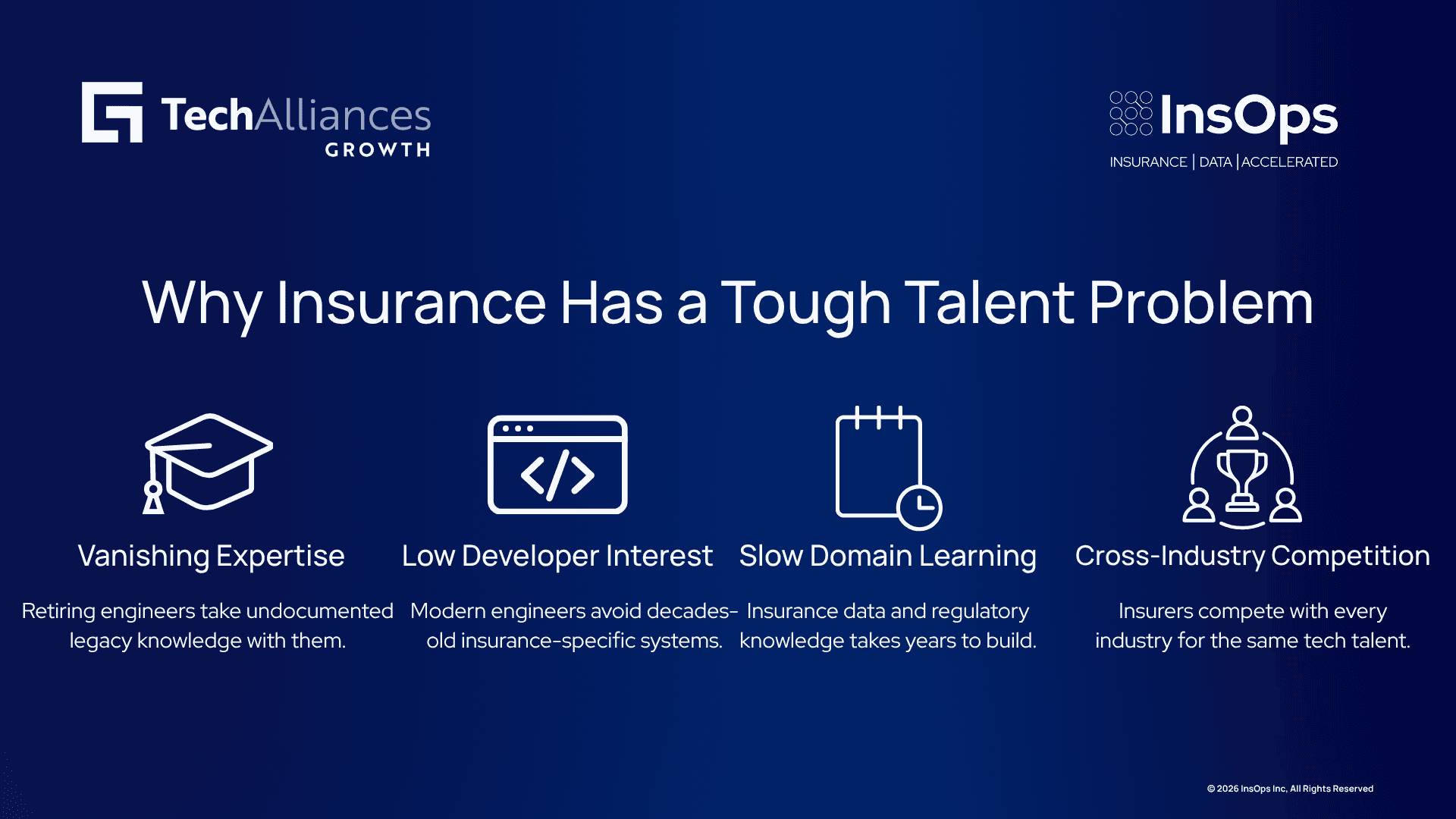
Legacy expertise is disappearing. The engineers who understand why a given AS/400 field or COBOL routine works the way it does are retiring, often without documenting the business logic they carry in their heads.
Modern developers don't want legacy systems. Engineers trained on cloud-native, API-first development have little incentive to build expertise in decades-old insurance-specific systems, making it hard to backfill retiring talent with equivalent experience.
Domain knowledge takes years to build. Understanding insurance data relationships, regulatory frameworks like NAIC, HIPAA, and GDPR, and how policy, claims, and underwriting data interact isn't something a generalist developer picks up in a few months.
Competing for the same talent as every other industry. Insurance carriers aren't just competing with other insurers for engineering talent. They're competing with every industry investing in cloud and AI, most of which offer more modern tech stacks as a selling point.
The result: even carriers with adequate budgets often can't fill the roles they need, or end up with teams stretched across too many legacy systems with too little institutional knowledge.
Where CTOs Can Actually Move the Needle
Four levers matter more than headcount alone:
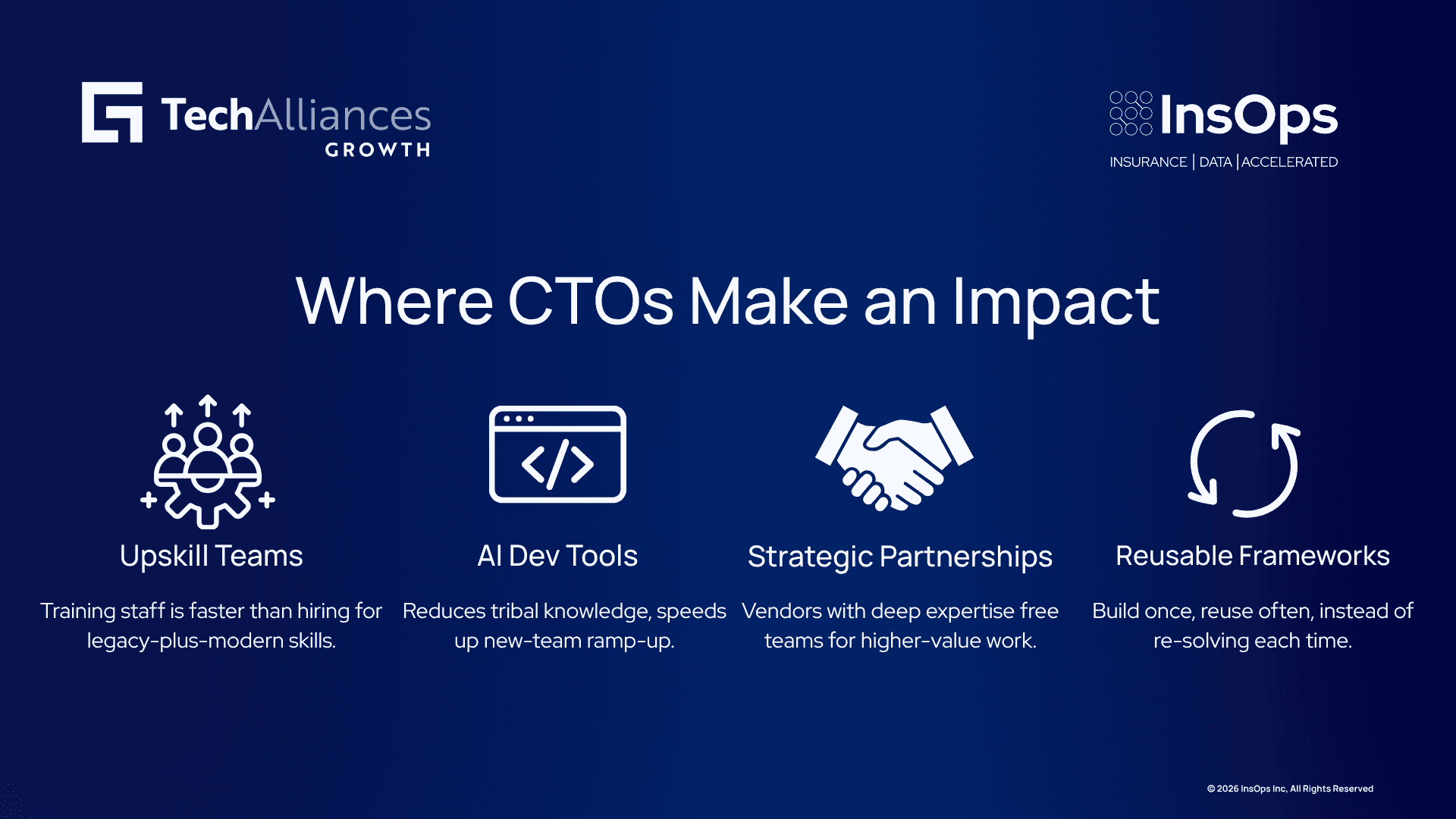
Upskilling existing teams. Training current staff on modern architecture and AI-assisted tools is often faster and more reliable than hiring externally for hard-to-fill legacy-plus-modern skill combinations.
AI-assisted development tools. Tools that help developers understand, document, and modernize legacy code reduce how much tribal knowledge has to live in one person's head, and shorten the ramp-up time for new team members.
Strategic technology partnerships. Rather than building every capability in-house, partnering with vendors who bring deep insurance-specific expertise lets internal teams focus on the work that actually requires their institutional knowledge.
Reusable development frameworks. Building once and reusing across projects, rather than re-solving the same integration or migration problem for every initiative, multiplies the output of a limited team instead of requiring it to grow linearly with project count.
The through-line across all four: reduce how much specialized insurance-and-legacy expertise each individual project consumes, so the talent you have goes further.
How InsOps Helps
InsOps is designed to reduce the specialized talent burden of legacy modernization and integration work, rather than requiring carriers to staff up with rare legacy-systems expertise for every project.
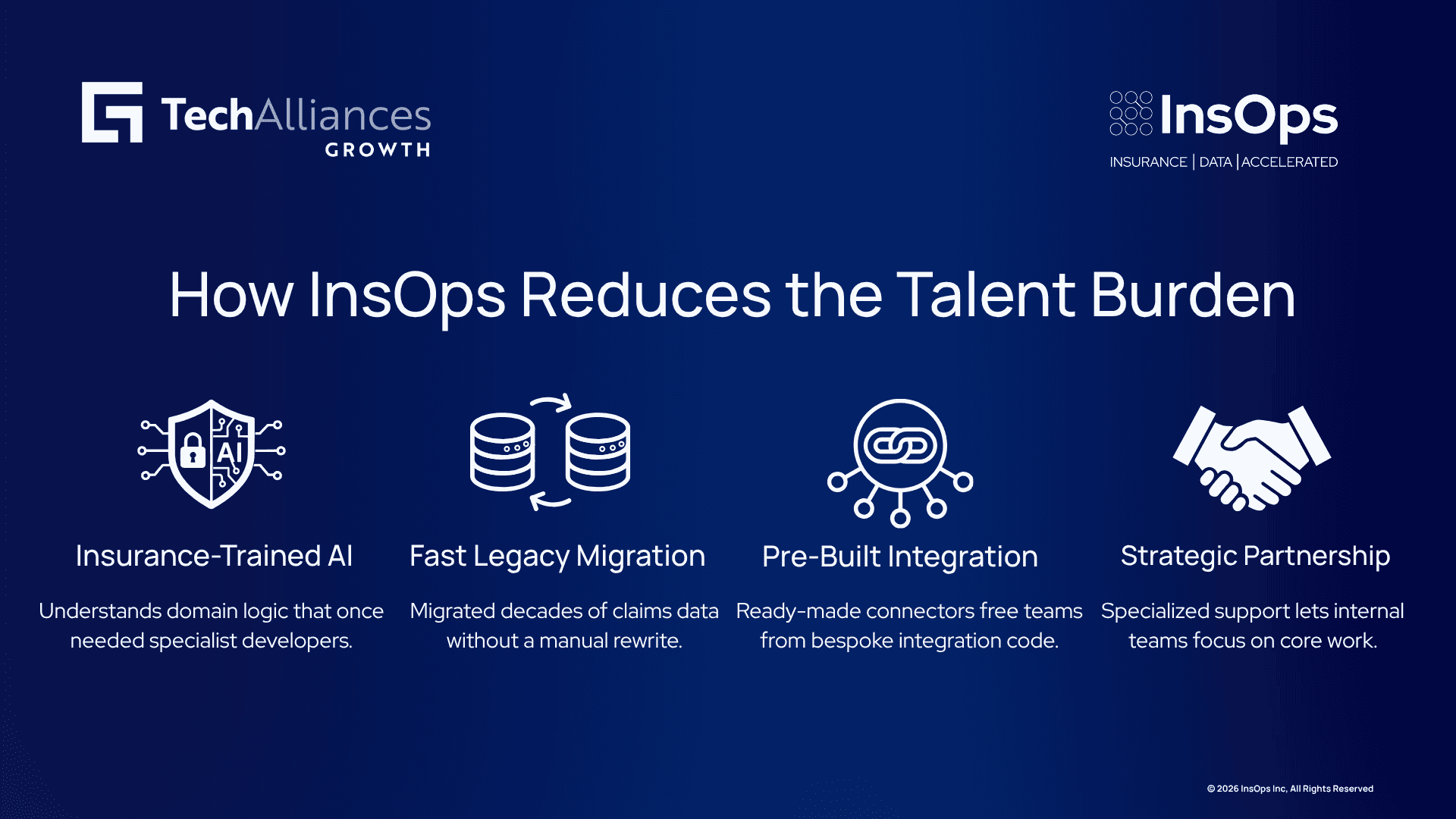
Insurance-trained AI model. InsOps's model was built specifically for P&C insurance data, understanding domain logic, field semantics, and data interdependencies that would otherwise require a developer with years of insurance-specific experience to interpret correctly.
Legacy migration without a manual line-by-line rewrite. InsOps migrated 40+ years of AS/400 claims data into Guidewire ClaimCenter Cloud in 6 months, at 99%+ accuracy, work that would traditionally require a team of legacy systems specialists working for far longer.
Pre-built integration, not custom development. Integration Gateway provides pre-built connectors for Guidewire PolicyCenter, ClaimCenter, BillingCenter, UnderwritingCenter, and PricingCenter, with our AI model handling payload mapping. This means internal teams aren't building bespoke integration code for every core system connection, freeing them to focus on higher-value work.
Human-in-the-loop, not a replacement for your team. InsOps doesn't operate autonomously. Every mapping, migration, and integration output is validated by human review, meaning your existing team's institutional knowledge is applied where it matters most, decisions, not repetitive manual data work.
A strategic partnership model. Rather than requiring carriers to build deep in-house expertise in legacy data migration and integration from scratch, InsOps functions as the specialized partner for that specific problem, letting internal teams stay focused on their core roadmap.
For CTOs facing a talent shortage that isn't closing anytime soon, the highest-leverage move is reducing how much specialized capacity each project demands, not just trying to out-hire competitors for the same scarce skill set.
FAQ
Why is the talent shortage worse for insurance IT than other industries? Insurance requires a rare combination of modern software skills and deep, insurance-specific domain knowledge, including legacy systems like AS/400 and COBOL, and regulatory frameworks like NAIC, HIPAA, and GDPR. Few developers have both, and the number who understand legacy insurance systems is shrinking as experienced staff retire.
Can AI-assisted development tools really reduce the need for specialized legacy talent? Yes, in specific ways. Tools that understand legacy code and insurance data structures can handle mapping, migration, and documentation tasks that would otherwise require a developer with years of system-specific experience, though human review remains essential for validating outputs.
Should carriers prioritize upskilling current staff or hiring new talent? Both matter, but upskilling is often faster and lower-risk for hard-to-fill roles. Existing staff already have institutional and regulatory context; teaching them modern tools and architecture is frequently more efficient than finding external candidates with both legacy and modern expertise.
What role do technology partnerships play in addressing the talent shortage? Partnerships let carriers access deep, specific expertise, such as legacy data migration or core system integration, without building that capability in-house from scratch. This allows internal teams to stay focused on the work that most requires their institutional knowledge.
Does relying on AI-assisted tools for legacy modernization create risk in a regulated industry? It depends on how the tools are used. Human-in-the-loop review is critical: AI should assist with mapping, migration, and documentation, but decisions and validation should remain with qualified staff, particularly for data handled under NAIC, HIPAA, or GDPR requirements.
How long does it typically take to modernize legacy systems without a large specialized team? With the right tooling, timelines can be significantly shorter than a fully manual approach. InsOps, for example, migrated 40+ years of claims data into Guidewire ClaimCenter Cloud in 6 months, work that would traditionally require a much larger and more specialized team over a longer period.