

Regulatory compliance in P&C insurance isn't a checkpoint at the end of a project. It's a requirement that has to be embedded into architecture from the start, governance, audit trails, and policy-based security built into every system and every data pipeline, not bolted on before an audit.
For CTOs, this is a harder problem than it looks. Insurance data touches NAIC requirements, state-specific regulations, HIPAA where health-adjacent claims data is involved, and GDPR for carriers with international exposure. Every system that touches that data, core platforms, integration layers, migration tooling, needs governance built in, not added after the fact.
Why Compliance Gets Harder as Architecture Modernizes
Ironically, the same modernization efforts meant to improve insurance operations often make compliance harder before they make it easier:
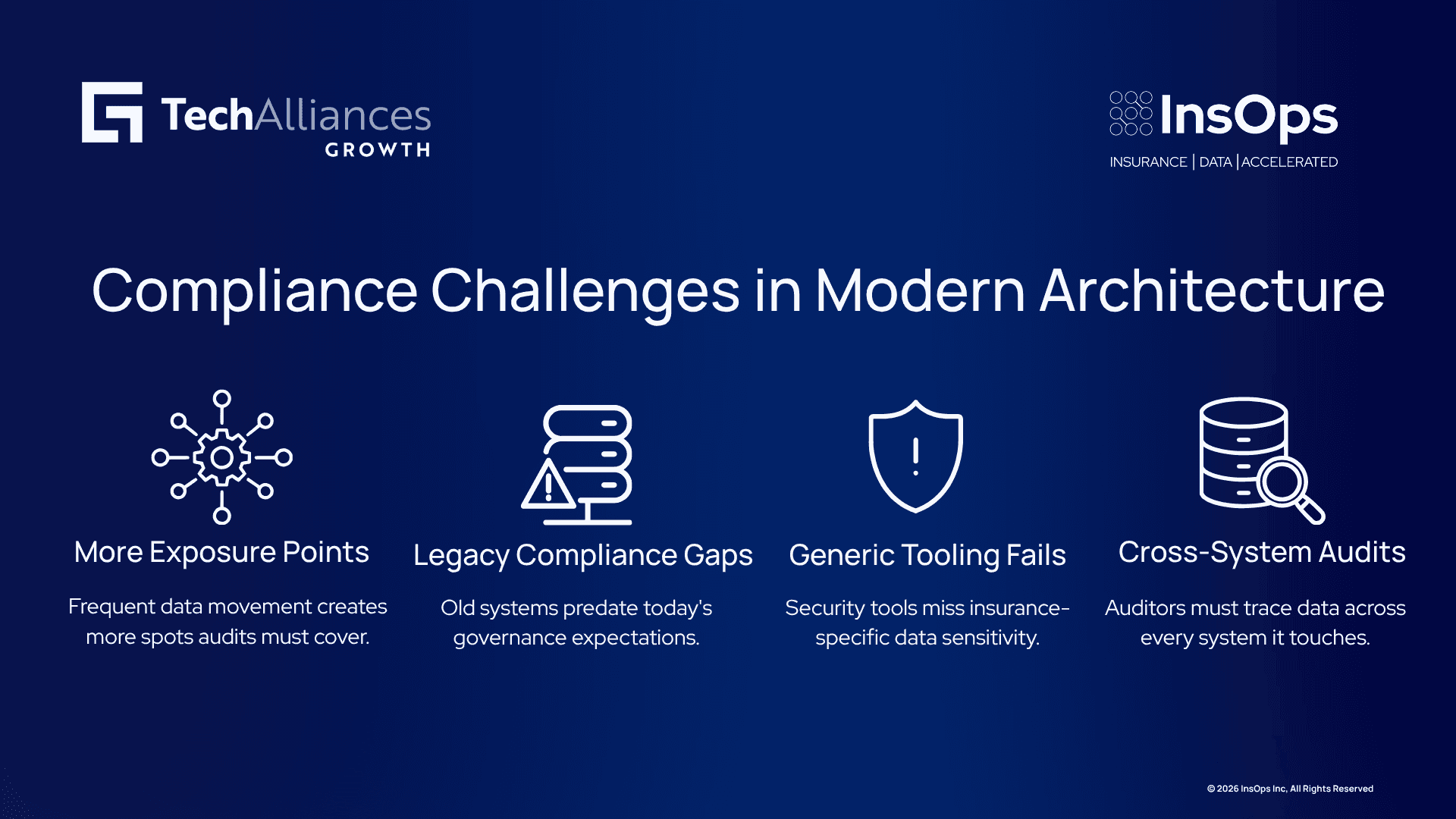
More data movement means more exposure points. As carriers move toward real-time integration and event-driven architecture, data moves between systems more frequently, and each movement is a point where governance and audit trails need to hold.
Legacy systems weren't built with modern compliance frameworks in mind. AS/400 and other legacy platforms predate current governance expectations, meaning migration projects have to build compliance into the new environment rather than simply carrying old practices forward.
DevSecOps pipelines need insurance-specific policy enforcement. Generic security tooling doesn't understand insurance-specific data sensitivity, like the difference between a policy number and a claimant's protected health information embedded in claims notes.
Audit trails have to span systems, not just one. As data flows across policy, claims, underwriting, and billing systems, an auditor needs to trace a single data point's full path, not just its record within one application.
Modernization without governance built in doesn't reduce compliance risk. It just distributes that risk across more systems.
What Embedded Governance Actually Looks Like
Strong regulatory compliance architecture in P&C insurance rests on four pillars:
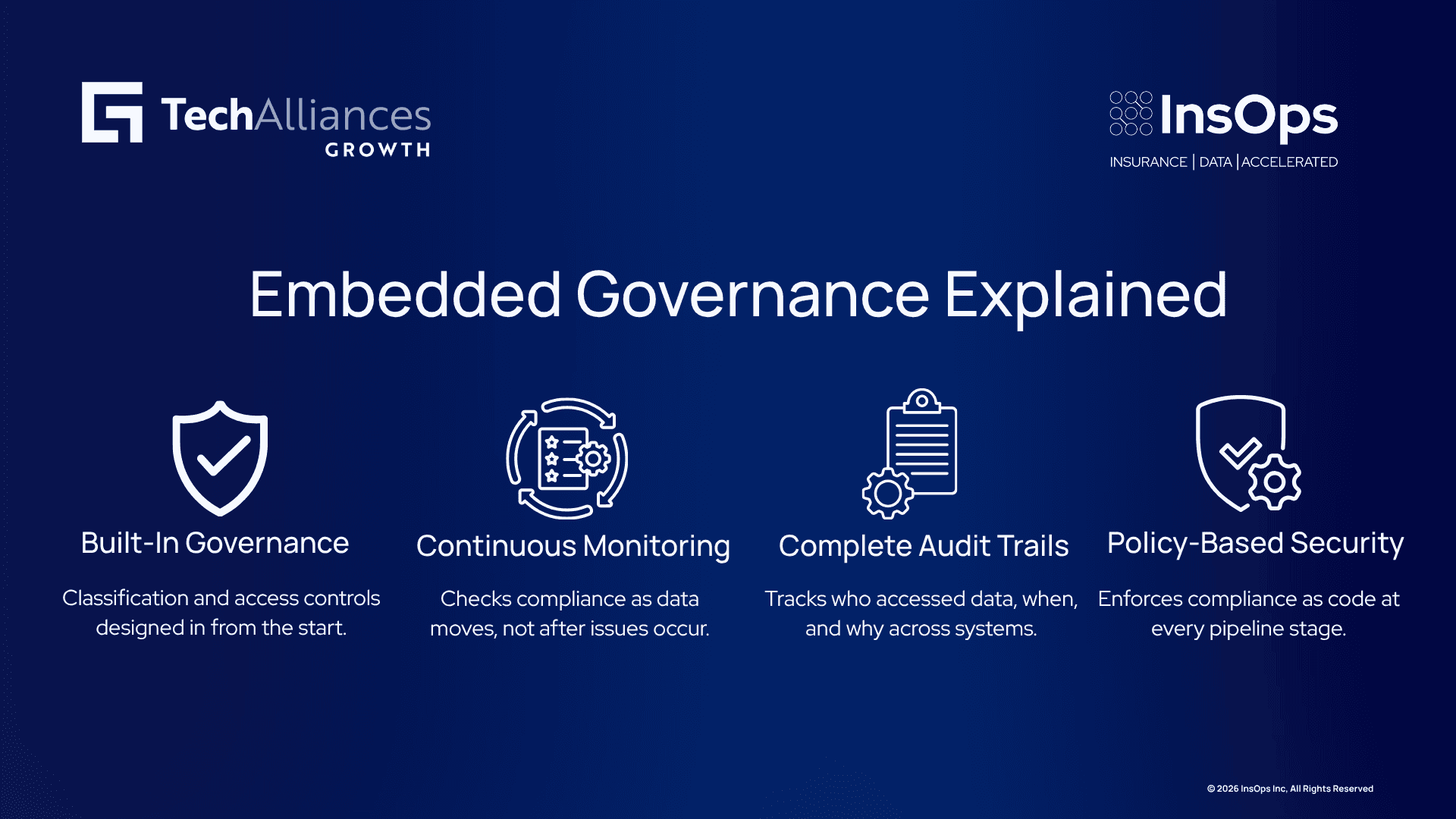
Governance built into architecture, not layered on top. Data classification, access controls, and retention policies designed into systems from the start, so compliance isn't a separate project running alongside development.
Systematic compliance monitoring. Continuous checks against regulatory requirements as data moves and systems change, rather than periodic manual review that only catches issues after they've already occurred.
Complete audit trails. A record of who accessed what data, when, and why, spanning every system the data touches, so an audit can reconstruct the full picture rather than piecing together fragments from different platforms.
Policy-based security in DevSecOps pipelines. Security and compliance policies enforced as code, checked at every stage of development and deployment, not just verified in production after release.
The carriers managing this well aren't treating governance as a compliance team's separate responsibility. They're building it into the same architecture decisions that govern performance, integration, and scalability.
How InsOps Helps
InsOps is designed with regulatory frameworks built into how data is handled at every step, not added as a separate compliance layer.
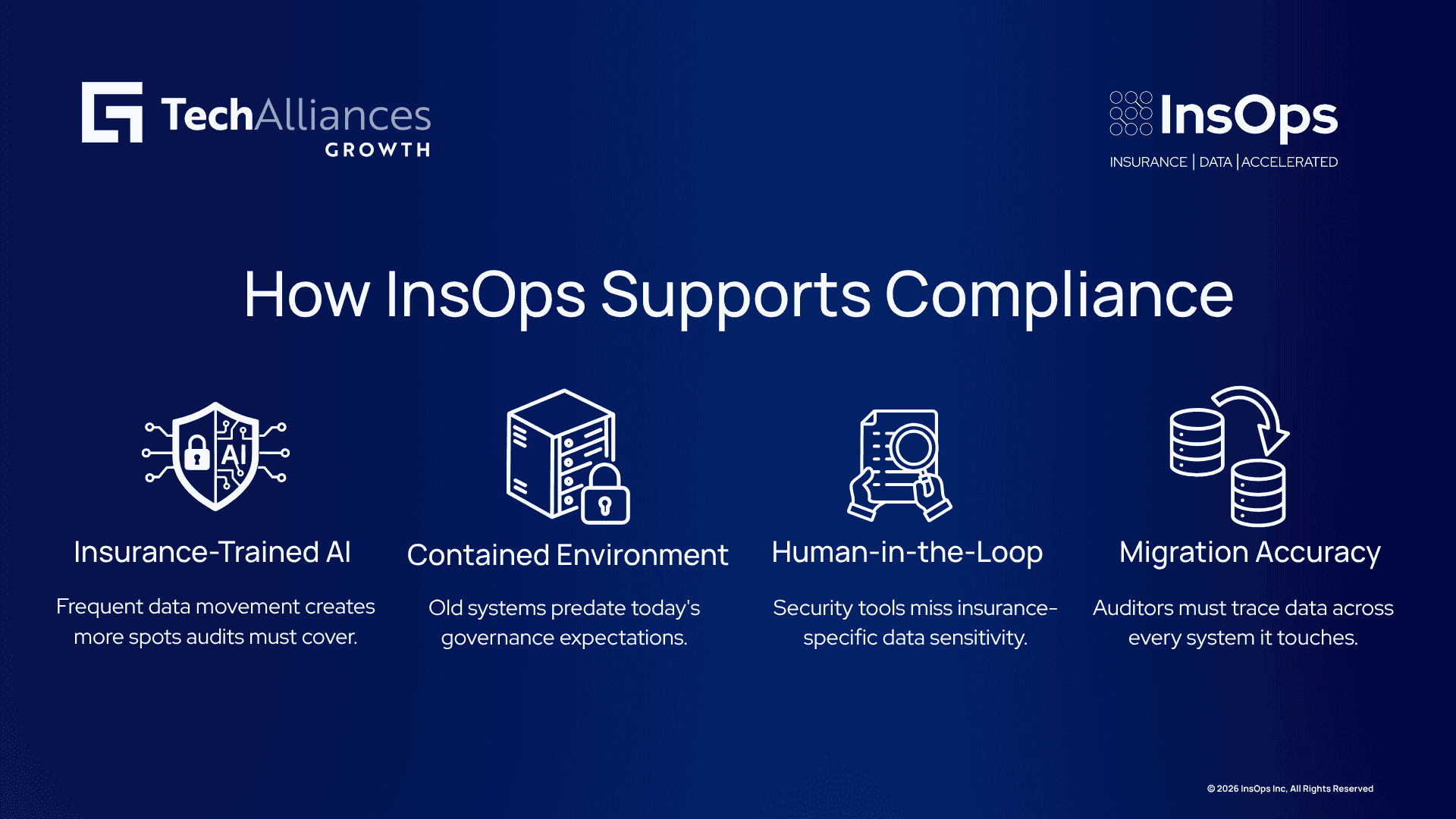
Insurance-trained data understanding. Our AI model recognizes field semantics and data interdependencies specific to insurance, including which fields carry regulatory sensitivity under NAIC, HIPAA, and GDPR, so governance decisions are grounded in accurate data classification rather than generic pattern matching.
Runs inside your controlled environment. InsOps operates inside the insurer's own infrastructure. Sensitive data never leaves your environment to be mapped, migrated, or transformed, which matters directly for data residency and access control requirements.
Human-in-the-loop by design. InsOps never acts autonomously. Every data mapping, migration, or integration output goes through human review before it's used, creating a natural audit point at every stage rather than relying on a black-box process.
Legacy migration with accuracy carriers can stand behind. Our migration of 40+ years of AS/400 claims data into Guidewire ClaimCenter Cloud achieved 99%+ accuracy, an important baseline when the data being moved is subject to regulatory scrutiny and audit requirements.
Building toward dedicated compliance tooling. InsOps is developing a Data Privacy wrapper, powered by our core AI model, focused on PII and PHI handling, and a dedicated DOI Compliance capability is in development to address state-specific regulatory requirements more directly. Carriers interested in early access to these capabilities can reach out to discuss timelines and fit.
For CTOs, the priority isn't finding a tool that promises to make compliance disappear. It's finding an architecture partner whose data handling practices are already built around the regulatory realities of insurance, so governance strengthens as systems modernize instead of eroding.
FAQ
Why is regulatory compliance harder during architecture modernization, not easier? Modernization often increases the number of systems data moves between, particularly with real-time integration and event-driven architecture. Each additional data movement is a new point where governance and audit trails need to hold, so compliance risk needs active management, not less attention, during a transition.
What regulatory frameworks are most relevant to P&C insurance data? NAIC requirements and state-specific insurance regulations apply broadly. HIPAA becomes relevant where claims data includes health-adjacent information. GDPR applies to carriers with international data exposure. Systems handling insurance data need to account for all frameworks that apply to their specific data types.
Can legacy systems be made compliant with modern governance frameworks without full replacement? It depends on the system and the gap between its original design and current requirements. In many cases, governance can be layered around legacy systems through controlled integration and monitoring, though a full data migration to a modern platform often provides a cleaner foundation for embedding compliance from the ground up.
What does "policy-based security" mean in a DevSecOps context? It means security and compliance rules are defined as code and enforced automatically at each stage of development and deployment, rather than checked manually after a system is already in production. This catches policy violations earlier and more consistently.
Does using AI for data migration or integration introduce compliance risk? It can, if the AI operates without human oversight or lacks understanding of regulatory data sensitivity. Human-in-the-loop review, where every AI-assisted output is validated before use, along with an AI model trained specifically on insurance data classifications, reduces this risk significantly compared to generic tooling.
Is InsOps's DOI Compliance capability available now? It's currently in development. Carriers interested in early access or wanting to understand how it fits their compliance roadmap can reach out to discuss timelines directly.