

Regulatory compliance and cybersecurity have historically operated as adjacent but separate functions in many P&C carriers, compliance teams tracking regulatory requirements, security teams managing technical controls, with alignment happening mostly at audit time. That separation doesn't hold up well against current expectations. Regulators increasingly expect demonstrable, continuous evidence that security controls are functioning and aligned with governance frameworks, not a point-in-time attestation produced once a year.
For CISOs, this means cyber governance and regulatory compliance need to be treated as one integrated function: continuously monitored, consistently documented, and structurally connected to enterprise governance rather than reconciled after the fact through manual audit preparation.
Why Point-in-Time Compliance No Longer Meets the Bar
Traditional compliance validation relied on periodic audits, an annual or semi-annual review confirming that controls were in place and functioning as of that specific review date. Two things have made that model insufficient:
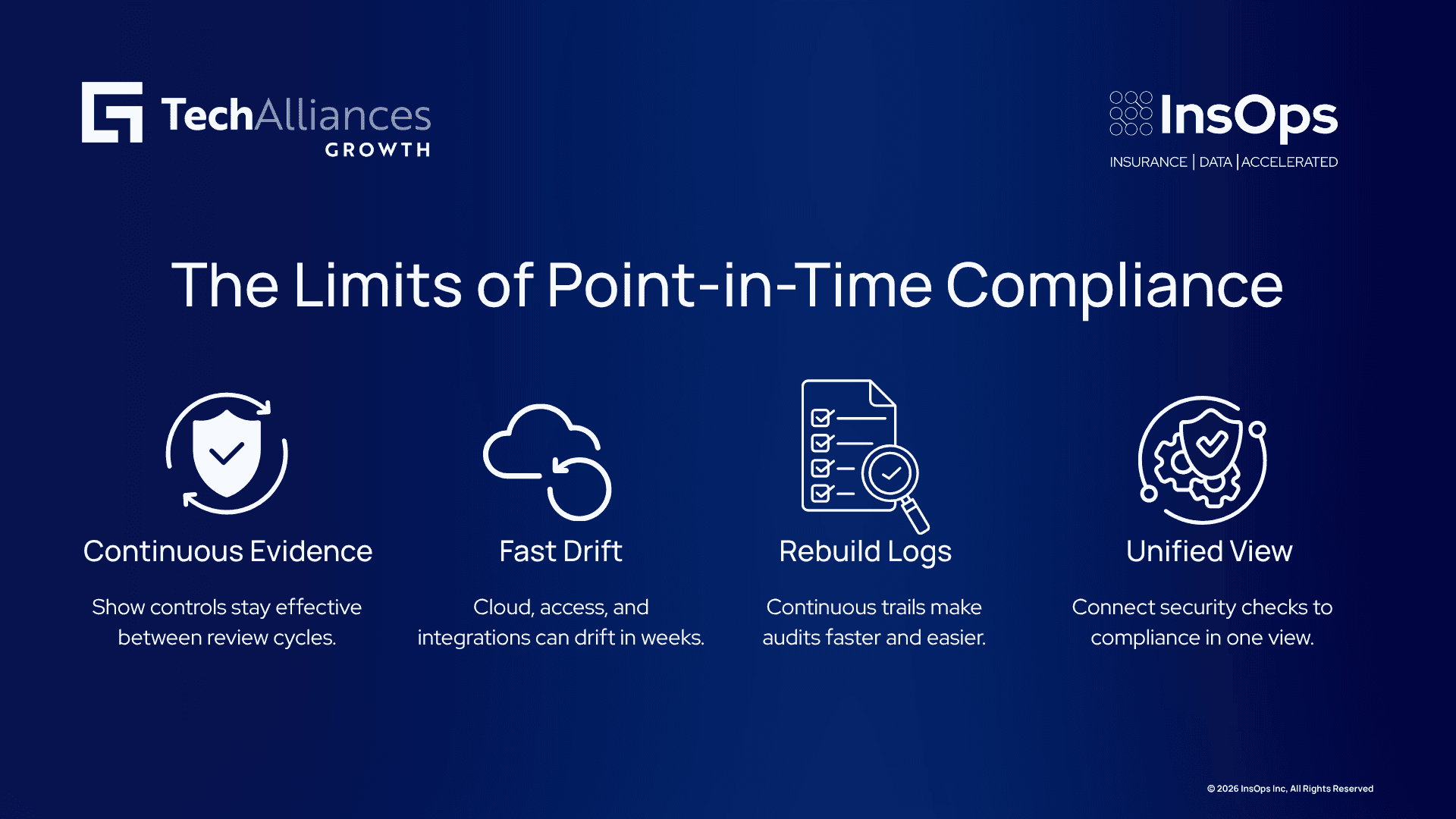
Regulatory expectations have shifted toward continuous evidence. Frameworks increasingly expect organizations to demonstrate ongoing control effectiveness, not just a snapshot, particularly as regulators recognize how quickly technical environments change between audit cycles.
Environments change faster than audit cycles. Cloud configurations, integrations, and access permissions shift constantly. A control validated as effective during an audit can drift out of compliance weeks later without anyone noticing until the next review.
Manual audit trail reconstruction is slow and incomplete. When audit trails aren't captured continuously and systematically, reconstructing what happened, who accessed what data, when a configuration changed, becomes a time-consuming, best-effort exercise rather than a reliable record.
Security control validation and compliance validation are often disconnected. A security team may confirm a control is technically functioning while a compliance team separately confirms a regulatory requirement is met, without a shared, continuously updated view connecting the two.
What Integrated Cyber Governance Requires
Bringing regulatory compliance and cybersecurity governance into a single, continuously functioning practice requires four connected capabilities:
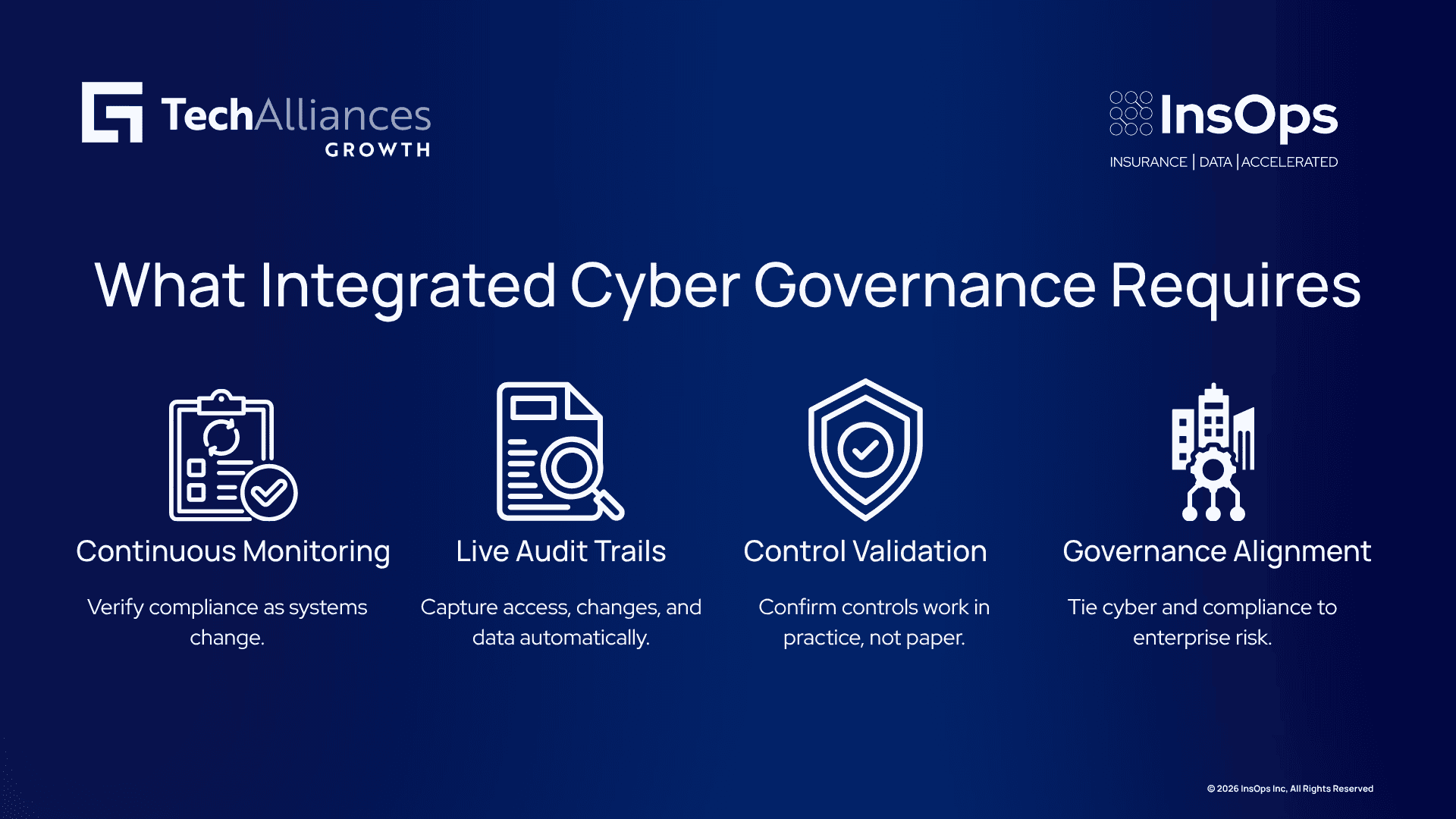
Continuous compliance monitoring. Ongoing verification that systems and controls meet applicable regulatory requirements, NAIC, HIPAA where relevant, GDPR for carriers with international exposure, rather than relying on periodic manual review to catch drift after it's already occurred.
Complete, continuously captured audit trails. A systematic record of access, changes, and data movement across systems, maintained as a byproduct of normal operations rather than reconstructed under pressure ahead of an audit.
Continuous validation of security controls. Ongoing confirmation that security controls are actually functioning as intended, not just documented as in place, closing the gap between a control existing on paper and a control demonstrably working in practice.
Structural alignment with enterprise governance frameworks. Security and compliance practices connected to the same governance structure that oversees broader enterprise risk, rather than operating as a parallel, loosely coordinated function.
The goal is a governance model where a regulator, auditor, or board member asking "can you show me this control is working right now" gets a direct answer backed by continuous evidence, not a promise to check and follow up.
Why This Matters More as Architecture Modernizes
As carriers move toward cloud infrastructure, API-first integration, and AI-assisted processes, the number of systems and control points that need to stay aligned with governance requirements grows substantially. Each new integration, each new cloud workload, each new AI-assisted process is a new point where compliance monitoring and control validation need to extend, or a new gap where they don't.
This is particularly relevant for legacy modernization and data migration projects. Moving sensitive data from a legacy system into a modern platform changes where audit trail responsibility sits, and if governance alignment isn't built into the migration process itself, the resulting environment can end up with weaker audit and compliance coverage than the legacy system it replaced, even though the underlying technology is more modern.
How InsOps Helps
InsOps supports regulatory compliance and cyber governance specifically within the scope of legacy data migration and system integration, where governance continuity is often at greatest risk during a transition.
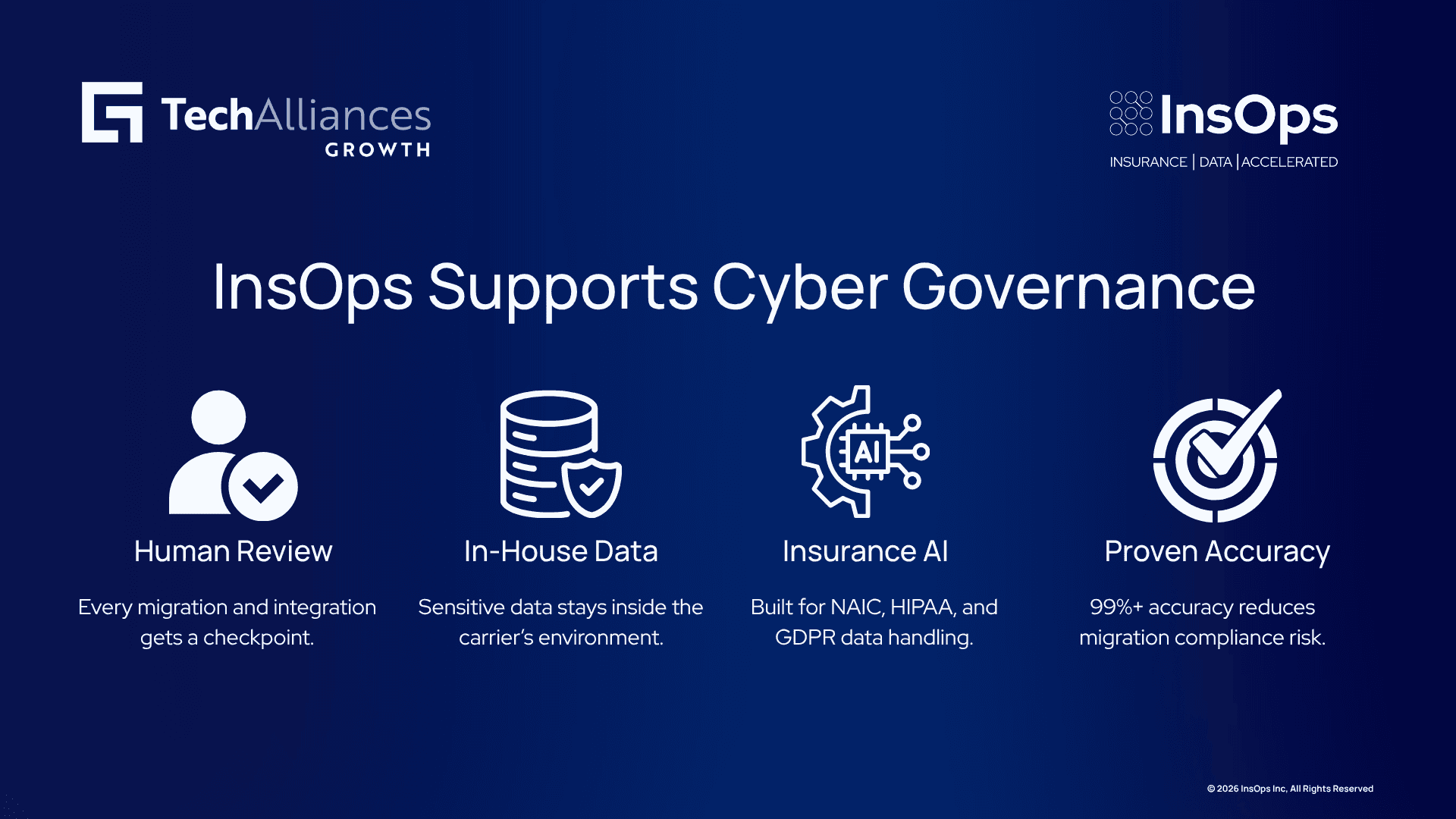
Human-in-the-loop validation creates a natural audit checkpoint. InsOps never processes or migrates data autonomously. Every mapping, migration, and integration output is validated by human review, creating a consistent, structural audit point built into the process itself rather than relying on after-the-fact reconstruction.
Data stays inside your governed environment. InsOps operates inside the insurer's own controlled infrastructure. Sensitive data is never sent to an external environment for processing, which keeps audit trail continuity and governance oversight within the carrier's existing framework rather than introducing a separate, external system to reconcile.
Insurance-trained understanding of regulated data. Our AI model is trained specifically on insurance data structures and relevant regulatory frameworks, including NAIC requirements, HIPAA, and GDPR, supporting more accurate identification and handling of data subject to specific compliance obligations during migration and integration work.
Proven accuracy reduces compliance risk from incomplete migration. InsOps's migration of 40+ years of AS/400 claims data into Guidewire ClaimCenter Cloud achieved 99%+ accuracy, reducing the risk of data being lost, duplicated, or improperly transformed in ways that could create compliance gaps or incomplete audit trails in the resulting system.
For CISOs, InsOps's relevance to cyber governance is specific: it ensures that during one of the highest-risk moments for governance continuity, a legacy migration or integration project, human oversight, controlled data handling, and insurance-specific regulatory awareness are built into the process rather than addressed only once the new system is already in production.
FAQ
Why is point-in-time compliance validation no longer considered sufficient? Because technical environments change constantly, cloud configurations shift, access permissions get modified, integrations evolve, while periodic audits only capture a snapshot at one point in time. A control validated as effective during an audit can drift out of compliance before the next review cycle without anyone noticing.
What's the difference between a security control being documented and a security control being validated? A documented control describes what's supposed to be in place. A validated control has been actively confirmed to be functioning as intended. Continuous validation closes the gap between policy documentation and operational reality, which is increasingly what regulators and auditors expect to see evidence of.
Why do audit trails need to be captured continuously rather than reconstructed for an audit? Continuous capture produces a reliable, complete record as a natural byproduct of system operation. Reconstructing an audit trail after the fact is time-consuming, often incomplete, and depends on data and logs that may not have been designed with audit reconstruction in mind.
How does legacy data migration affect regulatory compliance and audit trail continuity? Migrating data to a new system changes where audit trail responsibility sits. If governance and compliance requirements aren't built into the migration process itself, the resulting system can end up with weaker audit and compliance coverage than the legacy system it replaced, despite being more technically modern.
Why should security governance and regulatory compliance be treated as one integrated function rather than separate teams? Because a control that satisfies a security team's technical requirements and a control that satisfies a regulatory requirement need to be the same continuously validated thing, not two separately maintained assessments that only get reconciled during audit preparation. Integration reduces gaps and duplicated effort between the two functions.
Does InsOps provide continuous compliance monitoring or automated security control validation as standalone capabilities? No. InsOps focuses on legacy data migration and system integration, with human-reviewed processing that creates natural audit checkpoints within that specific scope. Dedicated continuous compliance monitoring and security control validation tools remain necessary as the broader governance foundation across the enterprise.