

Most security operations centers aren't short on alerts. They're drowning in them. A typical SOC in a mid-to-large P&C carrier can generate thousands of alerts daily across SIEM, endpoint tools, network monitoring, and cloud security platforms, far more than any analyst team can meaningfully investigate. The result is alert fatigue: real threats buried in noise, analysts desensitized to warnings, and response times that lag well behind what a fast-moving attack actually requires.
For CISOs, the fix isn't more alerts or more analysts. It's better prioritization, using AI-powered SIEM, SOAR, behavioral analytics, and threat intelligence to separate the signal from the noise before it ever reaches a human analyst's queue.
Why Alert Volume Alone Isn't the Real Problem
It's tempting to frame alert fatigue as a volume problem, too many alerts, not enough people. But the deeper issue is precision. Most SOCs aren't failing because they lack detection coverage. They're failing because:
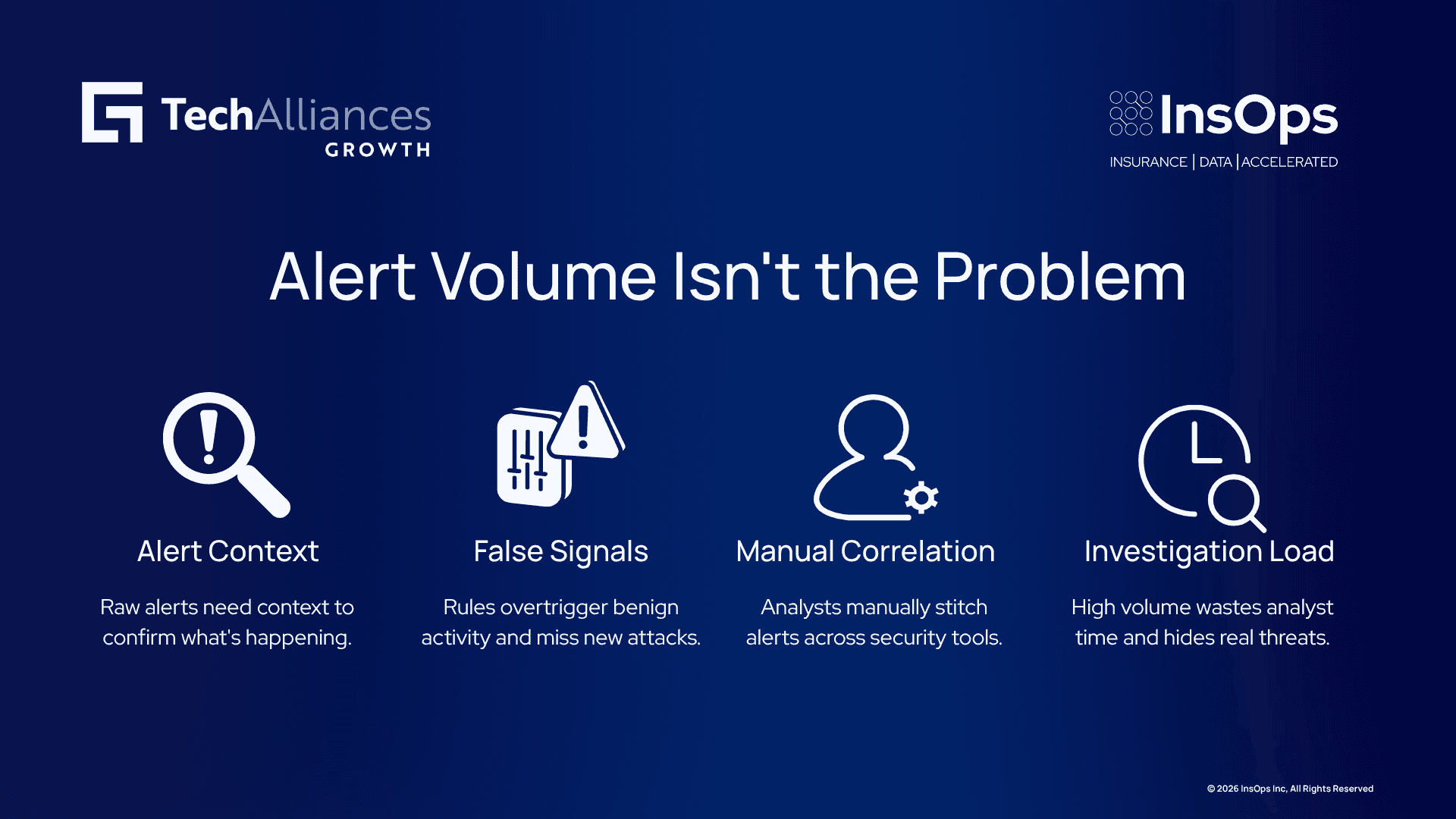
Alerts lack context. A raw alert flagging unusual login activity doesn't tell an analyst whether it's a legitimate traveling employee or a credential compromise, without significant manual investigation to establish context.
Rule-based detection generates high false-positive rates. Traditional signature and rule-based detection tends to overtrigger on benign anomalies while still missing genuinely novel attack patterns that don't match a known signature.
Correlation across tools is manual. When SIEM, endpoint, network, and cloud security tools each generate alerts independently, analysts often have to manually piece together whether several separate alerts represent one coordinated incident or several unrelated events.
Investigation time is disproportionate to alert volume. Even a small percentage of alerts requiring deep investigation, if the total volume is high enough, consumes more analyst time than a team can sustainably provide, leading to alerts being closed with minimal review just to keep the queue manageable.
This is how alert fatigue becomes a genuine security risk, not just an operational annoyance. When analysts are conditioned to treat most alerts as noise, the real signal, the alert indicating an actual active threat, gets the same abbreviated attention as everything else.
What AI-Powered Security Operations Actually Changes
AI-powered SIEM, SOAR, and behavioral analytics address alert fatigue by changing what reaches the analyst in the first place, not just how fast the analyst can process what arrives:
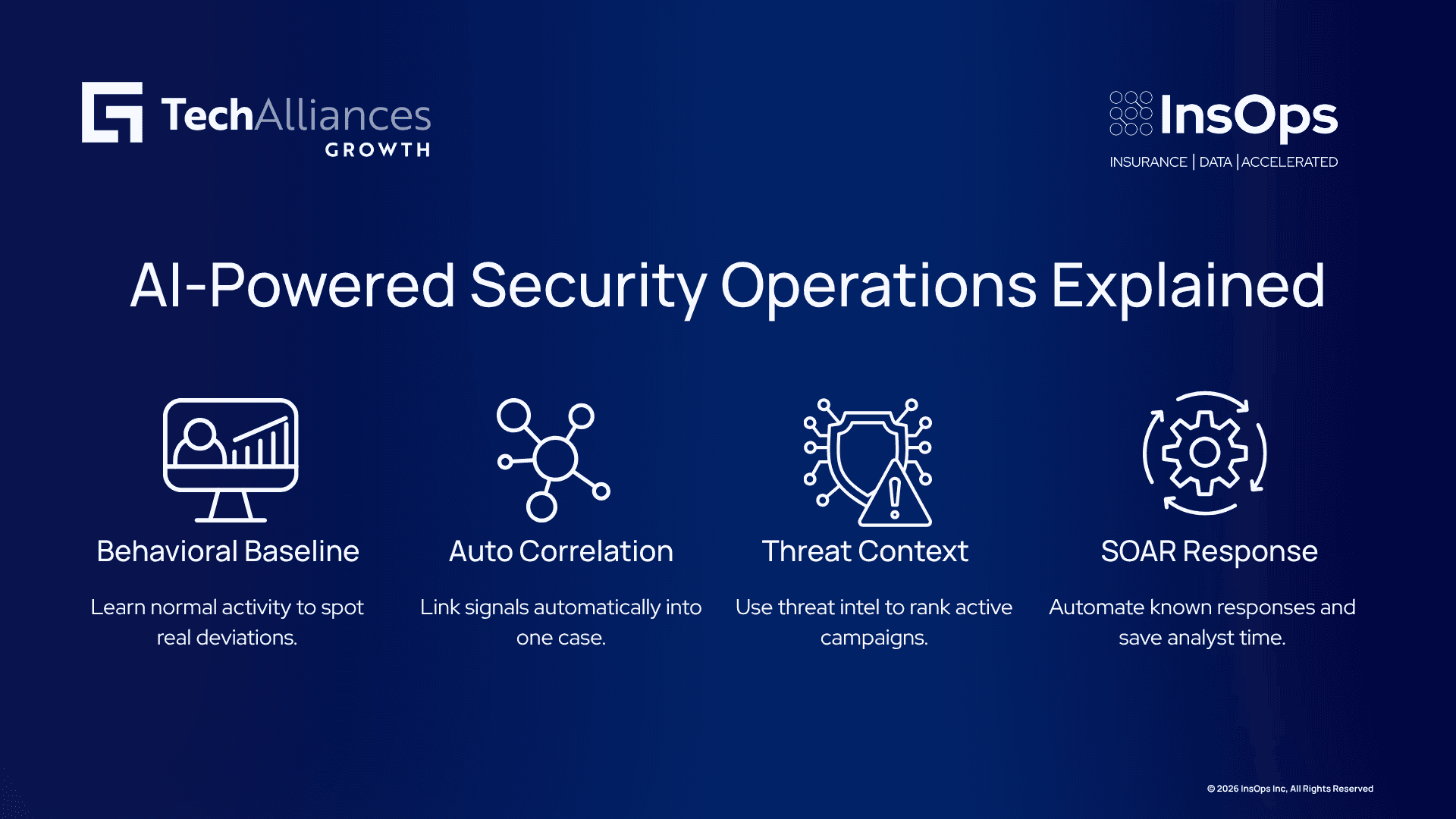
Behavioral analytics establish a baseline. Rather than relying solely on known signatures, behavioral analytics learn what normal activity looks like for a given user, system, or network segment, flagging genuine deviations rather than triggering on activity that merely matches a broad rule.
AI-powered SIEM correlates across sources automatically. Instead of an analyst manually connecting alerts from separate tools, AI-driven correlation identifies when multiple signals represent a single coordinated incident, surfacing the incident as one prioritized case rather than a dozen disconnected alerts.
Threat intelligence adds external context. Integrating threat intelligence feeds helps prioritize alerts based on known active campaigns, attacker techniques, and indicators of compromise relevant to the current threat landscape, rather than treating every anomaly as equally urgent.
SOAR handles investigation and response for well-understood patterns. Security Orchestration, Automation, and Response platforms can automatically gather context, enrich alerts with relevant data, and even execute predefined response actions for alert types with clear, established handling procedures, freeing analyst time for genuinely novel or ambiguous cases.
Together, these capabilities shift the SOC's workload from "review everything" to "review what actually matters," which is the only sustainable way to keep pace with both alert volume and attacker sophistication.
Why This Matters Specifically for P&C Insurers
Insurance environments generate a particularly noisy alert landscape: legacy systems with limited native security telemetry, a growing number of third-party integrations each with their own access patterns, and increasingly complex cloud footprints, all layered on top of standard endpoint and network monitoring. Without strong prioritization, SOC teams in insurance environments are especially prone to alert fatigue simply because there are more distinct systems and integration points generating signals than in a more architecturally uniform industry.
How InsOps Helps
InsOps is not a SIEM, SOAR, or security operations platform, and CISOs building or improving their security operations program should look to dedicated SOC tooling and threat intelligence vendors for that capability.
Where InsOps has an indirect but real connection to this challenge is in reducing the number of loosely monitored, manually maintained integration points that often contribute to noisy, hard-to-correlate alert landscapes in the first place. Integration Gateway's pre-built connectors for Guidewire PolicyCenter, ClaimCenter, BillingCenter, UnderwritingCenter, and PricingCenter replace ad hoc, custom-built point-to-point connections with a standardized integration layer, one that's more consistent to monitor than a patchwork of individually built connections each generating their own distinct alert patterns.
InsOps also keeps sensitive data processing inside the insurer's own controlled environment, with every output validated by human review rather than autonomous action, which reduces one category of activity a SOC would otherwise need to monitor for anomalous or unauthorized automated behavior.
For CISOs, this is a supporting consideration, not a security operations solution. A well-architected, standardized integration environment is simply easier to monitor consistently than one built from years of individually maintained custom connections, which indirectly supports the broader goal of reducing noise across the environment. The core work of alert prioritization, AI-powered SIEM, SOAR, behavioral analytics, and threat intelligence, remains a dedicated security operations investment.
FAQ
Why does alert fatigue create genuine security risk rather than just an operational inconvenience? When analysts are consistently overwhelmed by high alert volume and false positives, they become conditioned to give most alerts minimal attention. This means a real, active threat can receive the same abbreviated review as routine noise, increasing the chance it's missed or investigated too late.
How does behavioral analytics reduce false positives compared to traditional rule-based detection? Behavioral analytics establish a baseline of normal activity for a specific user, system, or network segment, flagging genuine deviations from that baseline rather than triggering broadly on activity that merely matches a general rule, which tends to overtrigger on benign anomalies.
What's the difference between AI-powered SIEM and traditional SIEM? Traditional SIEM aggregates and correlates logs largely based on predefined rules. AI-powered SIEM adds pattern recognition and automated correlation across data sources, identifying when multiple alerts represent a single coordinated incident without requiring an analyst to manually connect the signals.
What does SOAR actually automate in a security operations context? SOAR platforms automate context gathering, alert enrichment, and, for well-understood alert types with established response procedures, initial response actions. This is typically applied to routine, well-characterized incidents, freeing analyst time for novel or ambiguous cases that genuinely require human judgment.
Why are P&C insurance environments particularly prone to alert fatigue? Insurance environments often combine legacy systems with limited native telemetry, numerous third-party integrations each with distinct access patterns, and growing cloud footprints, creating more distinct sources of alerts than in architecturally simpler industries, which increases both alert volume and the difficulty of correlating signals across sources.
Does InsOps provide SIEM, SOAR, or threat intelligence capabilities? No. InsOps focuses on legacy data migration and system integration. Its relevance to security operations is indirect, standardizing integration points and keeping data processing inside a controlled, human-reviewed environment, which can reduce certain sources of alert noise, but it isn't a substitute for dedicated SIEM, SOAR, behavioral analytics, or threat intelligence tooling.