

External attackers get most of the attention in security planning, but a substantial share of data exposure incidents in P&C insurance trace back to something far less dramatic: an employee misconfiguring access, a well-meaning staff member falling for a phishing attempt, or a departing employee retaining access longer than they should have. Insider threats and human error don't require a sophisticated attacker. They just require a gap in monitoring, training, or access discipline.
For CISOs, this category of risk is harder to address than external threats in one specific way: the people involved usually aren't acting maliciously, and the controls that stop a malicious insider look different from the ones that catch an honest mistake. Both need to be covered, and neither is solved by perimeter security or endpoint detection alone.
Why Insider Risk Is Distinct From External Threat Risk
Insider threats and human error share a security operations home with external threats, but they require a different approach:
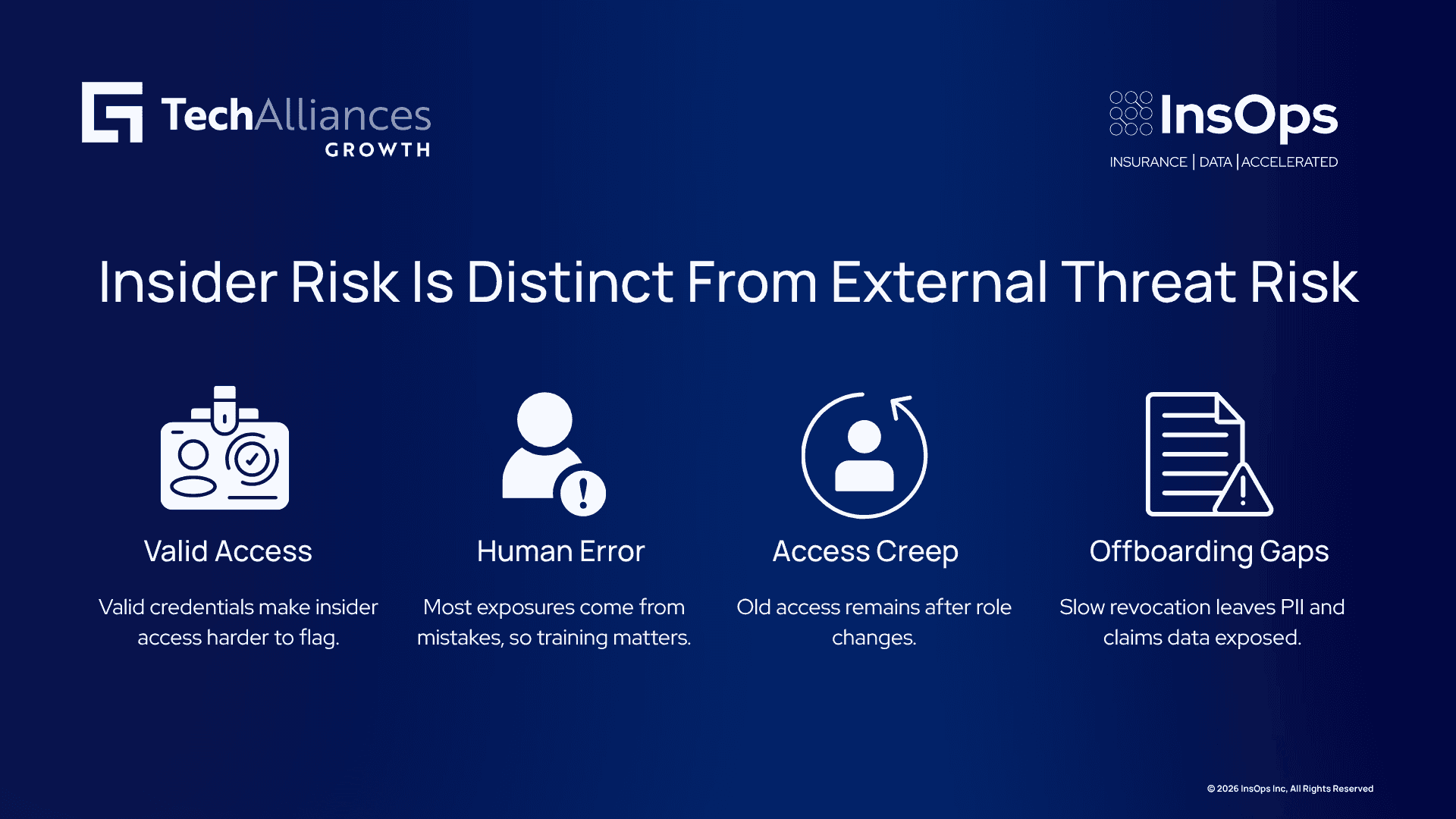
Legitimate access makes detection harder. An insider using their own valid credentials to access sensitive data doesn't trigger the same alerts as an external intrusion attempt, because from a technical standpoint, nothing about the access itself looks unauthorized.
Most incidents are accidental, not malicious. The majority of insider-related exposure comes from human error, misconfigured access, misdirected sensitive data, an employee falling for a social engineering attempt, rather than deliberate misuse, meaning training and process controls matter as much as monitoring.
Over-provisioned access is a passive but persistent risk. Employees frequently retain access accumulated across role changes, project assignments, or tenure, well beyond what their current role actually requires, creating a larger attack surface than necessary even without any malicious intent.
Departing employees are a specific, recurring exposure point. Access that isn't promptly revoked when an employee leaves, especially in roles with access to sensitive claims or policy data, remains a common and preventable source of incidents.
Insurance data sensitivity raises the stakes of any single incident. An insider incident involving policyholder PII, claims data, or health-adjacent information carries the same regulatory and reputational consequences as an external breach, regardless of whether it was accidental or deliberate.
Why Least-Privilege Access Is the Foundation
Before behavioral monitoring or awareness training can meaningfully reduce insider risk, access itself needs to be scoped correctly. Least-privilege access, ensuring every user has only the access their current role genuinely requires, directly shrinks the size of a potential incident regardless of whether it originates from malicious intent or an honest mistake.
This is where access accumulation becomes a quiet, compounding risk. An employee who's moved through three roles over five years often retains access from all three, not because anyone decided they needed it, but because no one formally revoked it when their responsibilities changed. Enforcing least-privilege access requires ongoing review, not just correct provisioning at the point of hire.
What Reducing Insider Risk Actually Requires
Four practices work together to address both malicious insider threats and honest human error:
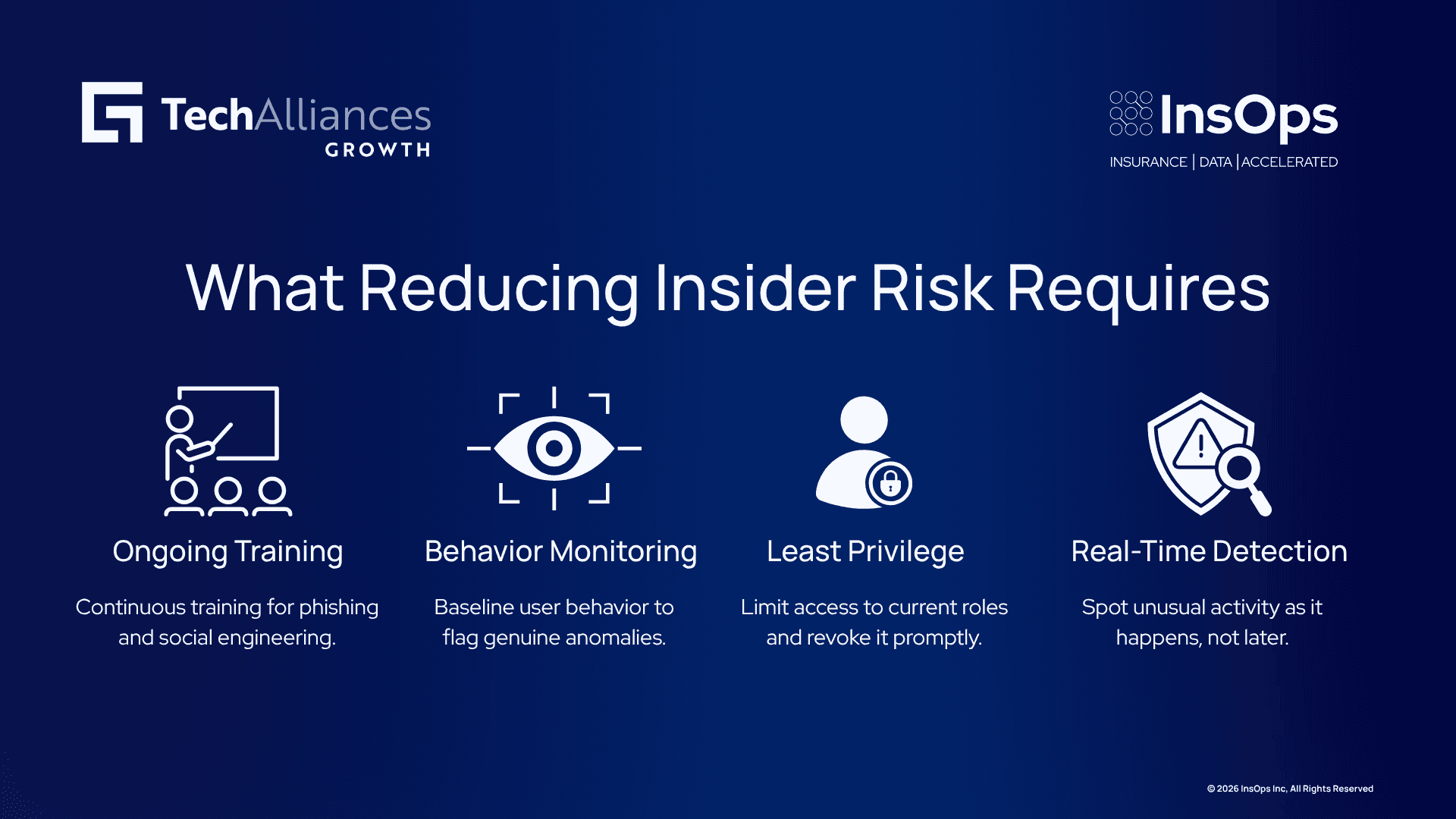
Continuous security awareness training. Not a once-a-year compliance exercise, but ongoing, updated training that reflects current phishing techniques, social engineering tactics, and data handling practices specific to the sensitive information employees actually work with.
AI-driven user behavior monitoring. Establishing a behavioral baseline for how each user typically accesses systems and data, then flagging genuine deviations, unusual data access volume, atypical access times, access patterns inconsistent with a user's role, rather than relying on static rules that can't account for role-specific variation.
Enforced least-privilege access. Access rights scoped to current role requirements, reviewed periodically rather than only at initial provisioning, with a defined, prompt process for revoking access when roles change or employment ends.
Real-time anomalous activity detection. Identifying and responding to unusual activity as it happens, rather than discovering it during a periodic audit well after the exposure has already occurred.
These four practices address different points in the risk lifecycle: training reduces the likelihood of an incident, least-privilege access limits its potential scope, and behavior monitoring and real-time detection catch it quickly if it happens anyway.
Why This Connects to Broader Architecture Decisions
Insider risk isn't isolated from the rest of an insurer's technology environment. Legacy systems with weak native access logging make behavioral monitoring harder to implement effectively. Point-to-point integrations built without consistent access governance create additional paths where over-provisioned access can accumulate unnoticed. Modernization efforts that don't specifically address access scoping as part of the transition can end up carrying forward the same access sprawl into a new, more modern system.
This means insider threat reduction benefits from the same underlying architecture improvements that support broader security goals: standardized, well-governed integration points, and modernization projects that treat access scoping as a deliberate requirement rather than an afterthought.
How InsOps Helps
InsOps is not a user behavior monitoring, security awareness training, or access governance platform, and CISOs building an insider threat program should look to dedicated tools in those categories for that core capability.
Where InsOps connects to this challenge is in how access is structured during the legacy data migration and integration work it performs. Because InsOps operates inside the insurer's own controlled environment and every output is validated through human review rather than autonomous processing, sensitive data handling during migration and integration doesn't introduce a new, separately managed access point that could become another source of over-provisioned or under-monitored access.
Integration Gateway's standardized connectors for Guidewire PolicyCenter, ClaimCenter, BillingCenter, UnderwritingCenter, and PricingCenter also reduce the number of individually built, separately credentialed integration points that tend to accumulate their own access sprawl over time, supporting the broader goal of keeping access scoped and governable rather than distributed across many custom, hard-to-track connections.
This is a supporting consideration, not a solution to insider risk itself. Continuous awareness training, behavioral monitoring, least-privilege enforcement, and real-time anomalous activity detection remain the core, dedicated practices required to manage insider threats and human error effectively.
FAQ
Why is insider threat detection harder than detecting external attacks? Because insiders typically use their own legitimate credentials to access data, which doesn't trigger the same alerts as an unauthorized external intrusion attempt. From a purely technical standpoint, the access itself looks authorized, even when the activity is inappropriate or represents an accidental exposure.
Are most insider-related security incidents malicious or accidental? The majority stem from human error rather than deliberate misuse, misconfigured access, misdirected data, falling for a phishing attempt, which is why security awareness training and process controls are as important as behavioral monitoring focused on detecting intentional misuse.
Why does least-privilege access matter even for employees with no history of concerning behavior? Because least-privilege access limits the potential scope of any incident, whether it originates from an honest mistake or a compromised account, regardless of intent. Over-provisioned access simply creates a larger attack surface than necessary, even for employees who never misuse it themselves.
How does AI-driven behavior monitoring differ from traditional rule-based access monitoring? AI-driven monitoring establishes a behavioral baseline specific to each user's typical access patterns, then flags genuine deviations from that individual baseline. Traditional rule-based monitoring applies static thresholds uniformly, which can miss anomalies that fall within generic limits but are still unusual for a specific user's normal behavior.
Why is departing employee access considered a specific, recurring risk category? Because access revocation for departing employees is often a manual, easily delayed process, and any gap between an employee's departure and their access being fully revoked is a window where that access could be misused or simply left unnecessarily active, particularly risky for roles with access to sensitive claims or policy data.
Does InsOps provide user behavior monitoring or access governance capabilities? No. InsOps focuses on legacy data migration and system integration. Its relevance to insider threat reduction is indirect, keeping data processing inside a controlled, human-reviewed environment and reducing custom integration sprawl, but dedicated behavioral monitoring, awareness training, and access governance tools remain necessary for a complete insider threat program.