

The cybersecurity talent shortage isn't news to any CISO. Open security roles routinely stay unfilled for months, experienced analysts are recruited away by better offers, and the specialized expertise needed to secure insurance-specific systems, legacy platforms, regulatory frameworks, insurance data structures, is even harder to find than general security talent. Hiring more people isn't a strategy when the people don't exist to hire.
The CISOs managing this well have shifted the question from "how do we hire our way out of this" to "how do we get more security capability out of the analysts we already have." That means AI security copilots, reducing repetitive manual work, investing in the team already in place, and knowing when a managed security service is a better answer than an unfilled internal role.
Why This Shortage Hits Insurance Especially Hard
A few factors compound the general cybersecurity talent shortage specifically for P&C carriers:
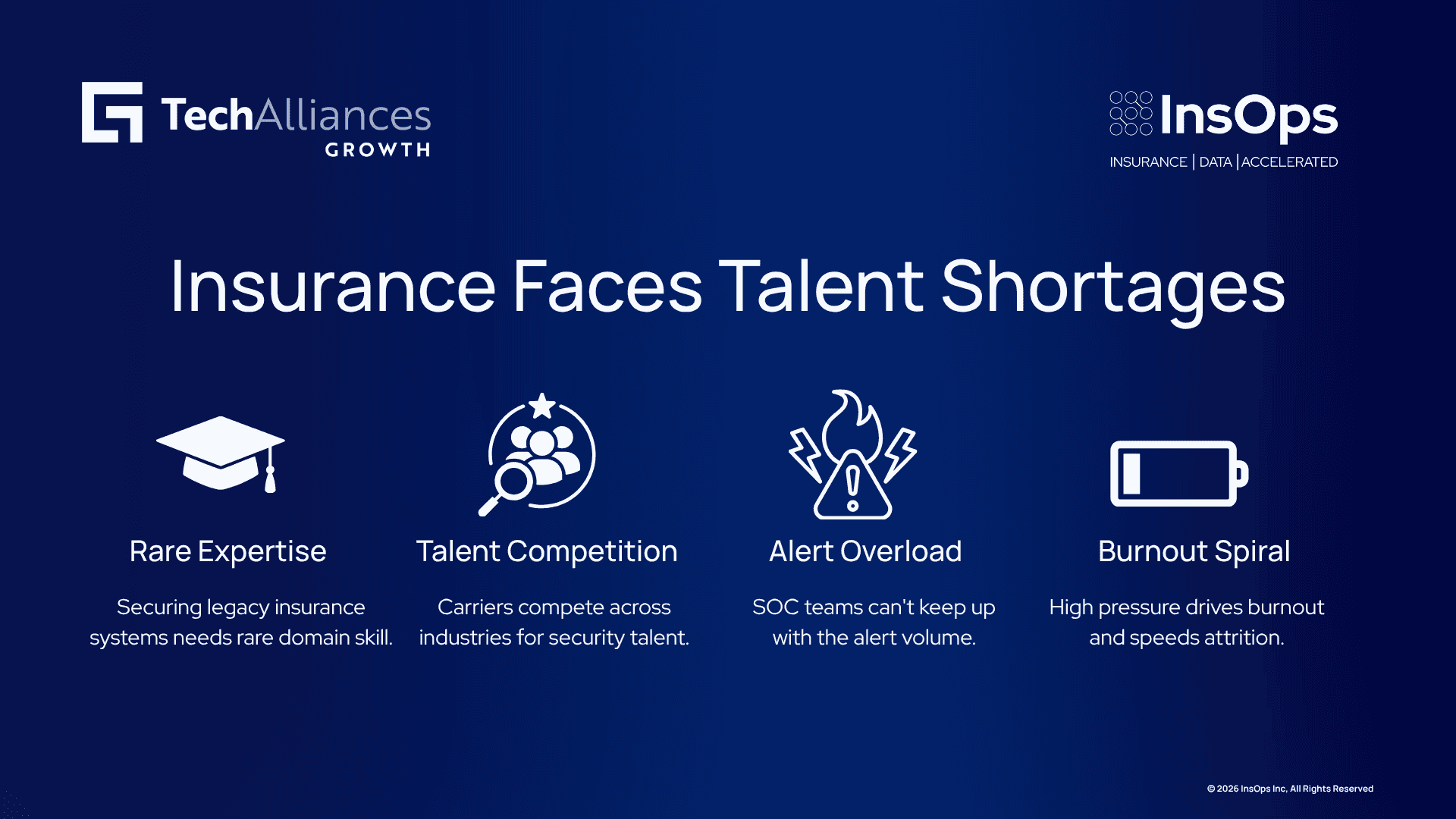
Insurance-specific security expertise is rare. Understanding how to secure legacy AS/400 systems, Guidewire-based platforms, and insurance-specific data flows requires domain knowledge that a generalist security analyst doesn't automatically have, narrowing the qualified candidate pool significantly.
Competing against every other industry for the same general talent pool. Insurance carriers aren't just competing with other insurers for security talent. They're competing with every industry investing in security, many of which offer more modern tech stacks or higher compensation.
Alert volume outpaces available analyst capacity. Even fully staffed SOC teams often can't keep pace with alert volume, meaning the gap isn't just about unfilled roles, it's about the workload exceeding what any reasonably sized team can manually handle.
Burnout accelerates attrition. Understaffed security teams facing high alert volume and constant pressure experience higher burnout, which drives the departures that keep the shortage from ever closing, a compounding cycle rather than a static problem.
Why Hiring Alone Won't Solve This
It's tempting to treat the talent shortage as purely a recruiting problem, more open roles, better compensation, more aggressive sourcing. Those efforts matter, but they don't scale to match the actual gap. There simply aren't enough qualified candidates in the market to fill every open security role industry-wide, and insurance-specific expertise narrows that pool further.
This means the more durable strategy is increasing the effective capacity of the team already in place, so the organization's security posture doesn't depend entirely on winning a competitive hiring market that isn't going to loosen up significantly in the near term.
What Actually Increases Analyst Productivity
Four approaches meaningfully increase the security capability an organization gets from its existing team:
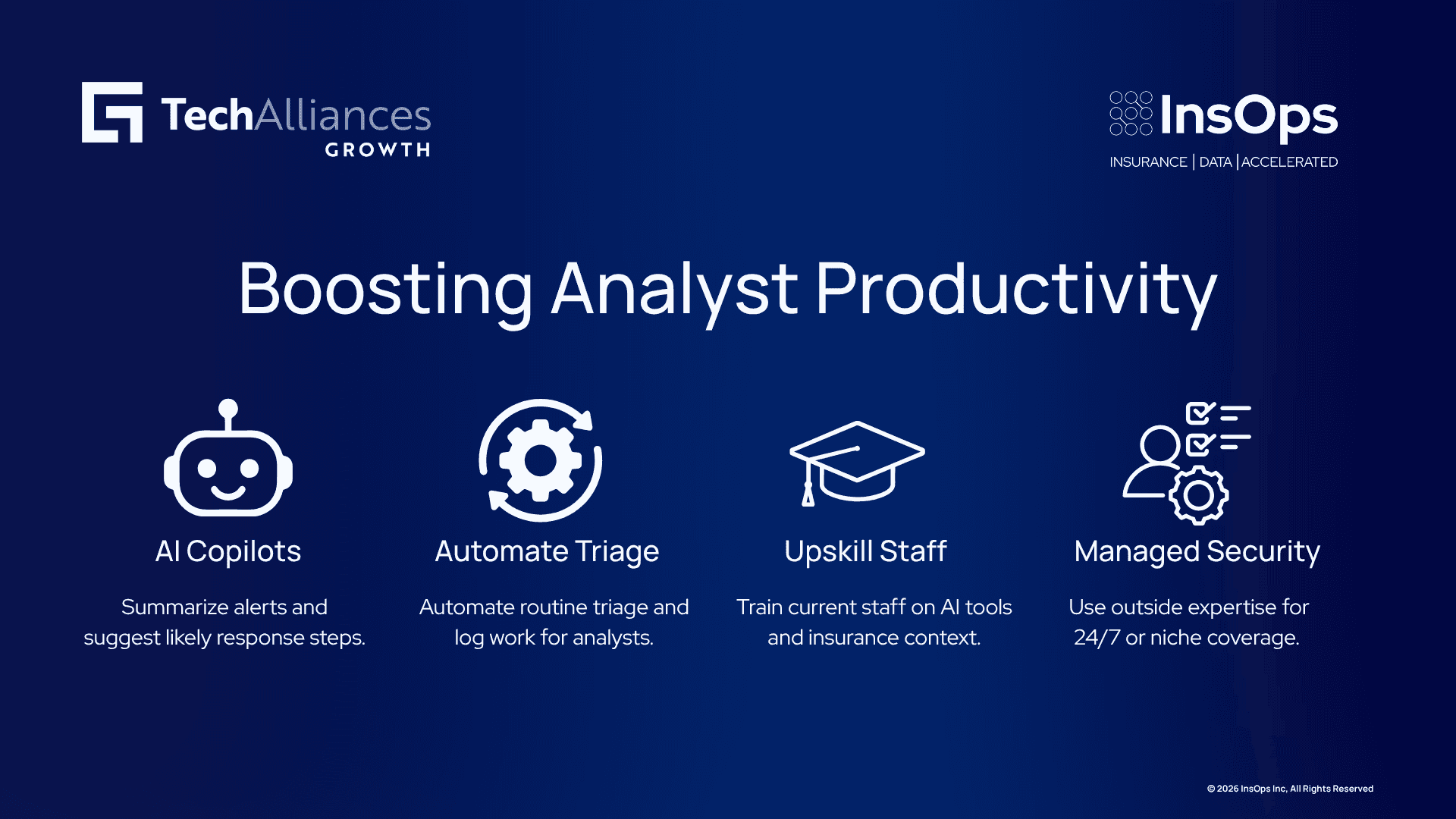
AI security copilots. Tools that help analysts investigate faster, summarizing alert context, suggesting likely root causes, and drafting initial response steps, reduce the time each investigation takes without requiring the analyst to have memorized every possible attack pattern.
Reducing repetitive manual tasks. Alert triage, log correlation, and routine investigation steps that follow a consistent, predictable pattern are strong candidates for automation, freeing analyst time for the genuinely novel or ambiguous cases that require human judgment.
Workforce upskilling. Investing in current staff, particularly around AI-assisted tools and insurance-specific security context, is often faster and more reliable than trying to hire externally for a rare combination of skills the market has very few candidates for.
Managed security services. For specific functions, particularly around-the-clock monitoring or specialized capability that would otherwise require hiring for a narrow, hard-to-fill role, managed services provide access to expertise without requiring the carrier to recruit and retain that expertise directly.
The right mix depends on the organization's specific gaps, but the common thread is the same: increase what the existing team can accomplish, rather than assuming the solution is simply more people.
Why This Connects to the Broader Environment, Not Just the SOC
A security team's workload isn't determined solely by how many analysts are on staff. It's shaped by how much noise, complexity, and manual overhead the underlying environment generates. A sprawling, inconsistently monitored set of custom integrations creates more investigative overhead than a standardized, well-governed integration layer. Legacy systems with limited native security telemetry require more manual work to monitor effectively than modern systems built with better observability in mind.
This means reducing the underlying complexity of the technology environment, fewer ad hoc integrations, fewer unmonitored legacy systems, is itself a form of talent shortage mitigation. It doesn't require hiring anyone, but it does reduce the total workload the existing team has to manage.
How InsOps Helps
InsOps is not a security analyst productivity tool, an AI security copilot, or a managed security service, and CISOs addressing the talent shortage directly should invest in dedicated tools and services built for that purpose.
Where InsOps connects to this challenge is in reducing the underlying environmental complexity that contributes to security team workload. Integration Gateway's standardized connectors for Guidewire PolicyCenter, ClaimCenter, BillingCenter, UnderwritingCenter, and PricingCenter replace ad hoc, individually built integration points with a consistent, more easily monitored integration layer, reducing the investigative overhead that comes with a sprawling set of custom connections each behaving differently.
InsOps's approach to legacy data migration, achieving 99%+ accuracy in moving 40+ years of AS/400 claims data into Guidewire ClaimCenter Cloud, also reduces the specialized legacy systems expertise a security team would otherwise need to maintain indefinitely just to understand and monitor an aging platform, expertise that's often as scarce on the security side as it is on the engineering side.
This is a supporting, environmental consideration, not a direct answer to the talent shortage itself. AI security copilots, task automation within the security workflow, workforce upskilling, and managed security services remain the core, dedicated strategies for increasing security team capacity and capability.
FAQ
Why can't the cybersecurity talent shortage be solved simply by offering higher salaries? Because the shortage reflects an actual shortfall in the number of qualified candidates in the market, not just a compensation mismatch. Even well-funded organizations often can't fill open security roles quickly, particularly for specialized expertise like insurance-specific security knowledge, because the candidates largely don't exist in sufficient numbers.
How do AI security copilots actually help analysts, rather than replacing them? They reduce the time and expertise required for routine parts of an investigation, summarizing context, suggesting likely causes, drafting initial steps, so analysts can move faster through common cases and spend more of their time and judgment on genuinely novel or ambiguous situations that still require human expertise.
When does it make more sense to use a managed security service instead of hiring internally? Managed services make sense for functions requiring around-the-clock coverage or specialized expertise that would otherwise require hiring for a narrow, hard-to-fill role. They provide access to that capability without requiring the organization to recruit and retain talent directly for a function that may not need a full-time internal hire.
Why is workforce upskilling often more effective than external hiring for closing skill gaps? Existing staff already have institutional knowledge and organizational context. Teaching them new tools and practices is frequently faster and more reliable than trying to find external candidates who combine security expertise with the specific institutional and domain knowledge the role requires.
How does reducing environmental complexity help with the talent shortage? A security team's workload is shaped by how much noise and manual overhead the underlying technology environment generates. Standardizing integrations and modernizing legacy systems reduces the total investigative burden on the team, effectively increasing capacity without requiring additional headcount.
Does InsOps provide AI security copilot or managed security service capabilities? No. InsOps focuses on legacy data migration and system integration. Its connection to the talent shortage is indirect, reducing the environmental complexity and legacy systems expertise burden that contributes to security team workload, but dedicated AI security copilots, task automation tools, and managed security services remain necessary to directly address analyst productivity and capacity.