

The carriers winning market share today aren't necessarily the ones with the best products. They're the ones who can launch a new product, adjust pricing, or respond to a shifting risk landscape in weeks instead of quarters. Business agility, the ability to change quickly without breaking things, has moved from a nice-to-have to a core competitive requirement.
For CTOs, this means the traditional insurance IT delivery model, annual release cycles, waterfall planning, manual QA gates, isn't just slow. It's a structural disadvantage against competitors who've adopted Agile delivery, DevSecOps, CI/CD, and AI-assisted development as the default way of working.
Why Insurance IT Has Been Slow to Move
P&C insurance has specific reasons release cycles have historically lagged other industries:

Regulatory sensitivity creates real caution. Changes to pricing, underwriting rules, or claims logic carry compliance implications, which has historically pushed carriers toward infrequent, heavily reviewed releases rather than continuous delivery.
Legacy core systems resist incremental change. Tightly coupled architecture means a small change can require testing across the entire system, making frequent releases genuinely risky, not just organizationally uncomfortable.
Manual QA and deployment processes. Without CI/CD pipelines, testing and deployment are manual, time-consuming steps that limit how often a team can safely release, regardless of how fast the development work itself moves.
Skill gaps in modern delivery practices. Teams built around legacy systems and annual release cycles often haven't had the opportunity to build deep expertise in Agile, DevSecOps, or CI/CD practices.
These are legitimate constraints, but they're increasingly solvable ones. Carriers that treat them as permanent are conceding ground to competitors who've decided to solve them instead.
What Business Agility Actually Requires
Moving from slow, infrequent releases to fast, responsive delivery involves several practices working together:

Agile delivery. Breaking large initiatives into smaller, iterative releases so value reaches the business continuously, rather than in large, infrequent batches with long feedback loops.
DevSecOps. Building security and compliance checks into the development pipeline itself, so faster releases don't come at the cost of regulatory risk or security gaps.
CI/CD pipelines. Automated testing and deployment processes that let teams release confidently and frequently, replacing manual QA gates that limit release cadence.
Low-code platforms. Enabling business and technical teams to build and adjust workflows, forms, and rules without a full development cycle for every change, particularly useful for underwriting rules or claims workflows that change frequently.
AI-assisted software development. Tools that help developers write, review, and modernize code faster, reducing the time between identifying a needed change and shipping it.
The goal isn't speed for its own sake. It's closing the gap between a business need and a working solution, so market responsiveness stops being limited by IT delivery timelines.
Where the Data and Integration Layer Fits In
Agility in application delivery only goes as far as the data layer allows. A carrier can ship code faster with CI/CD and still be stuck waiting weeks for a data integration to be built manually for a new partner or product line. Fast software delivery and fast data connectivity have to move together, or the data layer becomes the new bottleneck.
This is where legacy data migration and integration work directly support business agility goals: a carrier with real-time, API-first connectivity into its core systems can launch a new distribution partnership or product variant without a custom integration project blocking the timeline.
How InsOps Helps
InsOps supports business agility by removing one of the slowest, most manual parts of the technology stack: legacy data migration and system integration.
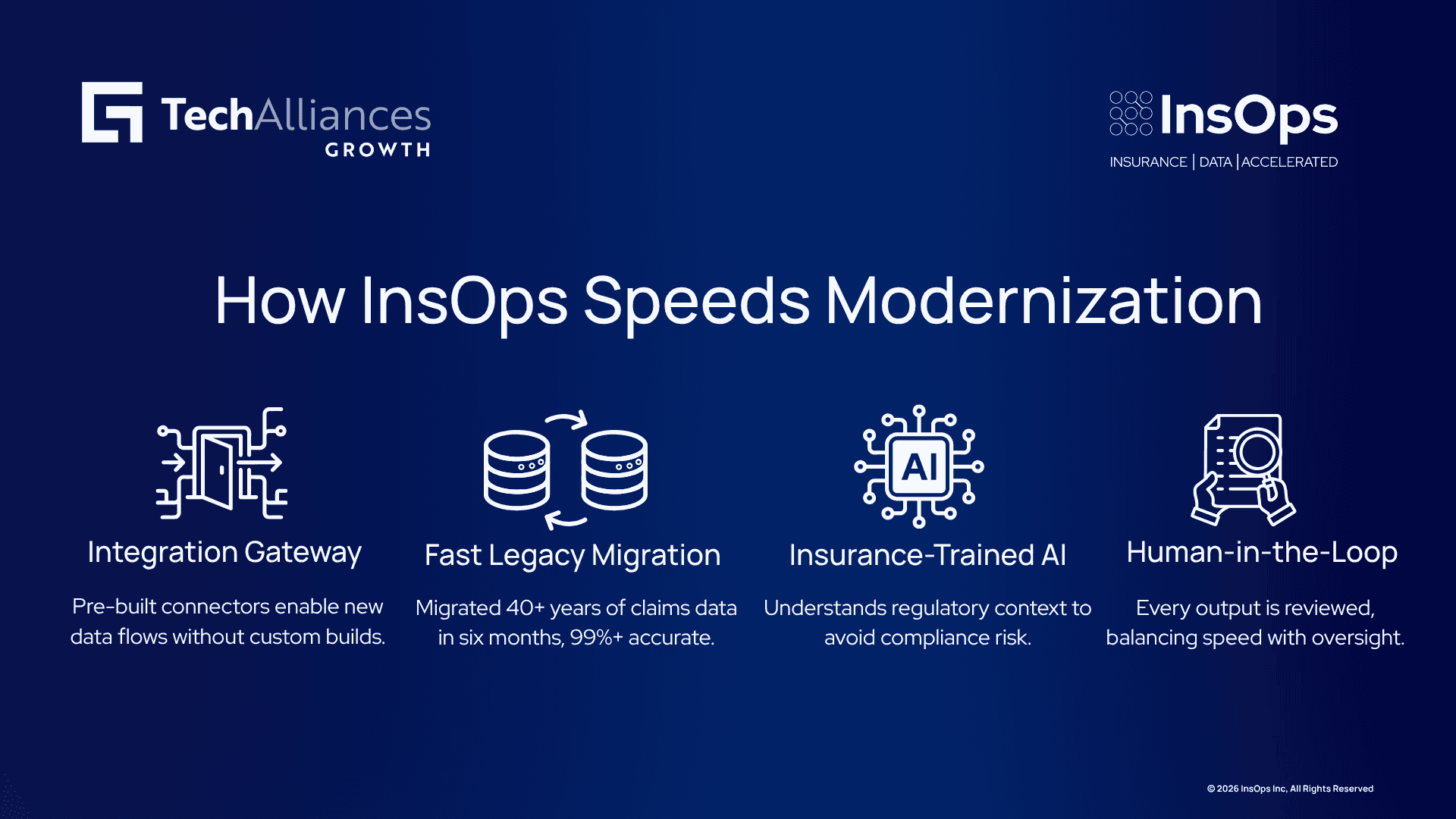
Integration Gateway for real-time connectivity. Pre-built connectors for Guidewire PolicyCenter, ClaimCenter, BillingCenter, UnderwritingCenter, and PricingCenter mean new integrations, new distribution partners, new data flows, don't require a custom-built connection from scratch. Our insurance-trained AI model maps payloads automatically, with human review at every step.
Legacy migration that doesn't stall the roadmap. InsOps migrated 40+ years of AS/400 claims data into Guidewire ClaimCenter Cloud in 6 months, at 99%+ accuracy, the kind of timeline that keeps a broader modernization roadmap moving instead of becoming a multi-year blocker on its own.
Insurance-trained AI, not a generic dev tool. InsOps's model understands insurance-specific data relationships and regulatory context, which matters for teams trying to move faster without introducing compliance risk into pricing, underwriting, or claims logic.
Human-in-the-loop, built for regulated environments. Speed doesn't come at the cost of oversight. Every InsOps output is validated by human review before use, which matters for carriers balancing faster releases against real regulatory exposure.
For CTOs pursuing business agility, the application layer, Agile delivery, DevSecOps, CI/CD, is only half the equation. InsOps addresses the other half: making sure the data and integration layer can move as fast as the software does.
FAQ
Why has business agility become more urgent for P&C carriers specifically? Competitive pressure now includes responsiveness, launching products, adjusting pricing, or connecting new distribution partners quickly. Carriers still operating on annual release cycles are structurally slower to respond than competitors who've adopted Agile, DevSecOps, and CI/CD as standard practice.
Does moving faster with CI/CD increase regulatory risk? Not when DevSecOps practices are built into the pipeline. Embedding security and compliance checks directly into the development and deployment process actually reduces risk compared to infrequent releases with manual, easily skipped review steps.
What's the relationship between low-code platforms and business agility? Low-code platforms let business and technical teams adjust workflows, forms, and rules without a full development cycle for every change. This is particularly valuable for underwriting rules and claims workflows that change more frequently than core system logic.
Can legacy core systems support Agile delivery and CI/CD? It's harder, but not impossible. Tightly coupled legacy systems make isolated, frequent changes riskier because small updates can require testing across the entire system. This is one reason composable, API-first architecture and CI/CD adoption often go hand in hand.
Why does data integration speed matter for business agility if the software delivery process is already fast? Because a new product launch or distribution partnership typically requires new data connections, not just new code. If integration still requires a custom-built connection every time, it becomes the bottleneck even when application development itself is fast.
How does InsOps fit into a broader business agility strategy? InsOps addresses the data migration and integration layer specifically, providing pre-built connectors and AI-assisted mapping so new data flows and partner connections don't require custom development every time, keeping pace with faster application release cycles.