

Before an underwriter can evaluate a risk, they have to assemble it. That means opening broker emails, downloading attachments, reading through PDFs and scanned forms, pulling numbers out of loss runs and schedules, and retyping those numbers into a policy administration system. On most commercial submissions, this reading-and-retyping work happens before the underwriter applies any judgment at all.
According to Capgemini's World Property and Casualty Insurance Report, underwriters spend 41% of their time on administrative and operational tasks like data entry and record-keeping. That figure comes from a global survey of insurance executives and underwriters across commercial and personal lines, and it means less than a third of an underwriter's day goes to the core work of assessing risk, calculating premiums, and managing a book.
What does manual document review actually look like on a commercial submission?
A single commercial lines submission can include an ACORD application, supplemental questionnaires, three to five years of loss runs, a statement of values, a location schedule, inspection reports, and a broker cover letter. Each of these arrives in a different format. Some are typed PDFs. Some are scanned images. Some are Excel files. The broker email itself often contains details that don't appear anywhere else in the packet.
The underwriter's first task isn't evaluating risk. It's assembling a coherent picture from scattered documents: pulling the insured name, effective date, limits, and class code from the application, then cross-referencing payroll and revenue against the schedule, then reading the loss runs for claim frequency and severity patterns. If any of those documents are missing or don't match, the underwriter stops to request clarification before pricing can begin.
Why does this matter beyond just being slow?
The cost isn't only time. When underwriters manually extract data, errors compound. A misread TIV changes the property rate. A missed open claim on a loss run understates reserve exposure. A class code copied from a narrative instead of the application can trigger the wrong rating rules entirely.
These aren't hypothetical risks. They're the kind of errors that surface later as audit adjustments, pricing disputes, or coverage gaps at claim time. The longer a human spends manually transcribing fields across document formats, the higher the chance that one of those fields gets transposed, truncated, or simply missed.
What would it take to fix this?
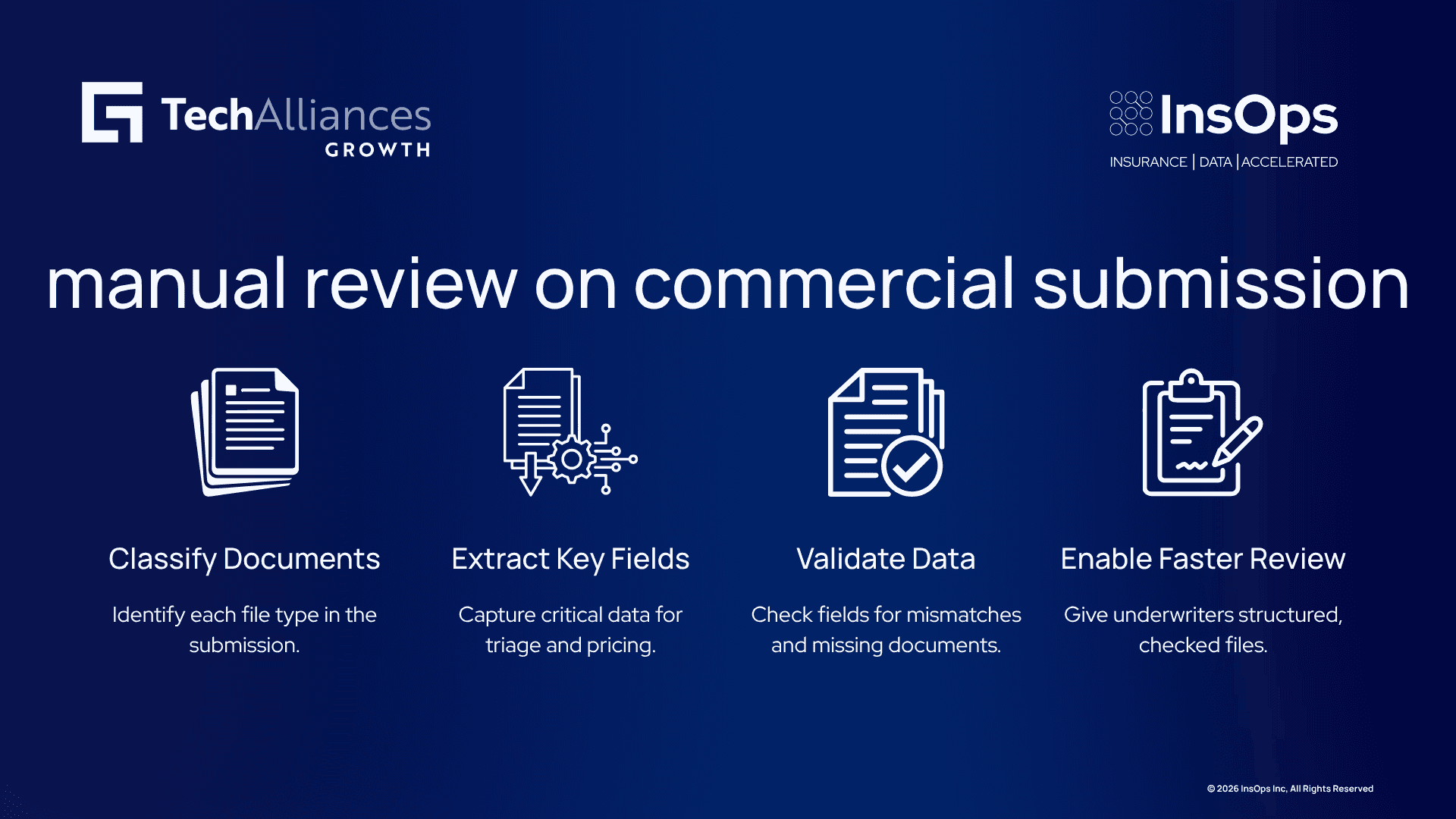
The pattern most carriers and MGAs are moving toward has three parts. First, classify each document in the submission packet by type, so the system knows whether it's reading a loss run, an ACORD form, or a schedule. Second, extract the specific fields that matter for triage and pricing, not every word on every page, but the named insured, the limits, the class, the exposure bases, the loss history. Third, validate those fields against each other before the underwriter sees the file, flagging where numbers don't reconcile or where required documents are missing.
This isn't about removing underwriters from the process. It's about making sure that when a file reaches them, it's already structured and checked, so they can start evaluating the risk immediately instead of spending their first hour assembling it.
How InsOps helps
InsOps ihas this kind of capability inside LiLa, its insurance-trained AI: extracting and classifying underwriting data from broker emails, PDFs, schedules, and inspection reports, then validating it before it reaches an underwriter. Because LiLa is trained on insurance data models, it understands the difference between a loss run and an ACORD form, and it knows what fields like "TIV," "LOB," and "deductible" mean in a P&C context, rather than treating them as generic text.
Every output would go through a human review step before the underwriter acts on it. Contact us to talk through what this could look like for your underwriting operation.
FAQ
How much of an underwriter's day goes to administrative work versus actual risk evaluation?
Capgemini's survey of insurance executives and underwriters found that 41% of underwriter time goes to administrative and operational tasks like data entry and record-keeping, while only about a third is spent on risk assessment, premium calculation, and book management. The rest goes to negotiation support and other activities.
Can AI read loss runs and ACORD forms accurately enough to trust?
The accuracy question depends on what "read" means. Extracting a named insured or a policy effective date from a digital PDF is straightforward. Extracting reserve amounts from a scanned, multi-page loss run with merged cells and inconsistent column headers is harder. The practical answer is that AI extraction with a human reviewing flagged fields consistently outperforms fully manual processing on both speed and accuracy, because a person checking a pre-filled field catches more errors than a person typing every field from scratch.